
KINEMATICS 1 KUS objectives BAT derive the suvat
KINEMATICS 1 KUS objectives BAT derive the suvat equations BAT apply them to solve problems BAT change between velocity measures Starter: covert these measures 16 m/s to km/h 40 mph to km/h
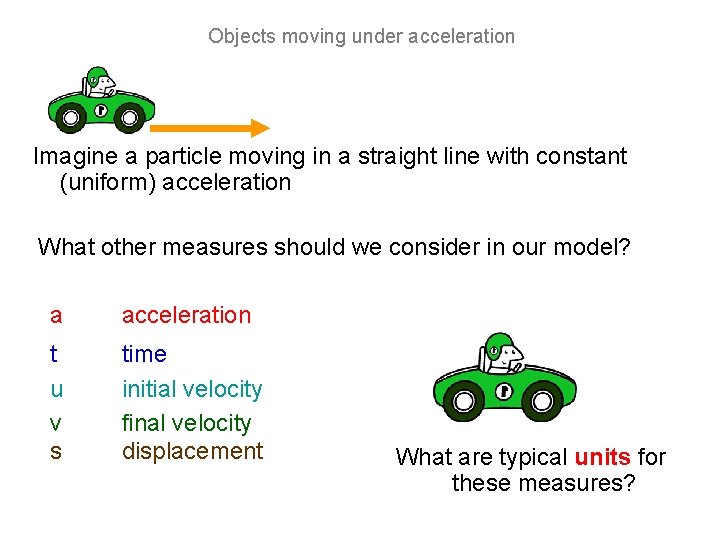
Objects moving under acceleration Imagine a particle moving in a straight line with constant (uniform) acceleration What other measures should we consider in our model? a acceleration t u v s time initial velocity final velocity displacement What are typical units for these measures?
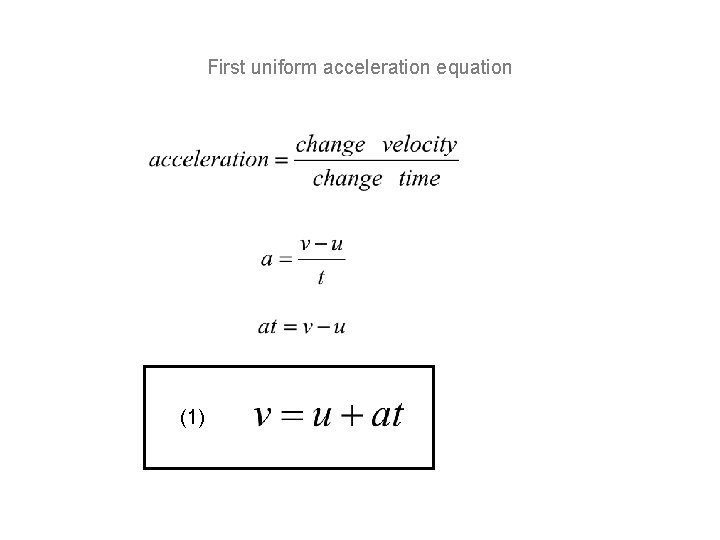
First uniform acceleration equation (1)
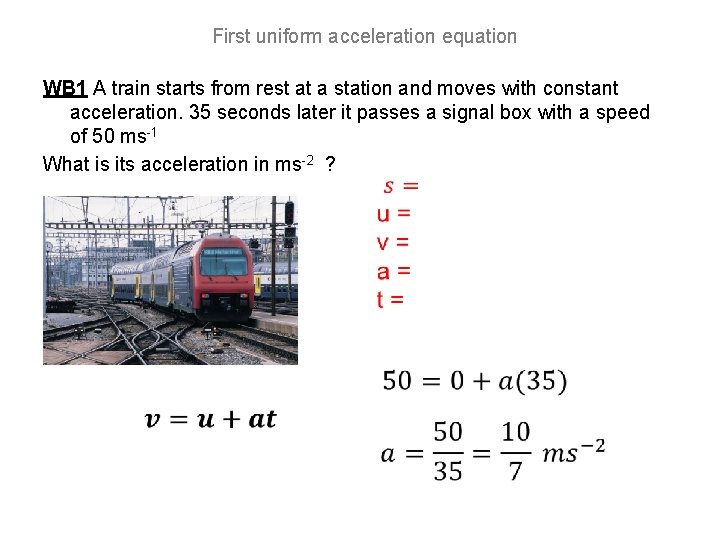
First uniform acceleration equation WB 1 A train starts from rest at a station and moves with constant acceleration. 35 seconds later it passes a signal box with a speed of 50 ms-1 What is its acceleration in ms-2 ?
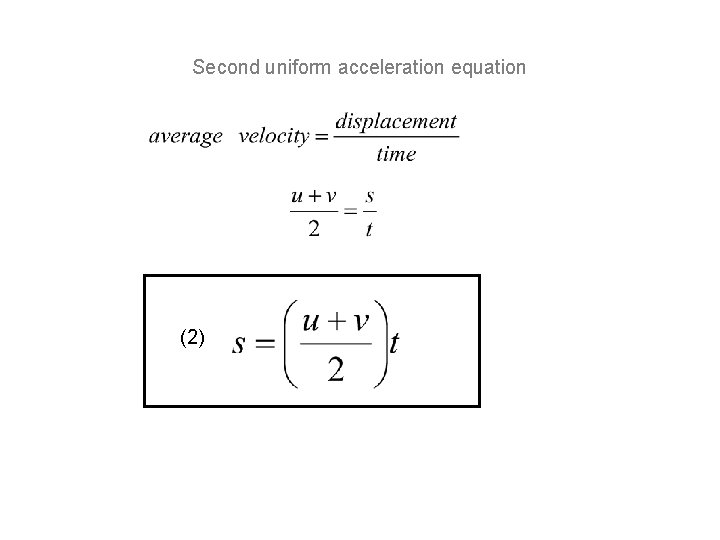
Second uniform acceleration equation (2)
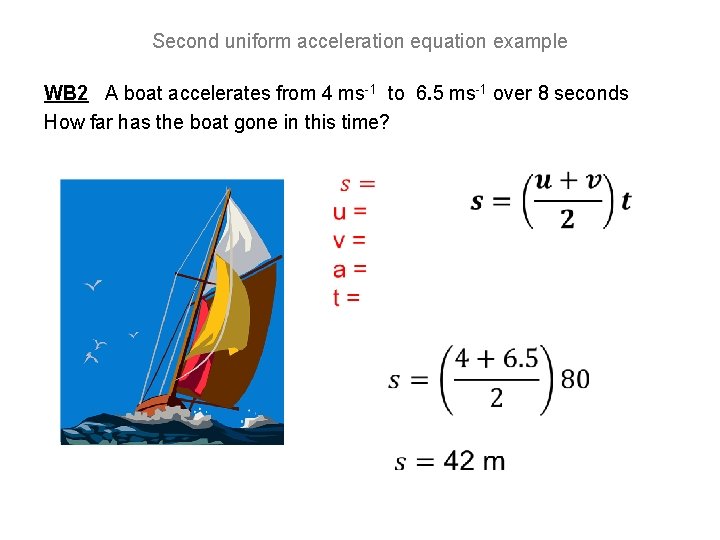
Second uniform acceleration equation example WB 2 A boat accelerates from 4 ms-1 to 6. 5 ms-1 over 8 seconds How far has the boat gone in this time?
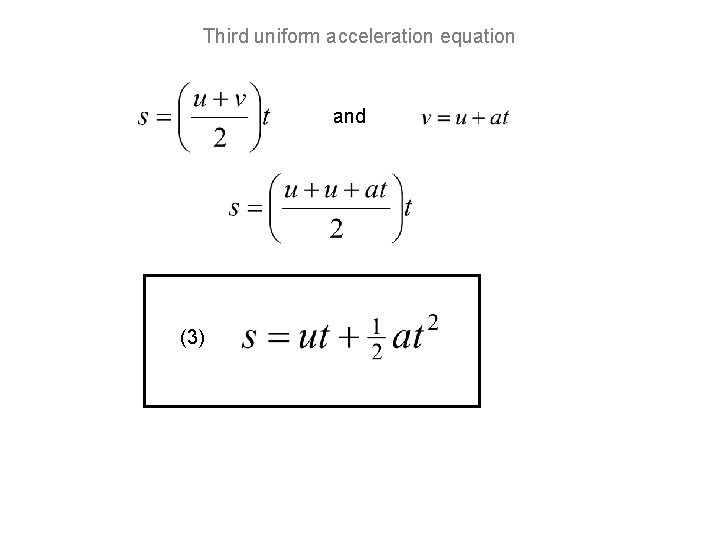
Third uniform acceleration equation and (3)
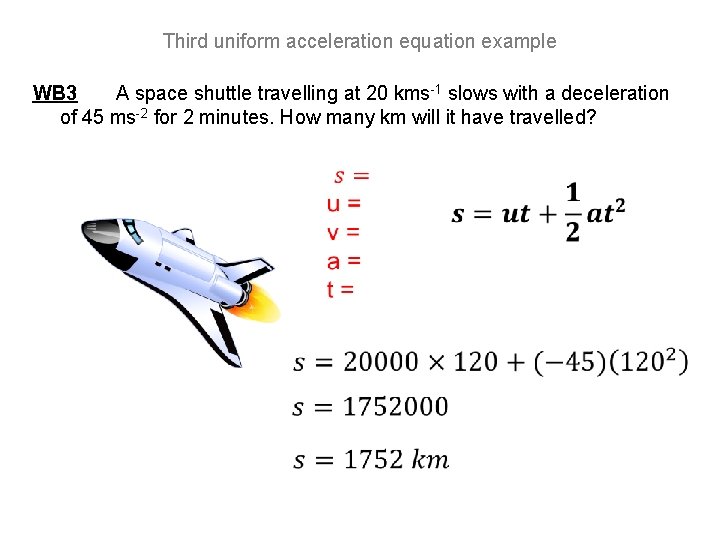
Third uniform acceleration equation example WB 3 A space shuttle travelling at 20 kms-1 slows with a deceleration of 45 ms-2 for 2 minutes. How many km will it have travelled?
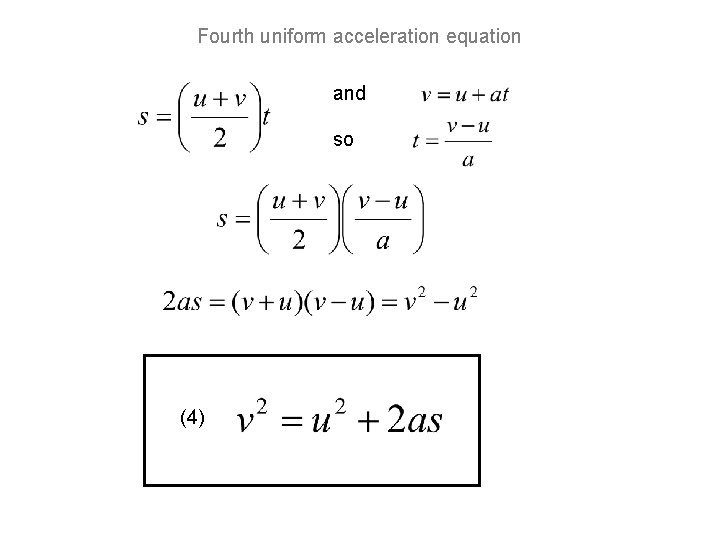
Fourth uniform acceleration equation and so (4)
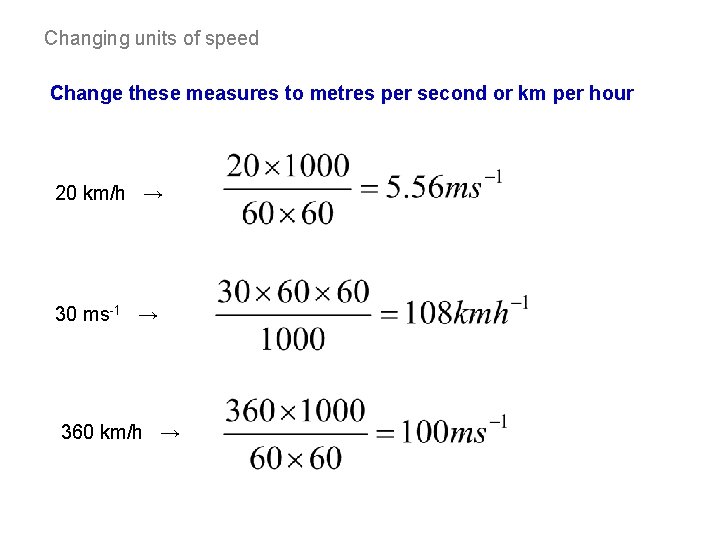
Changing units of speed Change these measures to metres per second or km per hour 20 km/h → 30 ms-1 → 360 km/h →
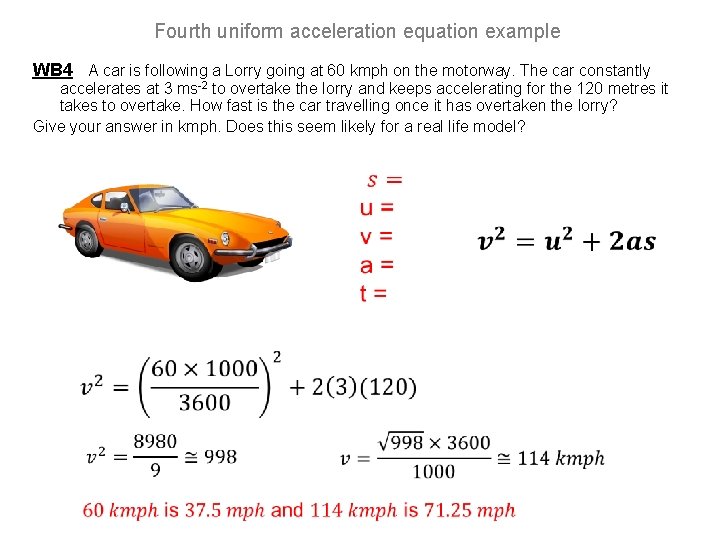
Fourth uniform acceleration equation example WB 4 A car is following a Lorry going at 60 kmph on the motorway. The car constantly accelerates at 3 ms-2 to overtake the lorry and keeps accelerating for the 120 metres it takes to overtake. How fast is the car travelling once it has overtaken the lorry? Give your answer in kmph. Does this seem likely for a real life model?
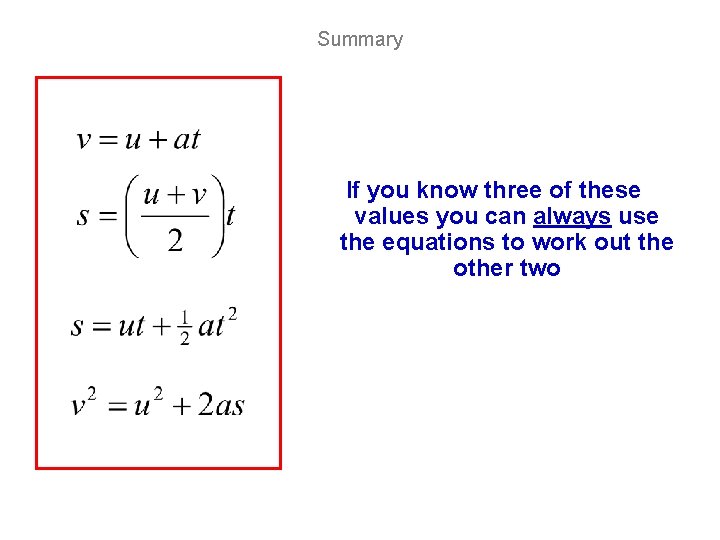
Summary If you know three of these values you can always use the equations to work out the other two
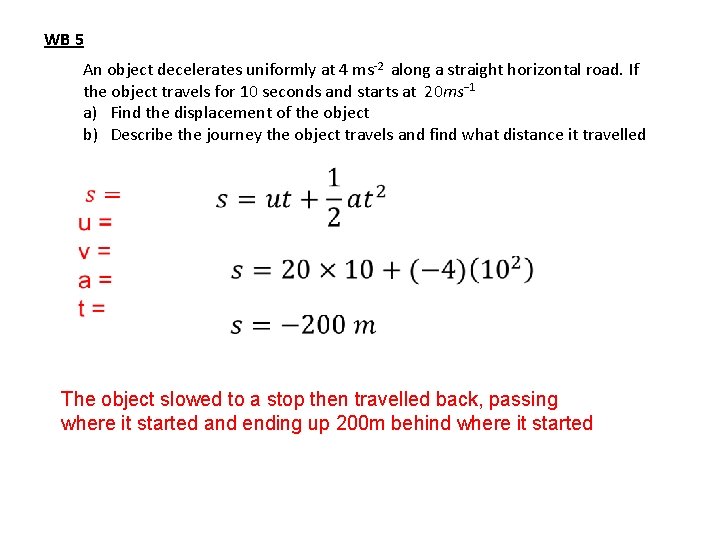
WB 5 An object decelerates uniformly at 4 ms-2 along a straight horizontal road. If the object travels for 10 seconds and starts at 20 ms− 1 a) Find the displacement of the object b) Describe the journey the object travels and find what distance it travelled The object slowed to a stop then travelled back, passing where it started and ending up 200 m behind where it started
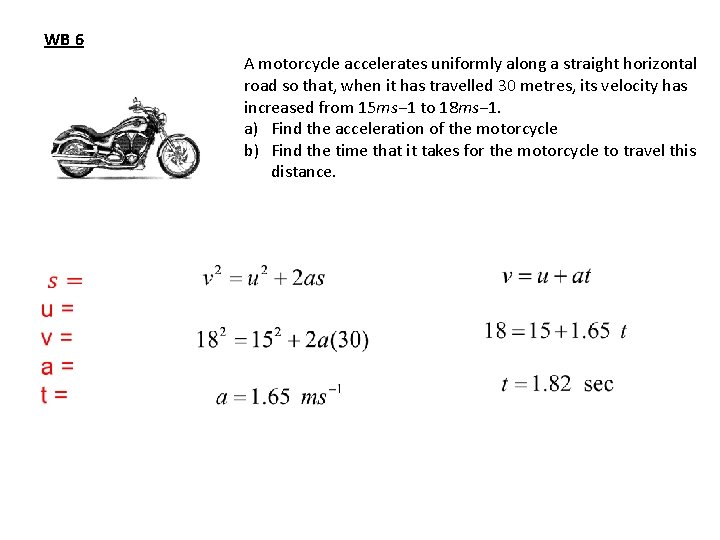
WB 6 A motorcycle accelerates uniformly along a straight horizontal road so that, when it has travelled 30 metres, its velocity has increased from 15 ms− 1 to 18 ms− 1. a) Find the acceleration of the motorcycle b) Find the time that it takes for the motorcycle to travel this distance.
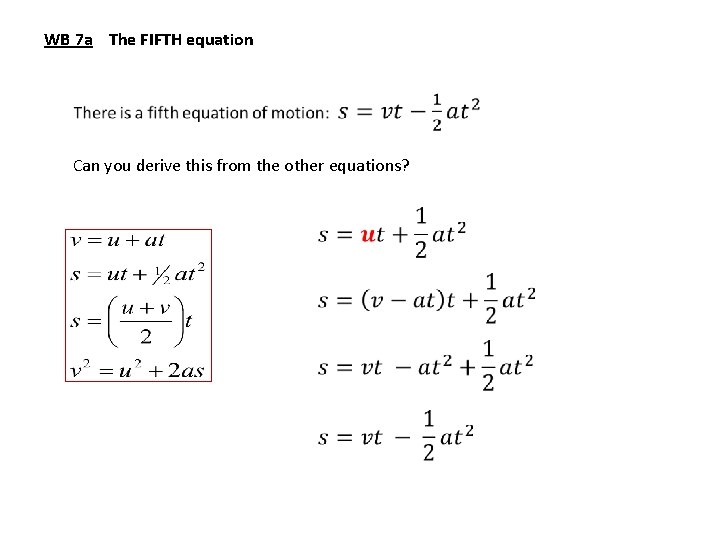
WB 7 a The FIFTH equation Can you derive this from the other equations?
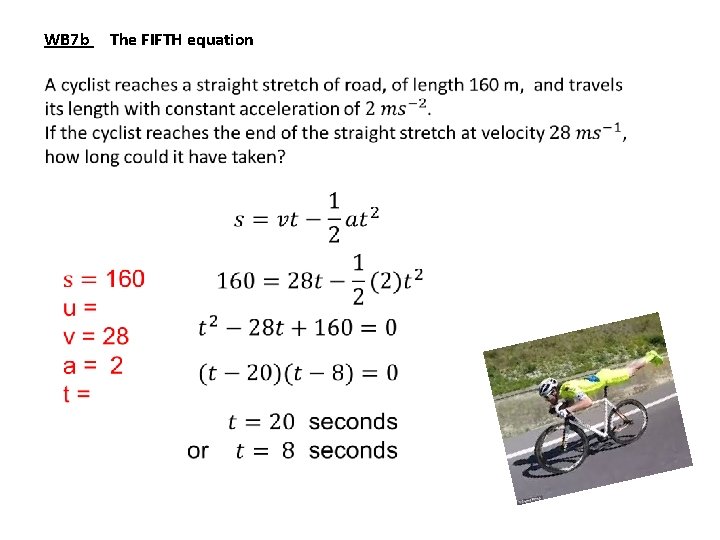
WB 7 b The FIFTH equation
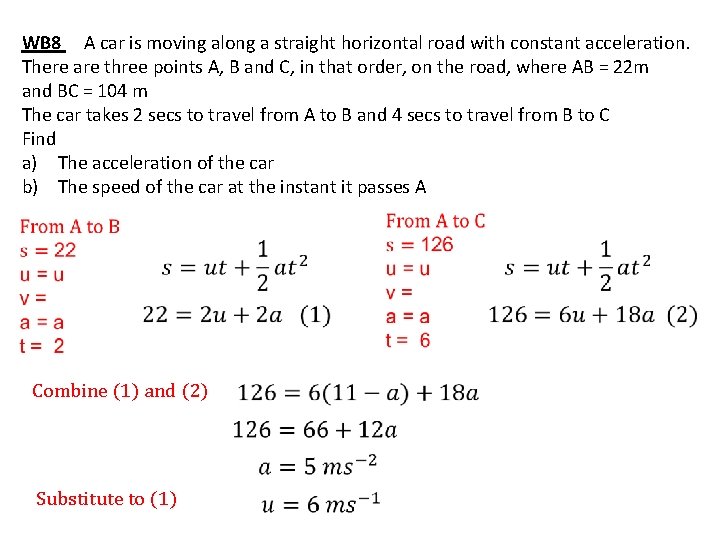
WB 8 A car is moving along a straight horizontal road with constant acceleration. There are three points A, B and C, in that order, on the road, where AB = 22 m and BC = 104 m The car takes 2 secs to travel from A to B and 4 secs to travel from B to C Find a) The acceleration of the car b) The speed of the car at the instant it passes A Combine (1) and (2) Substitute to (1)
KINEMATICS 1 KUS objectives 1 derive the suvat equations 2 apply them to solve problems 3 change between velocity measures One thing I will do For the next lesson …. One thing I need to remember for next lesson …. One thing I understood well is …. Plenary pyramid
END
- Slides: 20