
Kindergarten Virtual Curriculum Learning Guide 2020 2021 Virtual

- Slides: 20
Kindergarten Virtual Curriculum Learning Guide 2020 -2021
Virtual Kindergarten Schedule 8: 20 -9: 30 ELA Live with students (Morning Routines/Greetings)-Calendar Math, Phonics (Maxscholar) Monday, Tuesday, Thursday & Friday 9: 30 -10: 30 Offline (Small groups, Guided Reading & Assignments on their own) Monday, Tuesday, Thursday & Friday 10: 30 -11: 00 Live with students Monday, Tuesday, Thursday & Friday 11: 15 -12: 05 Collaborative Planning Monday, Tuesday, Thursday & Friday ****Wednesday full day of Planning 12: 05 -12: 35 Lunch 12: 35 -1: 00 Prep for Live session 1: 00 -1: 45 Math Live with Students 1: 45 -2: 15 Offline (Small groups, Guided Math & Assignments on their own) Monday, Tuesday, Thursday & Friday 2: 20 -3: 30 Science or Social Studies (Weekly rotation) Live with students Monday, Tuesday, Thursday & Friday
What will my child learn in Kindergarten • The curriculum for Kindergarten is designed to meet social, physical, cognitive, and emotional educational needs of fiveyear-old children. The Georgia Standards of Excellence (GSE) are designed to ensure that these goals are met in Kindergarten. These standards guide kindergarten teachers in preparing children to become independent, creative and critical thinkers. The focus is on teaching children HOW to think and learn throughout their lives. • The key to successful learning experiences is to discover what your child likes and to determine how to use these interests to explore and learn about the world. Working as a team, parents and teachers can help a child have a love for learning. This will be done through Virtual Learning.
Assessments GKIDS The Georgia Kindergarten Inventory of Developing Skills (GKIDS) is a yearlong, performance-based assessment. The goal of the assessment program is to provide teachers with information about the level of instructional support needed by individual students entering kindergarten and first grade. GKIDS allows teachers to assess student performance during instruction, record student performance in an online database, and generate reports for instructional planning, report cards, RTI, and/or parent conferences. Throughout the year, teachers may assess students and record GKIDS data based on their system’s curriculum map or report card schedule. Report Cards – sent home every 9 weeks detailing the student’s progress at meeting the Georgia Performance Standards. (Parent Portal) Early Star Literacy-Computer test that your child will be given to determine where they are at the beginning of school, they will be tested two more times before the end of the year. .
Ages and Stages of Kindergarten Students �Five-year-old children enjoy being challenged, and they like to complete a task. �Frequent practice of new skills such as tying shoes, is important. �Large motor skills are well-developed. This is seen as they walk, run, jump, kick, and throw. They can walk backwards, heel to toe. They can use alternating feet to walk up and down stairs. They skip using alternate feet. �Fine motor skills may vary greatly. Kindergarten students may demonstrate good control of pencils or crayons and may begin to color inside the lines. They can cut on a line using scissors. They can reproduce shapes and letters without a problem. They can print their own name. Although they can recognize some letters of the alphabet, they may sometimes reverse them. �Kindergarten students enjoy making new friends. �They participate in group play and share activities with other children. They have strong imaginations and create elaborate play ideas. �Five-year-olds like to learn new things and love to “brag” about what they can do.
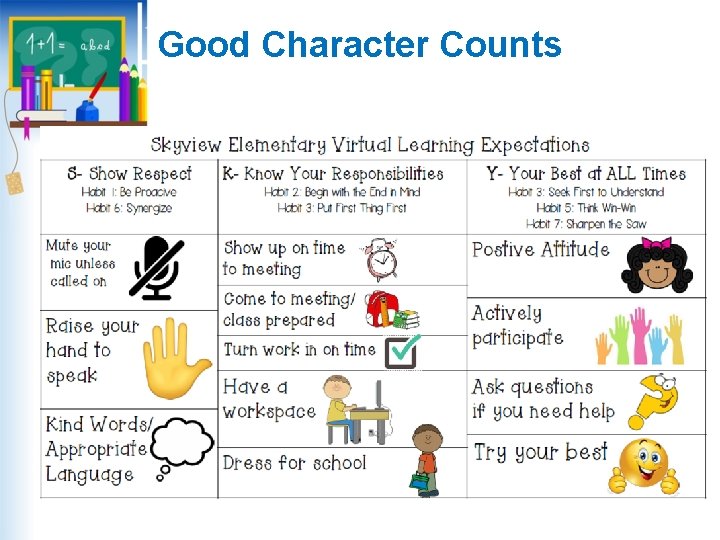
7 Habits of Happy Kids Our school will be learning leadership skills throughout the year using The Leader in Me Leadership Curriculum. We believe all students have important strengths to share and we will be learning about ways to develop and share those strengths. Part of The Leader in Me Leadership Curriculum involves learning about The 7 Habits of Happy Kids.
Reading The kindergarten program provides children with a literacy rich environment. We implement the program Max Scholar Phonics and Journeys. Students will participate in Accelerated Reader. When children participate in Language Arts activities, they will have the opportunity to talk, listen, write, and explore the world of letters, words, sentences, and books. • • • • When a child reads a book they learn. . �New words/Sight Words �Sentence structure �Creativity and imagination �Listening skills �A love for books �New information �Expressive language �Logical thinking �Eye-hand coordination �Reading readiness �Sequencing of events �Left-to-right text progression
Writing Children learn to write the same way they learn to talk. It is important to honor all different ways your child “writes, ” including pictures, scribbles, lines, spaces, letters, and phonetic spelling. Just as you celebrated the first words your child spoke, the same excitement should be celebrated for your child’s early writing attempts. Kindergarten allows children to explore how writing is useful and has meaning. When a child works at the Writing Center in Kindergarten, they learn…. . New words Self-expression Letters Writing in a complete sentence Sequencing of events Creativity and imagination Development of a story
Readiness tips to help your child read and write: Talk often to your child as you go about your daily routine. Make story time a regular part of the day. Read to your child and encourage him/her to “read to you” and tell stories. Go beyond books. Have a variety of reading materials available, such as books, newspapers, magazines, cereal boxes, computers, Ipads, and text messages! Let your child know that reading is happening everyday and everywhere they look! Be a reader yourself and let your child see you read. Discuss books you have read together. Your child will want to copy your good example! Look up things that interest your child in books or on the internet. Read the information to your child and you will both learn something new. Show that writing is fun. Have your child help you write a shopping list or write notes to you.
Math Children begin to understand numbers through counting and comparing objects in a set; breaking sets into different parts; composing tens when objects; describing, comparing, and classifying measurable objects; identifying, describing, and comparing shapes based on attributes. In kindergarten, your child will learn to: � Identify colors and shapes � Sort objects by size, shape, color, and thickness � Create patterns � Recognize and sequence numbers 1 -100 � Count to 100 by 10’s: 10, 20, 30, 40, . . . � Count objects � Estimate amounts � Understand the ordinal numbers (first, second, third, etc, through tenth) � Break a set apart(decompose) into two sets and (compose)putting parts together � Compare objects and sets using a variety of terms � Problem solve � Add and subtract using objects
Everyday math tips to help your child at home: • Use every opportunity to allow your child to count objects and make sets of objects. • Let your child sort objects, weigh objects, measure objects. • Use some of the following materials at home to help your child practice math concepts learned at school. Be creative and have fun with your child! �Building blocks, Legos, poms, cotton balls, toys �Forks and spoons, dried beans, toothpicks, cereal, grapes, candy �Laundry- (sort and count clothes) �Collections of beads, keys, nuts and bolts, buttons �Sand, water, rice, or grits and a plastic measuring cup
Science Kindergarten students will: • Determine the difference between living and nonliving things. • Compare and sort different materials [clay, cloth, paper, plastic]. • Recognize earth minerals [soil, rock, water, air] • Differentiate and categorize items found in both the day and night. • Explain the similarities and differences in animals. • Explain the similarities and differences in plants. • Explore how gravity and motion affects different objects.
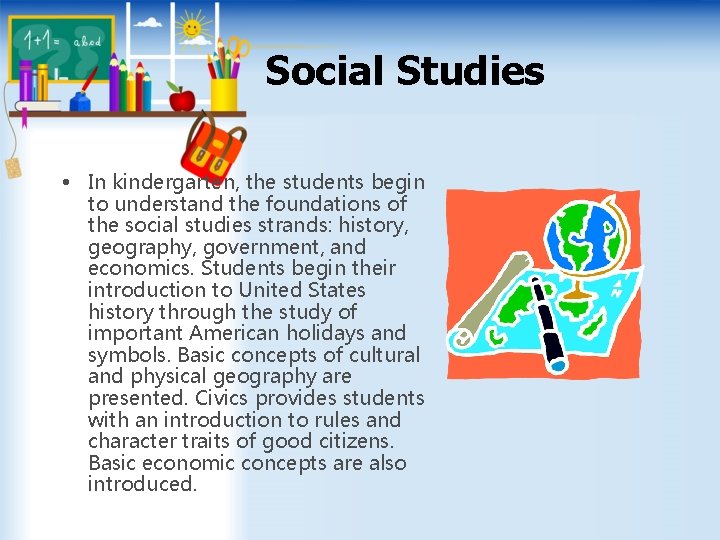
Social Studies • In kindergarten, the students begin to understand the foundations of the social studies strands: history, geography, government, and economics. Students begin their introduction to United States history through the study of important American holidays and symbols. Basic concepts of cultural and physical geography are presented. Civics provides students with an introduction to rules and character traits of good citizens. Basic economic concepts are also introduced.
Playing” at school • When your child comes home from school and you ask what he or she did today, the reply may be, “I played”. At the age of five a child’s play IS his or her work. Kindergarten students have many opportunities to experience the world around them in activity stations and/or small groups in the classroom. These stations are designed, planned and created by teachers to help your child learn and grow. • Play or Stations will be a little different, but your child will engage in many of the same activities just virtually.
Tips for a Happy Year of Virtual Learning in Kindergarten § Be On Time for each live session. § Have your child dressed and ready for Virtual Learning in school clothes that are comfortable, and in which the student can manage his or her own bathroom needs. § Students should be attentive and alert for learning. § Have all supplies handy for easy access during live session. • No eating or drinking while students are live with teachers. • If your child is sick, please inform your child’s teacher that he/she is sick and will not be participating live that day, send documentation of the child’s absence. • Remember to text or email documentation if your child can not be on during live session. • Remind is the form of communication that will be used this year, you can also send documentations in Remind
Homework/Offline Assignments Homework will be a little different with the Virtual Learning. During Virtual Learning Wednesdays will be offline learning/assignments as well as offline learning and assignments everyday after each live session. So assignments not completed can be considered as homework. Please plan to read to your child and they read to you, spend 5 -10 minutes each night on homework. Establish a routine time and place for your homework sessions. After completing the homework/offline assignments, send pictures or upload the documents. Also document the time that you spend each night reading with your child, use the books for Apple Munchers(list of books that are read to your child). It is very important that you read and keep track of the books read. Please upload your booklist/log for the Apple Muncher Log in on Fridays.
• Volunteer at Skyview? • Safety Precautions at this time.
Good Character Counts
Kindergarten Teachers Norma Lawrence/Holly. Sanders norma. lawrence@bcsdk 12. net Clara-Ellen Driggers-Taylor/Gayle Meadows claraellen. driggers@bcsdk 12. net Kerrie Welch/Valencia Jackson kerrie. welch@bcsdk 12. net
Let’s Have a Great Year by Working Together during Virtual Learning!