
Kimi ni Todoke by Tomofumi Tanizawa http www
きょうのおんがく ¡Kimi ni Todoke (きみにとどけ) by Tomofumi Tanizawa ¡http: //www. jpopasia. com/celebrity/tomofumitanizawa/videos/kimi-nitodoke: : 9967. html ¡Sawakaze by Tomofumi Tanizawa ¡http: //www. jpopasia. com/celebrity/tomofumitanizawa/vide os/sawakaze: : 1122. html

きょうのよてい ¡Vocab Q p 86 ¡Test Notes ¡Skit sign-up/Exit Ticket Review ¡Place �� でV ¡Destination に �� V ¡Topic は �� V ¡Kanji Practice ¡Exit Ticket/HW
Quiz 2 notes: P 1, Q 2: Eego = English Language ¡Igirisu = England ¡Also, eego is written えいご; usually a double ee is in fact “e i” ¡(though ええ、 like yes, is a double ee) P 1, Q 3: それはだれのかばんですか。 それのかばんはだれのですか。 P 2, Q 1: あなた = you, so the questions were asking about you. Also, you want an いいえ or ええ/はい。Must affirm or negate sentence
Skit Sign-up Sheet ¡I will pass a sheet around the class. Please sign up you and your group-mates ¡Groups should not be more than 2 or 3 people; no groups of 1 person ¡If you don’t have a group, please come see me immediately
Note on Skits: ¡You can use props and visual aids such as pictures. ¡If you want to use powerpoint to play some sound effects or show backgrounds, that is fine. ¡THIS SHOULD NOT BE A POWERPOINT PRESENTATION on a TOPIC; this is a SKIT
Exit Ticket Review 1. What is the を particle? What goes in front it? What does おちゃをのみます mean? of 2. わたしは にくを たべます。 What does this mean, and if you removed にくを from the sentence, is わたしは たべます a sentence? 3. Is a compound verb an irregular verb? What are the irregular verbs? 4. What is the difference between an う-verb and verb? a る- 5. Are there plurals in Japanese? How do you say “I eat the hamburgers”?
1. What is the を particle? What goes in front of it? does おちゃをのみます mean? What -- This is the direct object particle を。 It shows that the NOUN (Always a noun) that it is attached to is being directly acted upon by the verb おちゃをのみます : (I) drink tea. (what is being drunk? The tea) 2. わたしは にくを たべます。 What does this mean, and if you removed にくを from the sentence, is わたしは たべます a sentence? わたしは にくを たべます。 : I eat meat. わたしは (I; the subject is marked by the は particle) にくを (meat; the object being acted upon by the verb is marked with an を particle) たべます。 (eat; the verb) わたしは たべます. I eat. (It is a sentence. No direct object, thus it isn’t specified WHAT is eaten)
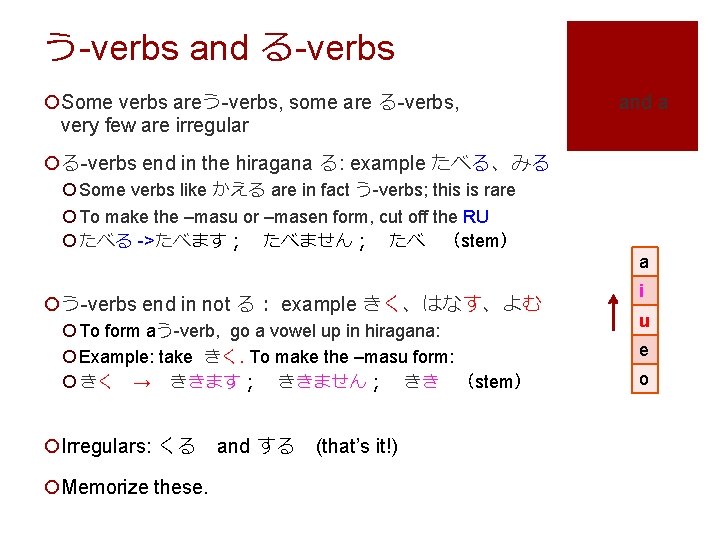
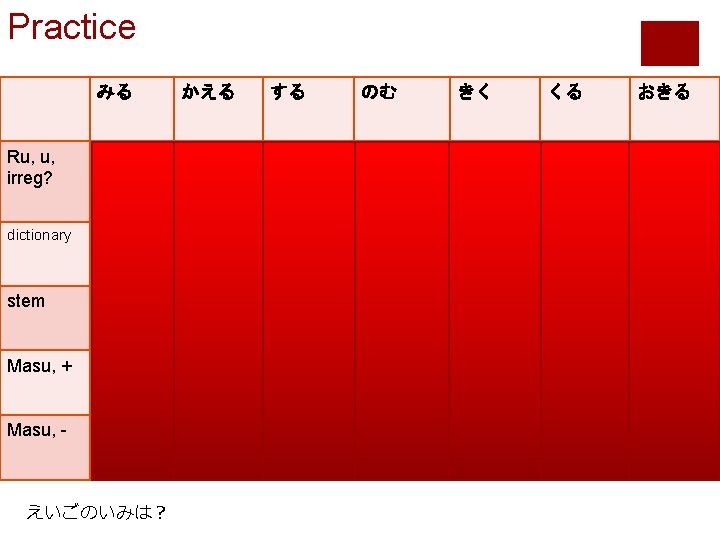
う-verbs and る-verbs ¡Some verbs areう-verbs, some are る-verbs, very few are irregular and a ¡る-verbs end in the hiragana る: example たべる、みる ¡ Some verbs like かえる are in fact う-verbs; this is rare ¡ To make the –masu or –masen form, cut off the RU ¡ たべる ->たべます; たべません; たべ (stem) ¡う-verbs end in not る: example きく、はなす、よむ ¡ To form aう-verb, go a vowel up in hiragana: ¡ Example: take きく. To make the –masu form: ¡ きく → ききます; ききません; きき (stem) ¡Irregulars: くる and する (that’s it!) ¡Memorize these. a i u e o
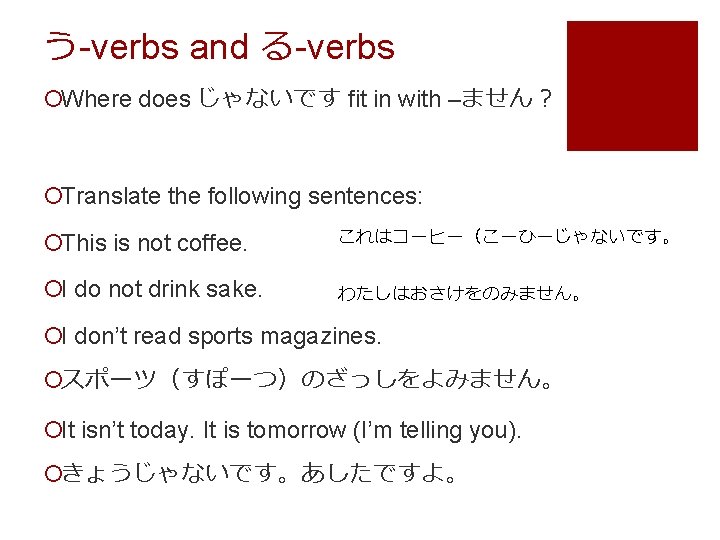
う-verbs and る-verbs ¡Where does じゃないです fit in with –ません? ¡Translate the following sentences: ¡This is not coffee. これはコーヒー(こーひーじゃないです。 ¡I do not drink sake. わたしはおさけをのみません。 ¡I don’t read sports magazines. ¡スポーツ(すぽーつ)のざっしをよみません。 ¡It isn’t today. It is tomorrow (I’m telling you). ¡きょうじゃないです。あしたですよ。
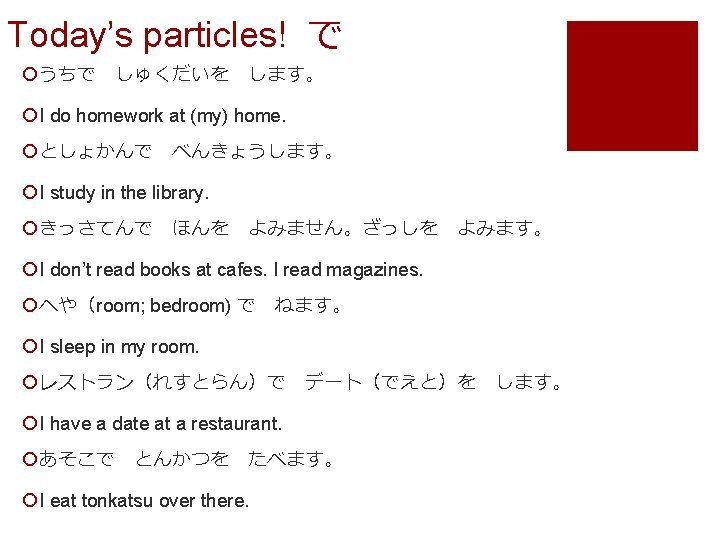
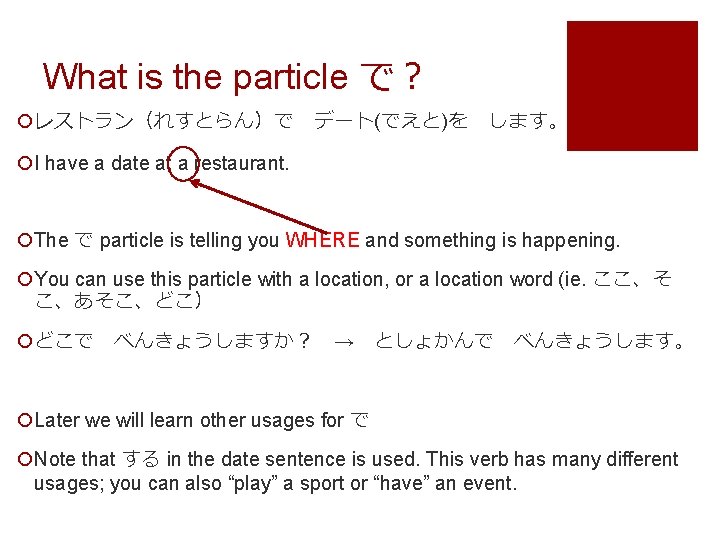
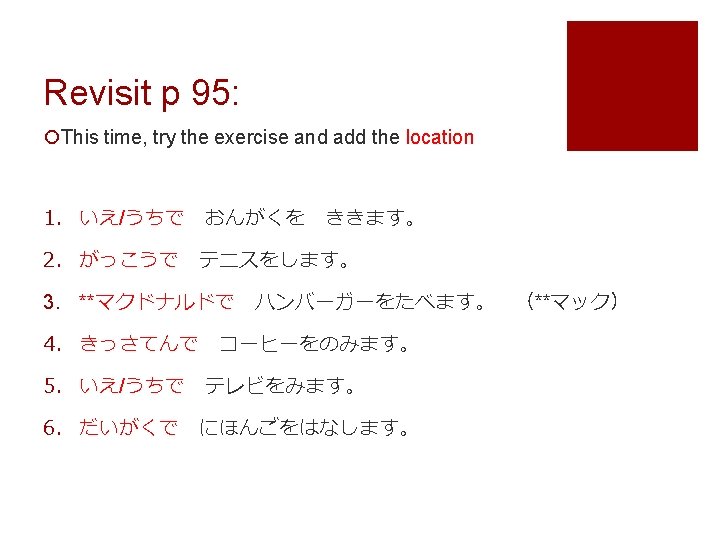
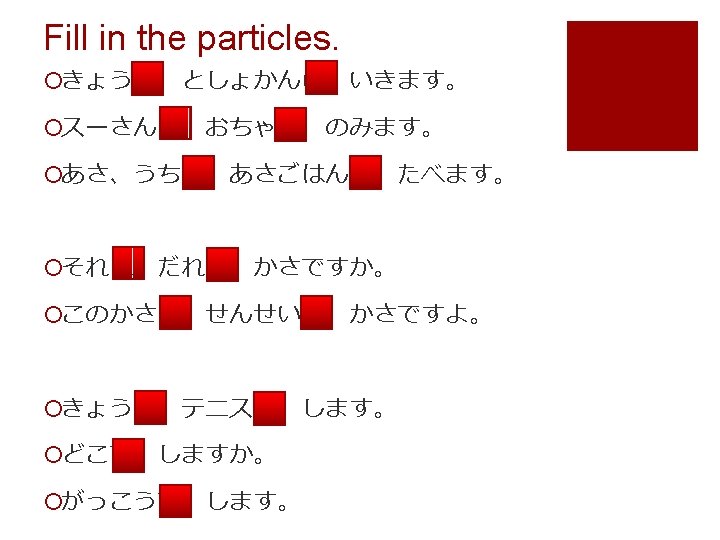
What is the particle で? ¡レストラン(れすとらん)で デート(でえと)を します。 ¡I have a date at a restaurant. ¡The で particle is telling you WHERE and something is happening. ¡You can use this particle with a location, or a location word (ie. ここ、そ こ、あそこ、どこ) ¡どこで べんきょうしますか? → としょかんで べんきょうします。 ¡Later we will learn other usages for で ¡Note that する in the date sentence is used. This verb has many different usages; you can also “play” a sport or “have” an event.
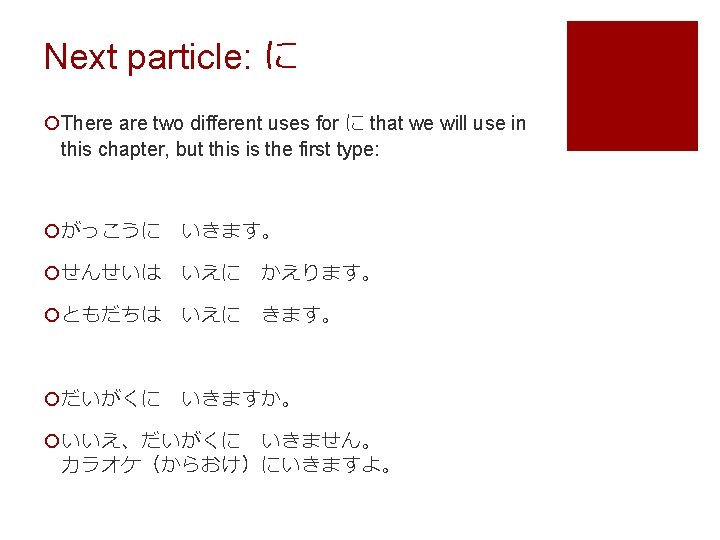
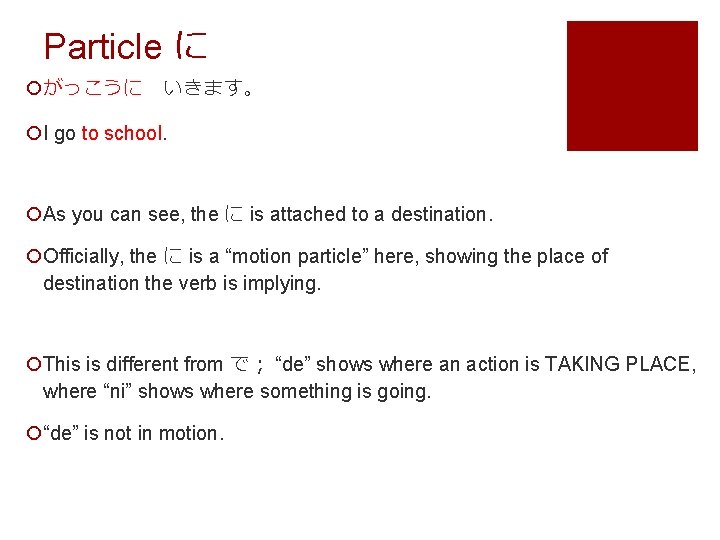
Particle に ¡がっこうに いきます。 ¡I go to school. ¡As you can see, the に is attached to a destination. ¡Officially, the に is a “motion particle” here, showing the place of destination the verb is implying. ¡This is different from で; “de” shows where an action is TAKING PLACE, where “ni” shows where something is going. ¡“de” is not in motion.
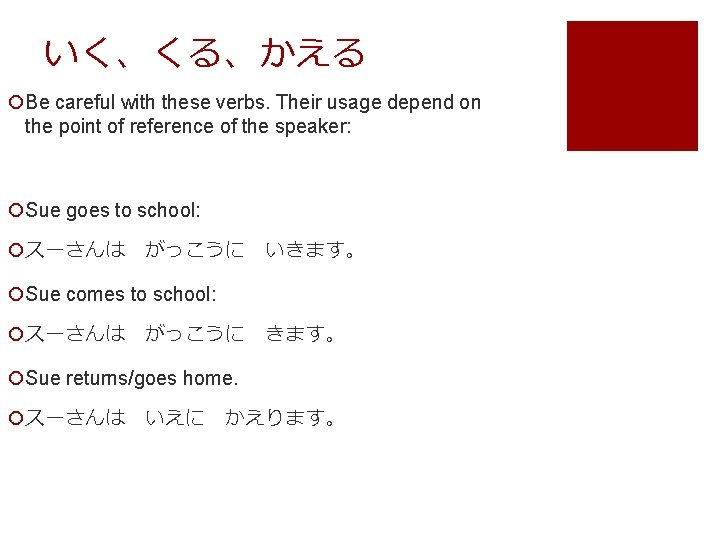
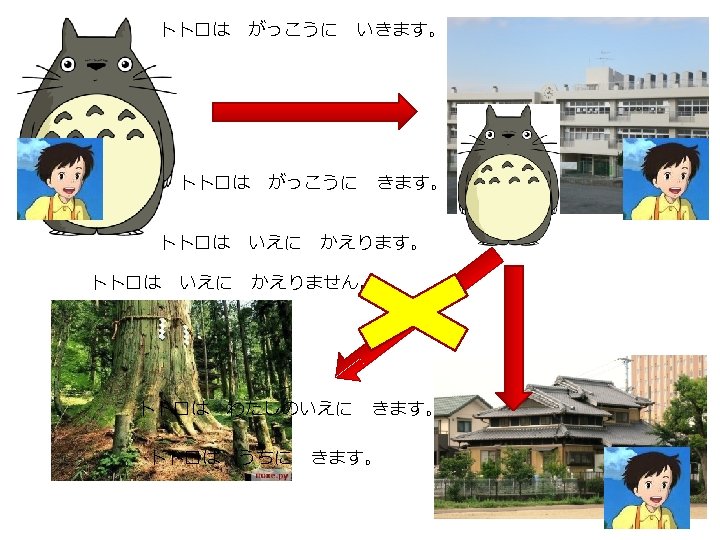
いく、くる、かえる ¡Be careful with these verbs. Their usage depend on the point of reference of the speaker: ¡Sue goes to school: ¡スーさんは がっこうに いきます。 ¡Sue comes to school: ¡スーさんは がっこうに きます。 ¡Sue returns/goes home. ¡スーさんは いえに かえります。
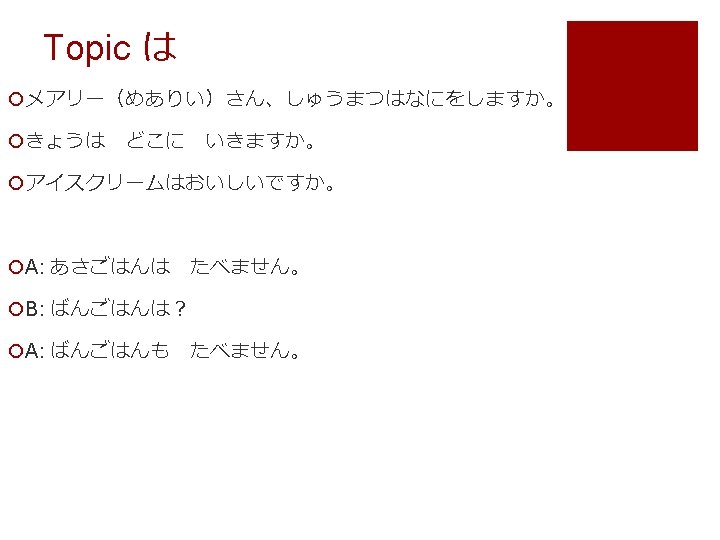
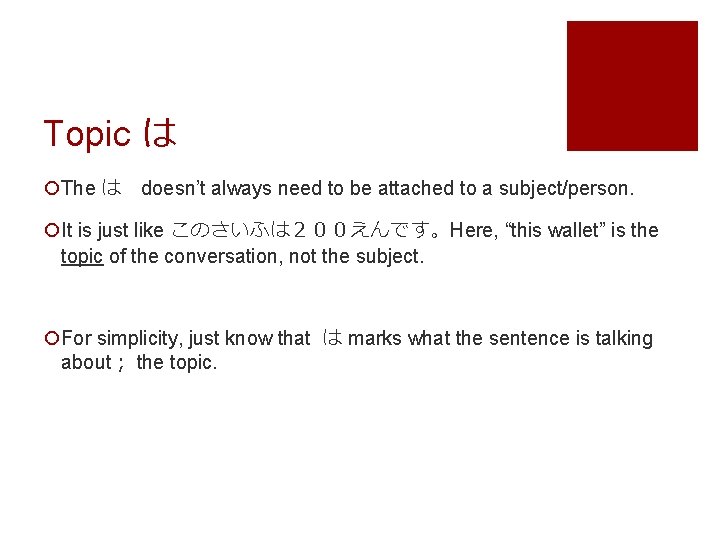
Topic は ¡The は doesn’t always need to be attached to a subject/person. ¡It is just like このさいふは200えんです。Here, “this wallet” is the topic of the conversation, not the subject. ¡For simplicity, just know that は marks what the sentence is talking about; the topic.
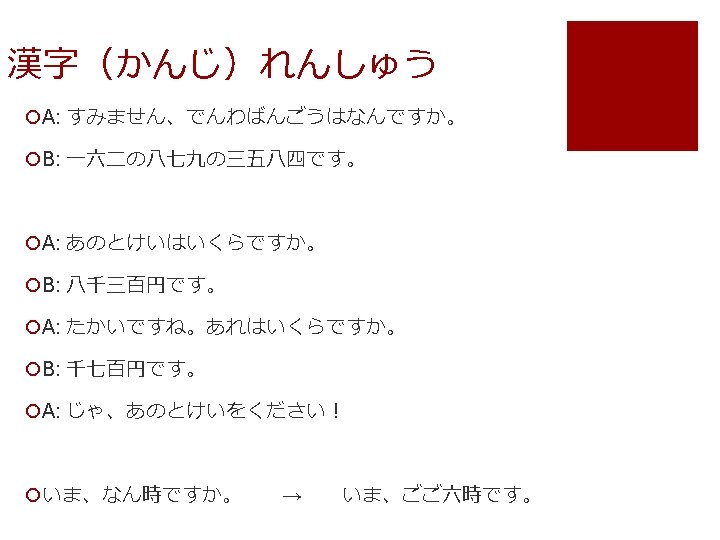
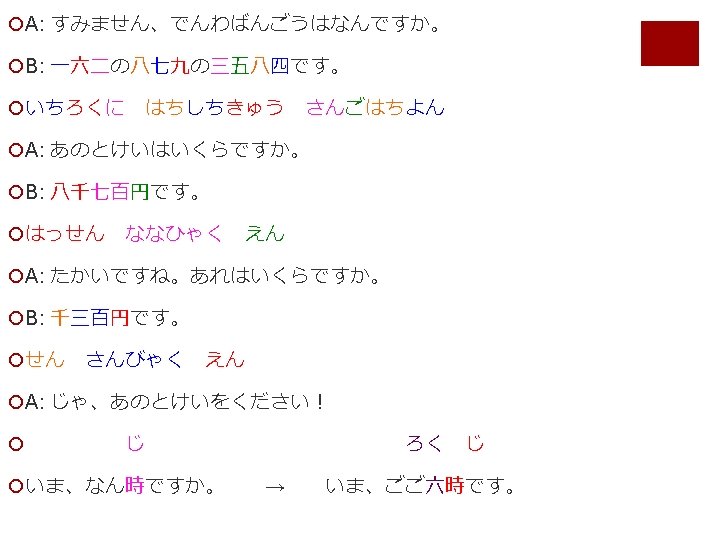
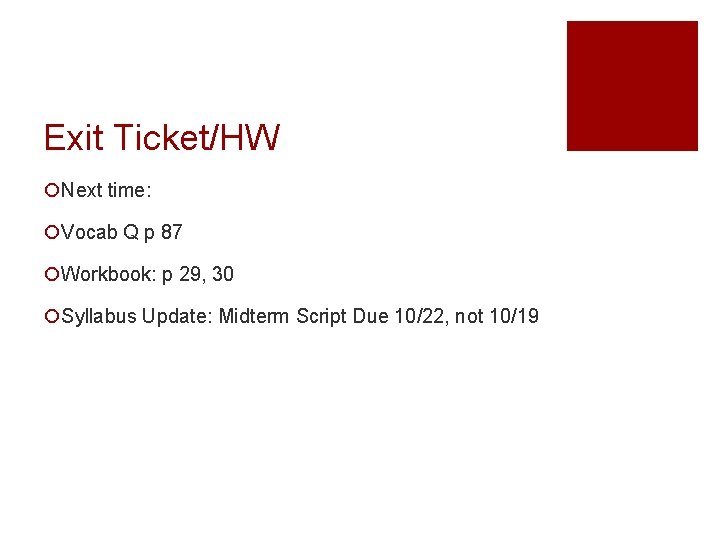
Exit Ticket/HW ¡Next time: ¡Vocab Q p 87 ¡Workbook: p 29, 30 ¡Syllabus Update: Midterm Script Due 10/22, not 10/19
- Slides: 26