
Kim Young Sek Department of Education KNUE youngsekknue
- Slides: 24
§ Kim, Young Sek § Department of Education, KNUE § youngsek@knue. ac. kr
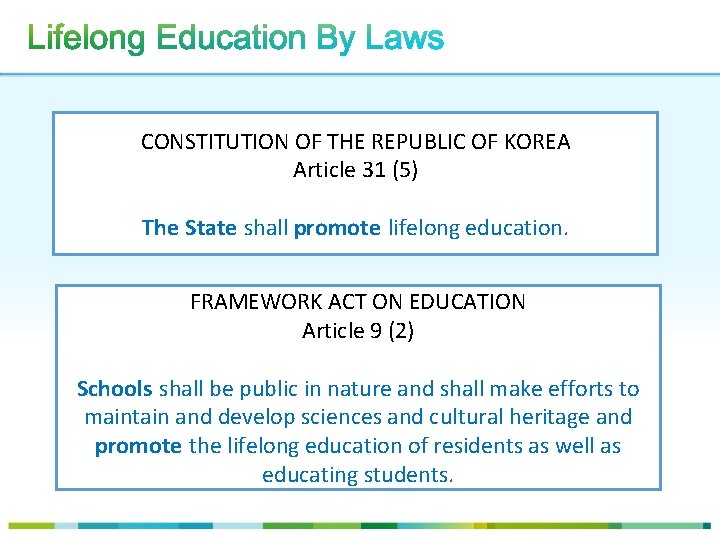
CONSTITUTION OF THE REPUBLIC OF KOREA Article 31 (5) The State shall promote lifelong education. FRAMEWORK ACT ON EDUCATION Article 9 (2) Schools shall be public in nature and shall make efforts to maintain and develop sciences and cultural heritage and promote the lifelong education of residents as well as educating students.
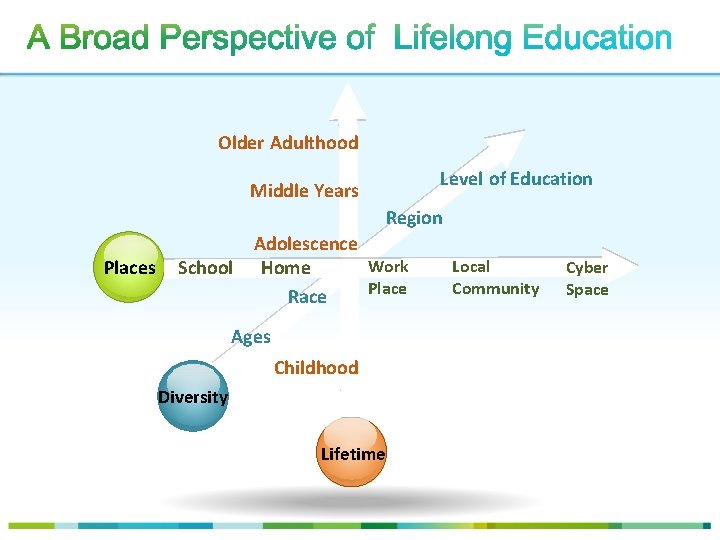
Older Adulthood Level of Education Middle Years Region Places School Adolescence Work Home Place Race Ages Childhood Diversity Lifetime Local Community Cyber Space
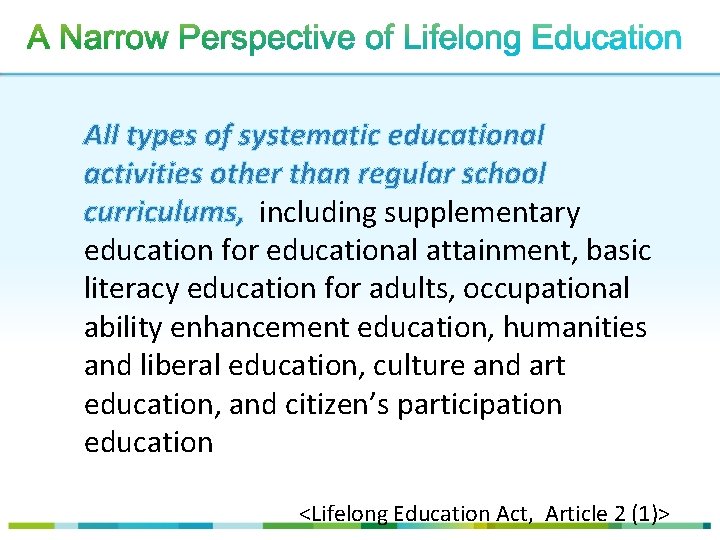
All types of systematic educational activities other than regular school curriculums, including supplementary education for educational attainment, basic literacy education for adults, occupational ability enhancement education, humanities and liberal education, culture and art education, and citizen’s participation education <Lifelong Education Act, Article 2 (1)>
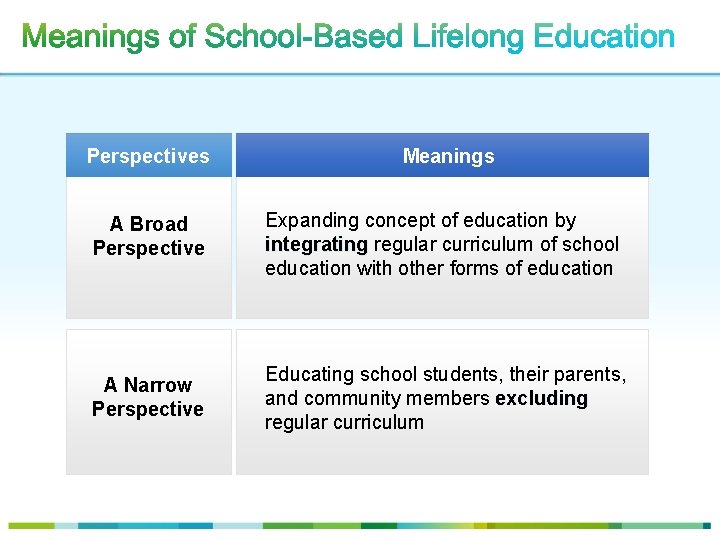
Perspectives Meanings A Broad Perspective Expanding concept of education by integrating regular curriculum of school education with other forms of education A Narrow Perspective Educating school students, their parents, and community members excluding regular curriculum
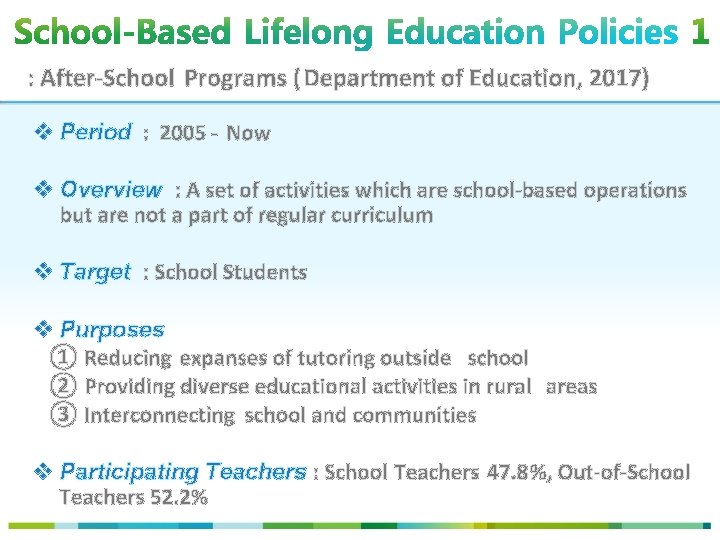
: After-School Programs (Department of Education, 2017) v Period : 2005 - Now v Overview : A set of activities which are school-based operations but are not a part of regular curriculum v Target : School Students v Purposes ① Reducing expanses of tutoring outside school ② Providing diverse educational activities in rural areas ③ Interconnecting school and communities v Participating Teachers : School Teachers 47. 8%, Out-of-School Teachers 52. 2%
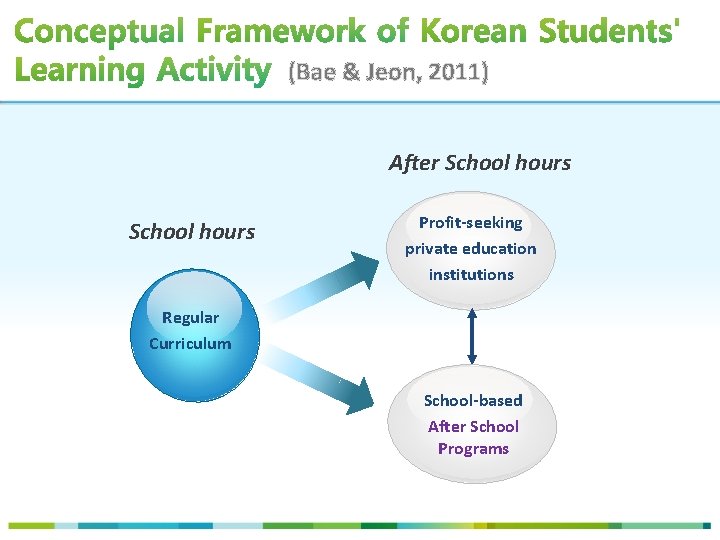
(Bae & Jeon, 2011) After School hours Profit-seeking private education institutions Regular Curriculum School-based After School Programs
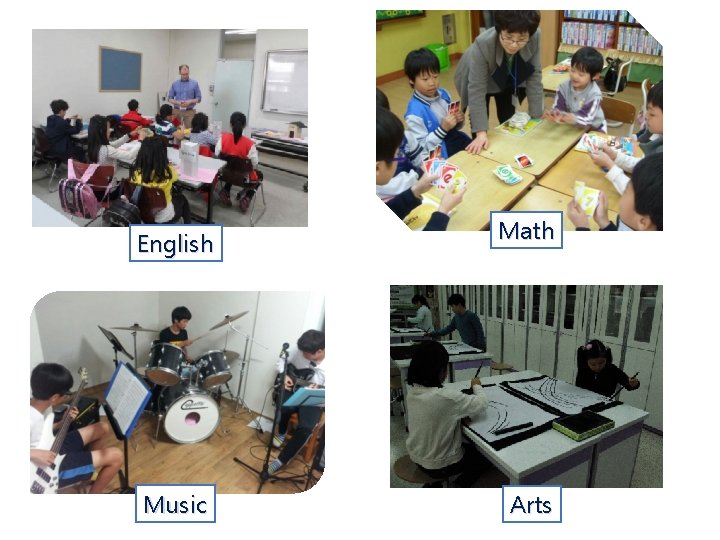
English Music Math Arts
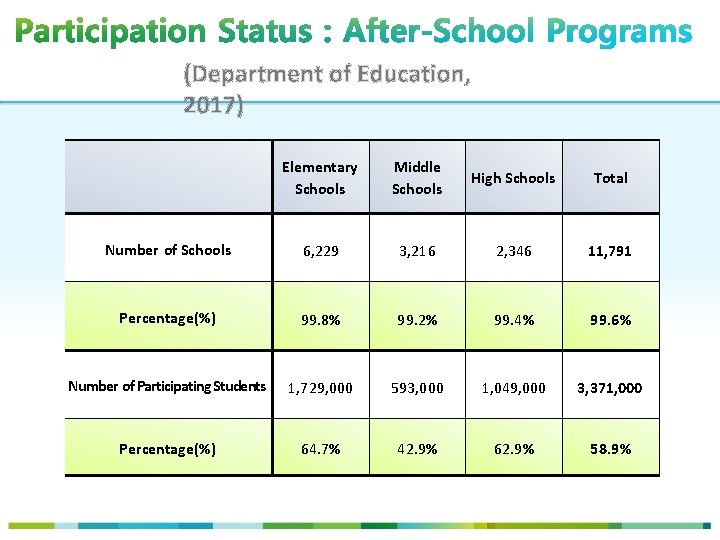
(Department of Education, 2017) Elementary Schools Middle Schools High Schools Total Number of Schools 6, 229 3, 216 2, 346 11, 791 Percentage(%) 99. 8% 99. 2% 99. 4% 99. 6% Number of Participating Students 1, 729, 000 593, 000 1, 049, 000 3, 371, 000 Percentage(%) 64. 7% 42. 9% 62. 9% 58. 9%
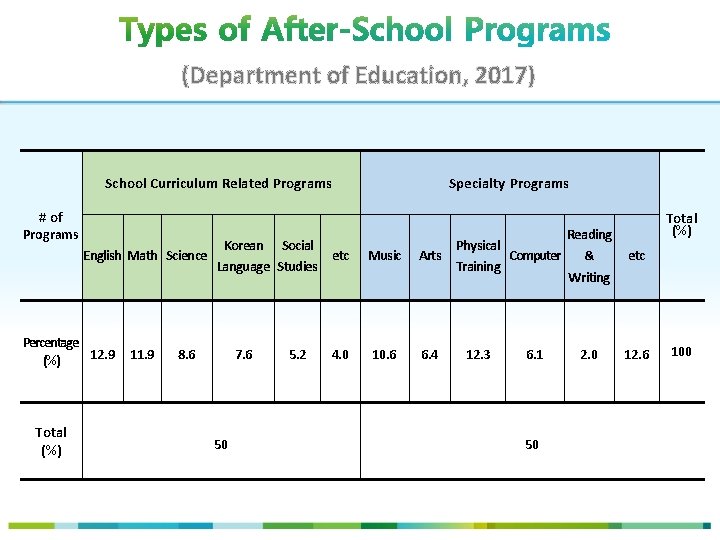
(Department of Education, 2017) School Curriculum Related Programs Specialty Programs # of Programs Korean Social English Math Science etc Language Studies Percentage 12. 9 (%) Total (%) 11. 9 8. 6 7. 6 50 5. 2 4. 0 Music Physical Arts Computer Training 10. 6 6. 4 12. 3 6. 1 50 Total (%) Reading & Writing etc 2. 0 12. 6 100
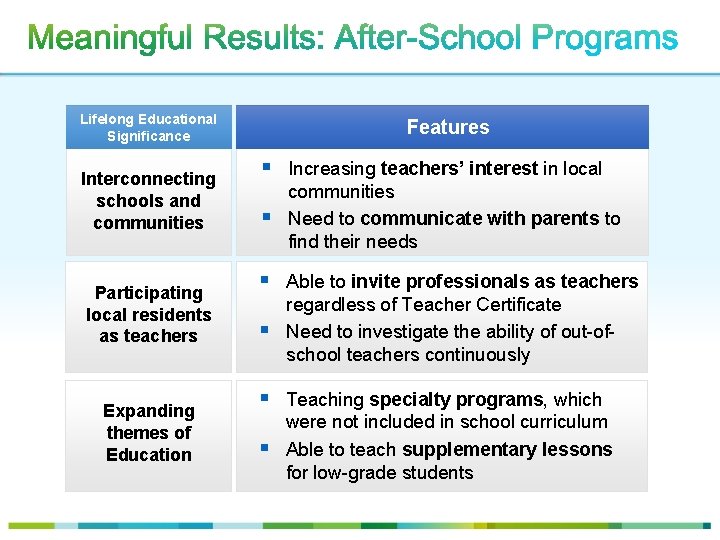
Lifelong Educational Significance Interconnecting schools and communities Participating local residents as teachers Expanding themes of Education Features § Increasing teachers’ interest in local § communities Need to communicate with parents to find their needs § Able to invite professionals as teachers § regardless of Teacher Certificate Need to investigate the ability of out-ofschool teachers continuously § Teaching specialty programs, which § were not included in school curriculum Able to teach supplementary lessons for low-grade students
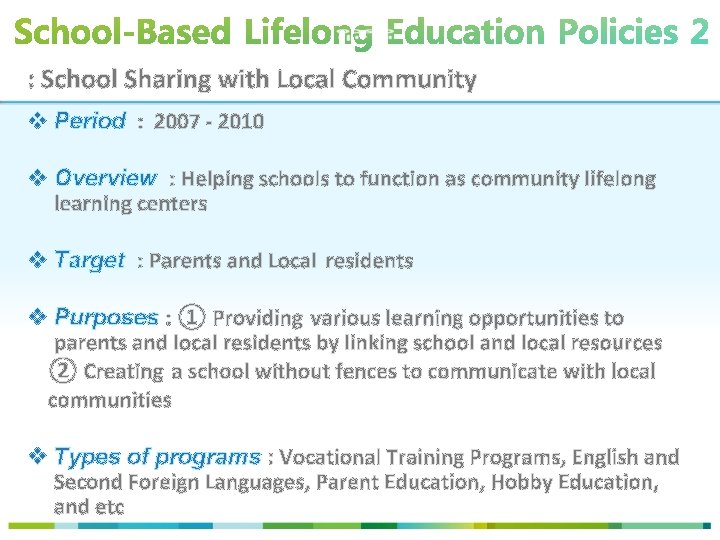
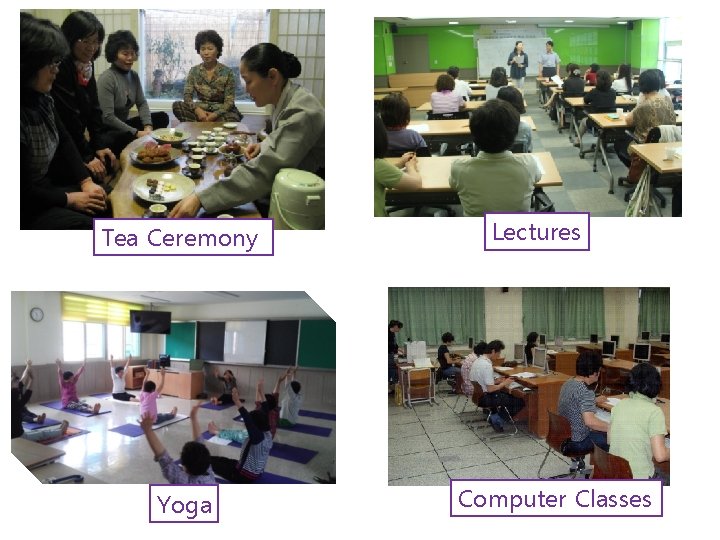
: School Sharing with Local Community v Period : 2007 - 2010 v Overview : Helping schools to function as community lifelong learning centers v Target : Parents and Local residents v Purposes : ① Providing various learning opportunities to parents and local residents by linking school and local resources ② Creating a school without fences to communicate with local communities v Types of programs : Vocational Training Programs, English and Second Foreign Languages, Parent Education, Hobby Education, and etc
Tea Ceremony Yoga Lectures Computer Classes
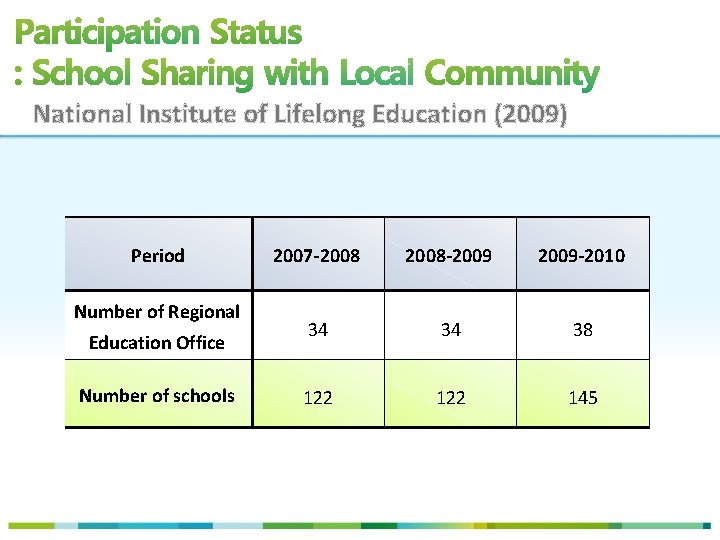
National Institute of Lifelong Education (2009) Period Number of Regional Education Office Number of schools 2007 -2008 -2009 -2010 34 34 38 122 145
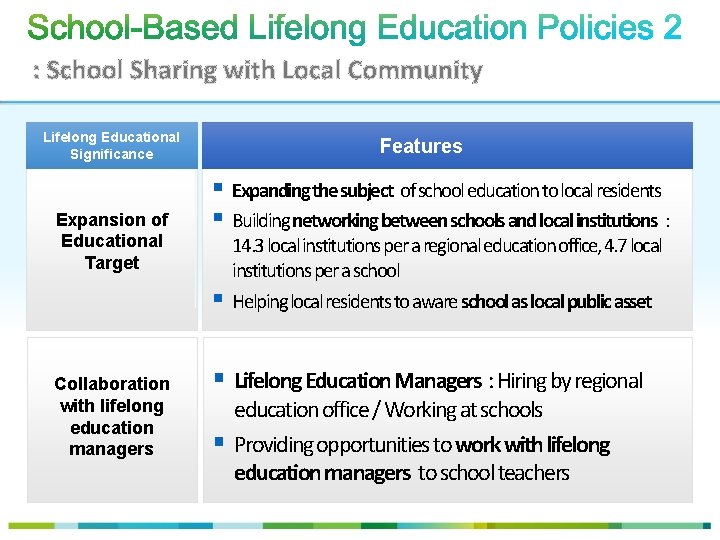
: School Sharing with Local Community Lifelong Educational Significance Expansion of Educational Target Features § Expanding the subject of school education to local residents § Building networking between schools and local institutions : § Collaboration with lifelong education managers 14. 3 local institutions per a regional education office, 4. 7 local institutions per a school Helping local residents to aware school as local public asset § Lifelong Education Managers : Hiring by regional § education office / Working at schools Providing opportunities to work with lifelong education managers to school teachers
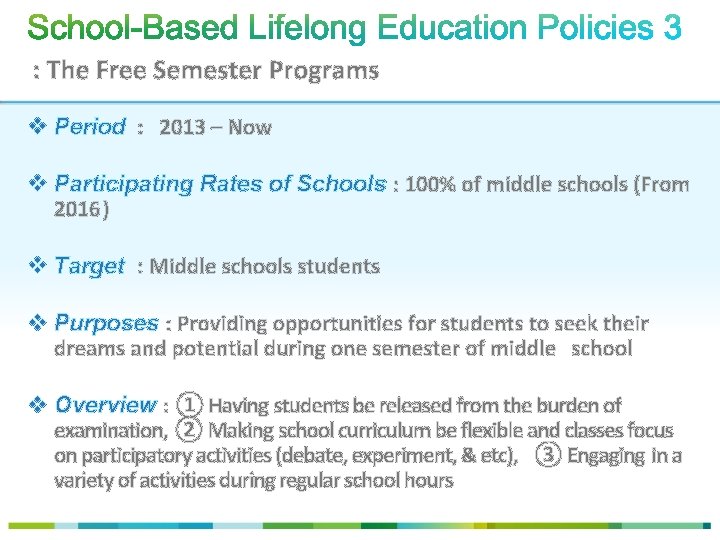
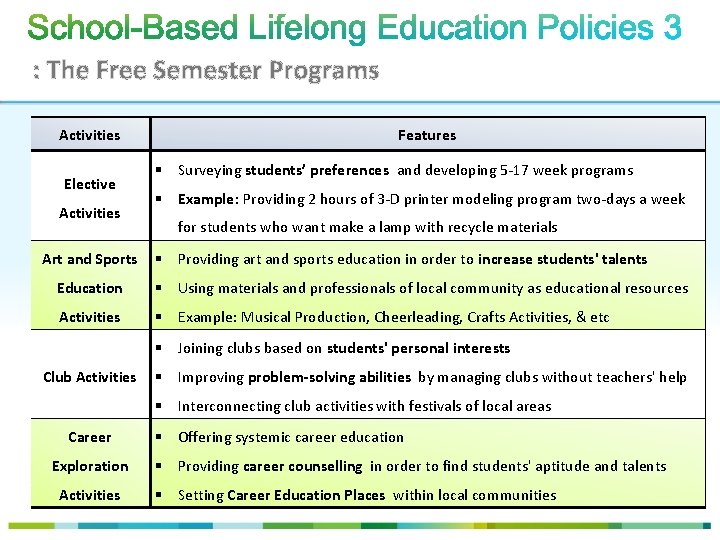
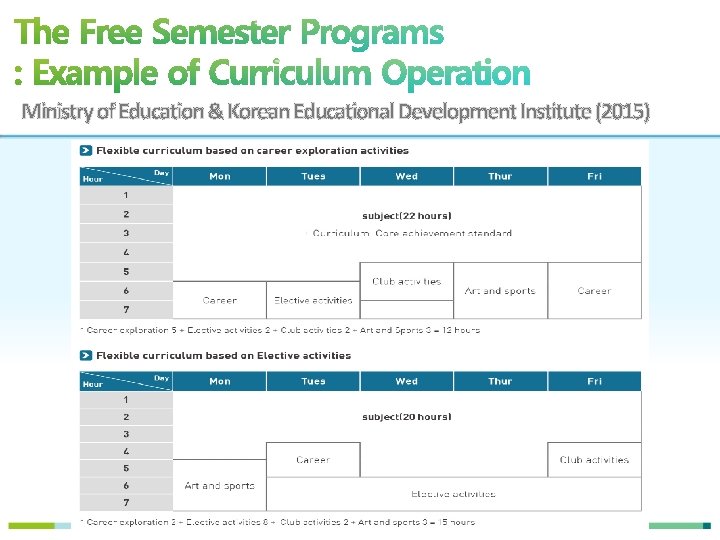
: The Free Semester Programs v Period : 2013 – Now v Participating Rates of Schools : 100% of middle schools (From 2016) v Target : Middle schools students v Purposes : Providing opportunities for students to seek their dreams and potential during one semester of middle school v Overview : ① Having students be released from the burden of examination, ② Making school curriculum be flexible and classes focus on participatory activities (debate, experiment, & etc), ③ Engaging in a variety of activities during regular school hours
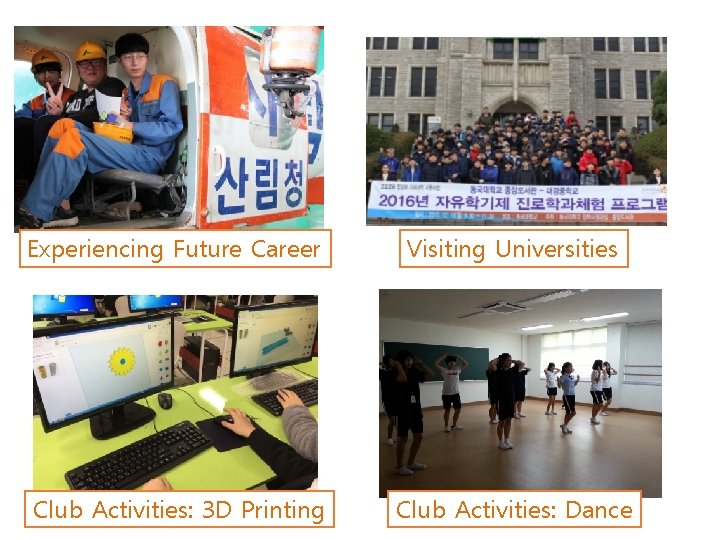
: The Free Semester Programs Activities Elective Activities Art and Sports Features § Surveying students’ preferences and developing 5 -17 week programs § Example: Providing 2 hours of 3 -D printer modeling program two-days a week for students who want make a lamp with recycle materials § Providing art and sports education in order to increase students' talents Education § Using materials and professionals of local community as educational resources Activities § Example: Musical Production, Cheerleading, Crafts Activities, & etc § Joining clubs based on students' personal interests Club Activities § Improving problem-solving abilities by managing clubs without teachers' help § Interconnecting club activities with festivals of local areas Career Exploration Activities § Offering systemic career education § Providing career counselling in order to find students' aptitude and talents § Setting Career Education Places within local communities
Experiencing Future Career Visiting Universities Club Activities: 3 D Printing Club Activities: Dance
Ministry of Education & Korean Educational Development Institute (2015)
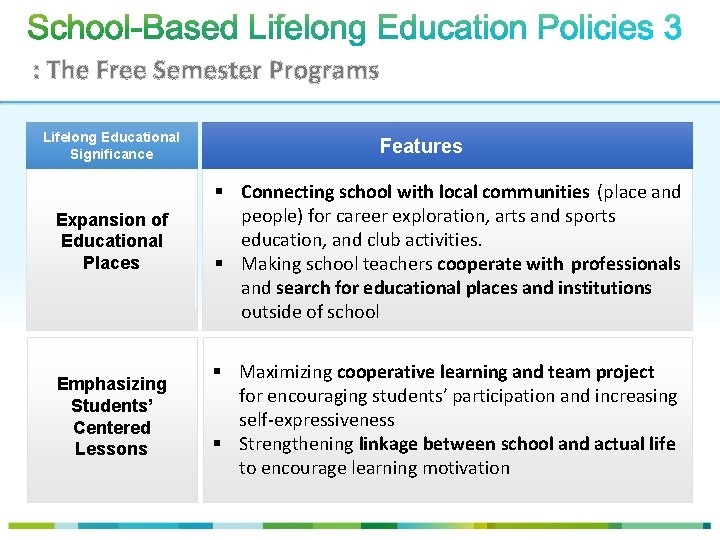
: The Free Semester Programs Lifelong Educational Significance Expansion of Educational Places Emphasizing Students’ Centered Lessons Features § Connecting school with local communities (place and people) for career exploration, arts and sports education, and club activities. § Making school teachers cooperate with professionals and search for educational places and institutions outside of school § Maximizing cooperative learning and team project for encouraging students’ participation and increasing self-expressiveness § Strengthening linkage between school and actual life to encourage learning motivation
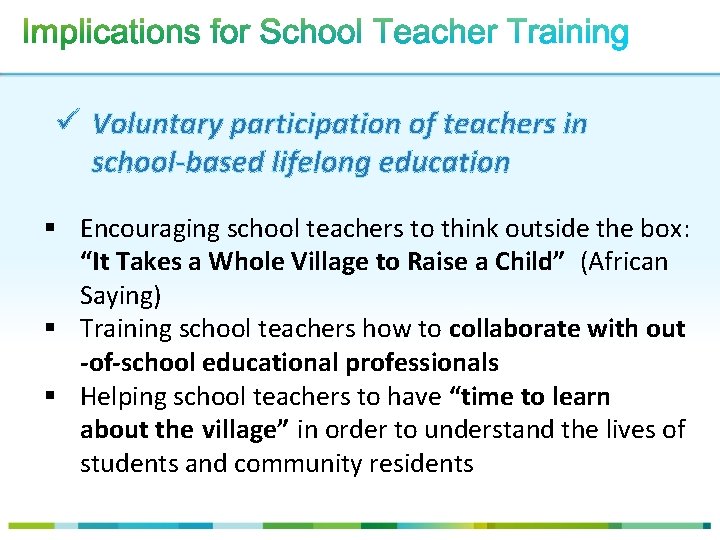
ü Voluntary participation of teachers in school-based lifelong education § Encouraging school teachers to think outside the box: “It Takes a Whole Village to Raise a Child” (African Saying) § Training school teachers how to collaborate with out -of-school educational professionals § Helping school teachers to have “time to learn about the village” in order to understand the lives of students and community residents
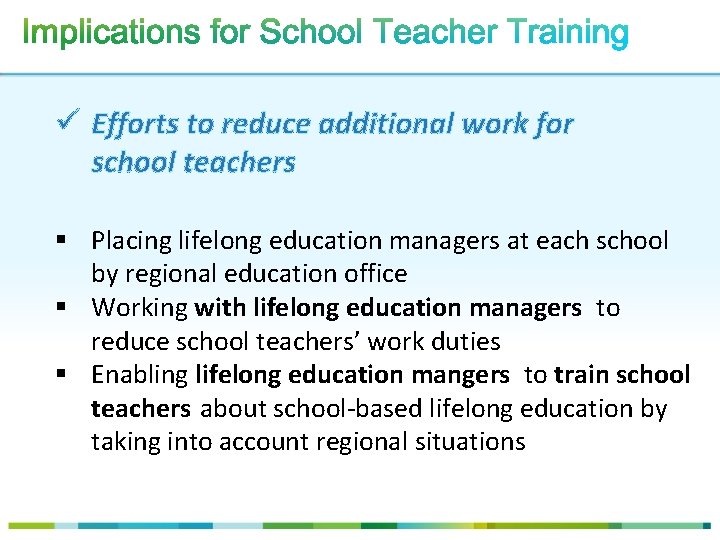
ü Efforts to reduce additional work for school teachers § Placing lifelong education managers at each school by regional education office § Working with lifelong education managers to reduce school teachers’ work duties § Enabling lifelong education mangers to train school teachers about school-based lifelong education by taking into account regional situations
§ Bae S. H. /Jeon, S. B. (2011). School-based afterschool programs: The key of quality and equality. Korea’s experience. In J. Ecarius, E. Klieme, L. Stecher, & J. Woods (Eds. ), Extended education – an international perspective: Proceeding of the international conference on extracurricular and out-of-school time educational research. Opladen, Germany: Barbara Budrich Publishers, pp. 199– 226. § Ministry of Education (2017). 2017 Current Status of Afterschool Programs (Written in Korean)http: //www. moe. go. kr/board. Cnts/view. do? board. ID=317&board. Seq=74098&lev=0&search. Ty pe=S&status. YN=W&page=1&s=moe&m=030202&op. Type= § Ministry of Education & Korean Educational Development Institute (2015). The Free Semester Program: Happy Education: to nurture dreams and talents. (Written in English) § National Institute of Lifelong Education (2009). 2009 White Book of Lifelong Education. (Written in Korean)
THANK YOU for your attention