
Kidneys Nephrons the Functional Unit Kidneys excretory organs
- Slides: 31
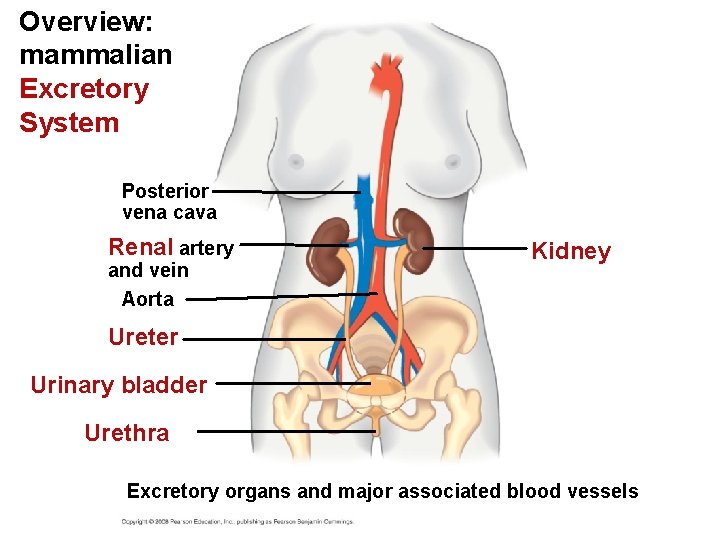
Kidneys : Nephrons = the Functional Unit • Kidneys = excretory organs of vertebrates, function in both excretion and osmoregulation. • Mammalian excretory systems center on paired kidneys, which are also the principal site of water balance and salt regulation. • Each kidney is supplied with blood by a renal artery and drained by a renal vein. • Urine exits each kidney through a duct called the ureter. • Both ureters drain into a common urinary bladder, and urine is expelled through a urethra. Copyright © 2008 Pearson Education Inc. , publishing as Pearson Benjamin Cummings
Overview: mammalian Excretory System Posterior vena cava Renal artery and vein Aorta Kidney Ureter Urinary bladder Urethra Excretory organs and major associated blood vessels
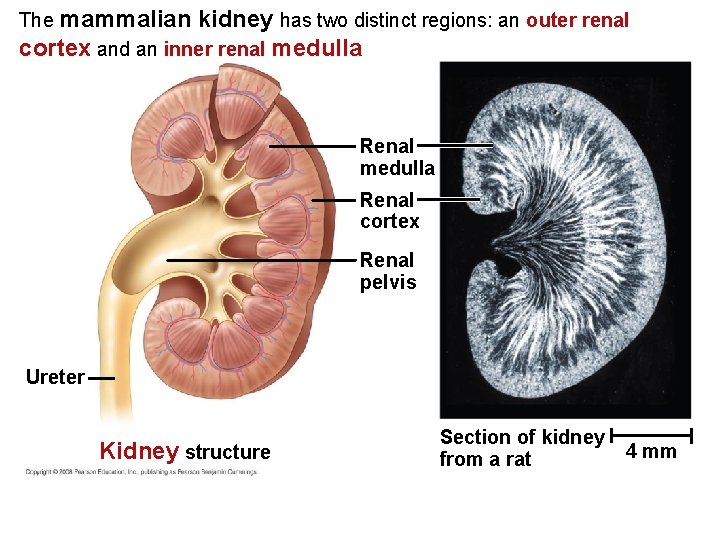
The mammalian kidney has two distinct regions: an outer renal cortex and an inner renal medulla Renal cortex Renal pelvis Ureter Kidney structure Section of kidney from a rat 4 mm
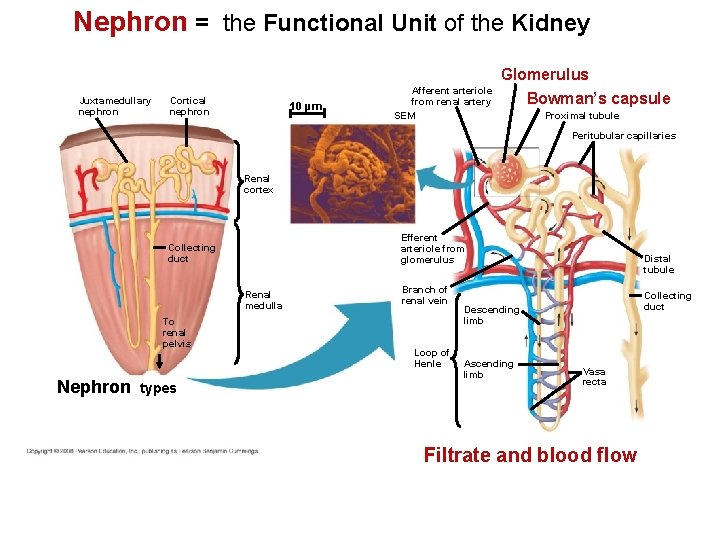
Nephron = the Functional Unit of the Kidney Juxtamedullary nephron Cortical nephron 10 µm Afferent arteriole from renal artery SEM Glomerulus Bowman’s capsule Proximal tubule Peritubular capillaries Renal cortex Efferent arteriole from glomerulus Collecting duct Renal medulla To renal pelvis Nephron types Branch of renal vein Loop of Henle Distal tubule Collecting duct Descending limb Ascending limb Vasa recta Filtrate and blood flow
• The nephron = the functional unit of the vertebrate kidney, consists of a single long tubule and a ball of capillaries called the glomerulus. • Bowman’s capsule surrounds and receives filtrate from the glomerulus capillaries. Copyright © 2008 Pearson Education Inc. , publishing as Pearson Benjamin Cummings
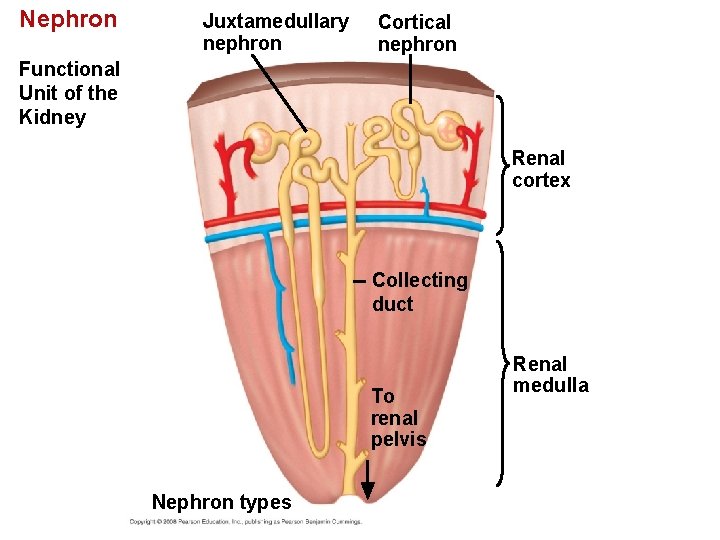
Nephron Juxtamedullary nephron Cortical nephron Functional Unit of the Kidney Renal cortex Collecting duct To renal pelvis Nephron types Renal medulla
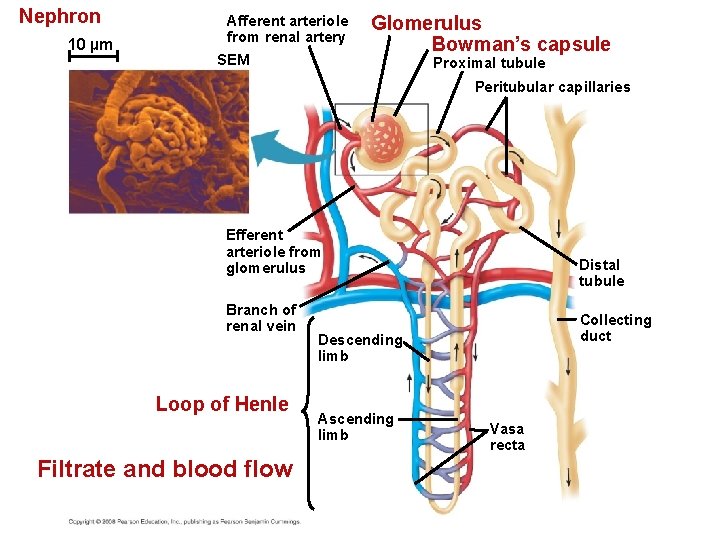
Nephron 10 µm Afferent arteriole from renal artery SEM Glomerulus Bowman’s capsule Proximal tubule Peritubular capillaries Efferent arteriole from glomerulus Branch of renal vein Loop of Henle Filtrate and blood flow Distal tubule Collecting duct Descending limb Ascending limb Vasa recta
Filtration : Glomerulus --> Bowman’s Capsule • Filtration occurs as blood pressure = hydrostatic pressure forces fluid from the blood in the glomerulus to lumen of Bowman’s capsule. • Filtration of small molecules is nonselective. • The filtrate contains salts, glucose, amino acids, vitamins, nitrogenous wastes, and other small molecules. Copyright © 2008 Pearson Education Inc. , publishing as Pearson Benjamin Cummings
Pathway of the Filtrate • From Bowman’s capsule, the filtrate passes through three regions of the nephron: the proximal tubule --> loop of Henle --> distal tubule… • Fluid from several nephrons flows into a collecting duct ---> renal pelvis ---> ureter. • Cortical nephrons are confined to the renal cortex, while juxtamedullary nephrons have loops of Henle that descend into the renal medulla. Copyright © 2008 Pearson Education Inc. , publishing as Pearson Benjamin Cummings
Blood Vessels Associated with the Nephrons • Each nephron is supplied with blood by an afferent arteriole = a branch of the renal artery that divides into the capillaries. • The capillaries converge as they leave the glomerulus, forming an efferent arteriole. • The vessels divide again, forming the peritubular capillaries, which surround the proximal and distal tubules. Copyright © 2008 Pearson Education Inc. , publishing as Pearson Benjamin Cummings
• Vasa recta are capillaries that serve the loop of Henle. • The vasa recta and the loop of Henle function as a countercurrent system. • The mammalian kidney conserves water by producing urine that is much more concentrated than body fluids. Copyright © 2008 Pearson Education Inc. , publishing as Pearson Benjamin Cummings
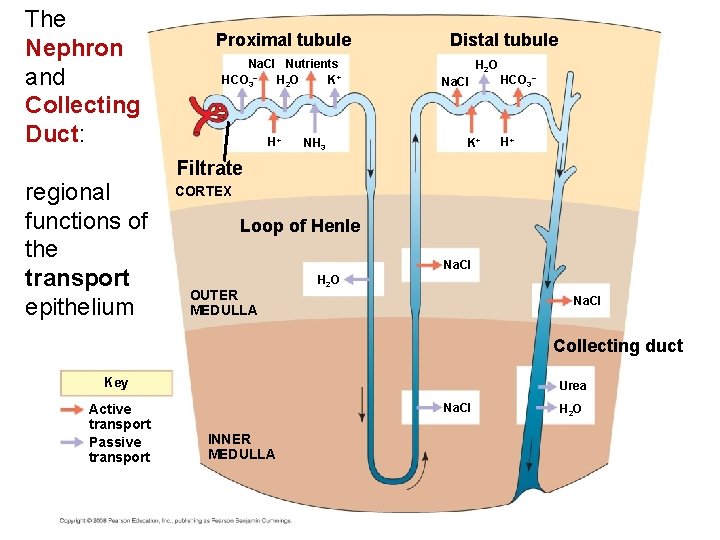
The nephron is organized for stepwise processing of blood filtrate Proximal Tubule • Reabsorption of ions, water, and nutrients takes place in the proximal tubule. • Molecules are transported actively and passively from the filtrate into the interstitial fluid and then capillaries. • Some toxic materials are secreted into the filtrate. • The filtrate volume decreases. Copyright © 2008 Pearson Education Inc. , publishing as Pearson Benjamin Cummings
Descending Limb of the Loop of Henle • Reabsorption of water continues through channels formed by aquaporin proteins. • Movement is driven by the high osmolarity of the interstitial fluid, which is hyperosmotic to the filtrate. • The filtrate becomes increasingly concentrated. Ascending Limb of the Loop of Henle • In the ascending limb of the loop of Henle, salt but not water is able to diffuse from the tubule into the interstitial fluid. • The filtrate becomes increasingly dilute. Copyright © 2008 Pearson Education Inc. , publishing as Pearson Benjamin Cummings
Distal Tubule • The distal tubule regulates the K+ and Na. Cl concentrations of body fluids. • The controlled movement of ions contributes to p. H regulation. Collecting Duct • The collecting duct carries filtrate through the medulla to the renal pelvis. • Water is lost as well as some salt and urea, and the filtrate becomes more concentrated. • Urine is hyperosmotic to body fluids. Copyright © 2008 Pearson Education Inc. , publishing as Pearson Benjamin Cummings
The Nephron and Collecting Duct: regional functions of the transport epithelium Proximal tubule Na. Cl Nutrients HCO 3– H 2 O K+ H+ NH 3 Distal tubule H 2 O Na. Cl K+ HCO 3– H+ Filtrate CORTEX Loop of Henle Na. Cl OUTER MEDULLA H 2 O Na. Cl Collecting duct Key Active transport Passive transport Urea Na. Cl INNER MEDULLA H 2 O
Solute Gradients and Water Conservation • Urine is much more concentrated than blood. • Cooperative action + precise arrangement of the loops of Henle and collecting ducts are largely responsible for the osmotic gradient that concentrates the urine. • Na. Cl and urea contribute to the osmolarity of the interstitial fluid, which causes reabsorption of water in the kidney and concentrates the urine. Copyright © 2008 Pearson Education Inc. , publishing as Pearson Benjamin Cummings
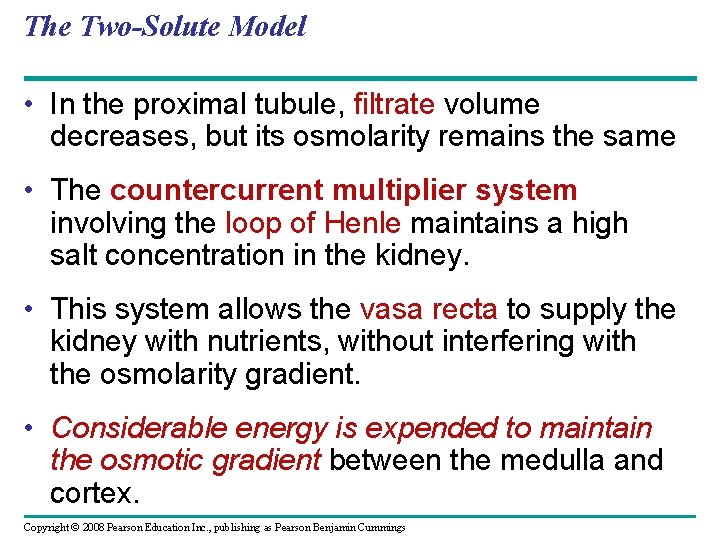
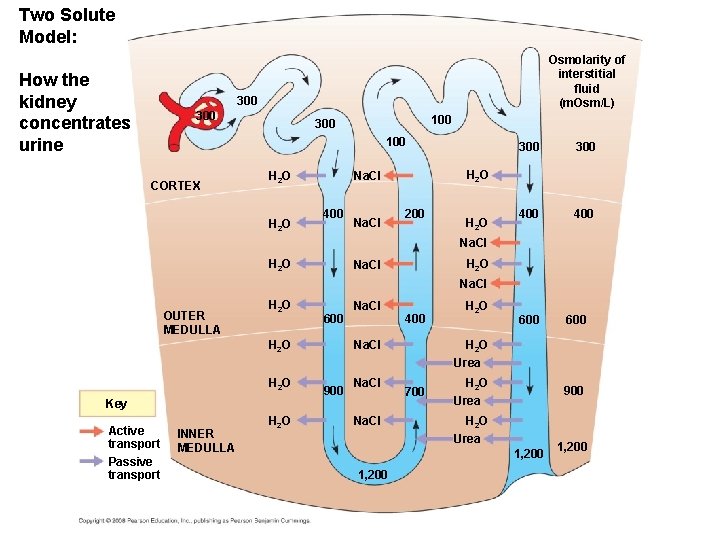
The Two-Solute Model • In the proximal tubule, filtrate volume decreases, but its osmolarity remains the same • The countercurrent multiplier system involving the loop of Henle maintains a high salt concentration in the kidney. • This system allows the vasa recta to supply the kidney with nutrients, without interfering with the osmolarity gradient. • Considerable energy is expended to maintain the osmotic gradient between the medulla and cortex. Copyright © 2008 Pearson Education Inc. , publishing as Pearson Benjamin Cummings
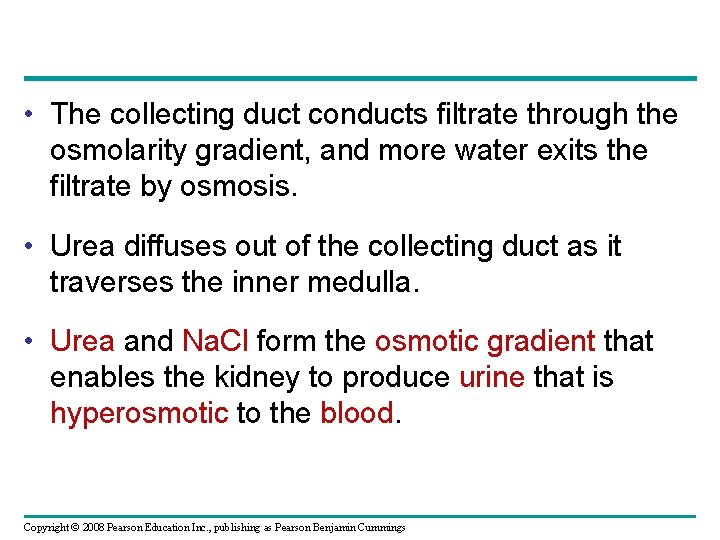
• The collecting duct conducts filtrate through the osmolarity gradient, and more water exits the filtrate by osmosis. • Urea diffuses out of the collecting duct as it traverses the inner medulla. • Urea and Na. Cl form the osmotic gradient that enables the kidney to produce urine that is hyperosmotic to the blood. Copyright © 2008 Pearson Education Inc. , publishing as Pearson Benjamin Cummings
Two Solute Model: How the kidney concentrates urine Osmolarity of interstitial fluid (m. Osm/L) 300 100 CORTEX H 2 O Na. Cl 300 400 H 2 O Na. Cl 400 300 200 H 2 O Na. Cl OUTER MEDULLA H 2 O 600 Na. Cl 400 600 H 2 O Na. Cl H 2 O Urea H 2 O Key Active transport Passive transport INNER MEDULLA H 2 O 900 Na. Cl 700 H 2 O 900 Urea H 2 O Urea 1, 200
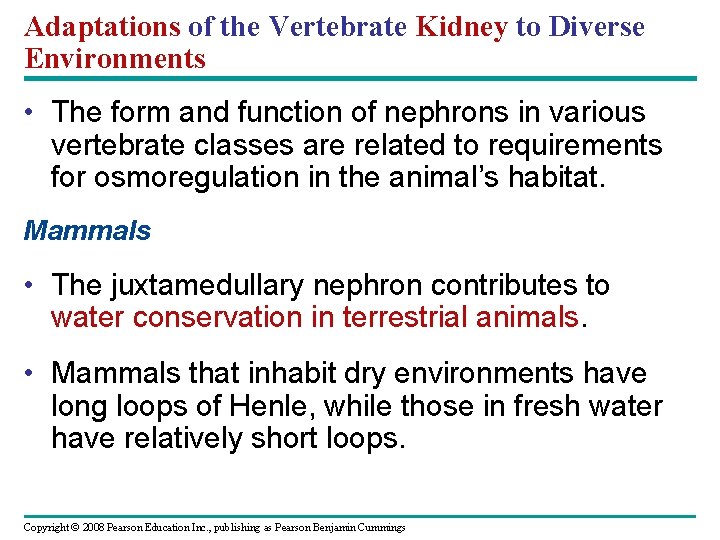
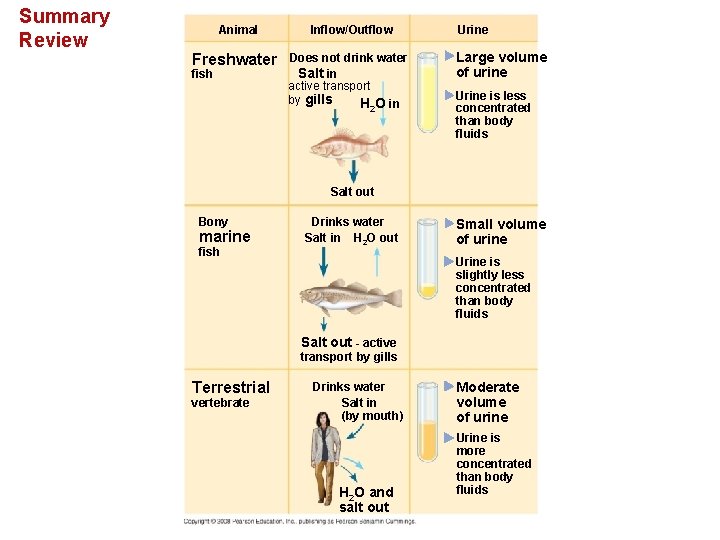
Adaptations of the Vertebrate Kidney to Diverse Environments • The form and function of nephrons in various vertebrate classes are related to requirements for osmoregulation in the animal’s habitat. Mammals • The juxtamedullary nephron contributes to water conservation in terrestrial animals. • Mammals that inhabit dry environments have long loops of Henle, while those in fresh water have relatively short loops. Copyright © 2008 Pearson Education Inc. , publishing as Pearson Benjamin Cummings
Birds and Other Reptiles • Birds have shorter loops of Henle but conserve water by excreting uric acid instead of urea. • Other reptiles have only cortical nephrons but also excrete nitrogenous waste as uric acid. Copyright © 2008 Pearson Education Inc. , publishing as Pearson Benjamin Cummings
Freshwater Fishes, Amphibians, Marine Bony Fishes • Freshwater fishes conserve salt in their distal tubules and excrete large volumes of dilute urine. • Kidney function in amphibians is similar to freshwater fishes. Amphibians conserve water on land by reabsorbing water from the urinary bladder. • Marine bony fishes are hypoosmotic compared with their environment and excrete very little urine. Copyright © 2008 Pearson Education Inc. , publishing as Pearson Benjamin Cummings
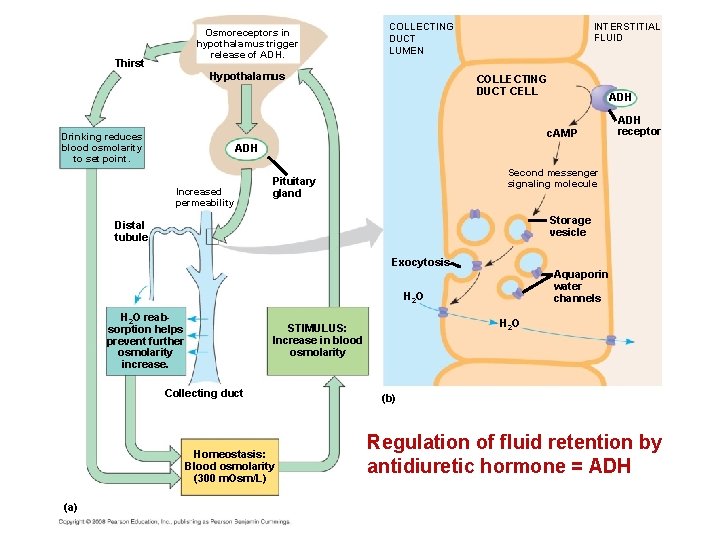
Hormonal circuits link kidney function, water balance, and blood pressure • Mammals control the volume and osmolarity of urine by nervous and hormonal control of water and salt reabsorption in the kidneys. • Antidiuretic hormone = ADH increases water reabsorption in the distal tubules and collecting ducts of the kidney. An increase in osmolarity triggers the release of ADH, which helps to conserve water. • Mutation in ADH production causes severe dehydration and results in diabetes insipidus. • Alcohol is a diuretic - it inhibits the release of ADH. Copyright © 2008 Pearson Education Inc. , publishing as Pearson Benjamin Cummings
Osmoreceptors in hypothalamus trigger release of ADH. Thirst COLLECTING DUCT LUMEN Hypothalamus INTERSTITIAL FLUID COLLECTING DUCT CELL c. AMP Drinking reduces blood osmolarity to set point. ADH receptor ADH Increased permeability Second messenger signaling molecule Pituitary gland Storage vesicle Distal tubule Exocytosis Aquaporin water channels H 2 O reabsorption helps prevent further osmolarity increase. H 2 O STIMULUS: Increase in blood osmolarity Collecting duct Homeostasis: Blood osmolarity (300 m. Osm/L) (a) ADH (b) Regulation of fluid retention by antidiuretic hormone = ADH
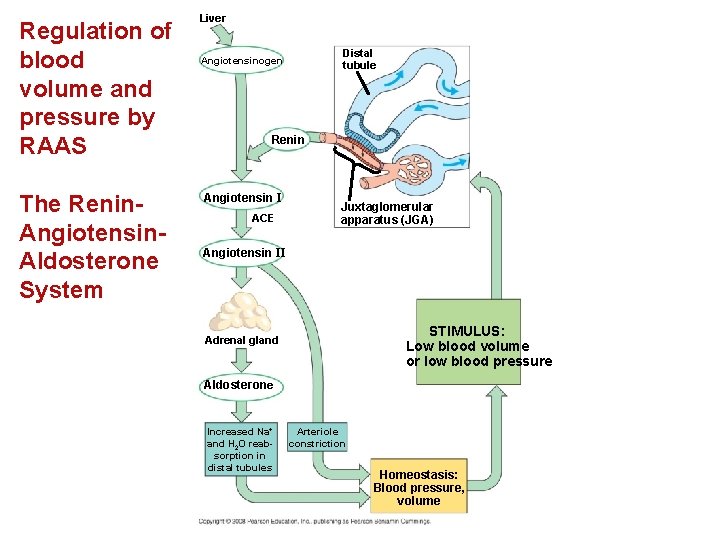
The Renin-Angiotensin-Aldosterone System • The renin-angiotensin-aldosterone system RAAS is part of a complex feedback circuit that functions in homeostasis. • A drop in blood pressure near the glomerulus causes the juxtaglomerular apparatus = JGA to release the enzyme renin. • Renin triggers the formation of the peptide angiotensin II. Copyright © 2008 Pearson Education Inc. , publishing as Pearson Benjamin Cummings
• Angiotensin II – Raises blood pressure and decreases blood flow to the kidneys – Stimulates the release of the hormone aldosterone, which increases blood volume and pressure. Copyright © 2008 Pearson Education Inc. , publishing as Pearson Benjamin Cummings
Regulation of blood volume and pressure by RAAS The Renin. Angiotensin. Aldosterone System Liver Distal tubule Angiotensinogen Renin Angiotensin I ACE Juxtaglomerular apparatus (JGA) Angiotensin II STIMULUS: Low blood volume or low blood pressure Adrenal gland Aldosterone Increased Na+ and H 2 O reabsorption in distal tubules Arteriole constriction Homeostasis: Blood pressure, volume
Homeostatic Regulation of the Kidney • ADH and RAAS both increase water reabsorption, but only RAAS will respond to a decrease in blood volume. • Another hormone, atrial natriuretic peptide ANP, opposes the RAAS. • ANP is released in response to an increase in blood volume and pressure and inhibits the release of renin. Copyright © 2008 Pearson Education Inc. , publishing as Pearson Benjamin Cummings
Summary Review Animal Freshwater fish Inflow/Outflow Does not drink water Salt in active transport by gills H O in 2 Urine Large volume of urine Urine is less concentrated than body fluids Salt out Bony marine fish Drinks water Salt in H 2 O out Small volume of urine Urine is slightly less concentrated than body fluids Salt out - active transport by gills Terrestrial vertebrate Drinks water Salt in (by mouth) H 2 O and salt out Moderate volume of urine Urine is more concentrated than body fluids
You should now be able to: 1. Distinguish between the following terms: isoosmotic, hyperosmotic, and hypoosmotic; osmoregulators and osmoconformers; stenohaline and euryhaline animals. 2. Define osmoregulation, excretion, anhydrobiosis. 3. Compare the osmoregulatory challenges of freshwater and marine animals. 4. Describe some of the factors that affect the energetic cost of osmoregulation. Copyright © 2008 Pearson Education Inc. , publishing as Pearson Benjamin Cummings
5. Describe and compare the protonephridial, metanephridial, and Malpighian tubule excretory systems. 6. Using a diagram, identify and describe the function of each region of the nephron. 7. Explain how the loop of Henle enhances water conservation. 8. Describe the nervous and hormonal controls involved in the regulation of kidney function. Copyright © 2008 Pearson Education Inc. , publishing as Pearson Benjamin Cummings