
Kidney Excretory regulatory functions necessary to sustain life

- Slides: 42
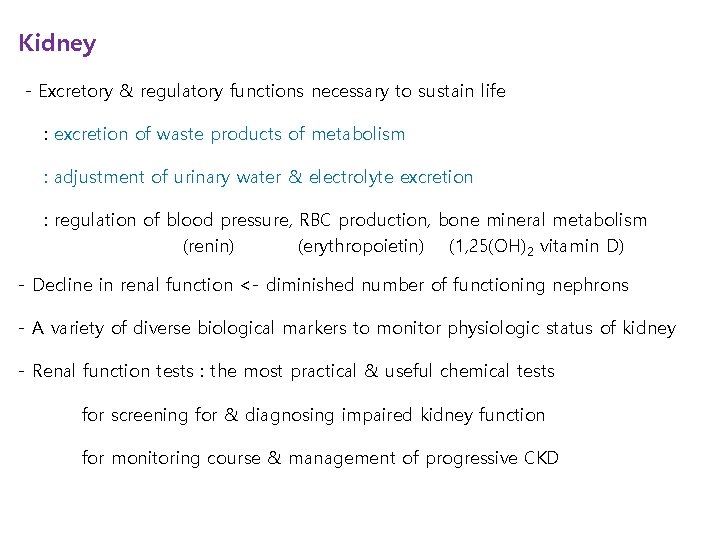
Kidney - Excretory & regulatory functions necessary to sustain life : excretion of waste products of metabolism : adjustment of urinary water & electrolyte excretion : regulation of blood pressure, RBC production, bone mineral metabolism (renin) (erythropoietin) (1, 25(OH) 2 vitamin D) - Decline in renal function <- diminished number of functioning nephrons - A variety of diverse biological markers to monitor physiologic status of kidney - Renal function tests : the most practical & useful chemical tests for screening for & diagnosing impaired kidney function for monitoring course & management of progressive CKD
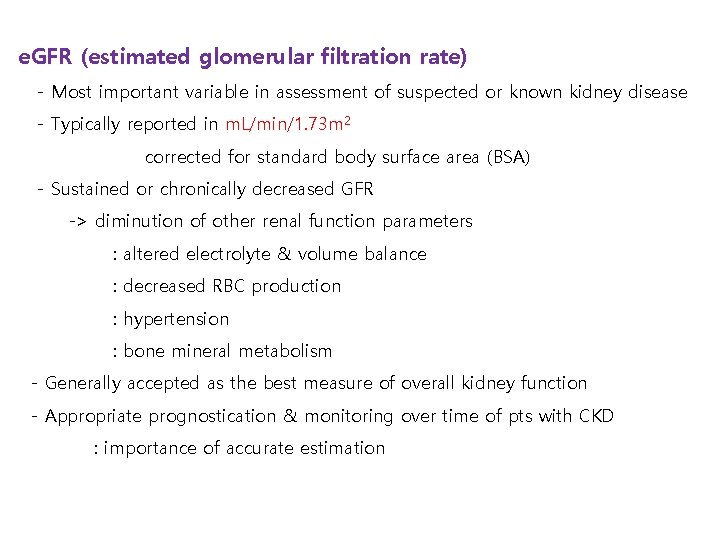
e. GFR (estimated glomerular filtration rate) - Most important variable in assessment of suspected or known kidney disease - Typically reported in m. L/min/1. 73 m 2 corrected for standard body surface area (BSA) - Sustained or chronically decreased GFR -> diminution of other renal function parameters : altered electrolyte & volume balance : decreased RBC production : hypertension : bone mineral metabolism - Generally accepted as the best measure of overall kidney function - Appropriate prognostication & monitoring over time of pts with CKD : importance of accurate estimation
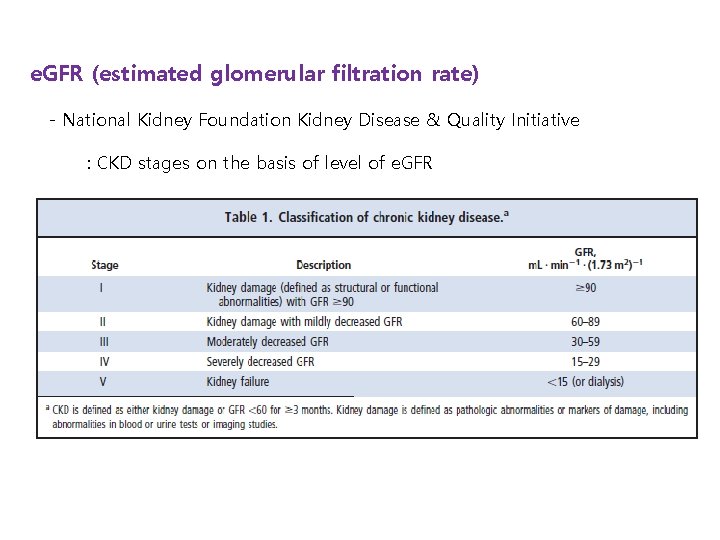
e. GFR (estimated glomerular filtration rate) - National Kidney Foundation Kidney Disease & Quality Initiative : CKD stages on the basis of level of e. GFR
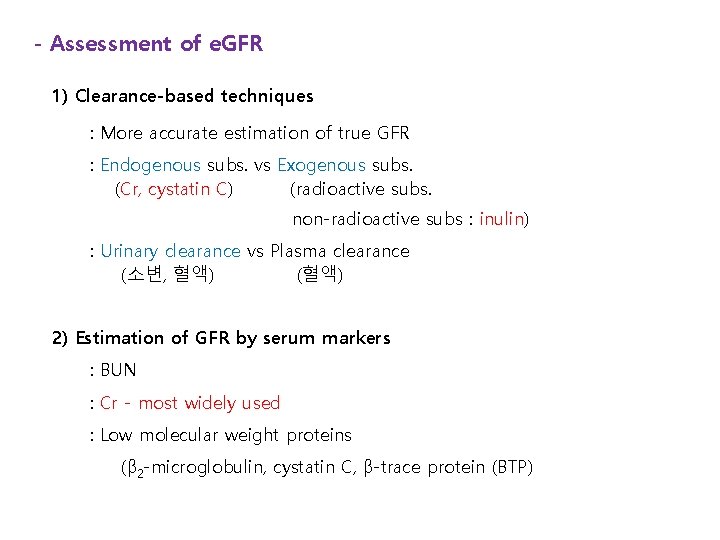
- Assessment of e. GFR 1) Clearance-based techniques : More accurate estimation of true GFR : Endogenous subs. vs Exogenous subs. (Cr, cystatin C) (radioactive subs. non-radioactive subs : inulin) : Urinary clearance vs Plasma clearance (소변, 혈액) (혈액) 2) Estimation of GFR by serum markers : BUN : Cr - most widely used : Low molecular weight proteins (β 2 -microglobulin, cystatin C, β-trace protein (BTP)
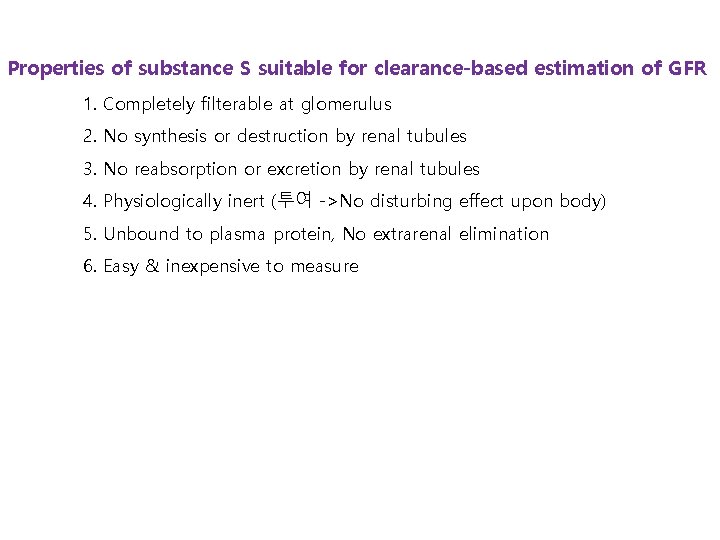
Properties of substance S suitable for clearance-based estimation of GFR 1. Completely filterable at glomerulus 2. No synthesis or destruction by renal tubules 3. No reabsorption or excretion by renal tubules 4. Physiologically inert (투여 ->No disturbing effect upon body) 5. Unbound to plasma protein, No extrarenal elimination 6. Easy & inexpensive to measure
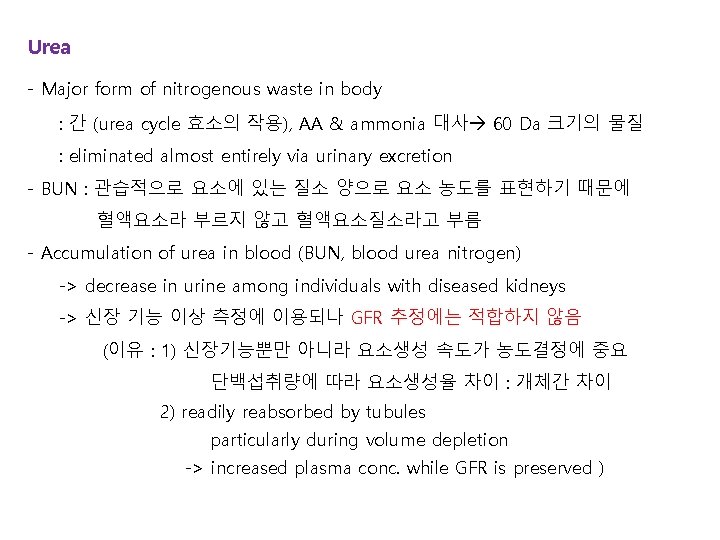
Urea - Major form of nitrogenous waste in body : 간 (urea cycle 효소의 작용), AA & ammonia 대사 60 Da 크기의 물질 : eliminated almost entirely via urinary excretion - BUN : 관습적으로 요소에 있는 질소 양으로 요소 농도를 표현하기 때문에 혈액요소라 부르지 않고 혈액요소질소라고 부름 - Accumulation of urea in blood (BUN, blood urea nitrogen) -> decrease in urine among individuals with diseased kidneys -> 신장 기능 이상 측정에 이용되나 GFR 추정에는 적합하지 않음 (이유 : 1) 신장기능뿐만 아니라 요소생성 속도가 농도결정에 중요 단백섭취량에 따라 요소생성율 차이 : 개체간 차이 2) readily reabsorbed by tubules particularly during volume depletion -> increased plasma conc. while GFR is preserved )
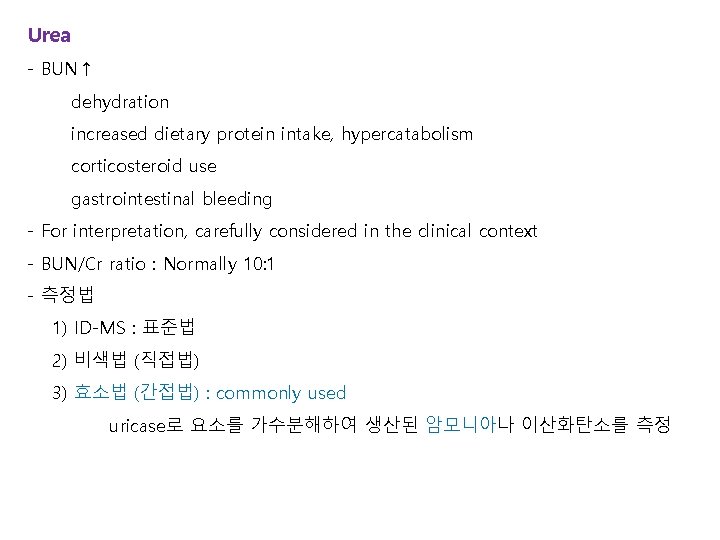
Urea - BUN↑ dehydration increased dietary protein intake, hypercatabolism corticosteroid use gastrointestinal bleeding - For interpretation, carefully considered in the clinical context - BUN/Cr ratio : Normally 10: 1 - 측정법 1) ID-MS : 표준법 2) 비색법 (직접법) 3) 효소법 (간접법) : commonly used uricase로 요소를 가수분해하여 생산된 암모니아나 이산화탄소를 측정
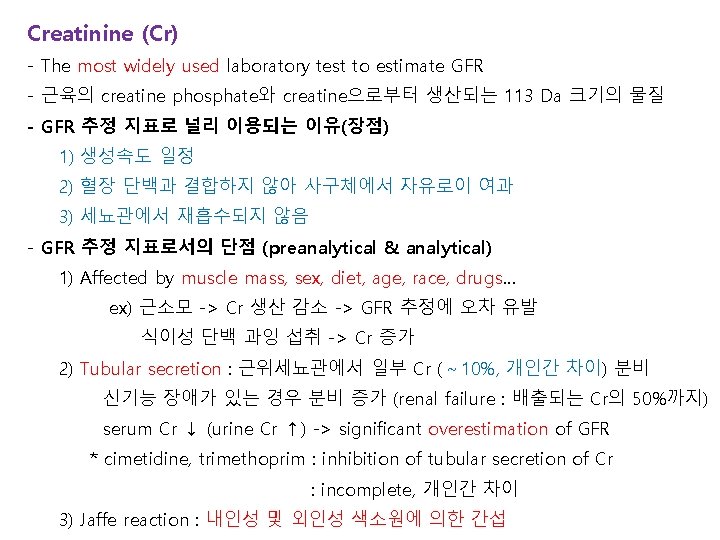
Creatinine (Cr) - The most widely used laboratory test to estimate GFR - 근육의 creatine phosphate와 creatine으로부터 생산되는 113 Da 크기의 물질 - GFR 추정 지표로 널리 이용되는 이유(장점) 1) 생성속도 일정 2) 혈장 단백과 결합하지 않아 사구체에서 자유로이 여과 3) 세뇨관에서 재흡수되지 않음 - GFR 추정 지표로서의 단점 (preanalytical & analytical) 1) Affected by muscle mass, sex, diet, age, race, drugs… ex) 근소모 -> Cr 생산 감소 -> GFR 추정에 오차 유발 식이성 단백 과잉 섭취 -> Cr 증가 2) Tubular secretion : 근위세뇨관에서 일부 Cr (~ 10%, 개인간 차이) 분비 신기능 장애가 있는 경우 분비 증가 (renal failure : 배출되는 Cr의 50%까지) serum Cr ↓ (urine Cr ↑) -> significant overestimation of GFR * cimetidine, trimethoprim : inhibition of tubular secretion of Cr : incomplete, 개인간 차이 3) Jaffe reaction : 내인성 및 외인성 색소원에 의한 간섭
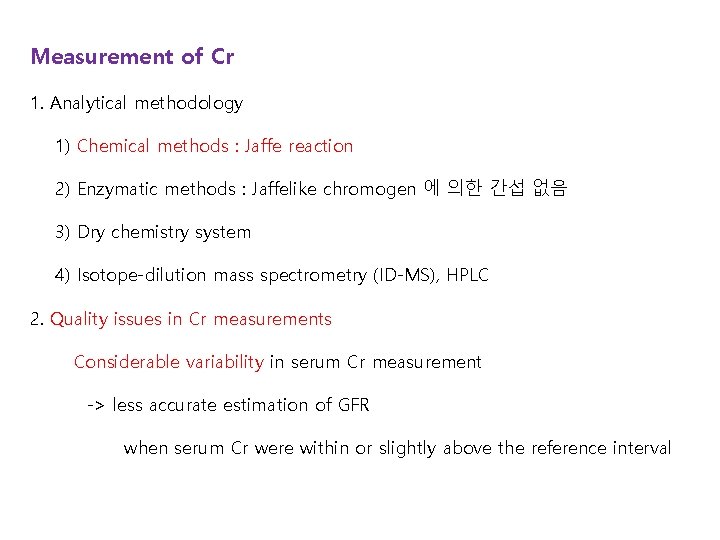
Measurement of Cr 1. Analytical methodology 1) Chemical methods : Jaffe reaction 2) Enzymatic methods : Jaffelike chromogen 에 의한 간섭 없음 3) Dry chemistry system 4) Isotope-dilution mass spectrometry (ID-MS), HPLC 2. Quality issues in Cr measurements Considerable variability in serum Cr measurement -> less accurate estimation of GFR when serum Cr were within or slightly above the reference interval
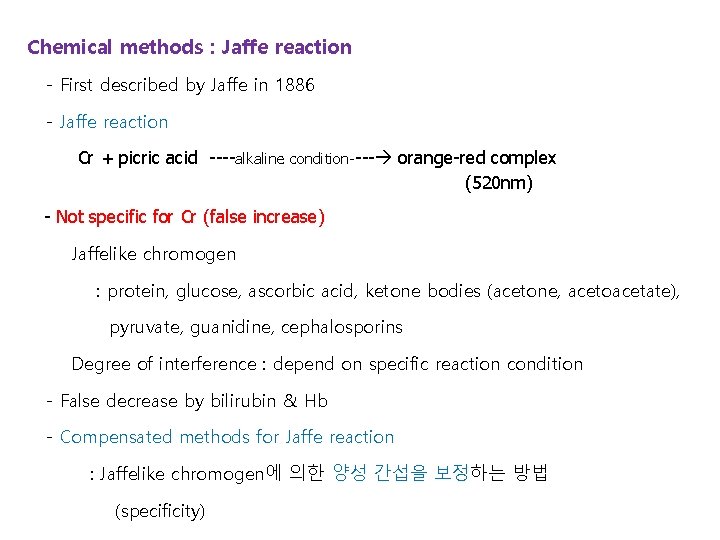
Chemical methods : Jaffe reaction - First described by Jaffe in 1886 - Jaffe reaction Cr + picric acid ----alkaline condition---- orange-red complex (520 nm) - Not specific for Cr (false increase) Jaffelike chromogen : protein, glucose, ascorbic acid, ketone bodies (acetone, acetoacetate), pyruvate, guanidine, cephalosporins Degree of interference : depend on specific reaction condition - False decrease by bilirubin & Hb - Compensated methods for Jaffe reaction : Jaffelike chromogen에 의한 양성 간섭을 보정하는 방법 (specificity)
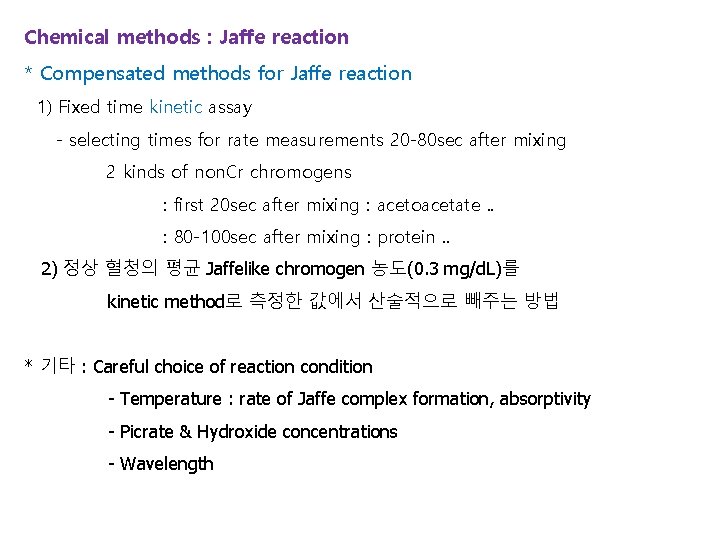
Chemical methods : Jaffe reaction * Compensated methods for Jaffe reaction 1) Fixed time kinetic assay - selecting times for rate measurements 20 -80 sec after mixing 2 kinds of non. Cr chromogens : first 20 sec after mixing : acetoacetate. . : 80 -100 sec after mixing : protein. . 2) 정상 혈청의 평균 Jaffelike chromogen 농도(0. 3 mg/d. L)를 kinetic method로 측정한 값에서 산술적으로 빼주는 방법 * 기타 : Careful choice of reaction condition - Temperature : rate of Jaffe complex formation, absorptivity - Picrate & Hydroxide concentrations - Wavelength
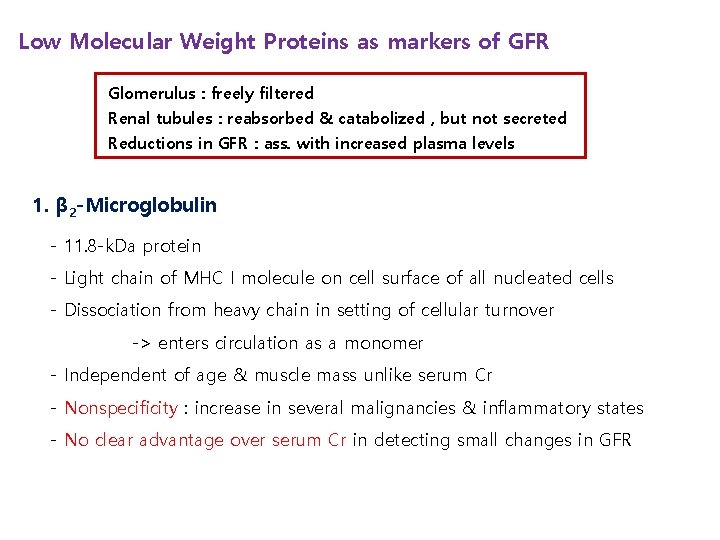
Low Molecular Weight Proteins as markers of GFR Glomerulus : freely filtered Renal tubules : reabsorbed & catabolized , but not secreted Reductions in GFR : ass. with increased plasma levels 1. β 2 -Microglobulin - 11. 8 -k. Da protein - Light chain of MHC I molecule on cell surface of all nucleated cells - Dissociation from heavy chain in setting of cellular turnover -> enters circulation as a monomer - Independent of age & muscle mass unlike serum Cr - Nonspecificity : increase in several malignancies & inflammatory states - No clear advantage over serum Cr in detecting small changes in GFR
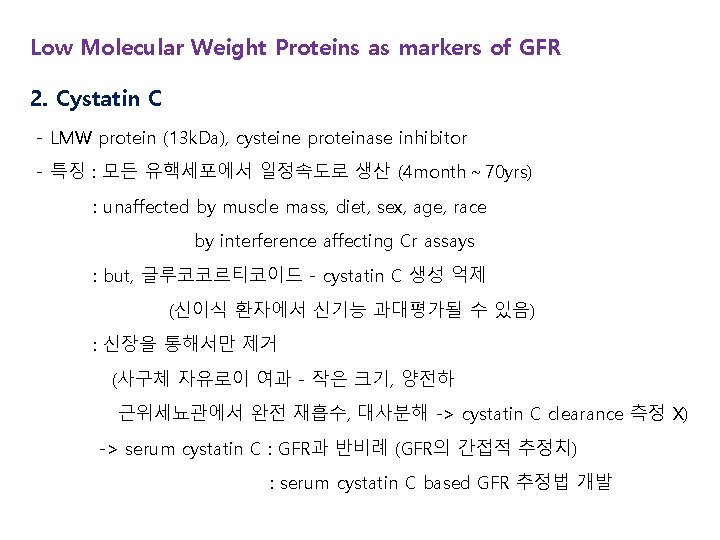
Low Molecular Weight Proteins as markers of GFR 2. Cystatin C - LMW protein (13 k. Da), cysteine proteinase inhibitor - 특징 : 모든 유핵세포에서 일정속도로 생산 (4 month~ 70 yrs) : unaffected by muscle mass, diet, sex, age, race by interference affecting Cr assays : but, 글루코코르티코이드 - cystatin C 생성 억제 (신이식 환자에서 신기능 과대평가될 수 있음) : 신장을 통해서만 제거 (사구체 자유로이 여과 - 작은 크기, 양전하 근위세뇨관에서 완전 재흡수, 대사분해 -> cystatin C clearance 측정 X) -> serum cystatin C : GFR과 반비례 (GFR의 간접적 추정치) : serum cystatin C based GFR 추정법 개발
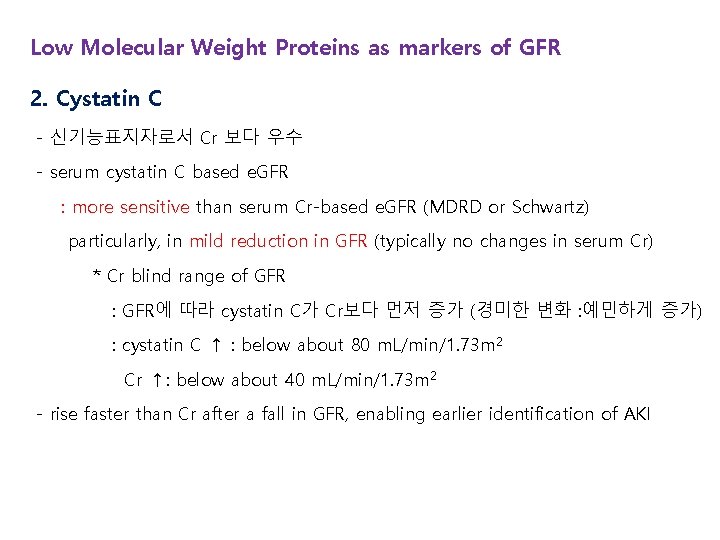
Low Molecular Weight Proteins as markers of GFR 2. Cystatin C - 신기능표지자로서 Cr 보다 우수 - serum cystatin C based e. GFR : more sensitive than serum Cr-based e. GFR (MDRD or Schwartz) particularly, in mild reduction in GFR (typically no changes in serum Cr) * Cr blind range of GFR : GFR에 따라 cystatin C가 Cr보다 먼저 증가 (경미한 변화 : 예민하게 증가) : cystatin C ↑ : below about 80 m. L/min/1. 73 m 2 Cr ↑: below about 40 m. L/min/1. 73 m 2 - rise faster than Cr after a fall in GFR, enabling earlier identification of AKI
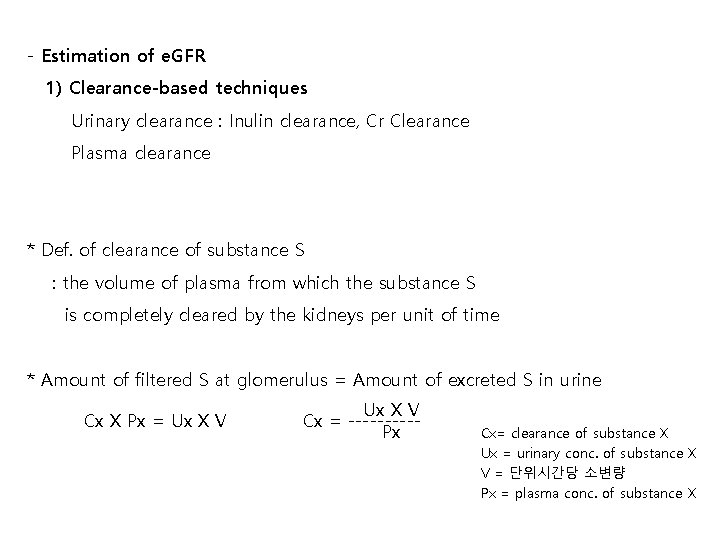
- Estimation of e. GFR 1) Clearance-based techniques Urinary clearance : Inulin clearance, Cr Clearance Plasma clearance * Def. of clearance of substance S : the volume of plasma from which the substance S is completely cleared by the kidneys per unit of time * Amount of filtered S at glomerulus = Amount of excreted S in urine Cx X Px = Ux X V Cx = -----Px Cx= clearance of substance X Ux = urinary conc. of substance X V = 단위시간당 소변량 Px = plasma conc. of substance X
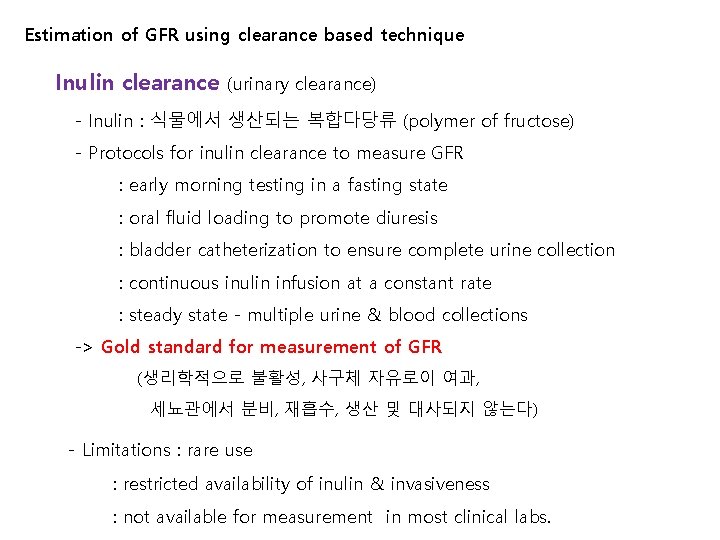
Estimation of GFR using clearance based technique Inulin clearance (urinary clearance) - Inulin : 식물에서 생산되는 복합다당류 (polymer of fructose) - Protocols for inulin clearance to measure GFR : early morning testing in a fasting state : oral fluid loading to promote diuresis : bladder catheterization to ensure complete urine collection : continuous inulin infusion at a constant rate : steady state - multiple urine & blood collections -> Gold standard for measurement of GFR (생리학적으로 불활성, 사구체 자유로이 여과, 세뇨관에서 분비, 재흡수, 생산 및 대사되지 않는다) - Limitations : rare use : restricted availability of inulin & invasiveness : not available for measurement in most clinical labs.
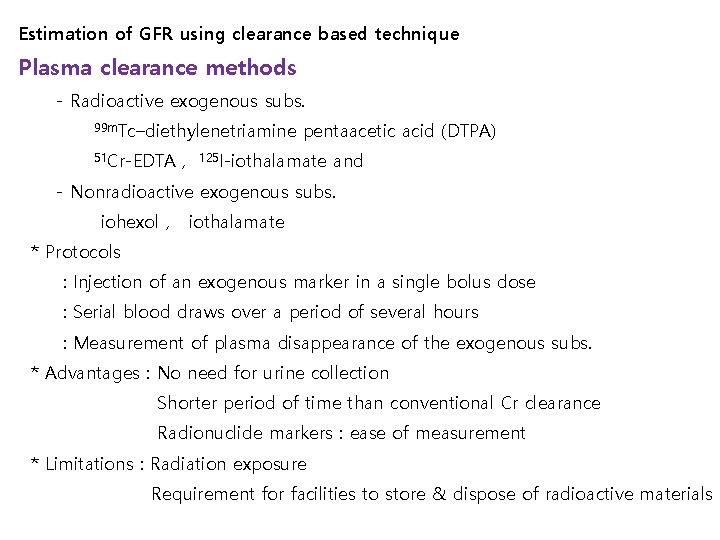
Estimation of GFR using clearance based technique Plasma clearance methods - Radioactive exogenous subs. 99 m. Tc–diethylenetriamine 51 Cr-EDTA , pentaacetic acid (DTPA) 125 I-iothalamate and - Nonradioactive exogenous subs. iohexol , iothalamate * Protocols : Injection of an exogenous marker in a single bolus dose : Serial blood draws over a period of several hours : Measurement of plasma disappearance of the exogenous subs. * Advantages : No need for urine collection Shorter period of time than conventional Cr clearance Radionuclide markers : ease of measurement * Limitations : Radiation exposure Requirement for facilities to store & dispose of radioactive materials
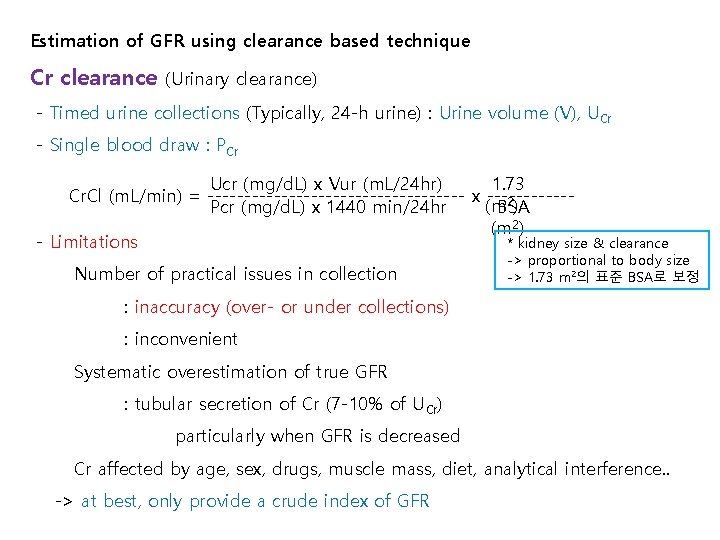
Estimation of GFR using clearance based technique Cr clearance (Urinary clearance) - Timed urine collections (Typically, 24 -h urine) : Urine volume (V), UCr - Single blood draw : PCr Ucr (mg/d. L) x Vur (m. L/24 hr) 1. 73 Cr. Cl (m. L/min) = ------------------ x ------2) (m Pcr (mg/d. L) x 1440 min/24 hr BSA (m 2) - Limitations * kidney size & clearance Number of practical issues in collection -> proportional to body size -> 1. 73 m 2의 표준 BSA로 보정 : inaccuracy (over- or under collections) : inconvenient Systematic overestimation of true GFR : tubular secretion of Cr (7 -10% of UCr) particularly when GFR is decreased Cr affected by age, sex, drugs, muscle mass, diet, analytical interference. . -> at best, only provide a crude index of GFR
- Assessment of e. GFR 2) Estimation of GFR by serum markers : BUN : Cr – 가장 널리 이용 : Low molecular weight proteins β 2 -microglobulin, cystatin C, β-trace protein (BTP)
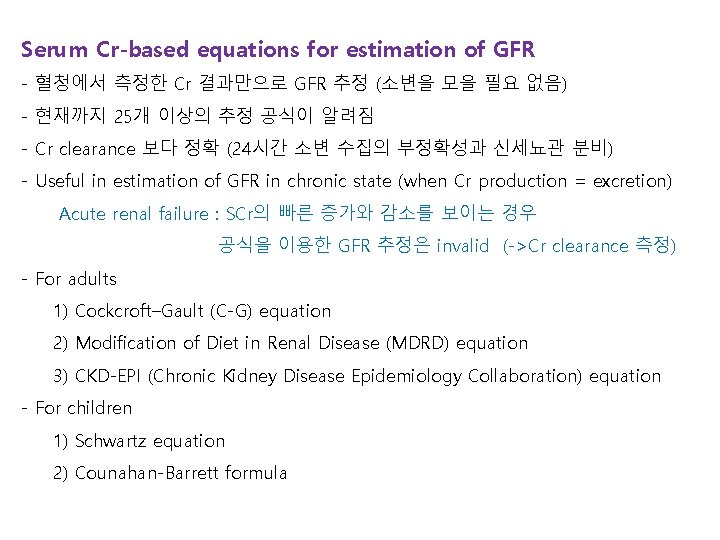
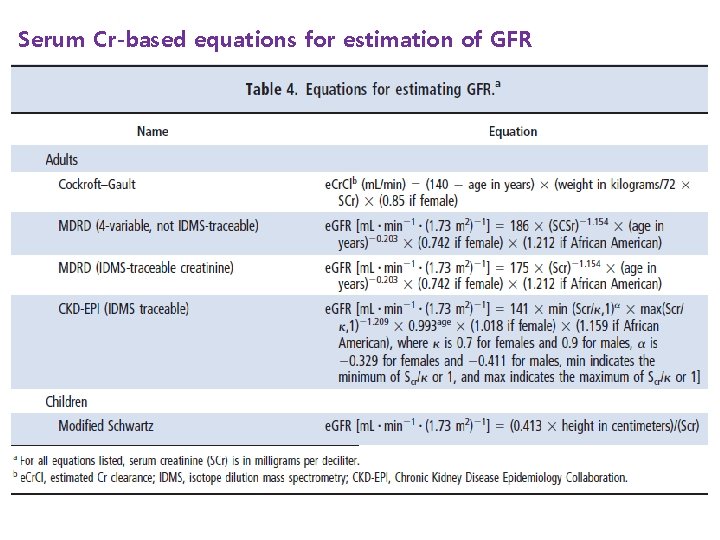
Serum Cr-based equations for estimation of GFR - 혈청에서 측정한 Cr 결과만으로 GFR 추정 (소변을 모을 필요 없음) - 현재까지 25개 이상의 추정 공식이 알려짐 - Cr clearance 보다 정확 (24시간 소변 수집의 부정확성과 신세뇨관 분비) - Useful in estimation of GFR in chronic state (when Cr production = excretion) Acute renal failure : SCr의 빠른 증가와 감소를 보이는 경우 공식을 이용한 GFR 추정은 invalid (->Cr clearance 측정) - For adults 1) Cockcroft–Gault (C-G) equation 2) Modification of Diet in Renal Disease (MDRD) equation 3) CKD-EPI (Chronic Kidney Disease Epidemiology Collaboration) equation - For children 1) Schwartz equation 2) Counahan-Barrett formula
Serum Cr-based equations for estimation of GFR
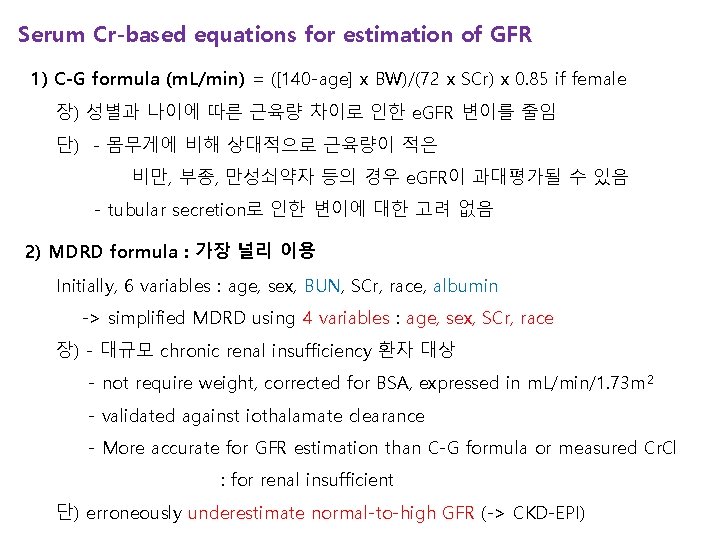
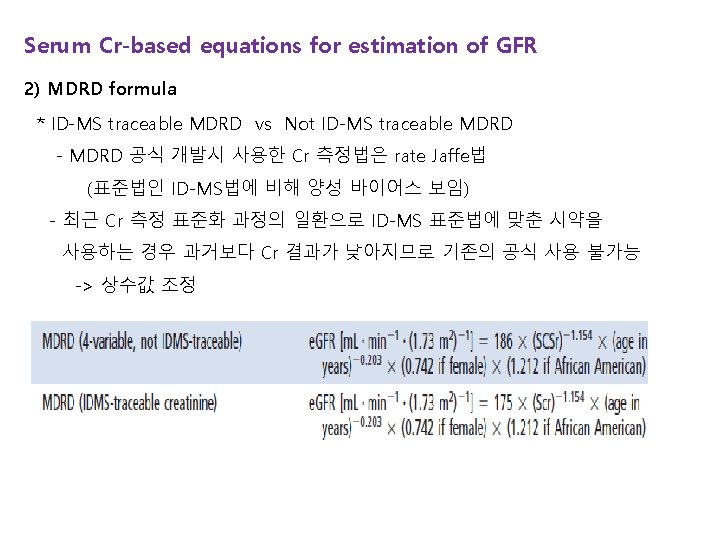
Serum Cr-based equations for estimation of GFR 1) C-G formula (m. L/min) = ([140 -age] x BW)/(72 x SCr) x 0. 85 if female 장) 성별과 나이에 따른 근육량 차이로 인한 e. GFR 변이를 줄임 단) - 몸무게에 비해 상대적으로 근육량이 적은 비만, 부종, 만성쇠약자 등의 경우 e. GFR이 과대평가될 수 있음 - tubular secretion로 인한 변이에 대한 고려 없음 2) MDRD formula : 가장 널리 이용 Initially, 6 variables : age, sex, BUN, SCr, race, albumin -> simplified MDRD using 4 variables : age, sex, SCr, race 장) - 대규모 chronic renal insufficiency 환자 대상 - not require weight, corrected for BSA, expressed in m. L/min/1. 73 m 2 - validated against iothalamate clearance - More accurate for GFR estimation than C-G formula or measured Cr. Cl : for renal insufficient 단) erroneously underestimate normal-to-high GFR (-> CKD-EPI)
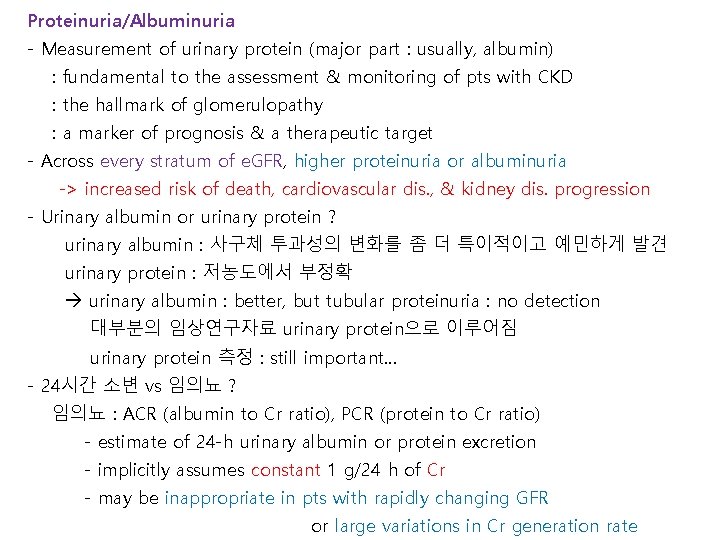
Proteinuria/Albuminuria - Measurement of urinary protein (major part : usually, albumin) : fundamental to the assessment & monitoring of pts with CKD : the hallmark of glomerulopathy : a marker of prognosis & a therapeutic target - Across every stratum of e. GFR, higher proteinuria or albuminuria -> increased risk of death, cardiovascular dis. , & kidney dis. progression - Urinary albumin or urinary protein ? urinary albumin : 사구체 투과성의 변화를 좀 더 특이적이고 예민하게 발견 urinary protein : 저농도에서 부정확 urinary albumin : better, but tubular proteinuria : no detection 대부분의 임상연구자료 urinary protein으로 이루어짐 urinary protein 측정 : still important… - 24시간 소변 vs 임의뇨 ? 임의뇨 : ACR (albumin to Cr ratio), PCR (protein to Cr ratio) - estimate of 24 -h urinary albumin or protein excretion - implicitly assumes constant 1 g/24 h of Cr - may be inappropriate in pts with rapidly changing GFR or large variations in Cr generation rate
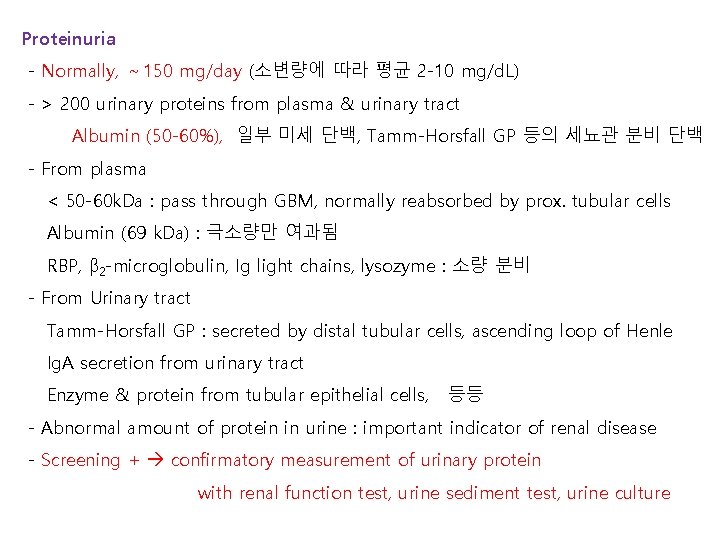
Proteinuria - Normally, ~ 150 mg/day (소변량에 따라 평균 2 -10 mg/d. L) - > 200 urinary proteins from plasma & urinary tract Albumin (50 -60%), 일부 미세 단백, Tamm-Horsfall GP 등의 세뇨관 분비 단백 - From plasma < 50 -60 k. Da : pass through GBM, normally reabsorbed by prox. tubular cells Albumin (69 k. Da) : 극소량만 여과됨 RBP, β 2 -microglobulin, Ig light chains, lysozyme : 소량 분비 - From Urinary tract Tamm-Horsfall GP : secreted by distal tubular cells, ascending loop of Henle Ig. A secretion from urinary tract Enzyme & protein from tubular epithelial cells, 등등 - Abnormal amount of protein in urine : important indicator of renal disease - Screening + confirmatory measurement of urinary protein with renal function test, urine sediment test, urine culture
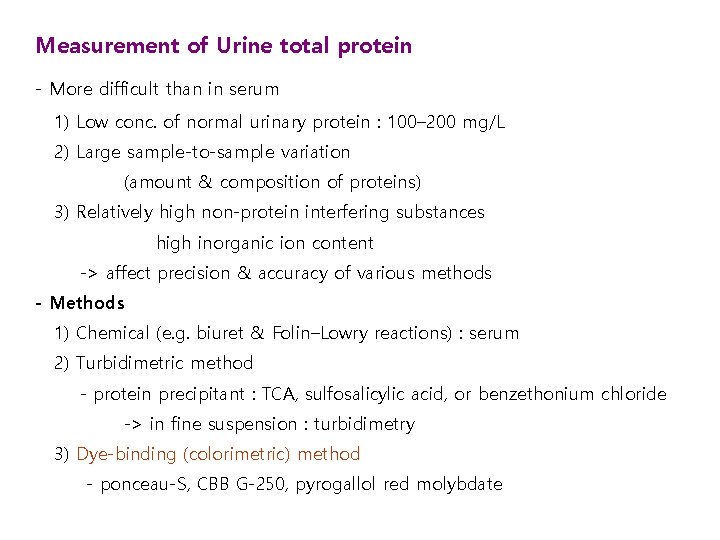
Measurement of Urine total protein - More difficult than in serum 1) Low conc. of normal urinary protein : 100– 200 mg/L 2) Large sample-to-sample variation (amount & composition of proteins) 3) Relatively high non-protein interfering substances high inorganic ion content -> affect precision & accuracy of various methods - Methods 1) Chemical (e. g. biuret & Folin–Lowry reactions) : serum 2) Turbidimetric method - protein precipitant : TCA, sulfosalicylic acid, or benzethonium chloride -> in fine suspension : turbidimetry 3) Dye-binding (colorimetric) method - ponceau-S, CBB G-250, pyrogallol red molybdate
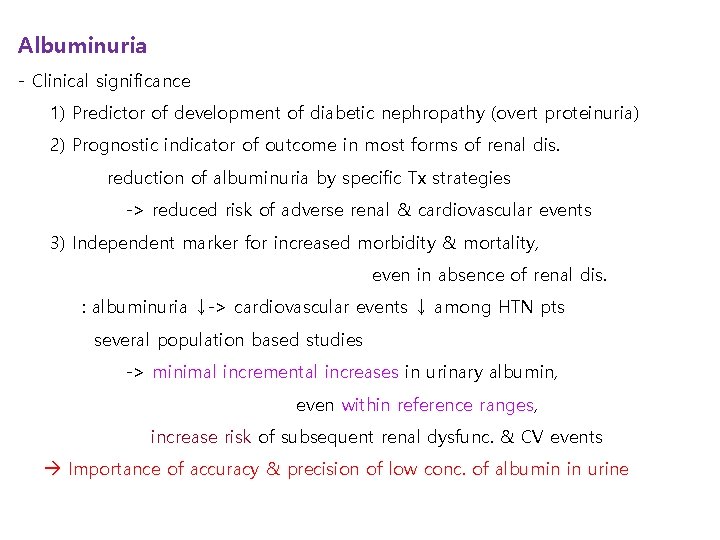
Albuminuria - Clinical significance 1) Predictor of development of diabetic nephropathy (overt proteinuria) 2) Prognostic indicator of outcome in most forms of renal dis. reduction of albuminuria by specific Tx strategies -> reduced risk of adverse renal & cardiovascular events 3) Independent marker for increased morbidity & mortality, even in absence of renal dis. : albuminuria ↓-> cardiovascular events ↓ among HTN pts several population based studies -> minimal incremental increases in urinary albumin, even within reference ranges, increase risk of subsequent renal dysfunc. & CV events Importance of accuracy & precision of low conc. of albumin in urine
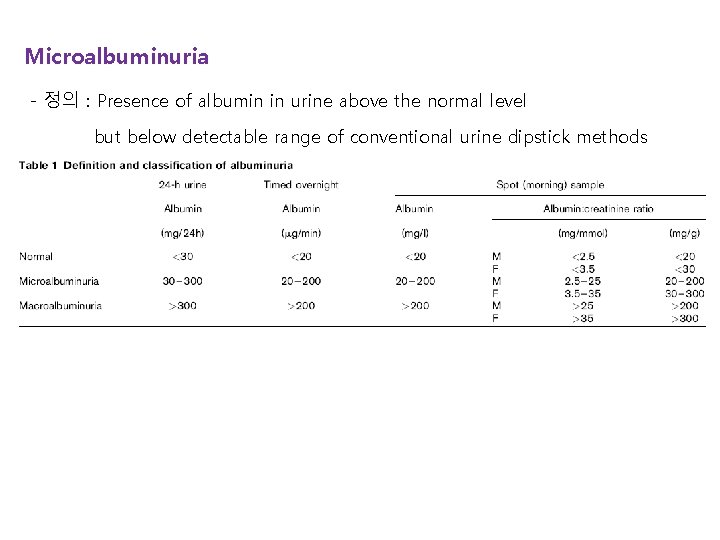
Microalbuminuria - 정의 : Presence of albumin in urine above the normal level but below detectable range of conventional urine dipstick methods
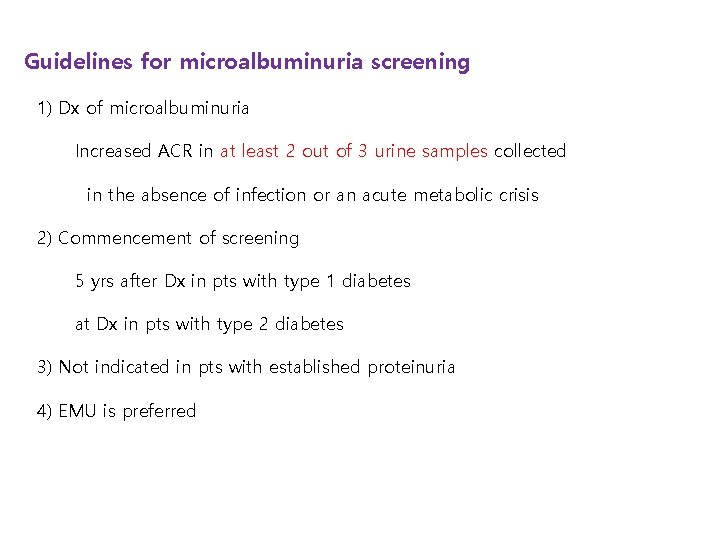
Guidelines for microalbuminuria screening 1) Dx of microalbuminuria Increased ACR in at least 2 out of 3 urine samples collected in the absence of infection or an acute metabolic crisis 2) Commencement of screening 5 yrs after Dx in pts with type 1 diabetes at Dx in pts with type 2 diabetes 3) Not indicated in pts with established proteinuria 4) EMU is preferred
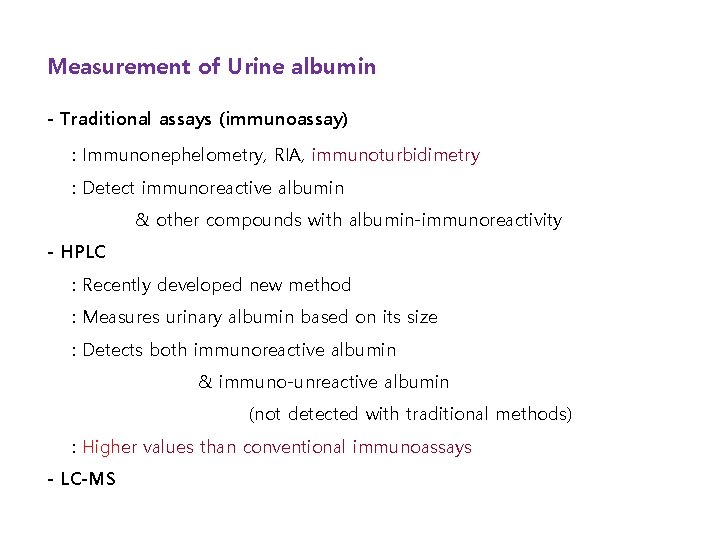
Measurement of Urine albumin - Traditional assays (immunoassay) : Immunonephelometry, RIA, immunoturbidimetry : Detect immunoreactive albumin & other compounds with albumin-immunoreactivity - HPLC : Recently developed new method : Measures urinary albumin based on its size : Detects both immunoreactive albumin & immuno-unreactive albumin (not detected with traditional methods) : Higher values than conventional immunoassays - LC-MS
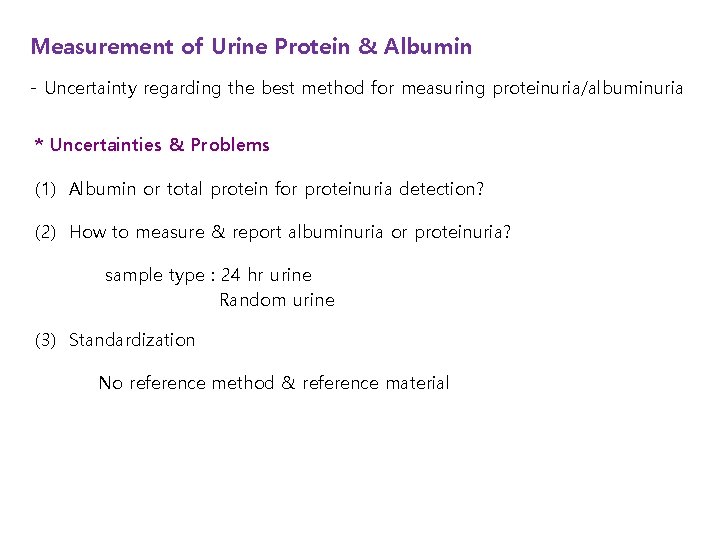
Measurement of Urine Protein & Albumin - Uncertainty regarding the best method for measuring proteinuria/albuminuria * Uncertainties & Problems (1) Albumin or total protein for proteinuria detection? (2) How to measure & report albuminuria or proteinuria? sample type : 24 hr urine Random urine (3) Standardization No reference method & reference material
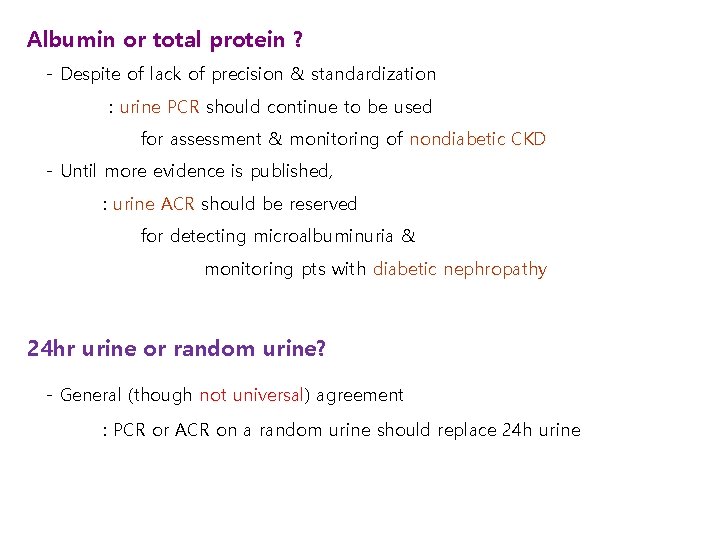
Albumin or total protein ? - Despite of lack of precision & standardization : urine PCR should continue to be used for assessment & monitoring of nondiabetic CKD - Until more evidence is published, : urine ACR should be reserved for detecting microalbuminuria & monitoring pts with diabetic nephropathy 24 hr urine or random urine? - General (though not universal) agreement : PCR or ACR on a random urine should replace 24 h urine
* 24 hr urine collection : Diurnal variation in protein excretion rate -> gold standard : Inconvenience & inaccuracy in urine collection : Not generally necessary except in select circumstances need for precise determination of albumin or protein excretion rate in longitudinal care of pts with glomerular dis. heavy proteinuria in whom clinical decision-making may be influenced
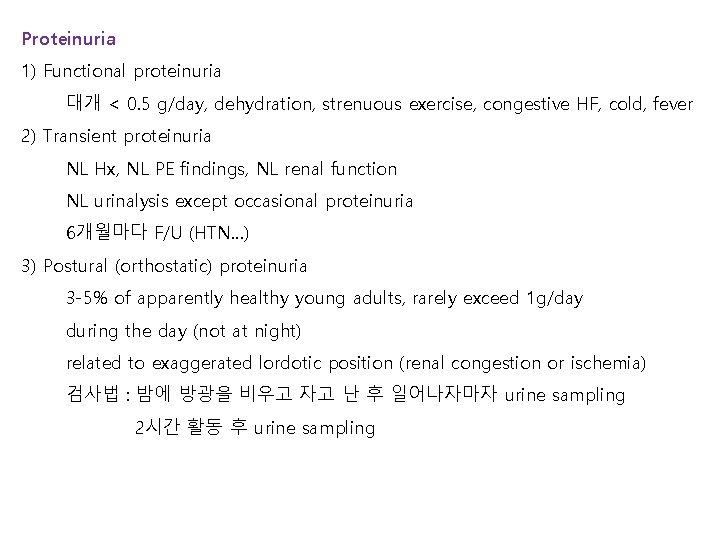
Proteinuria 1) Functional proteinuria 대개 < 0. 5 g/day, dehydration, strenuous exercise, congestive HF, cold, fever 2) Transient proteinuria NL Hx, NL PE findings, NL renal function NL urinalysis except occasional proteinuria 6개월마다 F/U (HTN…) 3) Postural (orthostatic) proteinuria 3 -5% of apparently healthy young adults, rarely exceed 1 g/day during the day (not at night) related to exaggerated lordotic position (renal congestion or ischemia) 검사법 : 밤에 방광을 비우고 자고 난 후 일어나자마자 urine sampling 2시간 활동 후 urine sampling
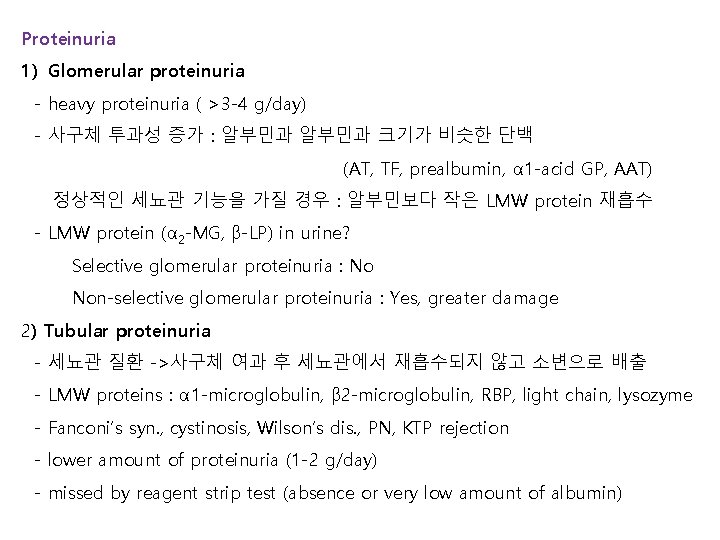
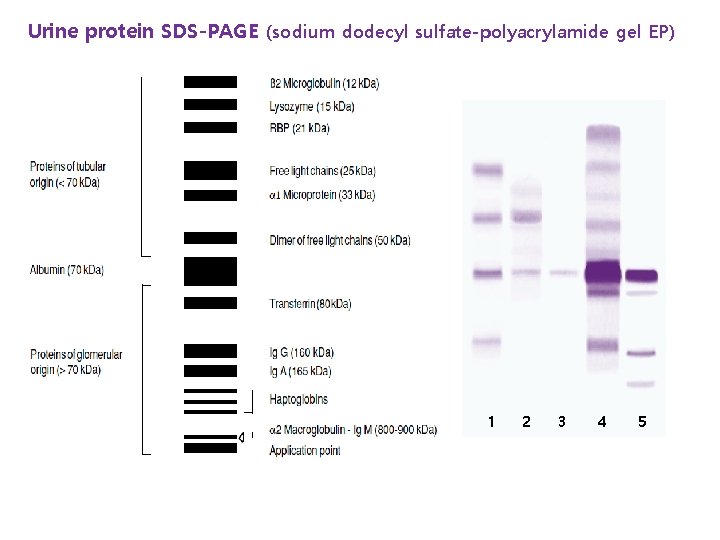
Proteinuria 1) Glomerular proteinuria - heavy proteinuria ( >3 -4 g/day) - 사구체 투과성 증가 : 알부민과 크기가 비슷한 단백 (AT, TF, prealbumin, α 1 -acid GP, AAT) 정상적인 세뇨관 기능을 가질 경우 : 알부민보다 작은 LMW protein 재흡수 - LMW protein (α 2 -MG, β-LP) in urine? Selective glomerular proteinuria : No Non-selective glomerular proteinuria : Yes, greater damage 2) Tubular proteinuria - 세뇨관 질환 ->사구체 여과 후 세뇨관에서 재흡수되지 않고 소변으로 배출 - LMW proteins : α 1 -microglobulin, β 2 -microglobulin, RBP, light chain, lysozyme - Fanconi’s syn. , cystinosis, Wilson’s dis. , PN, KTP rejection - lower amount of proteinuria (1 -2 g/day) - missed by reagent strip test (absence or very low amount of albumin)
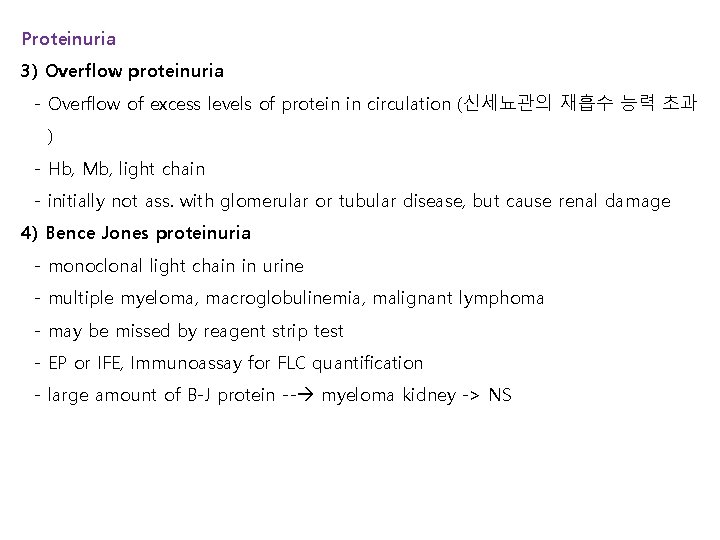
Proteinuria 3) Overflow proteinuria - Overflow of excess levels of protein in circulation (신세뇨관의 재흡수 능력 초과 ) - Hb, Mb, light chain - initially not ass. with glomerular or tubular disease, but cause renal damage 4) Bence Jones proteinuria - monoclonal light chain in urine - multiple myeloma, macroglobulinemia, malignant lymphoma - may be missed by reagent strip test - EP or IFE, Immunoassay for FLC quantification - large amount of B-J protein -- myeloma kidney -> NS
Urine protein SDS-PAGE (sodium dodecyl sulfate-polyacrylamide gel EP) 1 2 3 4 5
Hematuria, Hemoglobinuria, & Myoglobinuria : common uncommon rare : dark red to brown urine, reagent strip 요잠혈 +, 요침사 some RBC 1) Hematuria - ab. NL number of RBC in urine - asymptomatic microscopic hematuria - When? neoplastic & nonneoplastic dis. & trauma (including calculi) in kidney & urinary tract bleeding disorder & anticoagulant uses use of drug such as cyclophosphamide 심한 운동을 한 정상인(마라톤선수) - tendency of RBC to undergo lysis in urine (esp, alkaline p. H or SG < 1. 010) : reagent strip - useful adjunct to microscopic exam. more sensitive than microscopic exam. but, interfering substance (commonly, ascorbic acid) hematuria 발견위해 routine microscopic exam. 필요 - NL urinary sediment / reagent strip + Fresh urine exam
Hematuria, Hemoglobinuria, & Myoglobinuria 2) Hemoglobinuria - Hemolysis -> Hb : binding to plasma haptoglobin -> saturated -> free Hb : pass through glomerulus (MW 32 k. Da) -> reabsorption by proximal tubular cells (Hb -> ferritin & hemosiderin) excretion of remaining Hb (hemoglobinuria) - Pink plasma (at 50 mg/d. L level) - acquired hemolytic anemia > hereditary hemolytic anemia 참고) hemosiderinuria : chronic hemolytic state
Hematuria, Hemoglobinuria, & Myoglobinuria 3) Myoglobinuria - destruction of muscle fiber -> Mb release -> rapid clearance from blood (MW 17 k. Da) -> urine excretion (red-brown pigment) - rhabdomyolysis, trauma, strenuous exercise dermatomyositis… - Dx of Rhabdomyolysis & Myoglobinuria muscle tenderness or cramp red-brown urine within a day or two after exertion reagent strip 잠혈반응 : strong positive 요침사검사 : a few RBC clear serum markedly elevated CK, elevated aldolase Normal haptoglobin 회복양상 – 소변 2 -3일 내에 clearing, CK 감소
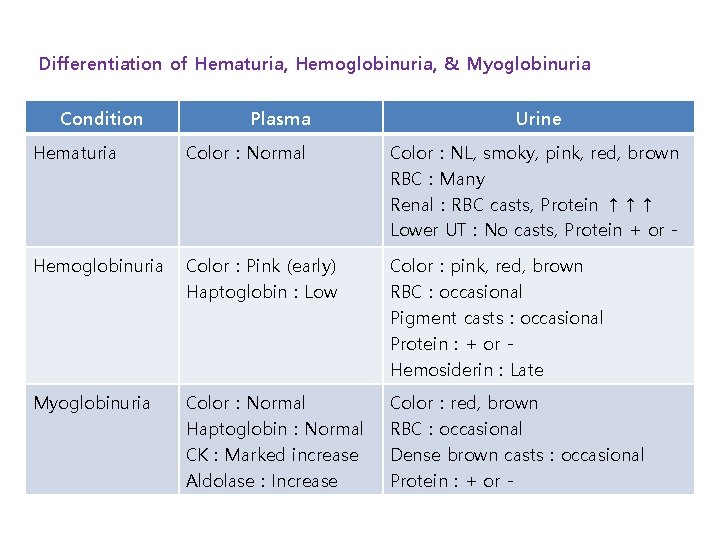
Differentiation of Hematuria, Hemoglobinuria, & Myoglobinuria Condition Plasma Urine Hematuria Color : Normal Color : NL, smoky, pink, red, brown RBC : Many Renal : RBC casts, Protein ↑↑↑ Lower UT : No casts, Protein + or - Hemoglobinuria Color : Pink (early) Haptoglobin : Low Color : pink, red, brown RBC : occasional Pigment casts : occasional Protein : + or Hemosiderin : Late Myoglobinuria Color : Normal Haptoglobin : Normal CK : Marked increase Aldolase : Increase Color : red, brown RBC : occasional Dense brown casts : occasional Protein : + or -