
KHRUSHCHEVS BRINKSMANSHIP The Danger Years 1957 1962 Housekeeping
KHRUSHCHEV’S BRINKSMANSHIP The Danger Years 1957 -1962
Housekeeping QUIZ: 20 Questions, 60 Minutes THURSDAY, October 31 at 12: 00 until TUESDAY, November 4 at 18: 00 TOPICS FOR PAPER. BY EMAIL. TODAY
TODAY REVIEW: KHRUSHCHEV AND EISENHOWER STRATEGIES AND THE BALANCE THE SPUTNIK LAUNCH AND ITS IMPACTS THE TAIWAN STRAITS CRISIS OF 1958 THE FIRST BERLIN ULTIMATUM THE SPIRIT OF CAMP DAVID THE U-2 AFFAIR THE SECOND BERLIN ULTIMATUM THE WALL THE CUBAN MISSILE CRISIS THE SOLUTION THE AFTERMATH NUCLEAR
REVIEW The Eisenhower Strategy for the Nuclear Age The New Look, or Massive Retaliation; Korea, Taiwan Khrushchev’s Strategy Nuclear Stalemate, Peaceful Coexistence, Victory from Below, The Suez Crisis The Nuclear Balance of Power in January, 1957 The Political Positions of Khrushchev and Eisenhower
SPUTNIK What was it? Military Impact: Very Big, But US still more powerful The ability to reach the United States with nuclear weapons Still very limited: Liquid, unstable fuel Khrushchev exaggerates the number and effectiveness of missiles Psychological Impact on US—HUGE Blow to US notions of superiority, invulnerability—like 9/11 Gives rise to the “missile gap” Eisenhower has better sense of truth—U-2 flights Impact on China: Thrilled, suggests to push further Taiwan Straits
The First Berlin Ultimatum: Khrushchev’s Strategy at work KHRUSHCHEV GETS IMPATIENT Soviet Union economy growing, but not as fast as he promised Missile infrastructure is expensive, would like to cut conventional weapons Resistance from military command Pressure also from China The Problem of Germany remains undecided legacy of World War II No peace treaty NATO countries don’t recognize East Germany as sovereign state: The “so-called DDR”
The Particular Problem of Berlin A Challenge to East German Sovereignty East Berlin acts as East German capital Legally under Four-Power Rule I n the middle of East German state Huge outflow of educated, ambitious people At the same time, “the blister on the heel” of NATO
The Ultimatum November, 1958: Soviets argue Western allies have broken Potsdam Agreement A solution must be found in six months If not, USSR would negotiate treaty with East Germanuy East Berlin becomes part of East Germany, West must negotiate with East Germany for access to W. Berlin The Impact Negotiations open, but nothing decided Eisenhower agrees situation in Berlin is “abnormal” Eisenhower invites Khrushchev to the United States Khrushchev declares victory, rescinds ultimatuam
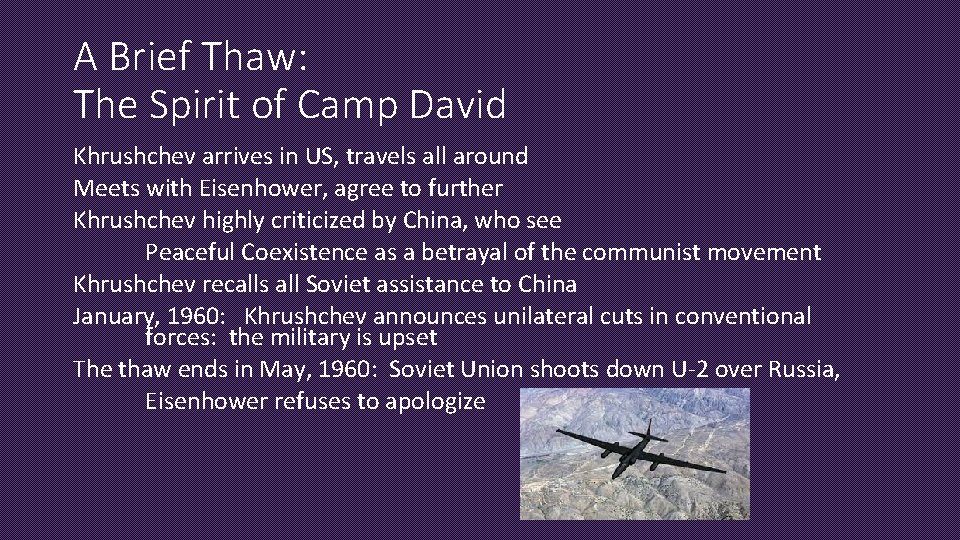
A Brief Thaw: The Spirit of Camp David Khrushchev arrives in US, travels all around Meets with Eisenhower, agree to further Khrushchev highly criticized by China, who see Peaceful Coexistence as a betrayal of the communist movement Khrushchev recalls all Soviet assistance to China January, 1960: Khrushchev announces unilateral cuts in conventional forces: the military is upset The thaw ends in May, 1960: Soviet Union shoots down U-2 over Russia, Eisenhower refuses to apologize
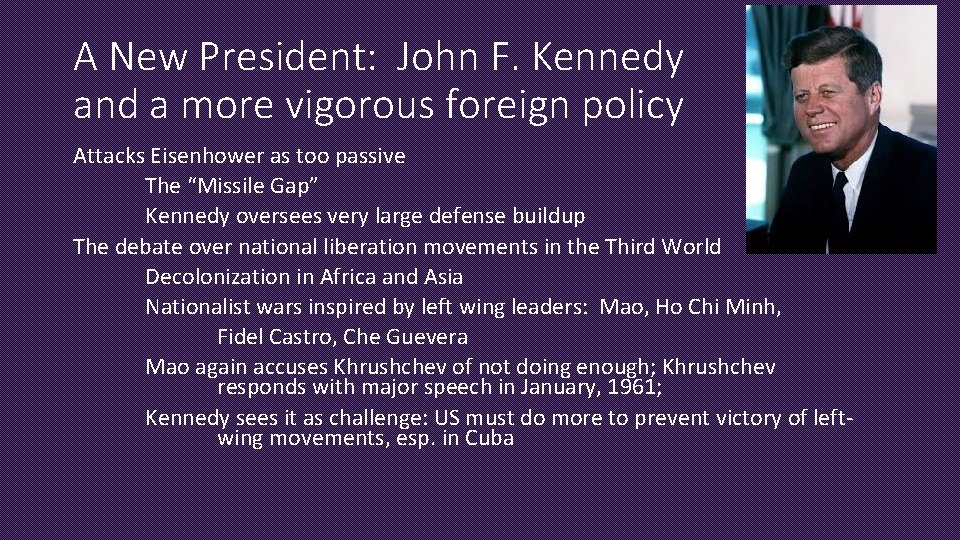
A New President: John F. Kennedy and a more vigorous foreign policy Attacks Eisenhower as too passive The “Missile Gap” Kennedy oversees very large defense buildup The debate over national liberation movements in the Third World Decolonization in Africa and Asia Nationalist wars inspired by left wing leaders: Mao, Ho Chi Minh, Fidel Castro, Che Guevera Mao again accuses Khrushchev of not doing enough; Khrushchev responds with major speech in January, 1961; Kennedy sees it as challenge: US must do more to prevent victory of leftwing movements, esp. in Cuba
Khrushchev’s Issues in 1961 -1962 His claims that he had forced US to negotiating table discredited by U-2 His claims of Soviet nuclear superiority exposed By 1962, US had about 300 SLBMs and ICBMS, as well as missiles Turkey and elsewhere In 1961, USSR had about four missiles; by 1962 less than 75 New satellite surveillance technology makes Khrushchev lie public Berlin: Emigration from East Germany even worse Cuba: Castro’s alliance with USSR very important to Khrushchev Shows USSR’s revolutionary credentials as opposed to China But Cuba also threatened: Bay of Pigs in April, 1961 Operation Mongoose: Plans to overthrow Castro in
The Second Berlin Ultimatum Vienna Summit: Kennedy-Khrushchev June 4, 1961 Khrushchev renews threat to negotiate separate peace treaty with East Germany Kennedy announces additional troops Migration gets worse Creation of Berlin Wall—August 12 -13, 1961 The Stand-Off in Berlin
The Decision to Put Missiles in Cuba Khrushchev 1. Wants to improve economy: diminish defense spending 2. Wants to reset balance of power NATO Missiles in Turkey (JFK thinks they are useless) 3. Wants to safeguard Cuba (real threats from US) 4. Pressure from military and others to build up weapons If he does it publicly, probably not a problem
The Crisis Unfolds The United States discovers Soviet missiles in Cuba (just before elections) The Executive Committee in the US meets (Ex. Comm) Initial discussion favors attack, but that turns The decision to blockade: provides time, puts burden of decision on USSR US doesn’t realize missiles already on Cuba https: //www. youtube. com/watch? v=XV 1 Zmv. Awr. BE The Standoff Communication: Letters and a back channel, very inefficient Bureaucratic and other mishaps: US flights over Siberia, US airplane and U-2 shot down Still not completely clear who had control over tactical nukes in Cuba
The Day of Decision • October 26: Castro writes Khrushchev a letter suggesting USSR use nuclear weapons if US invades, Khrushchev later says no • October 26: Soviet intelligence suggests an invasion is likely; Khrushchev writes a private letter suggesting he would remove missiles if US promises not to attack Cuba • October 27: Khrushchev writes another, public message also demanding NATO missiles in Turkey be removed. • October 27: SAM shoots down U-2. US thinks Kremlin ordered it
The Transcripts Kennedy makes the decisions He doesn’t talk much about domestic politics here He is concerned that it is the Western Hemisphere He is very concerned about US credibility with NATO, Turkey He is very concerned about world opinion He is less concerned than others about looking weak He is very concerned about looking for time, for more options He is more willing than the others to make a trade on Turkey’s missiles
The Decision: Kennedy makes a pledge that the United States will not attack Cuba The USSR takes out its missiles, allows verification SECRETLY: Robert Kennedy makes a deal with Soviet ambassador that US will remove missiles from Turkey within the year RAMIFICATIONS OF THIS SECRET DEAL: Khrushchev is highly criticized by China, and privately in USSR Kennedy becomes popular It increases US mythology in bargaining from strength LESSONS: Leaders don’t want to go to war Can’t control outcomes Soviets learn they need more nukes
- Slides: 17