
Keystroke Recognition using Wi Fi Signals Kamran Ali

- Slides: 20
Keystroke Recognition using Wi. Fi Signals Kamran Ali Dept. of Computer Science & Engineering Michigan State University Alex Liu Wei Wang Muhammad Shahzad
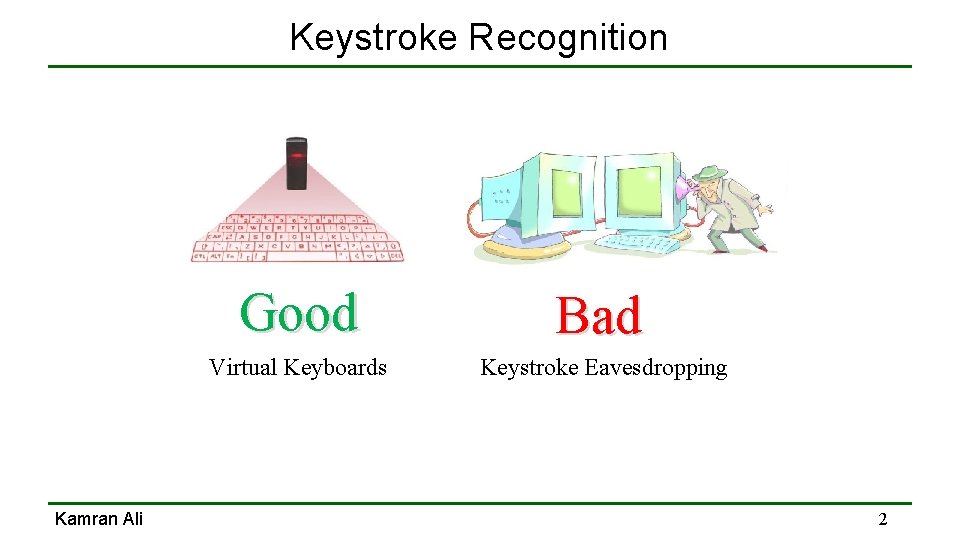
Keystroke Recognition Kamran Ali Good Bad Virtual Keyboards Keystroke Eavesdropping 2
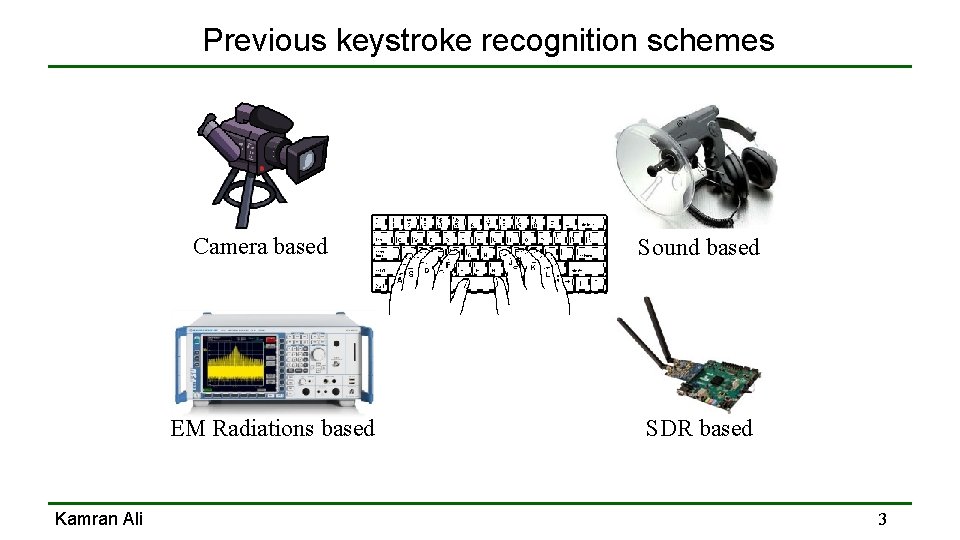
Previous keystroke recognition schemes Camera based EM Radiations based Kamran Ali Sound based SDR based 3
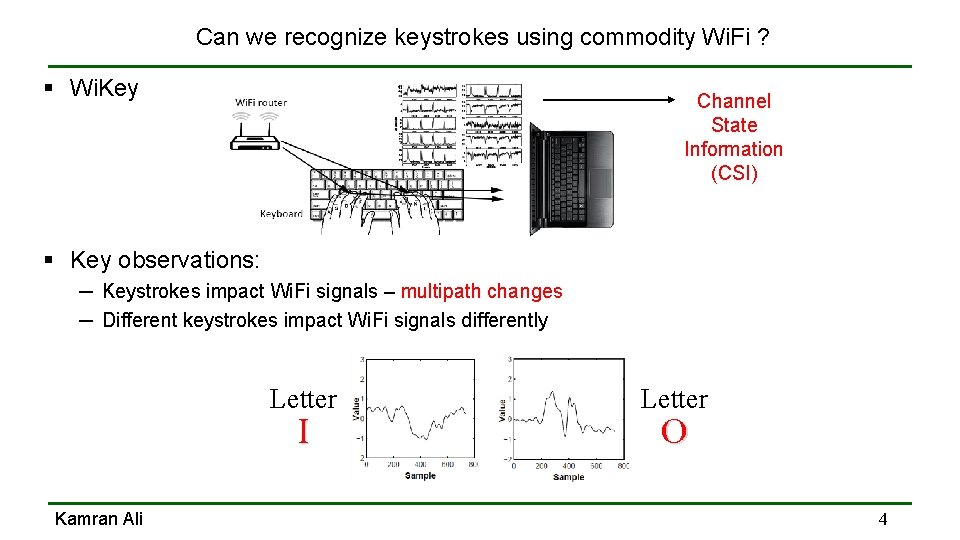
Can we recognize keystrokes using commodity Wi. Fi ? § Wi. Key Channel State Information (CSI) § Key observations: ─ Keystrokes impact Wi. Fi signals – multipath changes ─ Different keystrokes impact Wi. Fi signals differently Letter I Kamran Ali Letter O 4
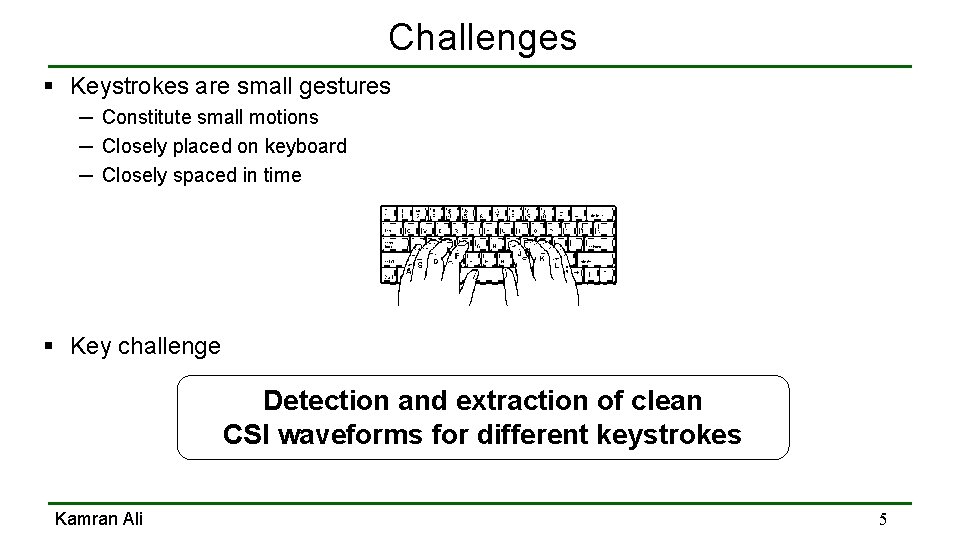
Challenges § Keystrokes are small gestures ─ Constitute small motions ─ Closely placed on keyboard ─ Closely spaced in time § Key challenge Detection and extraction of clean CSI waveforms for different keystrokes Kamran Ali 5
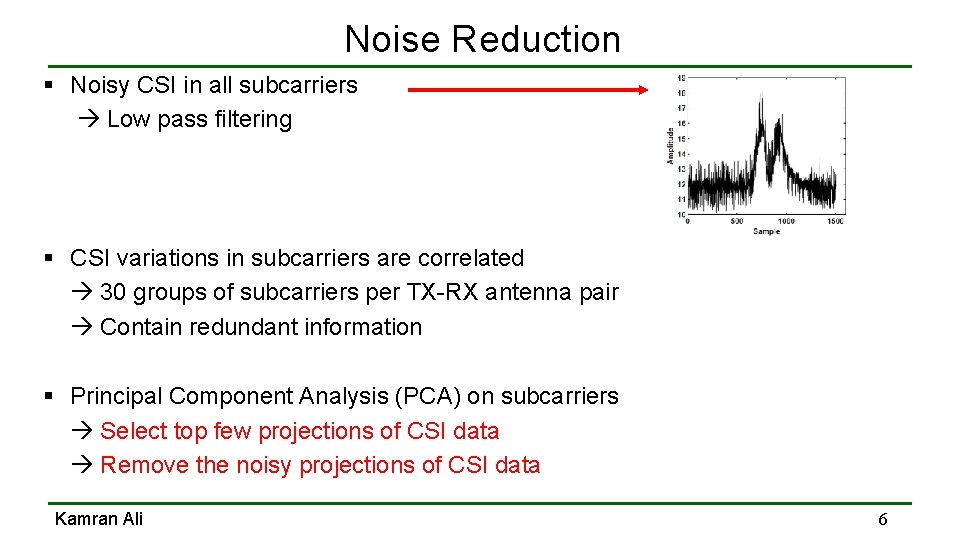
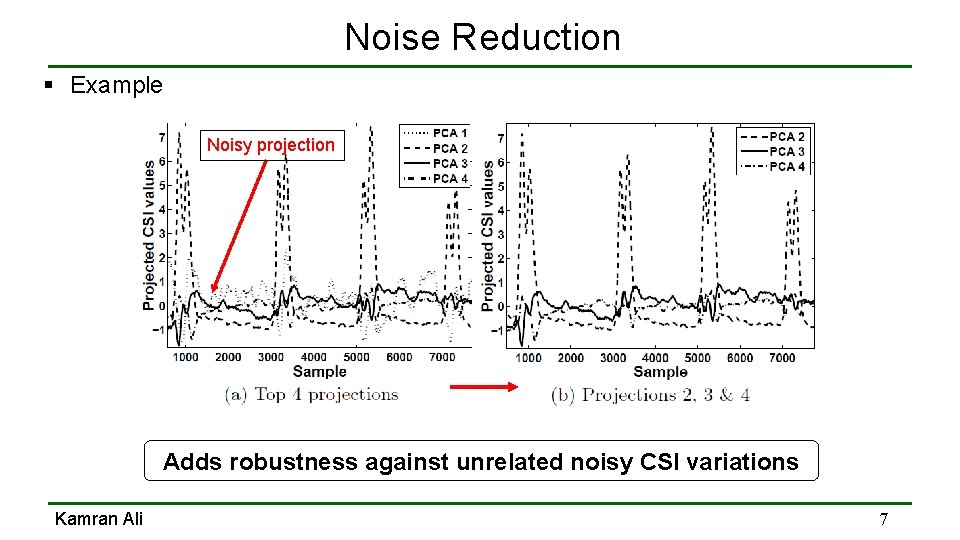
Noise Reduction § Noisy CSI in all subcarriers Low pass filtering § CSI variations in subcarriers are correlated 30 groups of subcarriers per TX-RX antenna pair Contain redundant information § Principal Component Analysis (PCA) on subcarriers Select top few projections of CSI data Remove the noisy projections of CSI data Kamran Ali 6
Noise Reduction § Example Noisy projection Adds robustness against unrelated noisy CSI variations Kamran Ali 7
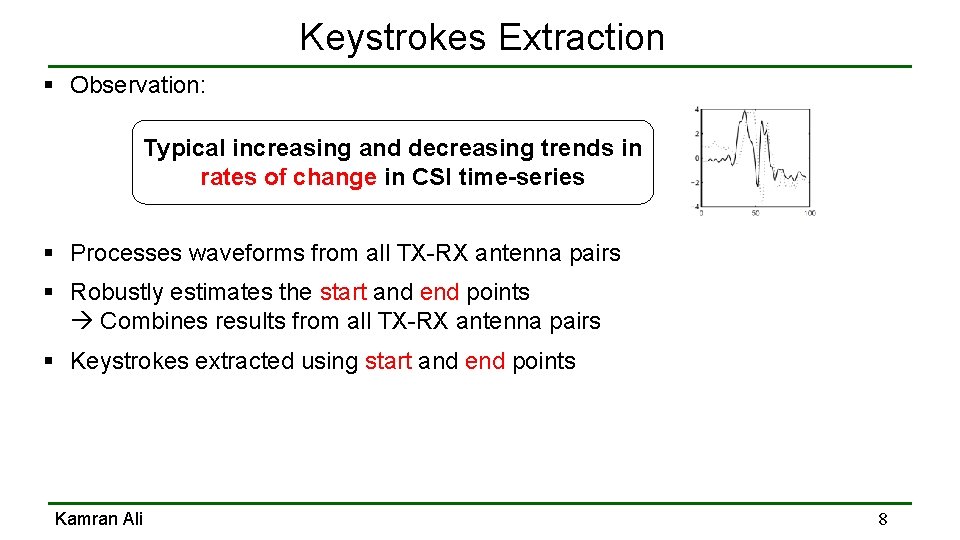
Keystrokes Extraction § Observation: Typical increasing and decreasing trends in rates of change in CSI time-series § Processes waveforms from all TX-RX antenna pairs § Robustly estimates the start and end points Combines results from all TX-RX antenna pairs § Keystrokes extracted using start and end points Kamran Ali 8
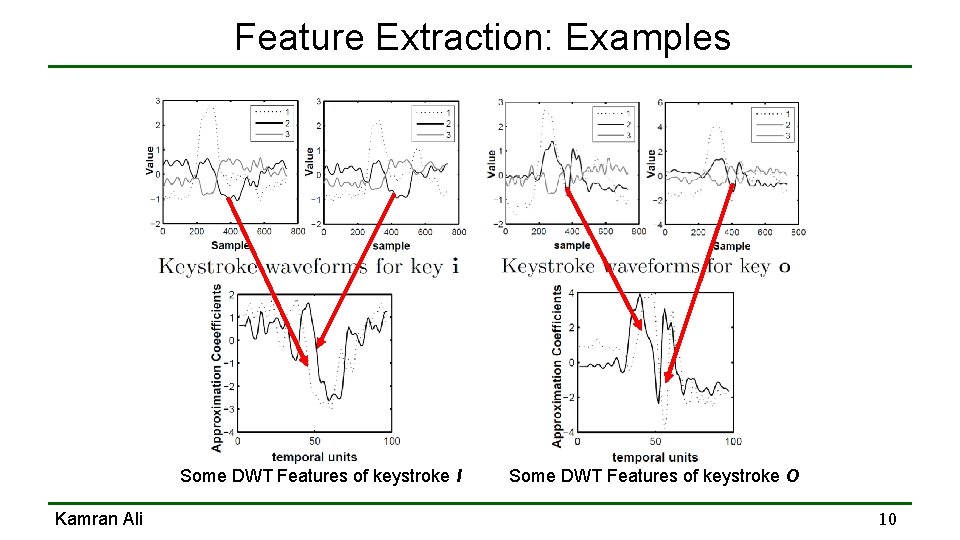
Feature Extraction § Shapes of keystroke waveforms used as features § Discrete Wavelet Transform ─ Compressed shape features from CSI waveforms ─ Applied 3 times consecutively to reduce computational complexity Kamran Ali 9
Feature Extraction: Examples Some DWT Features of keystroke I Kamran Ali Some DWT Features of keystroke O 10
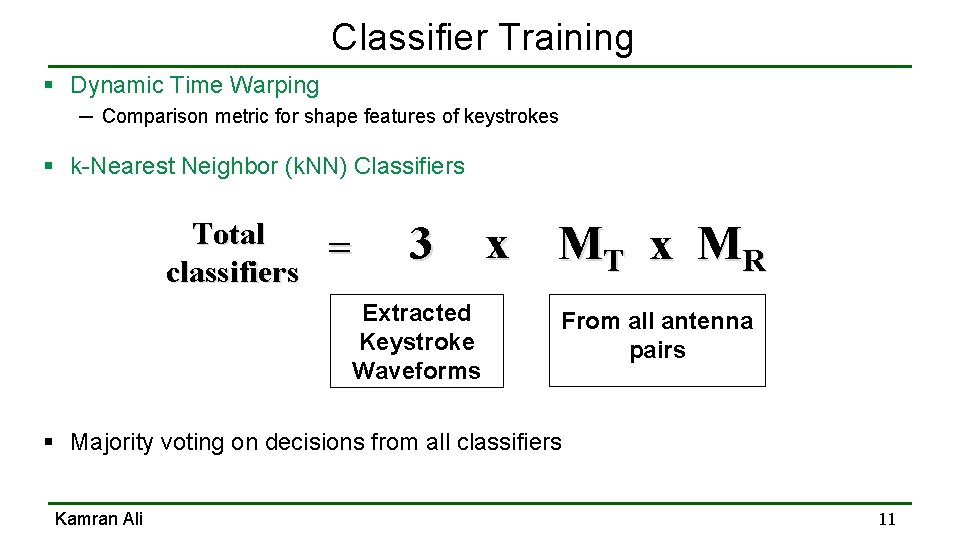
Classifier Training § Dynamic Time Warping ─ Comparison metric for shape features of keystrokes § k-Nearest Neighbor (k. NN) Classifiers Total classifiers = 3 Extracted Keystroke Waveforms x MT x MR From all antenna pairs § Majority voting on decisions from all classifiers Kamran Ali 11
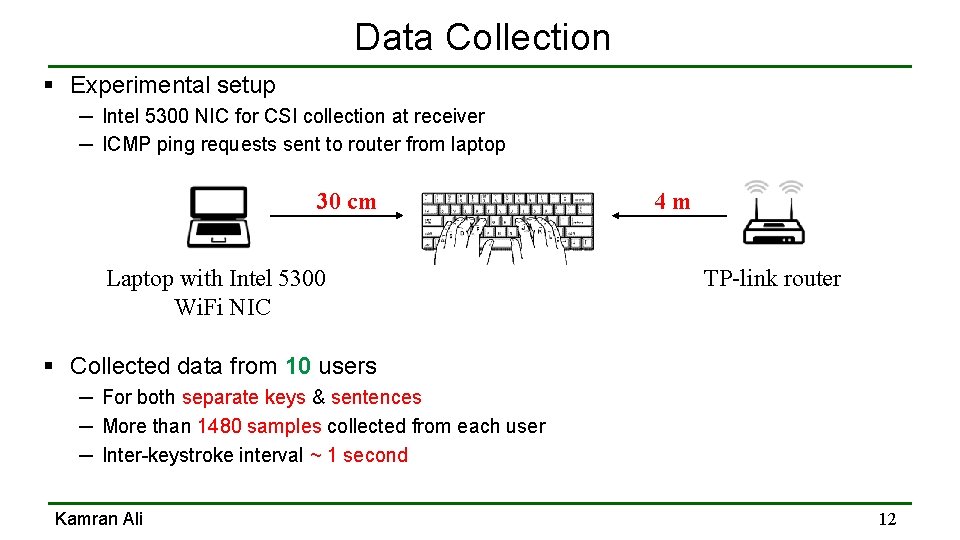
Data Collection § Experimental setup ─ Intel 5300 NIC for CSI collection at receiver ─ ICMP ping requests sent to router from laptop 30 cm Laptop with Intel 5300 Wi. Fi NIC 4 m TP-link router § Collected data from 10 users ─ For both separate keys & sentences ─ More than 1480 samples collected from each user ─ Inter-keystroke interval ~ 1 second Kamran Ali 12
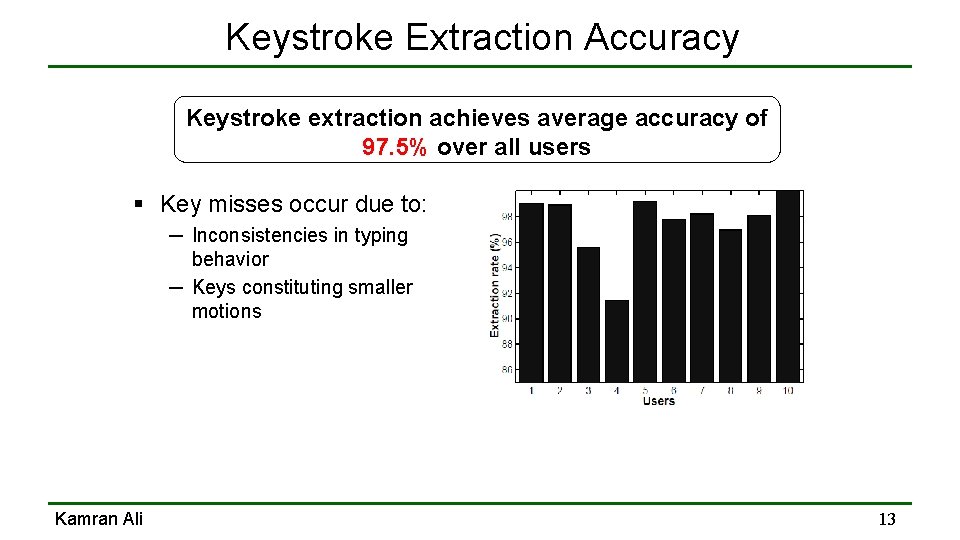
Keystroke Extraction Accuracy Keystroke extraction achieves average accuracy of 97. 5% over all users § Key misses occur due to: ─ Inconsistencies in typing behavior ─ Keys constituting smaller motions Kamran Ali 13
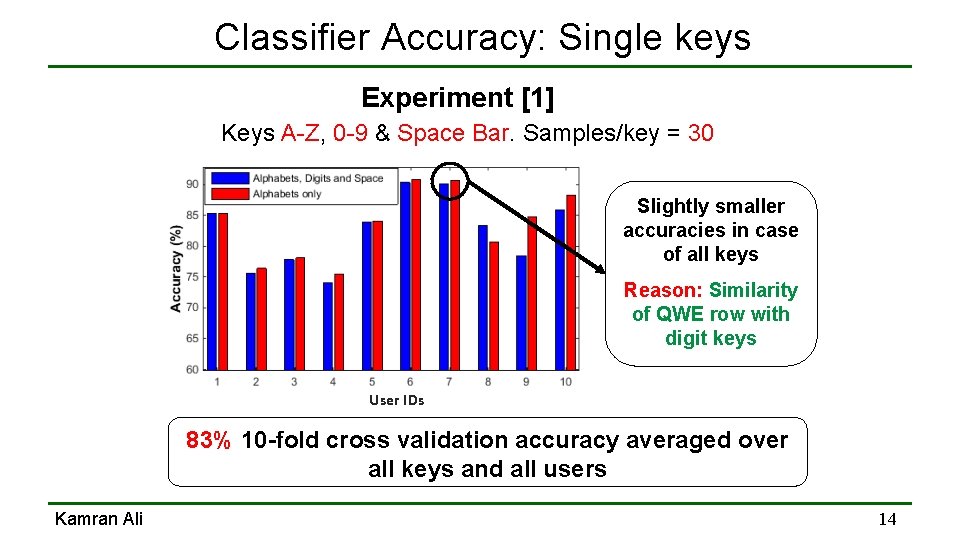
Classifier Accuracy: Single keys Experiment [1] Keys A-Z, 0 -9 & Space Bar. Samples/key = 30 Slightly smaller accuracies in case of all keys Reason: Similarity of QWE row with digit keys User IDs 83% 10 -fold cross validation accuracy averaged over all keys and all users Kamran Ali 14
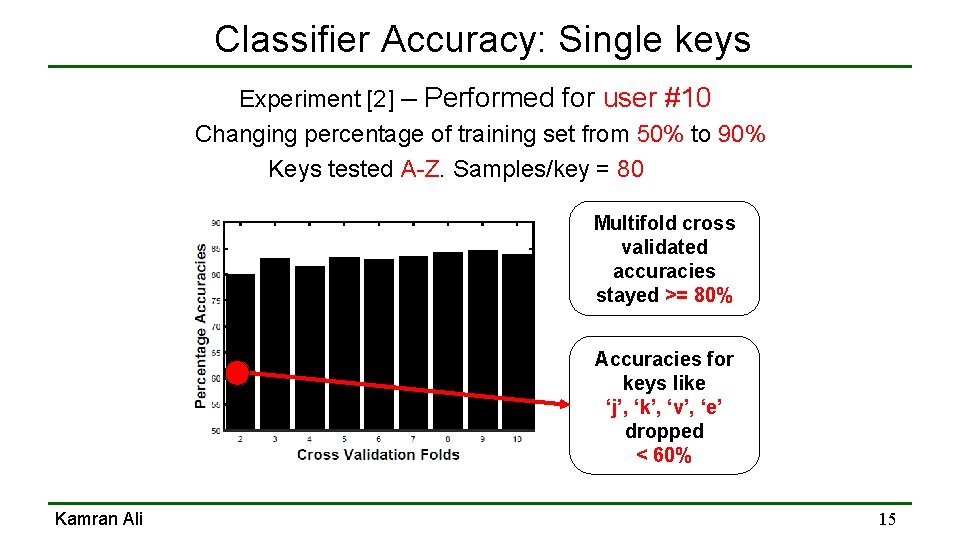
Classifier Accuracy: Single keys Experiment [2] – Performed for user #10 Changing percentage of training set from 50% to 90% Keys tested A-Z. Samples/key = 80 Multifold cross validated accuracies stayed >= 80% Accuracies for keys like ‘j’, ‘k’, ‘v’, ‘e’ dropped < 60% Kamran Ali 15
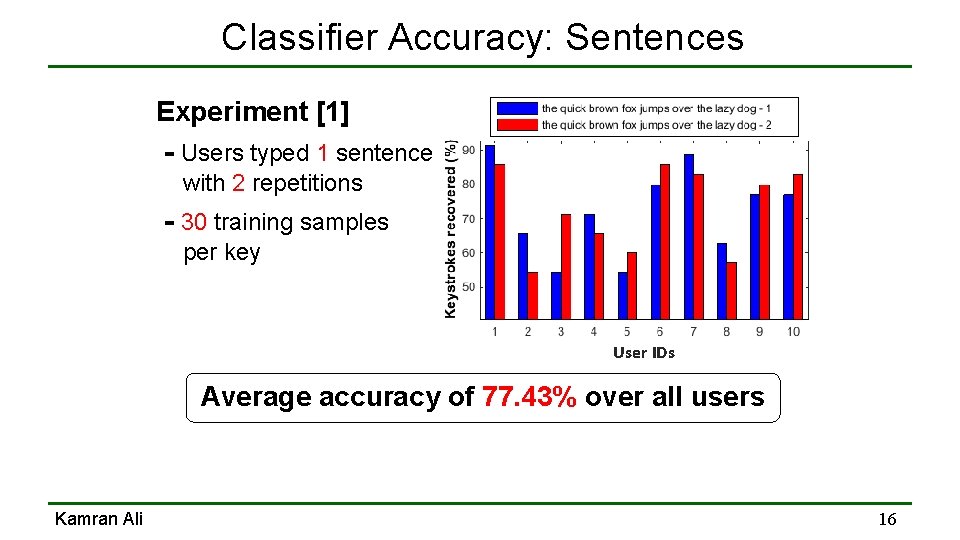
Classifier Accuracy: Sentences Experiment [1] - Users typed 1 sentence with 2 repetitions - 30 training samples per key User IDs Average accuracy of 77. 43% over all users Kamran Ali 16
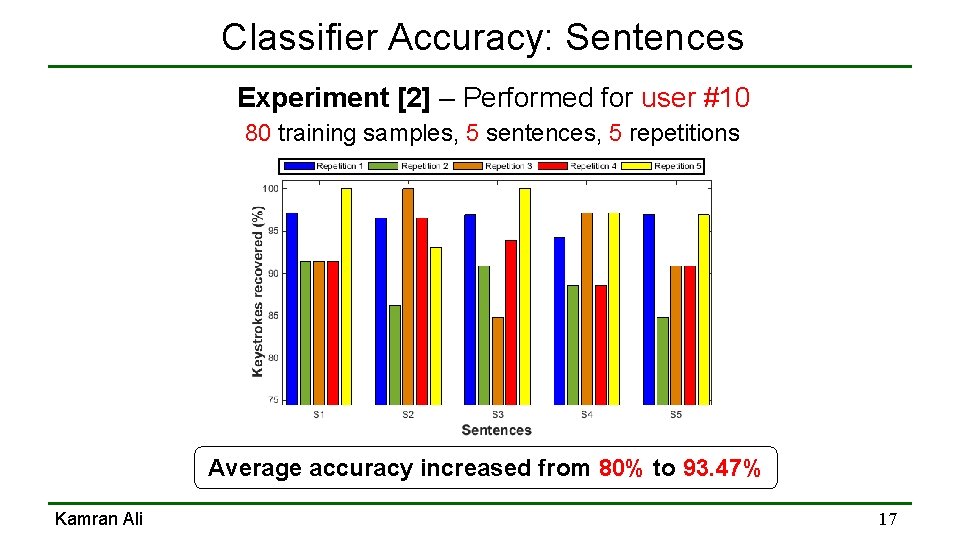
Classifier Accuracy: Sentences Experiment [2] – Performed for user #10 80 training samples, 5 sentences, 5 repetitions Average accuracy increased from 80% to 93. 47% Kamran Ali 17
Limitations § Tested in interference free surroundings § Affected by change in the positions of Wi-Fi devices § Supports relatively slower typing speeds ─ Approximately 15 words/minute § Requires high CSI sampling rate ─ Approximately 2500 samples/sec § Requires many training keystroke samples per key Kamran Ali 18
Conclusions § Wi-Fi based keystroke recognition scheme § Correlations in Wi-Fi subcarriers can be leveraged to reduce noise § Propose a robust algorithm for keystroke extraction § Shapes of CSI waveforms effective features for recognition of small gestures § Wi-Key can achieve more than 90% keystroke recognition accuracy for reasonable typing speeds Kamran Ali 19
Questions ? Thank you! Kamran Ali 20