
Keynes Beauty Contest Speculative Price Bubbles in the
Keynes’ Beauty Contest: Speculative Price Bubbles in the Absence of Common Knowledge in Experimental Stock Markets Shin’ichi Hirota and Shyam Sunder Osaka University (ISER) Workshop, March 6, 2002 Speculative Bubbles 1
The Purpose of Our Study • Explore why the price bubble occurs in stock markets • What investors believe about others’ beliefs • Experimental study Speculative Bubbles 2
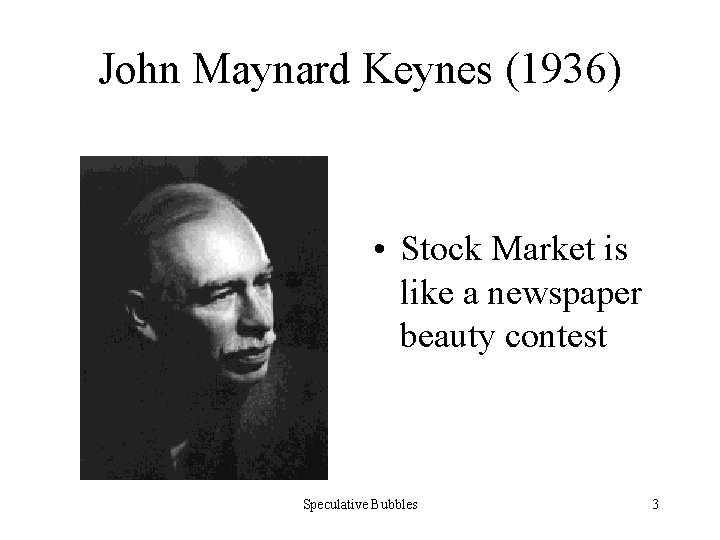
John Maynard Keynes (1936) • Stock Market is like a newspaper beauty contest Speculative Bubbles 3
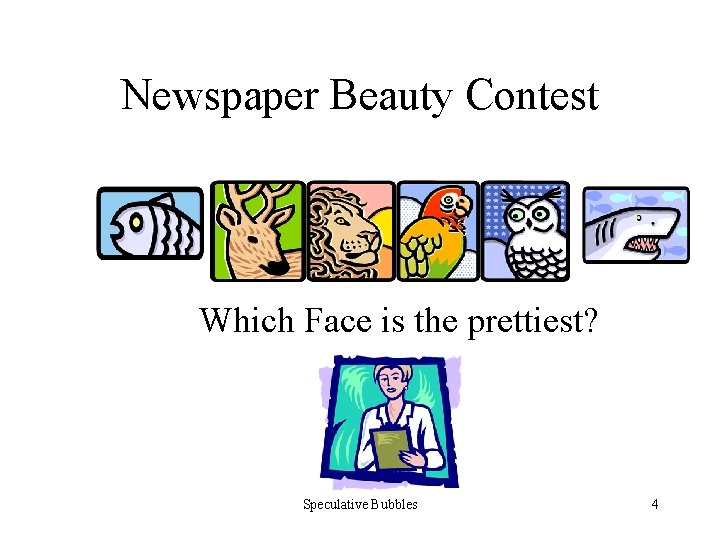
Newspaper Beauty Contest Which Face is the prettiest? Speculative Bubbles 4
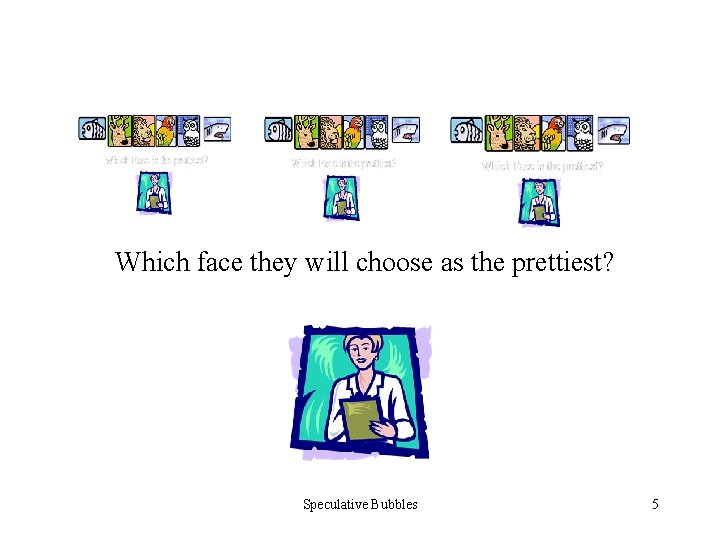
Which face they will choose as the prettiest? Speculative Bubbles 5
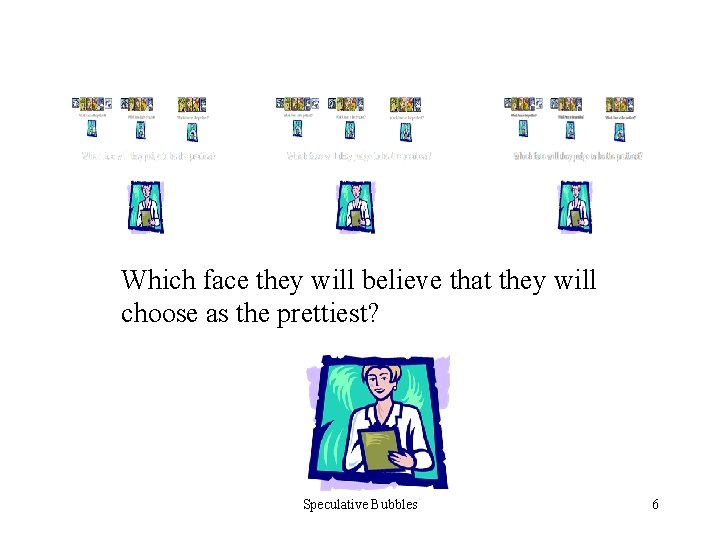
Which face they will believe that they will choose as the prettiest? Speculative Bubbles 6
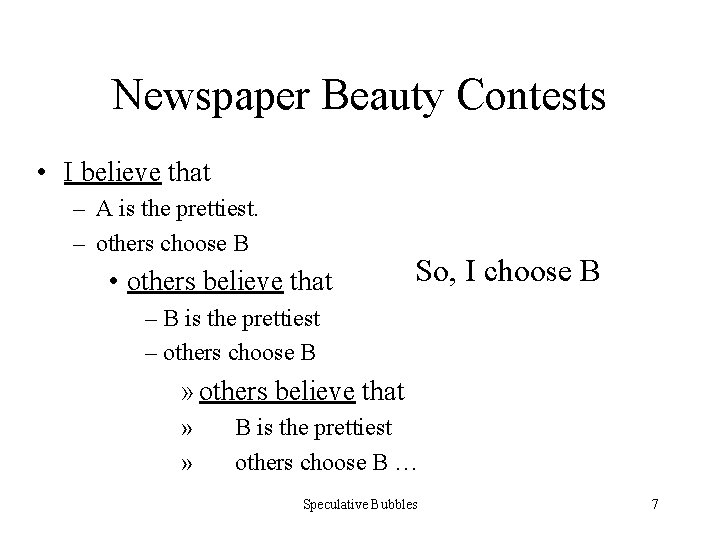
Newspaper Beauty Contests • I believe that – A is the prettiest. – others choose B • others believe that So, I choose B – B is the prettiest – others choose B » others believe that » B is the prettiest » others choose B … Speculative Bubbles 7
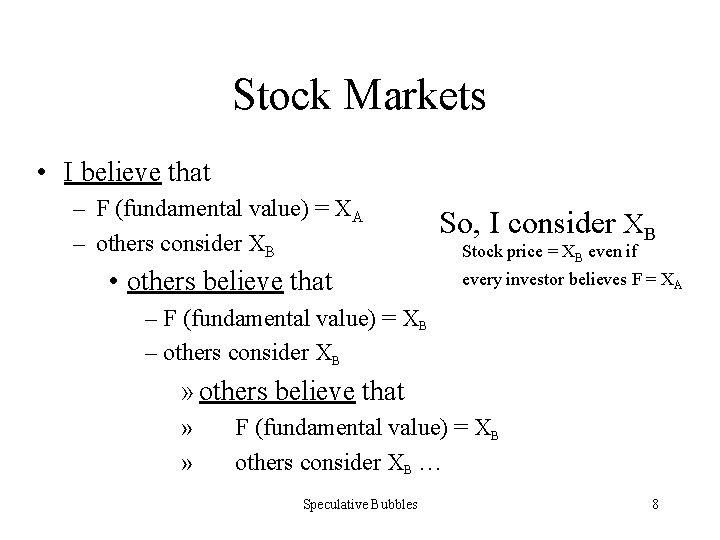
Stock Markets • I believe that – F (fundamental value) = XA – others consider XB • others believe that So, I consider XB Stock price = XB even if every investor believes F = XA – F (fundamental value) = XB – others consider XB » others believe that » F (fundamental value) = XB » others consider XB … Speculative Bubbles 8
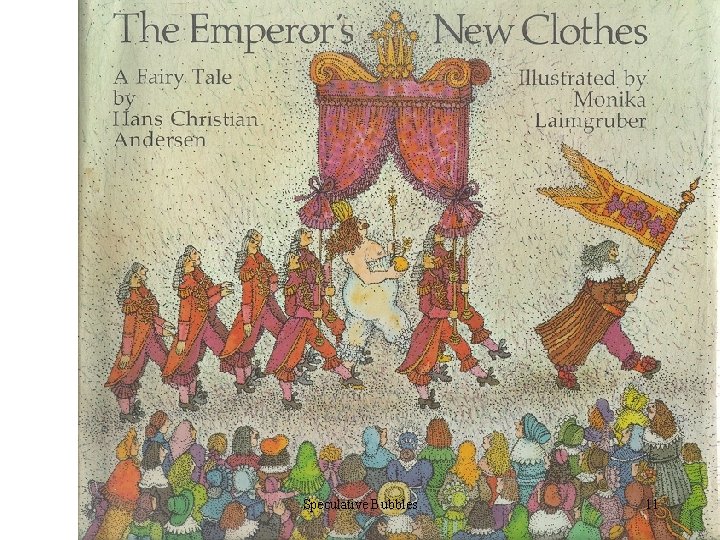
Plausible Story? ? • Well-known to practitioners and economists – True in real world? • 証券レディ (フィナンシャル・プランナー) – 「みんなそう思ってますよ」 • Central role of beliefs about others, and about others’ beliefs – Emperor’s Clothes, 日本の大学? Speculative Bubbles 9
Common Knowledge • When XA = XB the value of the stock is common knowledge. • In a great deal of modeling, common knowledge is routinely assumed • What happens when it breaks down? • When our higher order beliefs differ from first order belief, do they converge? (Aumann (1976)). Speculative Bubbles 10
Speculative Bubbles 11
Irrational Exuberance • Less-than-rational behavior – People do not know fundamentals (XA) – People trade without considering fundamentals • Bubble occurs due to investors’ error and emotional behavior (psychology) • Drawbacks – definition of bubbles, inconsistent exploration, useful exploration ? “Jack got lost because he is foolish” Speculative Bubbles 12
Beauty Contest Bubble • “Rational behavior” – Investor need not be irrational in decisions or beliefs, and need not believe the others to be irrational. • Bubbles generated by gap between the first and second (higher) order beliefs. • Do not depend on investor heterogeneity Speculative Bubbles 13
How to verify? • In the field it is difficult enough to know the first order investor beliefs (fundamental value), and their diversity • Second and higher order beliefs are also unobservable and practically out of reach • In lab we might have a better, though still limited, chance to know beliefs, perhaps even open a gap between the first and higher order beliefs and observe their consequences under controlled conditions Speculative Bubbles 14
Experimental Design • Double auction market for multiple units of a single security Multiple trading periods (3 minutes each) • Each investor endowed with 10 shares, 10, 000 points in “cash” • Liquidation by dividend or predicted price • Predictors knew the rules, no endowments, no ability to trade, could watch trading, knew the range of terminal dividends Speculative Bubbles 15
2 Types of Keynes’ Bubble • Type I – A gap between 1 st and higher order beliefs – Absence of common knowledge about dividends • Type II – Self-floating – Is this same as ‘rational bubble’? ? • Blanchard & Watson (1982), Tirole (1982)(1985) – Occurs in infinite maturity securities Speculative Bubbles 16
F=S sessions F S sessions • Dividend Value = Dividend Range – Common Knowledge – F=S – No Type I bubble • Dividend Value Dividend Range – Absence of Common Knowledge – F<S – Type I bubble may be observed Speculative Bubbles 17
Finite Maturity Securities Sessions • 15 periods. • Single liquidating dividend is paid at the end of Period 15 • By design, second order beliefs have the chance of being higher than the first order beliefs • Type I bubbles may be observed. • Bubbles continue until period T-1 and crash in the last period Speculative Bubbles 18
Indefinite Maturity Securities Sessions • Investors do not know ex ante how many periods they will have. • Dividend is paid at the end of Period 30, but session is likely to end before Period 30. • Terminal payoff by endogenous prediction game • Type II bubble may be observed. The price is totally dependent on market expectations Speculative Bubbles 19
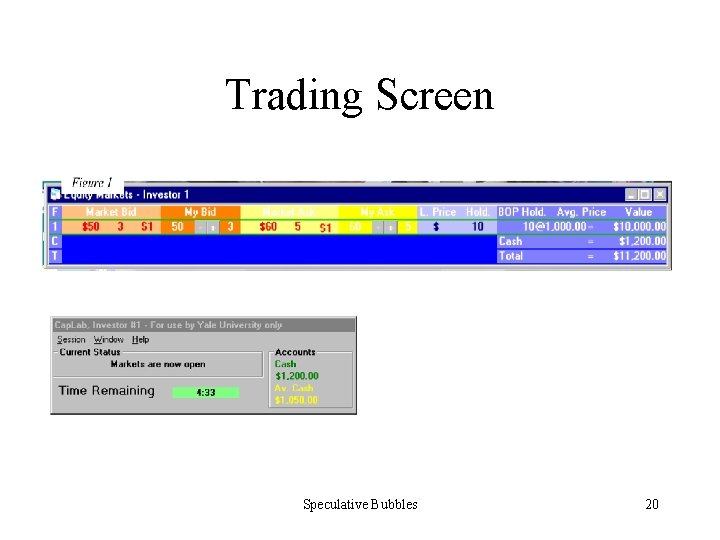
Trading Screen Speculative Bubbles 20
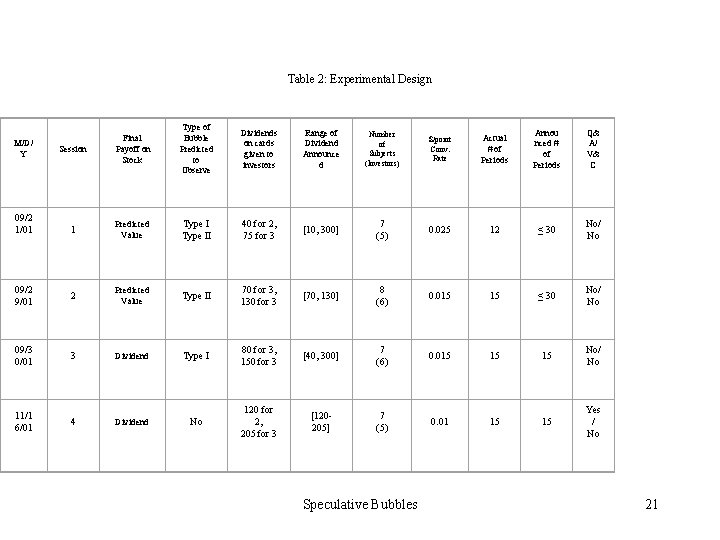
Table 2: Experimental Design Type of Bubble Predicted to Observe Dividends on cards given to investors Range of Dividend Announce d Number of Subjects (Investors) $/point Conv. Rate Actual # of Periods Annou nced # of Periods Q& A/ V& C M/D/ Y Session Final Payoff on Stock 09/2 1/01 1 Predicted Value Type II 40 for 2, 75 for 3 [10, 300] 7 (5) 0. 025 12 ≤ 30 No/ No 09/2 9/01 2 Predicted Value Type II 70 for 3, 130 for 3 [70, 130] 8 (6) 0. 015 15 ≤ 30 No/ No 09/3 0/01 3 Dividend Type I 80 for 3, 150 for 3 [40, 300] 7 (6) 0. 015 15 15 No/ No 11/1 6/01 4 Dividend No 120 for 2, 205 for 3 [120205] 7 (5) 0. 01 15 15 Yes / No Speculative Bubbles 21
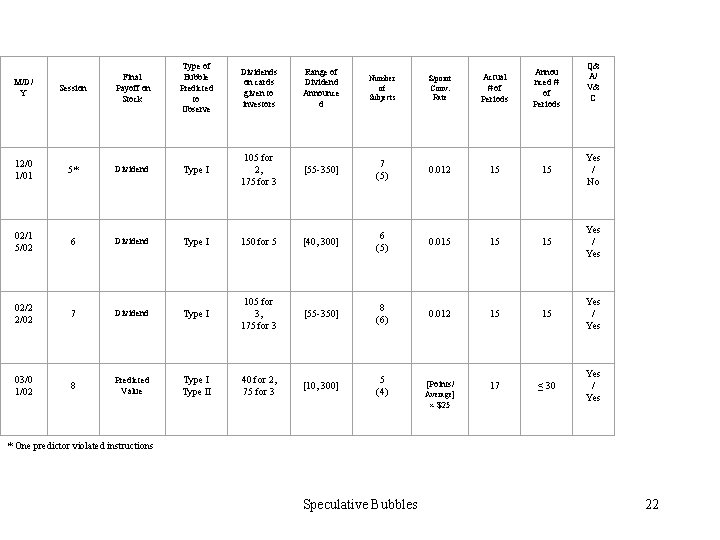
M/D/ Y Session Final Payoff on Stock Type of Bubble Predicted to Observe Dividends on cards given to investors Range of Dividend Announce d Number of Subjects $/point Conv. Rate Actual # of Periods Annou nced # of Periods Q& A/ V& C 12/0 1/01 5* Dividend Type I 105 for 2, 175 for 3 [55 -350] 7 (5) 0. 012 15 15 Yes / No 02/1 5/02 6 Dividend Type I 150 for 5 [40, 300] 6 (5) 0. 015 15 15 Yes / Yes 02/2 2/02 7 Dividend Type I 105 for 3, 175 for 3 [55 -350] 8 (6) 0. 012 15 15 Yes / Yes 03/0 1/02 8 Predicted Value Type II 40 for 2, 75 for 3 [10, 300] 5 (4) [Points/ 17 ≤ 30 Yes / Yes Average] $25 * One predictor violated instructions Speculative Bubbles 22
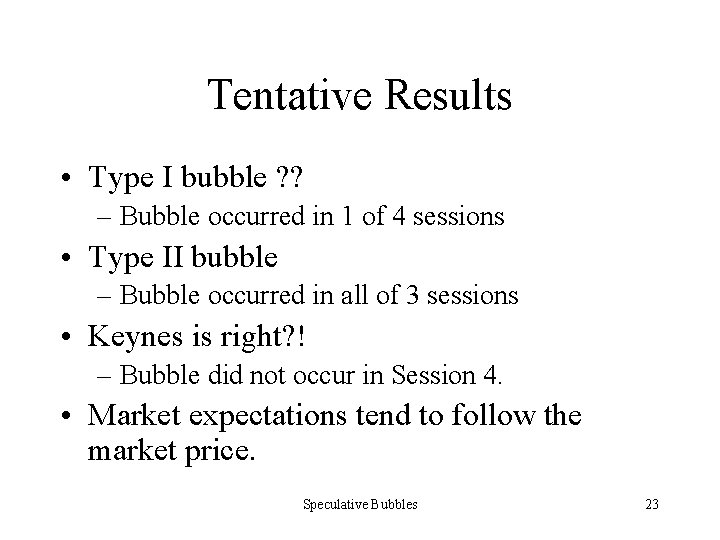
Tentative Results • Type I bubble ? ? – Bubble occurred in 1 of 4 sessions • Type II bubble – Bubble occurred in all of 3 sessions • Keynes is right? ! – Bubble did not occur in Session 4. • Market expectations tend to follow the market price. Speculative Bubbles 23
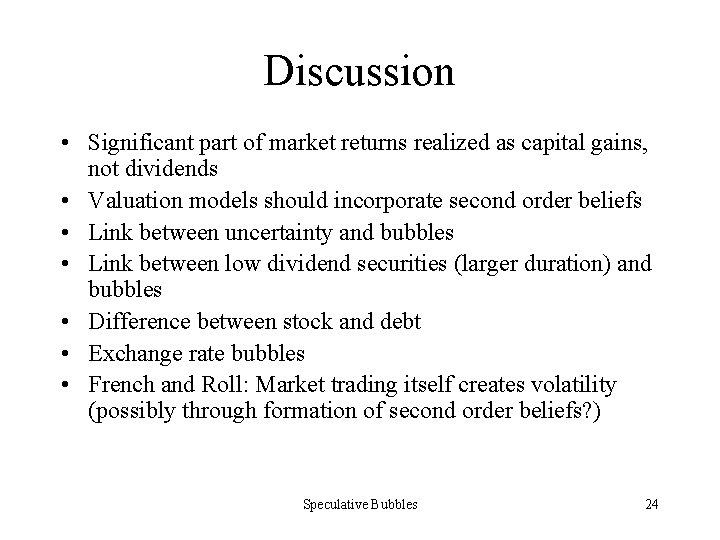
Discussion • Significant part of market returns realized as capital gains, not dividends • Valuation models should incorporate second order beliefs • Link between uncertainty and bubbles • Link between low dividend securities (larger duration) and bubbles • Difference between stock and debt • Exchange rate bubbles • French and Roll: Market trading itself creates volatility (possibly through formation of second order beliefs? ) Speculative Bubbles 24
- Slides: 24