
Key words Longitudinal wave Where the direction of
- Slides: 5
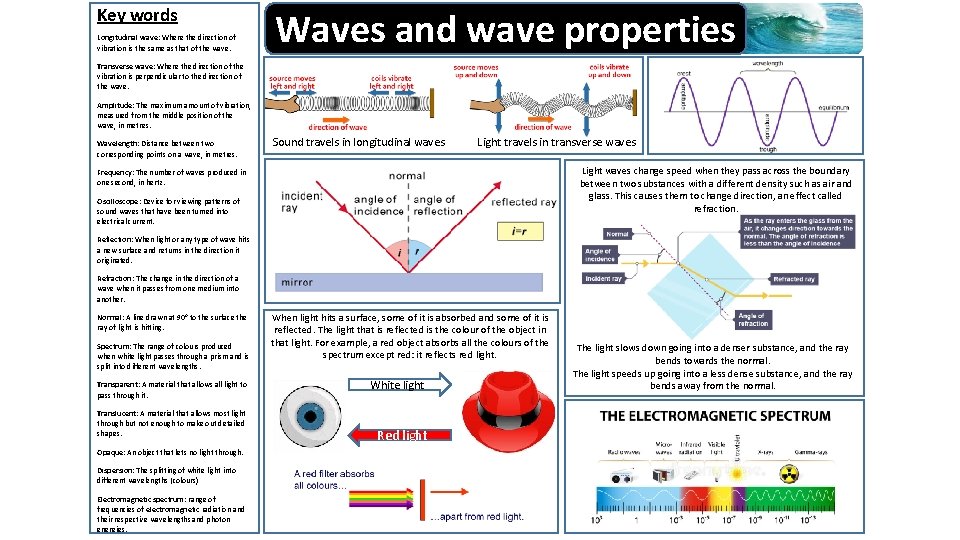
Key words Longitudinal wave: Where the direction of vibration is the same as that of the wave. Waves and wave properties Transverse wave: Where the direction of the vibration is perpendicular to the direction of the wave. Amplitude: The maximum amount of vibration, measured from the middle position of the wave, in metres. Wavelength: Distance between two corresponding points on a wave, in metres. Sound travels in longitudinal waves Light travels in transverse waves Light waves change speed when they pass across the boundary between two substances with a different density such as air and glass. This causes them to change direction, an effect called refraction. Frequency: The number of waves produced in one second, in hertz. Oscilloscope: Device for viewing patterns of sound waves that have been turned into electrical current. Reflection: When light or any type of wave hits a new surface and returns in the direction it originated. Refraction: The change in the direction of a wave when it passes from one medium into another. Normal: A line drawn at 90° to the surface the ray of light is hitting. Spectrum: The range of colours produced when white light passes through a prism and is split into different wavelengths. Transparent: A material that allows all light to pass through it. Translucent: A material that allows most light through but not enough to make out detailed shapes. Opaque: An object that lets no light through. Dispersion: The splitting of white light into different wavelengths (colours) Electromagnetic spectrum: range of frequencies of electromagnetic radiation and their respective wavelengths and photon energies. When light hits a surface, some of it is absorbed and some of it is reflected. The light that is reflected is the colour of the object in that light. For example, a red object absorbs all the colours of the spectrum except red: it reflects red light. White light Red light The light slows down going into a denser substance, and the ray bends towards the normal. The light speeds up going into a less dense substance, and the ray bends away from the normal.
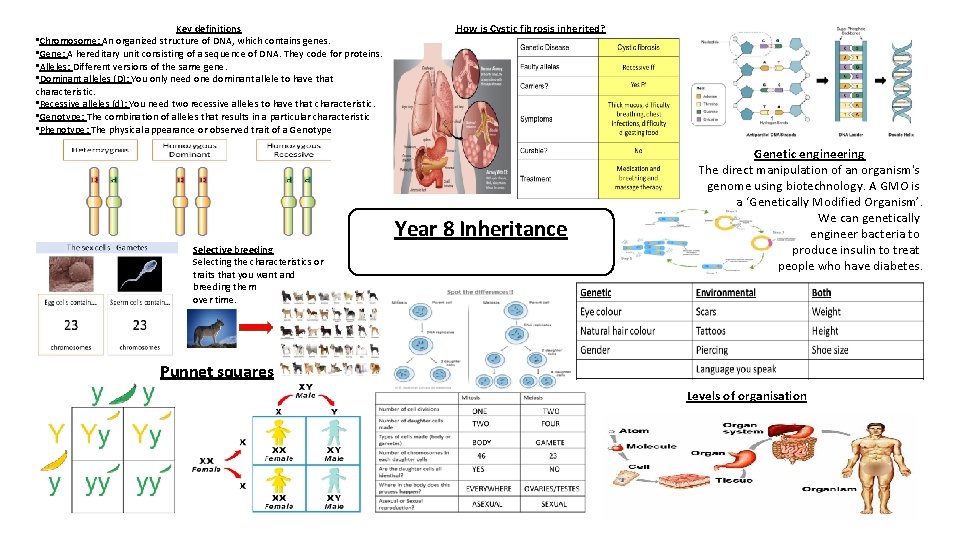
Key definitions • Chromosome: An organized structure of DNA, which contains genes. • Gene: A hereditary unit consisting of a sequence of DNA. They code for proteins. • Alleles: Different versions of the same gene. • Dominant alleles (D): You only need one dominant allele to have that characteristic. • Recessive alleles (d): You need two recessive alleles to have that characteristic. • Genotype: The combination of alleles that results in a particular characteristic • Phenotype: The physical appearance or observed trait of a Genotype How is Cystic fibrosis inherited? Year 8 Inheritance Selective breeding Selecting the characteristics or traits that you want and breeding them over time. Genetic engineering The direct manipulation of an organism's genome using biotechnology. A GMO is a ‘Genetically Modified Organism’. We can genetically engineer bacteria to produce insulin to treat people who have diabetes. Punnet squares Levels of organisation
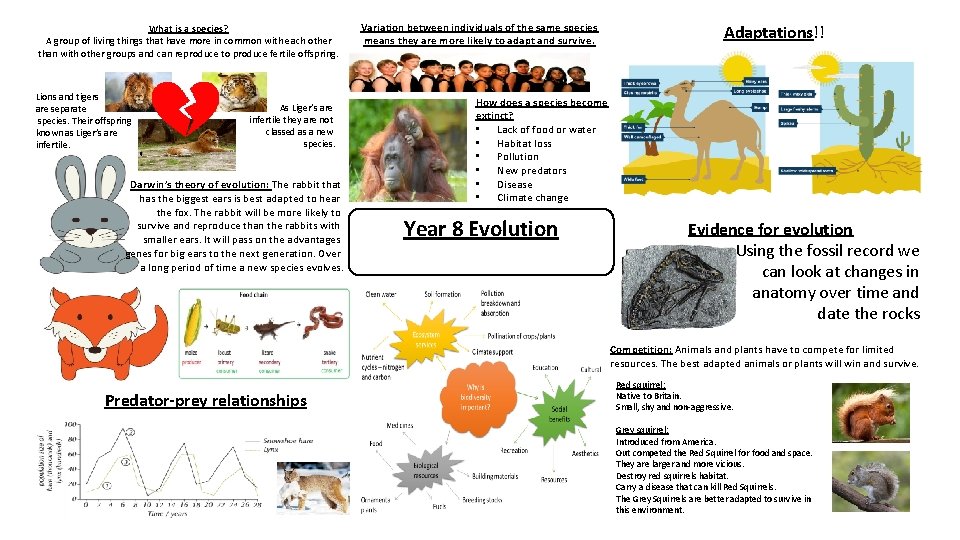
What is a species? A group of living things that have more in common with each other than with other groups and can reproduce to produce fertile offspring. Lions and tigers are separate species. Their offspring known as Liger’s are infertile. As Liger’s are infertile they are not classed as a new species. Darwin’s theory of evolution: The rabbit that has the biggest ears is best adapted to hear the fox. The rabbit will be more likely to survive and reproduce than the rabbits with smaller ears. It will pass on the advantages genes for big ears to the next generation. Over a long period of time a new species evolves. Variation between individuals of the same species means they are more likely to adapt and survive. Adaptations!! How does a species become extinct? • Lack of food or water • Habitat loss • Pollution • New predators • Disease • Climate change Year 8 Evolution Evidence for evolution Using the fossil record we can look at changes in anatomy over time and date the rocks Competition: Animals and plants have to compete for limited resources. The best adapted animals or plants will win and survive. Predator-prey relationships Red squirrel: Native to Britain. Small, shy and non-aggressive. Grey squirrel: Introduced from America. Out competed the Red Squirrel for food and space. They are larger and more vicious. Destroy red squirrels habitat. Carry a disease that can kill Red Squirrels. The Grey Squirrels are better adapted to survive in this environment.
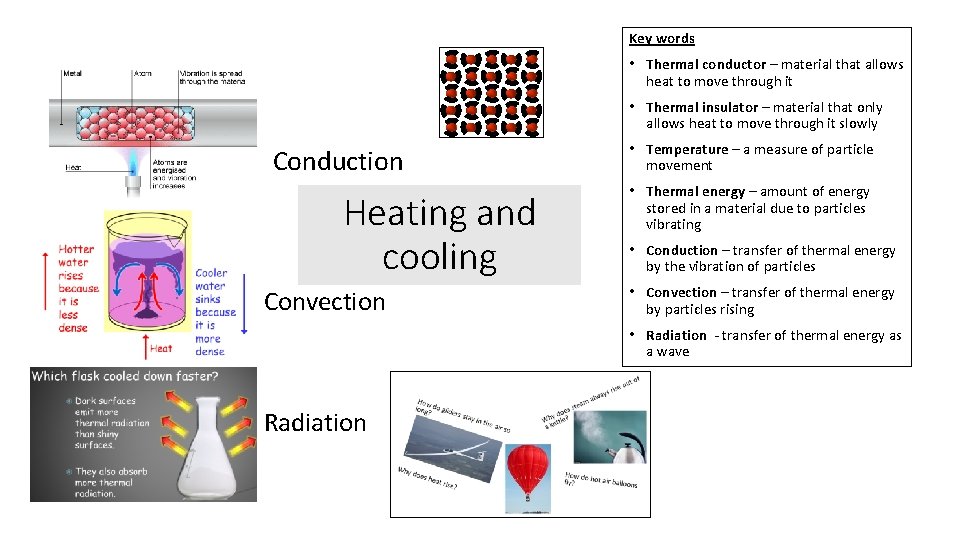
Key words • Thermal conductor – material that allows heat to move through it • Thermal insulator – material that only allows heat to move through it slowly Conduction Heating and cooling Convection • Temperature – a measure of particle movement • Thermal energy – amount of energy stored in a material due to particles vibrating • Conduction – transfer of thermal energy by the vibration of particles • Convection – transfer of thermal energy by particles rising • Radiation - transfer of thermal energy as a wave Radiation
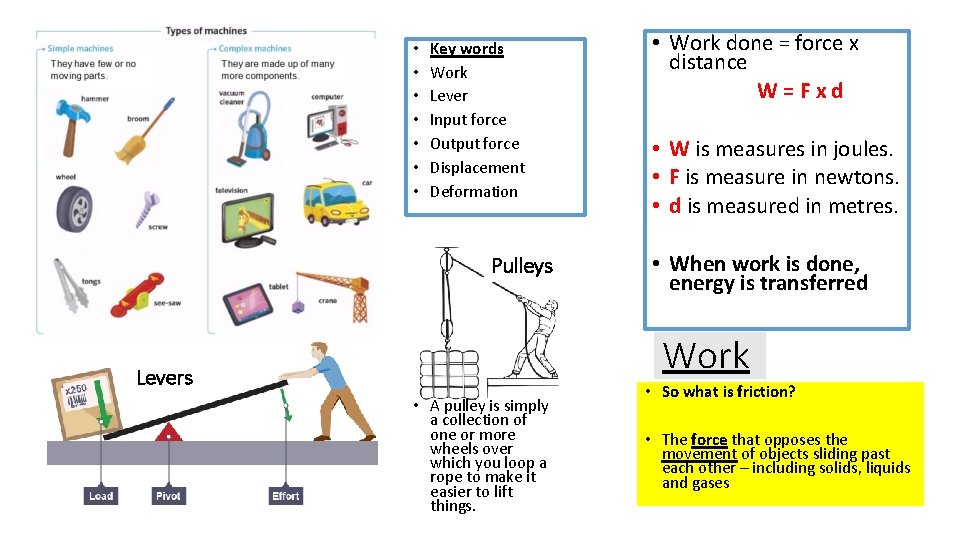
• • Key words Work Lever Input force Output force Displacement Deformation Pulleys • Work done = force x distance W=Fxd • W is measures in joules. • F is measure in newtons. • d is measured in metres. • When work is done, energy is transferred Work Levers • A pulley is simply a collection of one or more wheels over which you loop a rope to make it easier to lift things. • So what is friction? • The force that opposes the movement of objects sliding past each other – including solids, liquids and gases