
Key Words for Blooms Taxonomy Level Cognitive Domain
Key Words for Bloom’s Taxonomy Level
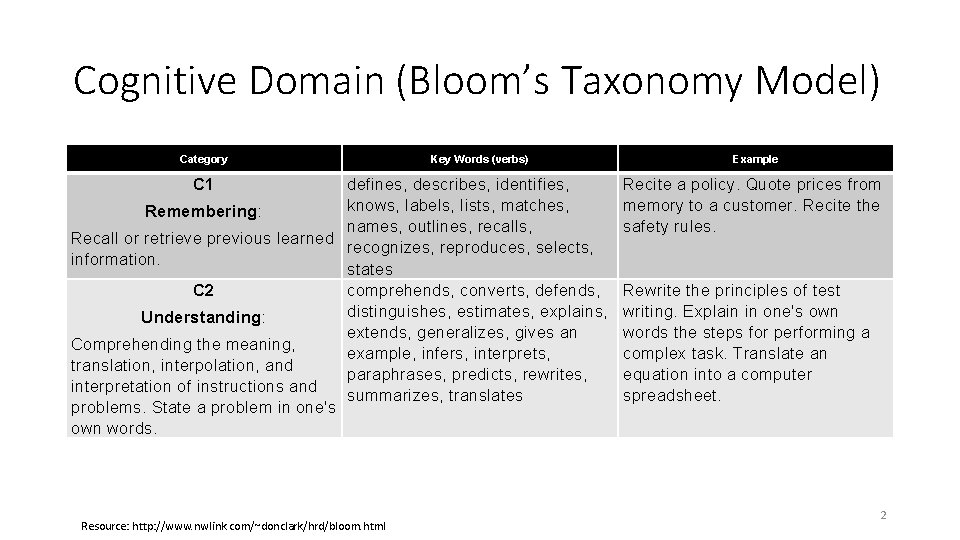
Cognitive Domain (Bloom’s Taxonomy Model) Category C 1 Key Words (verbs) defines, describes, identifies, knows, labels, lists, matches, Remembering: names, outlines, recalls, Recall or retrieve previous learned recognizes, reproduces, selects, information. states C 2 comprehends, converts, defends, distinguishes, estimates, explains, Understanding: extends, generalizes, gives an Comprehending the meaning, example, infers, interprets, translation, interpolation, and paraphrases, predicts, rewrites, interpretation of instructions and summarizes, translates problems. State a problem in one's own words. Resource: http: //www. nwlink. com/~donclark/hrd/bloom. html Example Recite a policy. Quote prices from memory to a customer. Recite the safety rules. Rewrite the principles of test writing. Explain in one's own words the steps for performing a complex task. Translate an equation into a computer spreadsheet. 2

Cognitive Domain (Bloom’s Taxonomy Model) Category C 3 Applying: Use a concept in a new situation or unprompted use of an abstraction. Applies what was learned in the classroom into novel situations in the work place. C 4 Analyzing: Separates material or concepts into component parts so that its organizational structure may be understood. Distinguishes between facts and inferences. Key Words (verbs) Example applies, changes, computes, constructs, demonstrates, discovers, manipulates, modifies, operates, predicts, prepares, produces, relates, shows, solves, uses Use a manual to calculate an employee's vacation time. Apply laws of statistics to evaluate the reliability of a written test. analyzes, breaks down, compares, contrasts, diagrams, deconstructs, differentiates, discriminates, distinguishes, identifies, illustrates, infers, outlines, relates, selects, separates Troubleshoot a piece of equipment by using logical deduction. Recognize logical fallacies in reasoning. Gathers information from a department and selects the required tasks for training. Resource: http: //www. nwlink. com/~donclark/hrd/bloom. html 3

Cognitive Domain (Bloom’s Taxonomy Model) Category Key Words (verbs) Example C 5 appraises, compares, concludes, contrasts, criticizes, critiques, defends, describes, discriminates, evaluates, explains, interprets, justifies, relates, summarizes, supports categorizes, combines, compiles, composes, creates, devises, designs, explains, generates, modifies, organizes, plans, rearranges, reconstructs, relates, reorganizes, revises, rewrites, summarizes, tells, writes Select the most effective solution. Hire the most qualified candidate. Explain and justify a new budget. Evaluating: Make judgments about the value of ideas or materials. C 6 Creating: Builds a structure or pattern from diverse elements. Put parts together to form a whole, with emphasis on creating a new meaning or structure. Resource: http: //www. nwlink. com/~donclark/hrd/bloom. html Write a company operations or process manual. Design a machine to perform a specific task. Integrates training from several sources to solve a problem. Revises and process to improve the outcome. 4

Affective Domain (Bloom’s Taxonomy Model) Category A 1 Receiving Phenomena: Awareness, willingness to hear, selected attention. A 2 Key Words (verbs) Example acknowledge, asks, attentive, courteous, dutiful, follows, gives, listens, understands Listen to others with respect. Listen for and remember the name of newly introduced people. answers, assists, aids, complies, conforms, discusses, greets, helps, labels, performs, presents, tells Participates in class discussions. Gives a presentation. Questions new ideals, concepts, models, etc. in order to fully understand them. Know the safety rules and practice them. Responds to Phenomena: Active participation on the part of the learners. Attend and react to a particular phenomenon. Learning outcomes may emphasize compliance in responding, willingness to respond, or satisfaction in responding (motivation). Resource: http: //www. nwlink. com/~donclark/hrd/Bloom/affective_domain. html 5
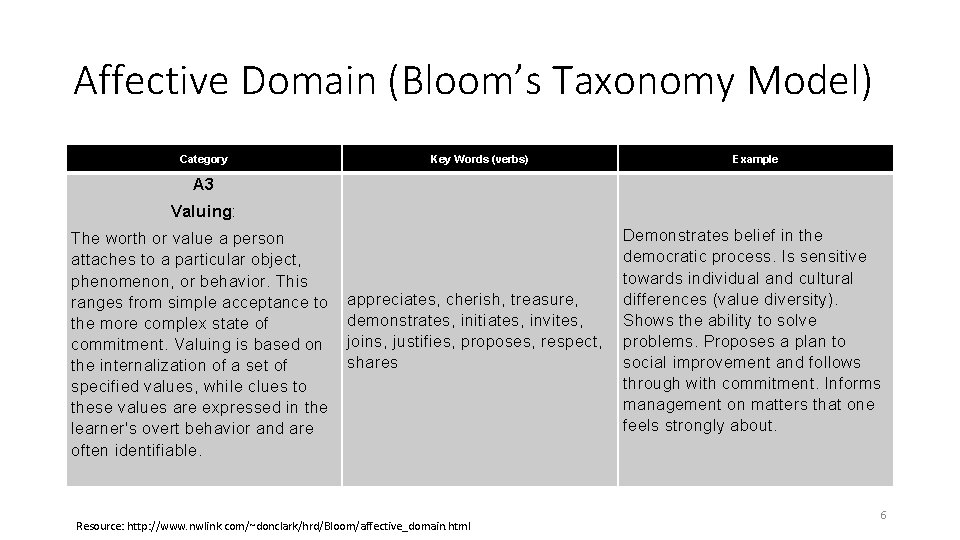
Affective Domain (Bloom’s Taxonomy Model) Category Key Words (verbs) Example A 3 Valuing: The worth or value a person attaches to a particular object, phenomenon, or behavior. This ranges from simple acceptance to the more complex state of commitment. Valuing is based on the internalization of a set of specified values, while clues to these values are expressed in the learner's overt behavior and are often identifiable. appreciates, cherish, treasure, demonstrates, initiates, invites, joins, justifies, proposes, respect, shares Resource: http: //www. nwlink. com/~donclark/hrd/Bloom/affective_domain. html Demonstrates belief in the democratic process. Is sensitive towards individual and cultural differences (value diversity). Shows the ability to solve problems. Proposes a plan to social improvement and follows through with commitment. Informs management on matters that one feels strongly about. 6
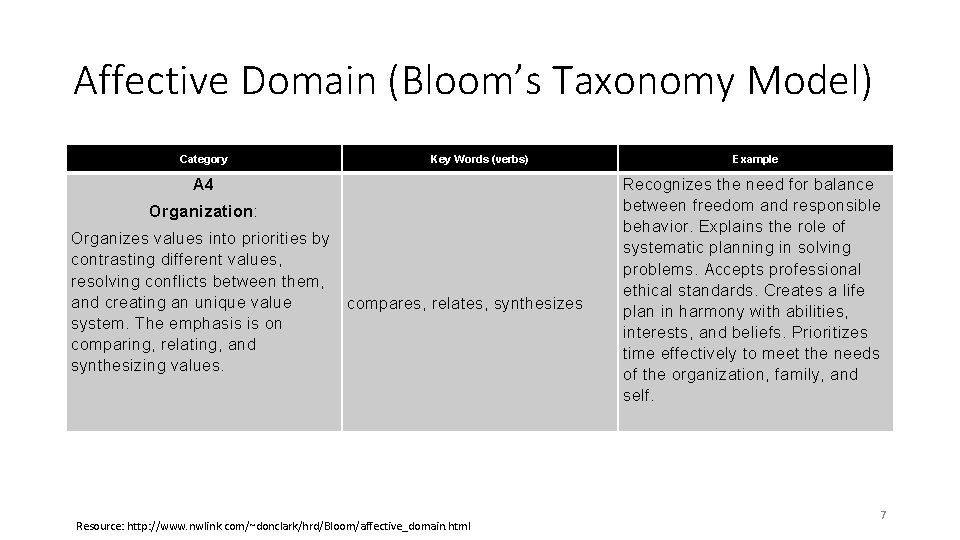
Affective Domain (Bloom’s Taxonomy Model) Category Key Words (verbs) A 4 Organization: Organizes values into priorities by contrasting different values, resolving conflicts between them, and creating an unique value system. The emphasis is on comparing, relating, and synthesizing values. compares, relates, synthesizes Resource: http: //www. nwlink. com/~donclark/hrd/Bloom/affective_domain. html Example Recognizes the need for balance between freedom and responsible behavior. Explains the role of systematic planning in solving problems. Accepts professional ethical standards. Creates a life plan in harmony with abilities, interests, and beliefs. Prioritizes time effectively to meet the needs of the organization, family, and self. 7
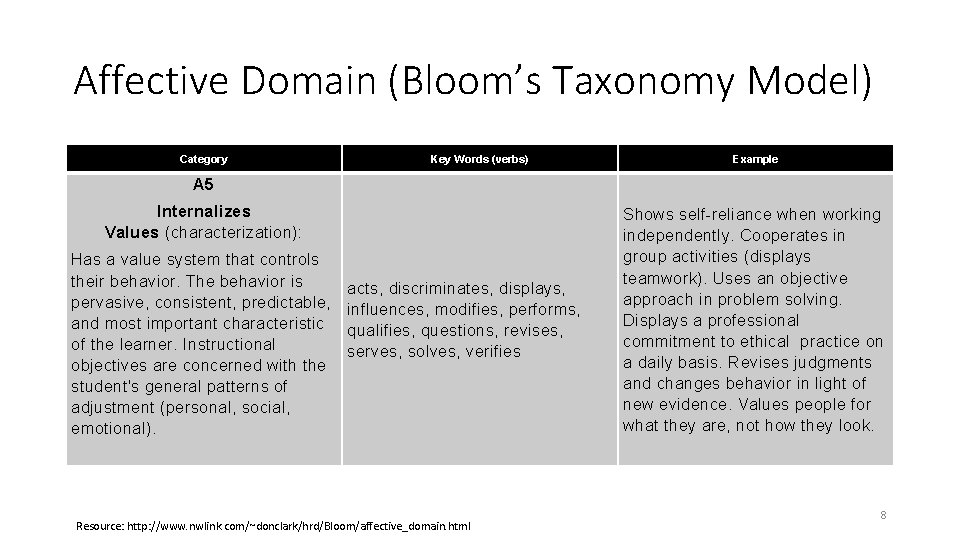
Affective Domain (Bloom’s Taxonomy Model) Category Key Words (verbs) Example A 5 Internalizes Values (characterization): Has a value system that controls their behavior. The behavior is pervasive, consistent, predictable, and most important characteristic of the learner. Instructional objectives are concerned with the student's general patterns of adjustment (personal, social, emotional). acts, discriminates, displays, influences, modifies, performs, qualifies, questions, revises, serves, solves, verifies Resource: http: //www. nwlink. com/~donclark/hrd/Bloom/affective_domain. html Shows self-reliance when working independently. Cooperates in group activities (displays teamwork). Uses an objective approach in problem solving. Displays a professional commitment to ethical practice on a daily basis. Revises judgments and changes behavior in light of new evidence. Values people for what they are, not how they look. 8
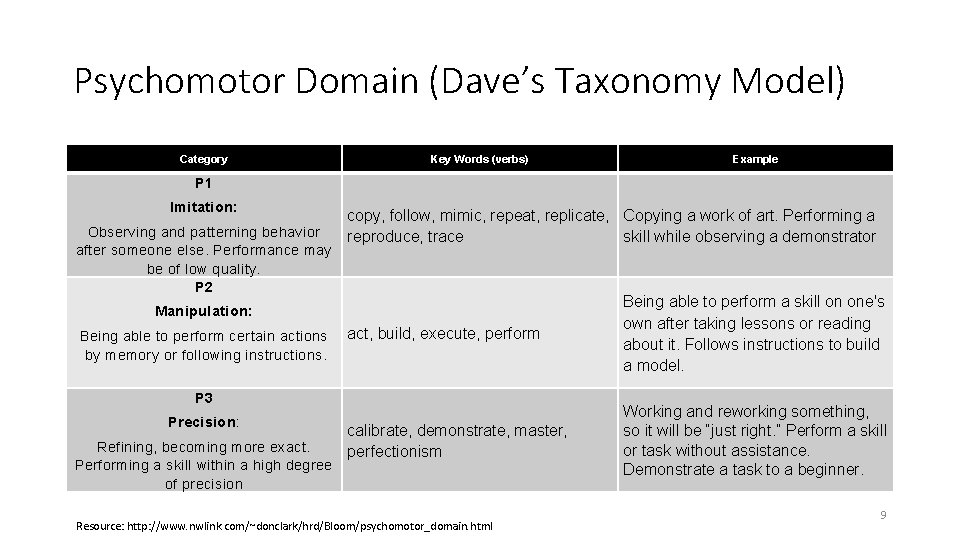
Psychomotor Domain (Dave’s Taxonomy Model) Category Key Words (verbs) Example P 1 Imitation: Observing and patterning behavior after someone else. Performance may be of low quality. P 2 copy, follow, mimic, repeat, replicate, Copying a work of art. Performing a reproduce, trace skill while observing a demonstrator act, build, execute, perform Being able to perform a skill on one's own after taking lessons or reading about it. Follows instructions to build a model. calibrate, demonstrate, master, perfectionism Working and reworking something, so it will be “just right. ” Perform a skill or task without assistance. Demonstrate a task to a beginner. Manipulation: Being able to perform certain actions by memory or following instructions. P 3 Precision: Refining, becoming more exact. Performing a skill within a high degree of precision Resource: http: //www. nwlink. com/~donclark/hrd/Bloom/psychomotor_domain. html 9
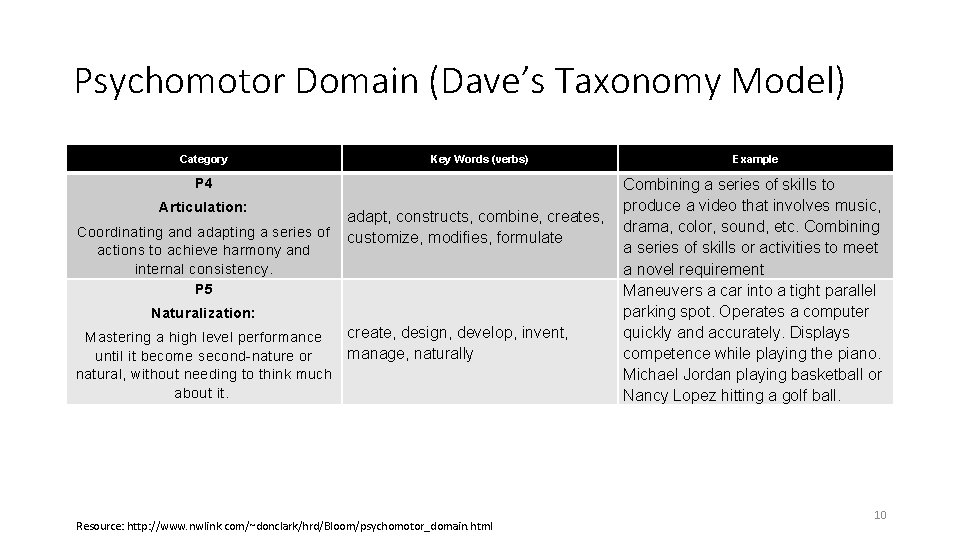
Psychomotor Domain (Dave’s Taxonomy Model) Category Key Words (verbs) P 4 Articulation: Coordinating and adapting a series of actions to achieve harmony and internal consistency. P 5 adapt, constructs, combine, creates, customize, modifies, formulate Naturalization: Mastering a high level performance until it become second-nature or natural, without needing to think much about it. create, design, develop, invent, manage, naturally Resource: http: //www. nwlink. com/~donclark/hrd/Bloom/psychomotor_domain. html Example Combining a series of skills to produce a video that involves music, drama, color, sound, etc. Combining a series of skills or activities to meet a novel requirement Maneuvers a car into a tight parallel parking spot. Operates a computer quickly and accurately. Displays competence while playing the piano. Michael Jordan playing basketball or Nancy Lopez hitting a golf ball. 10
- Slides: 10