
Key words definitions Key word Definition Ecology Biosphere
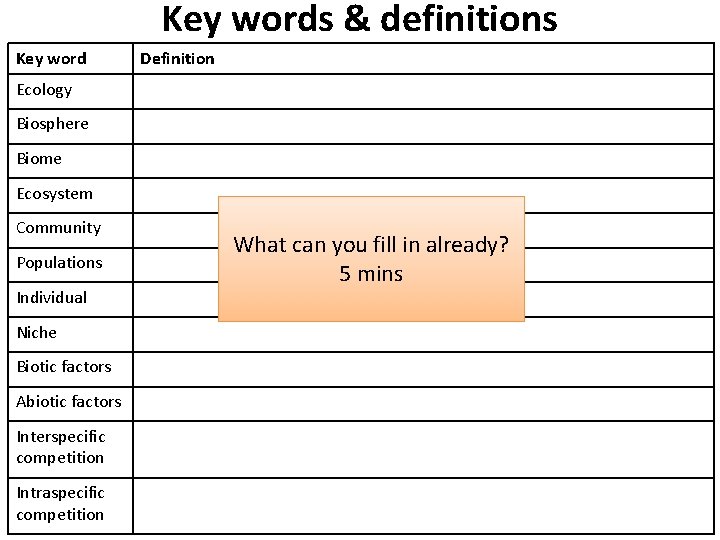
Key words & definitions Key word Definition Ecology Biosphere Biome Ecosystem Community Populations Individual Niche Biotic factors Abiotic factors Interspecific competition Intraspecific competition What can you fill in already? 5 mins
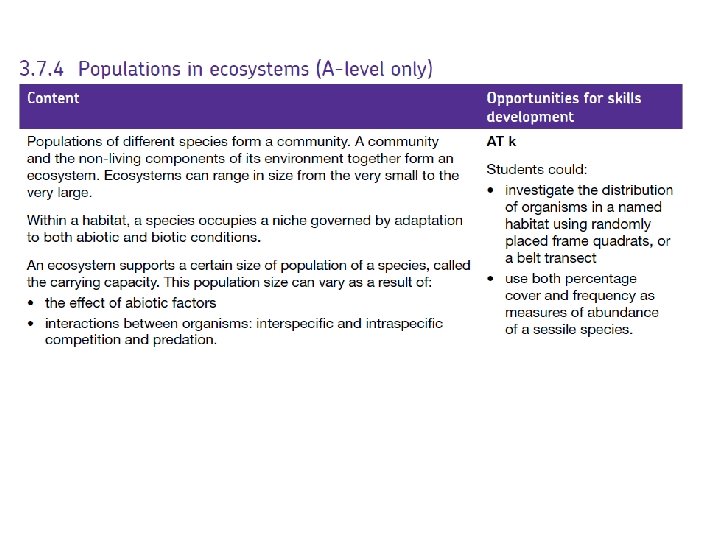
What is ecology? • The word ecology comes from the Greek for “house”. • Study of interrelationships between organisms and their environment • The environment includes both biotic (living) and abiotic (non-living) factors
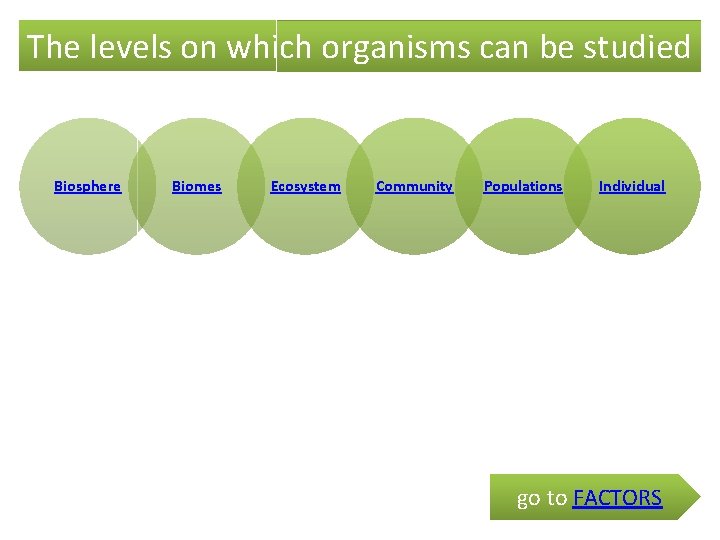
The levels on which organisms can be studied Biosphere Biomes Ecosystem Community Populations Individual go to FACTORS

Biosphere • The life supporting layer of land, air and water that surrounds the Earth. • It extends from the depths of the ocean (11 km below sea level) to at least the highest plant communities (6. 2 km)

Biome • The biosphere is made up of several types of biome. • These are classified due to their major vegetation types, for example TUNDRA or TROPICAL RAINFOREST.
Ecosystem • An Ecosystem is a part of a biome. • An ecosystem is made up of all the interacting biotic and abiotic features in a specific area. • Biomes themselves are far too large to study so ecology work tends to be based around a particular ecosystem. • Each ecosystem has a characteristic set of plants, animals and microbes e. g. an oak woodland • The organisms in an ecosystem form a self-sufficient unit in balance with their environment (there are energy flows and recycling of nutrients)
Community • All the populations of different organisms living and interacting in a particular place at the same time. • The word is often used to refer to organisms of a particular kind, such as the plant community on a lawn.
• The place where a community of organisms live. Habitat • Within an ecosystem there are many habitats. • Example – leaf canopy in an oak woodland • Within a habitat there are smaller units that have their own microclimate. These are microhabitats. Example – a crevice on the bark of an oak tree may be a microhabitat for a lichen.
Population • Ecosystems and communities contain populations of species. • A population is made up of all the interbreeding members of a species living together in the same place at the same time (the same habitat). • An example would be all the ash trees in a wood.
Individual • Finally each population is made up of many individuals. • The genetic and physiological adaptations of an individual organism to its environment is an important aspect of ecology.
What is a Niche? The niche of a species is its role in the community. A niche refers to where an organism lives and what it does there including all the biotic and abiotic conditions needed for an organism to survive, reproduce and maintain a viable population. No two species occupy exactly the same niche.
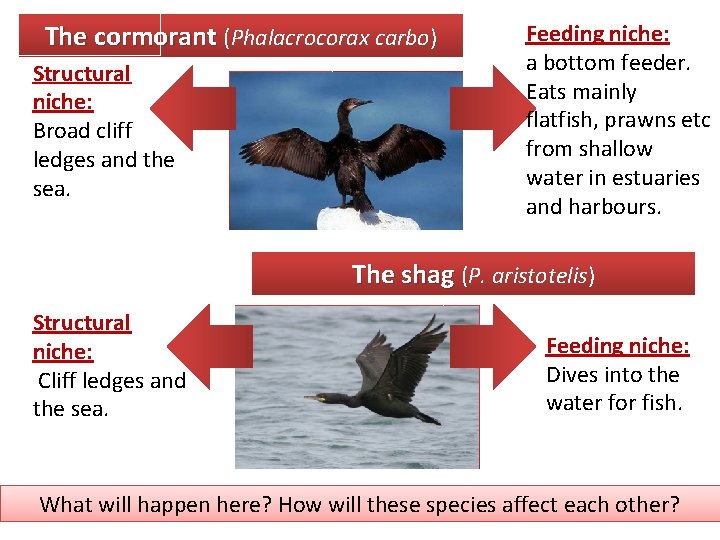
The cormorant (Phalacrocorax carbo) Structural niche: Broad cliff ledges and the sea. Feeding niche: a bottom feeder. Eats mainly flatfish, prawns etc from shallow water in estuaries and harbours. The shag (P. aristotelis) Structural niche: Cliff ledges and the sea. Feeding niche: Dives into the water for fish. What will happen here? How will these species affect each other?
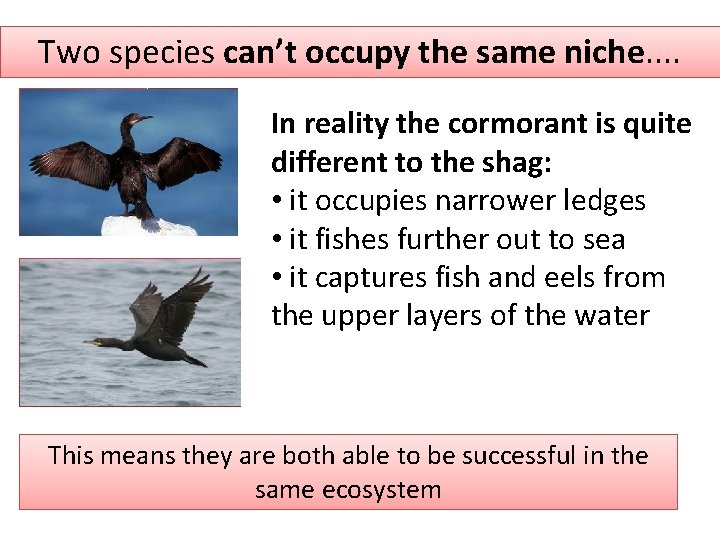
Two species can’t occupy the same niche. . In reality the cormorant is quite different to the shag: • it occupies narrower ledges • it fishes further out to sea • it captures fish and eels from the upper layers of the water This means they are both able to be successful in the same ecosystem
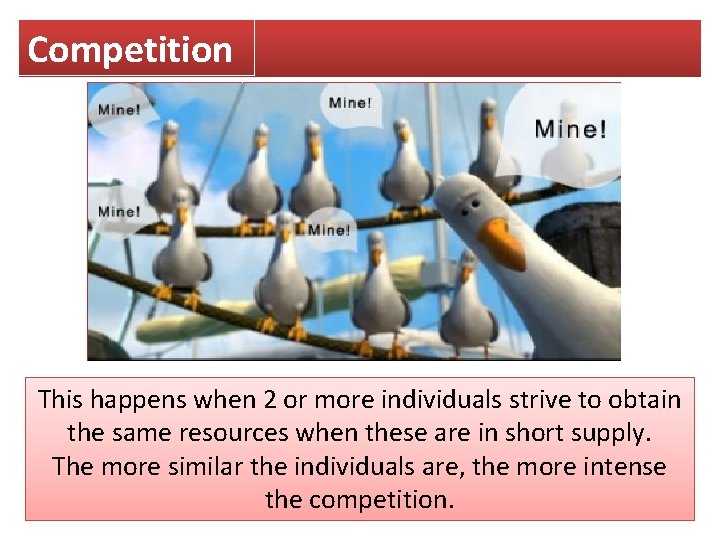
Competition This happens when 2 or more individuals strive to obtain the same resources when these are in short supply. The more similar the individuals are, the more intense the competition.
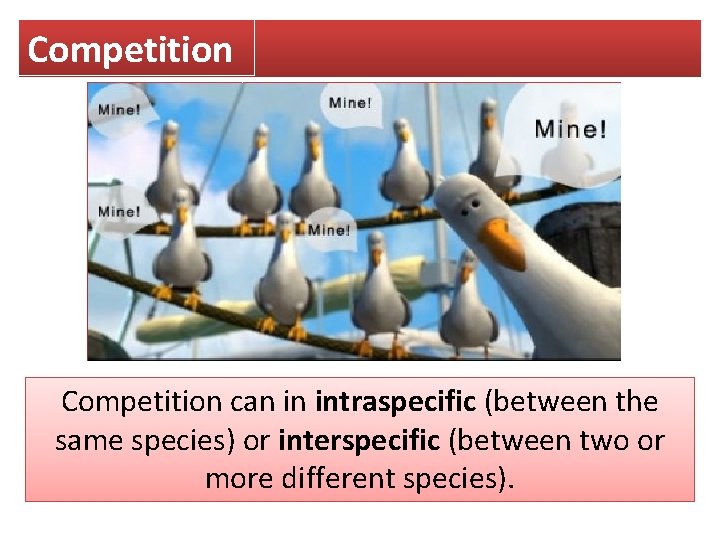
Competition can in intraspecific (between the same species) or interspecific (between two or more different species).
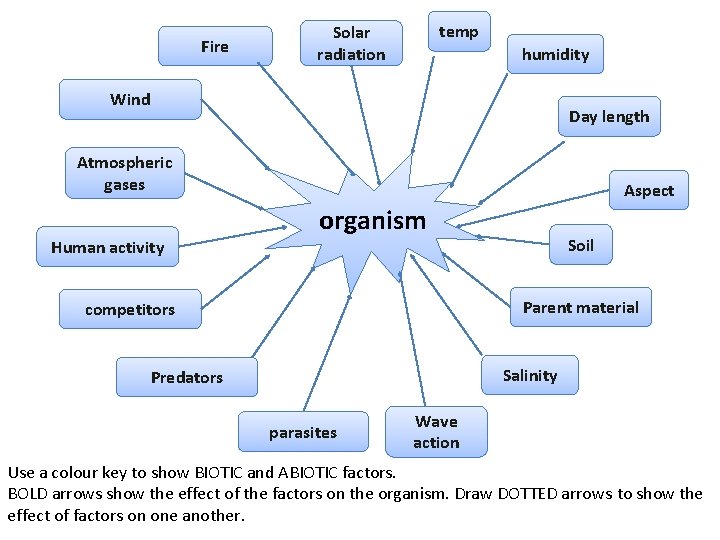
Fire temp Solar radiation humidity Wind Day length Atmospheric gases Human activity Aspect organism Soil Parent material competitors Salinity Predators parasites Wave action Use a colour key to show BIOTIC and ABIOTIC factors. BOLD arrows show the effect of the factors on the organism. Draw DOTTED arrows to show the effect of factors on one another.
Constructing an ecosystem • Within any ecosystem there are two main processes to consider: – The flow of energy through the ecosystem. – The cycling of elements through the ecosystem. • We are going to construct an ecosystem based on these two main principles.
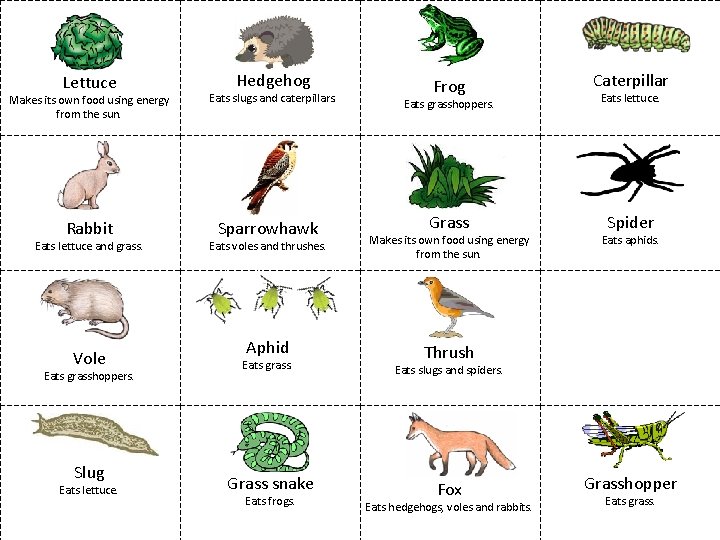
Lettuce Makes its own food using energy from the sun. Rabbit Eats lettuce and grass. Vole Eats grasshoppers. Slug Eats lettuce. Hedgehog Eats slugs and caterpillars. Sparrowhawk Frog Caterpillar Eats grasshoppers. Eats lettuce. Grass Spider Eats voles and thrushes. Makes its own food using energy from the sun. Aphid Thrush Eats grass. Eats slugs and spiders. Grass snake Fox Eats frogs. Eats hedgehogs, voles and rabbits. Eats aphids. Grasshopper Eats grass.
Constructing an ecosystem • As well as the cards provided, you will also have to draw/add your own elements to the ecosystem as some are missing.
Constructing an ecosystem • Cut out all of the cards and try to arrange them in a logical ecosystem. • Once your happy, glue them down. • Draw arrows between organisms to show the flow of energy (and therefore feeding relationships) within the ecosystem. • Around the outside, list any abiotic factors which could affect the individuals in the ecosystem.
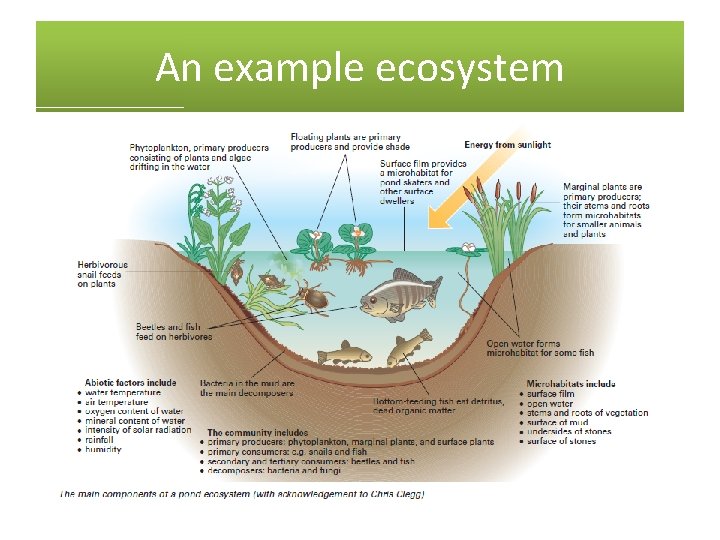
An example ecosystem
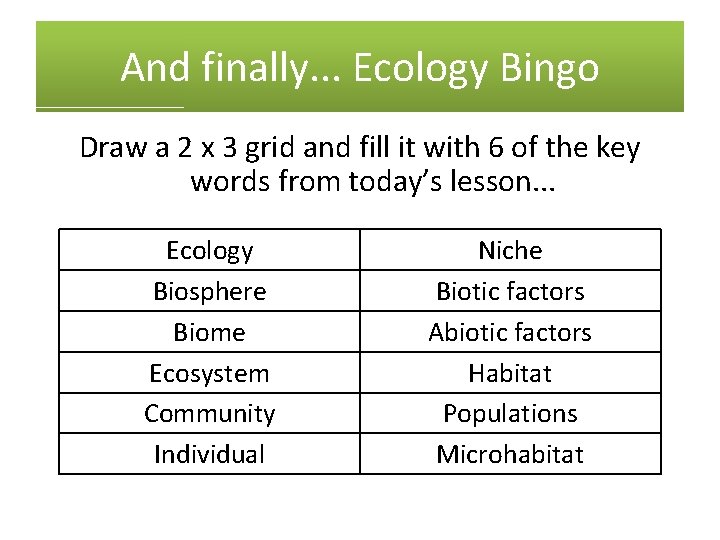
And finally. . . Ecology Bingo Draw a 2 x 3 grid and fill it with 6 of the key words from today’s lesson. . . Ecology Biosphere Biome Ecosystem Community Individual Niche Biotic factors Abiotic factors Habitat Populations Microhabitat
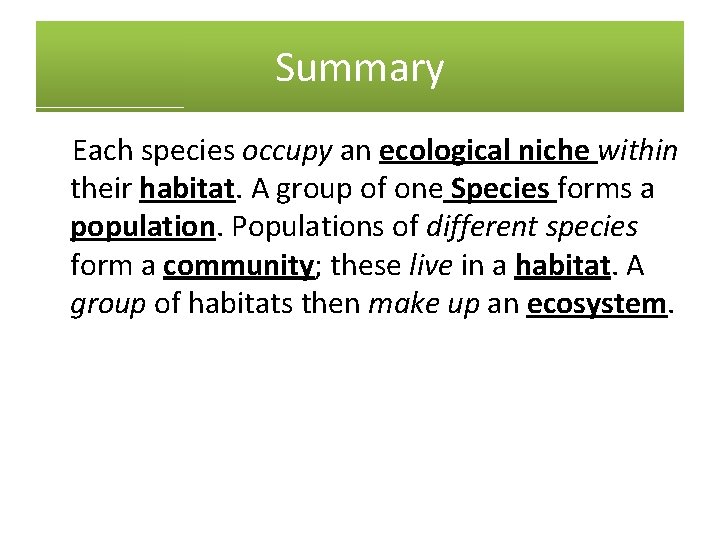
Summary Each species occupy an ecological niche within their habitat. A group of one Species forms a population. Populations of different species form a community; these live in a habitat. A group of habitats then make up an ecosystem.
- Slides: 24