
Key Vocabulary Skillrelated fitness BTEC Sport Knowledge Organiser
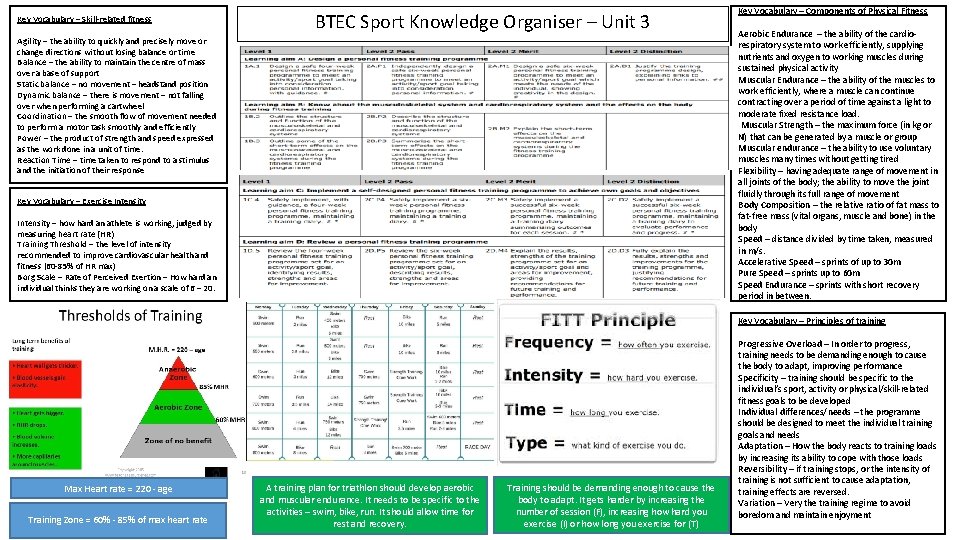
Key Vocabulary – Skill-related fitness BTEC Sport Knowledge Organiser – Unit 3 Agility – the ability to quickly and precisely move or change directions without losing balance or time Balance – the ability to maintain the centre of mass over a base of support Static balance – no movement – headstand position Dynamic balance – there is movement – not falling over when performing a cartwheel Coordination – the smooth flow of movement needed to perform a motor task smoothly and efficiently Power – the product of strength and speed expressed as the work done in a unit of time. Reaction Time – time taken to respond to a stimulus and the initiation of their response Key Vocabulary – Exercise Intensity – how hard an athlete is working, judged by measuring heart rate (HR) Training Threshold – the level of intensity recommended to improve cardiovascular health and fitness (60 -85% of HR max) Borg Scale – Rate of Perceived Exertion – How hard an individual thinks they are working on a scale of 6 – 20. Key Vocabulary – Components of Physical Fitness Aerobic Endurance – the ability of the cardiorespiratory system to work efficiently, supplying nutrients and oxygen to working muscles during sustained physical activity Muscular Endurance – the ability of the muscles to work efficiently, where a muscle can continue contracting over a period of time against a light to moderate fixed resistance load. Muscular Strength – the maximum force (in kg or N) that can be generated by a muscle or group Muscular endurance – the ability to use voluntary muscles many times without getting tired Flexibility – having adequate range of movement in all joints of the body; the ability to move the joint fluidly through its full range of movement Body Composition – the relative ratio of fat mass to fat-free mass (vital organs, muscle and bone) in the body Speed – distance divided by time taken, measured in m/s. Accelerative Speed – sprints of up to 30 m Pure Speed – sprints up to 60 m Speed Endurance – sprints with short recovery period in between. Key Vocabulary – Principles of training Max Heart rate = 220 - age Training Zone = 60% - 85% of max heart rate A training plan for triathlon should develop aerobic and muscular endurance. It needs to be specific to the activities – swim, bike, run. It should allow time for rest and recovery. Training should be demanding enough to cause the body to adapt. It gets harder by increasing the number of session (F), increasing how hard you exercise (I) or how long you exercise for (T) Progressive Overload – In order to progress, training needs to be demanding enough to cause the body to adapt, improving performance Specificity – training should be specific to the individual’s sport, activity or physical/skill-related fitness goals to be developed Individual differences/needs – the programme should be designed to meet the individual training goals and needs Adaptation – How the body reacts to training loads by increasing its ability to cope with those loads Reversibility – if training stops, or the intensity of training is not sufficient to cause adaptation, training effects are reversed. Variation – Very the training regime to avoid boredom and maintain enjoyment
- Slides: 1