
Key Topics NIF Overview Distributed Component Architecture Distribution
Key Topics · NIF Overview · Distributed Component Architecture · Distribution Complexity · Connection Management · Diagnostic Framework · Shot Automation · Commissioning Tools · Software Framework Evolution
NIF Facility flyover NIF is a stadium-sized facility that will contain · a 192 -beam, 1. 8 -Megajoule, 500 -Terawatt, ultraviolet laser system · a 10 -meter diameter target chamber with room for nearly 100 diagnostics
Symmetry & nomenclature National Ignition Facility “Quads” and “Bundles” are the basic building blocks of the NIF
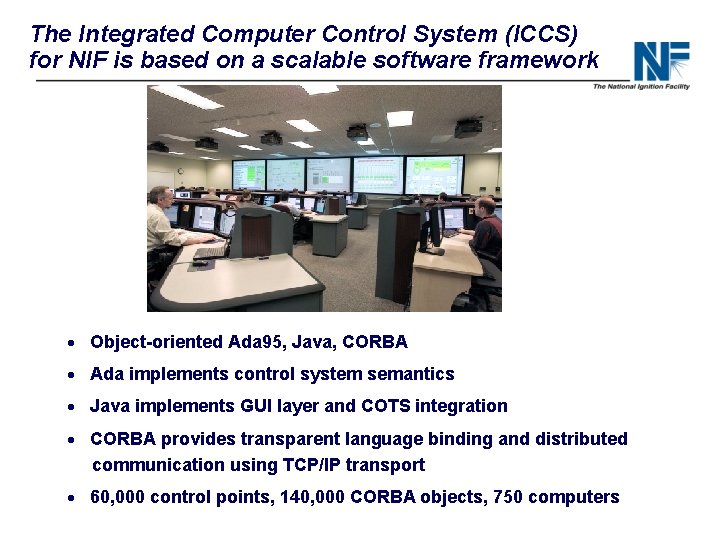
The Integrated Computer Control System (ICCS) for NIF is based on a scalable software framework · Object-oriented Ada 95, Java, CORBA · Ada implements control system semantics · Java implements GUI layer and COTS integration · CORBA provides transparent language binding and distributed communication using TCP/IP transport · 60, 000 control points, 140, 000 CORBA objects, 750 computers
Framework Approach
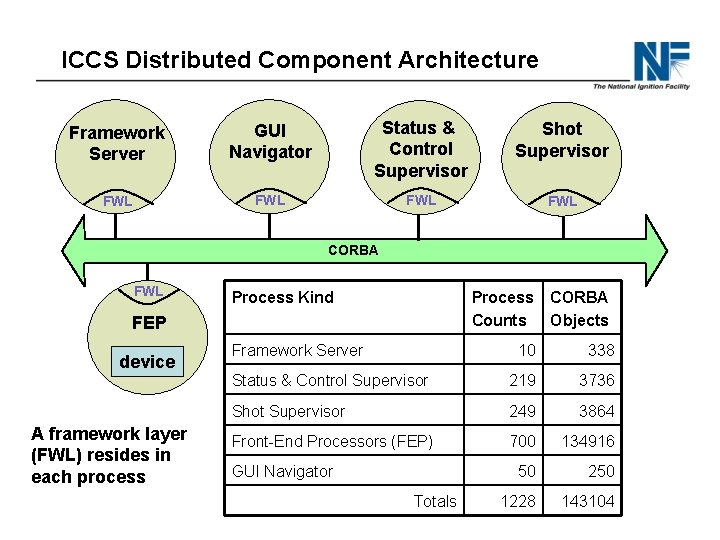
ICCS Distributed Component Architecture Framework Server GUI Navigator Status & Control Supervisor Shot Supervisor FWL FWL CORBA FWL Process Kind Process Counts FEP device A framework layer (FWL) resides in each process Framework Server CORBA Objects 10 338 Status & Control Supervisor 219 3736 Shot Supervisor 249 3864 Front-End Processors (FEP) 700 134916 50 250 1228 143104 GUI Navigator Totals
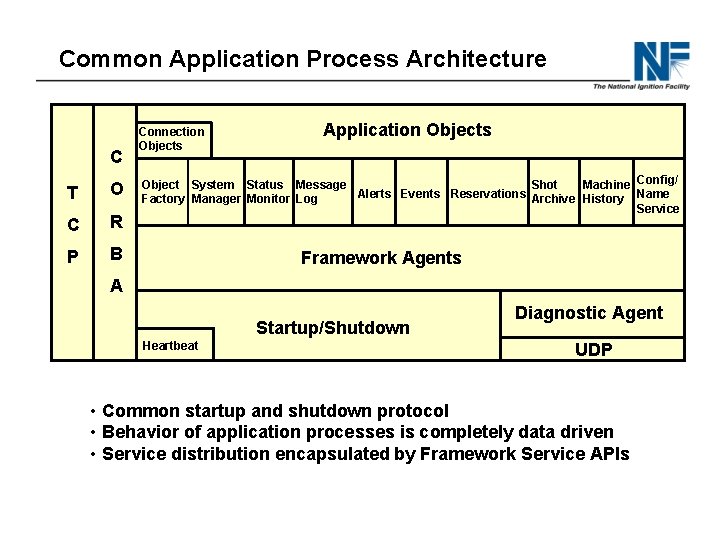
Common Application Process Architecture C T O C R P B Connection Objects Application Objects Object System Status Message Shot Machine Config/ Alerts Events Reservations Archive History Name Factory Manager Monitor Log Service Framework Agents A Startup/Shutdown Heartbeat Diagnostic Agent UDP • Common startup and shutdown protocol • Behavior of application processes is completely data driven • Service distribution encapsulated by Framework Service APIs
Distribution Complexity · Layered client-server computer architecture - 340 distinct CORBA interfaces - 700 Front-End Processors (Power PC, x 86, Sun) interface to various sensors, actuators, instruments - 50 server class computers (Sun) host supervisor software and framework servers - 14 console PCs host Java GUIs in the control room · Bundle-based hardware partitioning eliminates scaling risk by bounding CORBA object populations and TCP connections · CORBA provides transparent language binding (Java, Ada 95) and location independent inter-process communication · Policies define interface de-coupling mechanisms and common exception pattern
ICCS employs a component-based communication architecture with connection management · Decoupled inter-process communications reduces deadlock potential · Object reconnection allows transparent process restarts · Subscription management restores all subscription services · Process heartbeats verify process health · Status health heartbeats provide positive status health feedback · Timed remote invocations protect clients from problematic services ICCS provides fault resilience – degraded operation in the presence of server failure and recovery upon server restoration
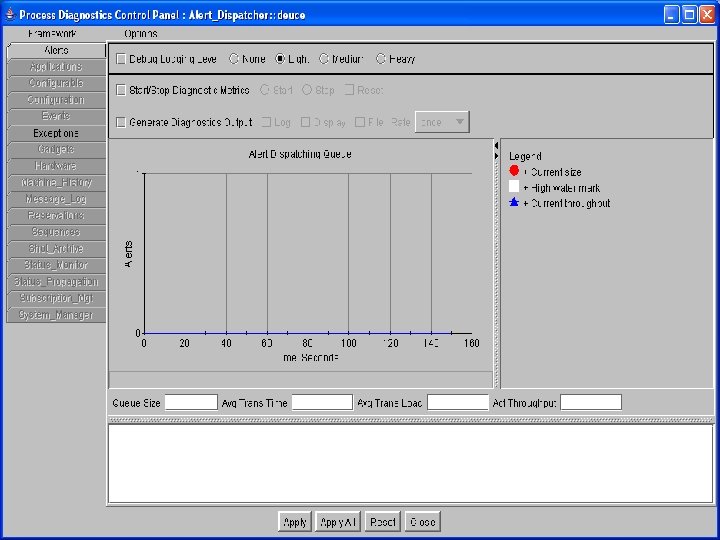
Diagnostic Architecture Framework · “Out-of-CORBA-band” probes (UDP) · System Level Diagnostics - Network, I/O, memory, CPU - SNMP based · Process Level Diagnostics - Diagnostic Agent embedded into ICCS process architecture - Custom diagnostic objects register with the Diagnostic Agent - Remotely activated and displayed - Stored for off-line analysis - Supports framework and application diagnostic classes
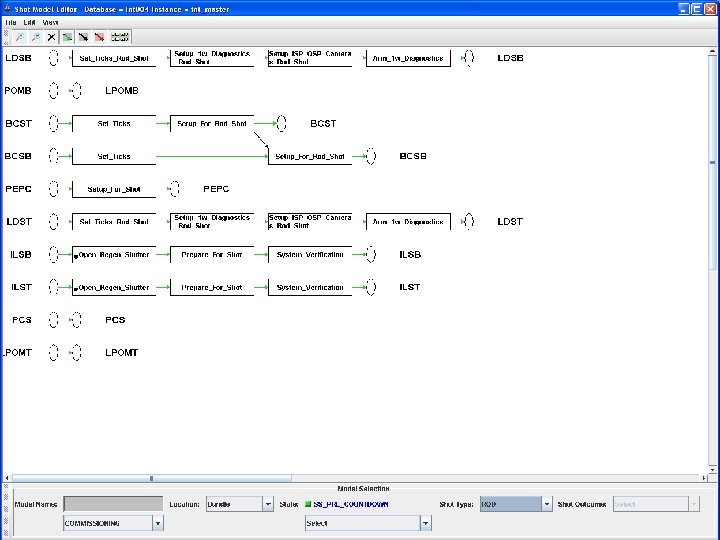
Shot Automation Framework · Requirements derived from NIF Early Light experience · Intensive, year long, design and development effort · Achieves NIF scale through bundle partitioning · State machine guides operators through 10 well defined shot cycle states · Shot model describes (in data) subsystem activities and dependencies · A workflow engine executes the shot model · Calculated participation based on laser beam destination and diagnostic use (only control components that are in the beam path) · Support error recovery - Operators given Pause/Play, Stop, Manual Step, Retry, and Resume Automation semantics - Can de-participate non-performing non-critical components/segments · Shot model editor provides flexibility to define different NIF operating scenarios
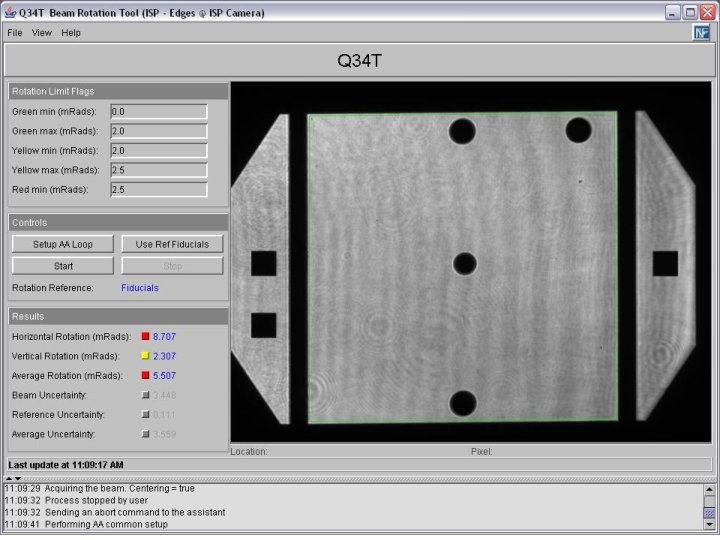
Commissioning Tools facilitate NIF build-out · Tools that enable efficient calibration/qualification of laser components · Framework utilizes existing device layer CORBA interfaces and separates displays from algorithms via autonomous threads · Contain complex algorithms that send commands to collections of devices and aggregate/process data · Results stored in a configuration database for use in integrated shot operations
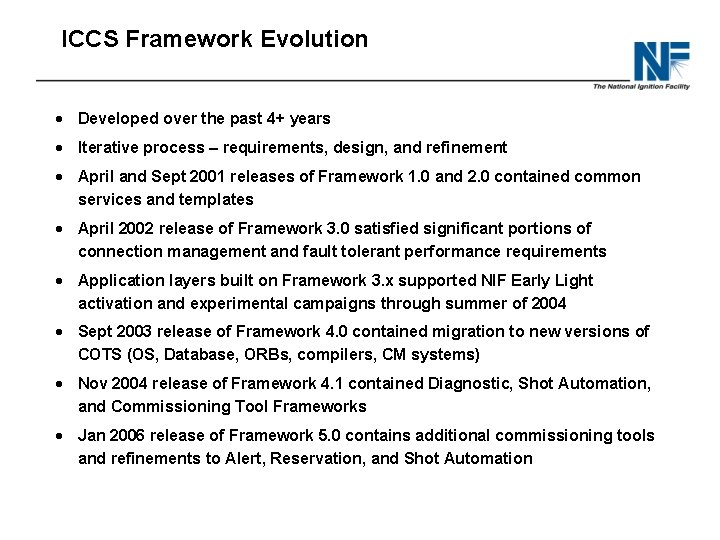
ICCS Framework Evolution · Developed over the past 4+ years · Iterative process – requirements, design, and refinement · April and Sept 2001 releases of Framework 1. 0 and 2. 0 contained common services and templates · April 2002 release of Framework 3. 0 satisfied significant portions of connection management and fault tolerant performance requirements · Application layers built on Framework 3. x supported NIF Early Light activation and experimental campaigns through summer of 2004 · Sept 2003 release of Framework 4. 0 contained migration to new versions of COTS (OS, Database, ORBs, compilers, CM systems) · Nov 2004 release of Framework 4. 1 contained Diagnostic, Shot Automation, and Commissioning Tool Frameworks · Jan 2006 release of Framework 5. 0 contains additional commissioning tools and refinements to Alert, Reservation, and Shot Automation
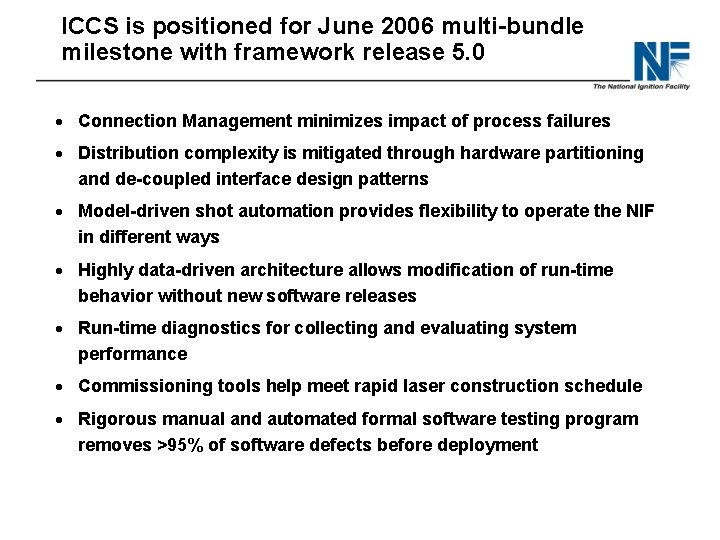
ICCS is positioned for June 2006 multi-bundle milestone with framework release 5. 0 · Connection Management minimizes impact of process failures · Distribution complexity is mitigated through hardware partitioning and de-coupled interface design patterns · Model-driven shot automation provides flexibility to operate the NIF in different ways · Highly data-driven architecture allows modification of run-time behavior without new software releases · Run-time diagnostics for collecting and evaluating system performance · Commissioning tools help meet rapid laser construction schedule · Rigorous manual and automated formal software testing program removes >95% of software defects before deployment
Status of the use of Large-Scale CORBADistributed Software Framework for NIF Controls ICALEPCS 2005 October 10 -14, 2005 R. Carey, R. Bettenhausen, C. Estes, J. Fisher, J. Krammen, L. Lagin, A. Ludwigsen, D. Mathisen, J. Matone, R. Patterson, C. Reynolds, R. Sanchez, E. Stout, J. Tappero, P. Van. Arsdall National Ignition Facility Lawrence Livermore National Laboratory The work was performed under the auspices of the U. S. Department of Energy National Nuclear Security Administration by the University of California Lawrence Livermore National Laboratory under Contract No. W-7405 -ENG-48.
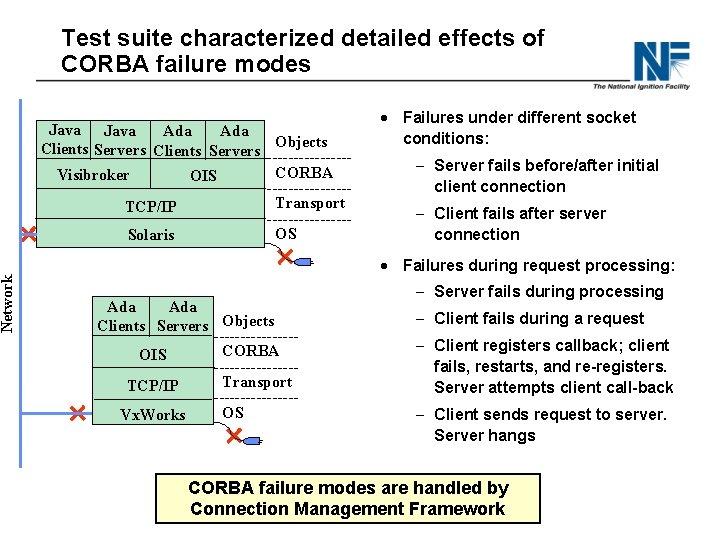
Network Test suite characterized detailed effects of CORBA failure modes Java Ada Objects Clients Servers --------CORBA Visibroker OIS --------Transport TCP/IP --------OS Solaris · Failures under different socket conditions: - Server fails before/after initial client connection - Client fails after server connection · Failures during request processing: Ada Clients Servers Objects --------CORBA OIS --------Transport TCP/IP --------OS Vx. Works - Server fails during processing - Client fails during a request - Client registers callback; client fails, restarts, and re-registers. Server attempts client call-back - Client sends request to server. Server hangs CORBA failure modes are handled by Connection Management Framework
Plug-and-play component architecture is designed to scale up
- Slides: 22