
KEY TIPS ON MEETING THE EMPLOYERS INTERACTIVE PROCESS








- Slides: 41
KEY TIPS ON MEETING THE EMPLOYER’S INTERACTIVE PROCESS OBLIGATIONS IN WORKERS’ COMPENSATION CASES Presented by JOHN B. FLOYD, Esq. , SENIOR PARTNER 1
DISCLAIMER NOTHING IN THIS PRESENTATION SHOULD BE INTERPRETED OR RELIED UPON AS LEGAL ADVICE. THE PRESENTATION IS FOR EDUCATIONAL PURPOSES ONLY. FOR LEGAL ADVICE YOU SHOULD CONSULT A QUALIFIED ATTORNEY OR OTHER EXPERT. THIS PRESENTATION MAY NOT BE RECORDED, COPIED, OR DISTRIBUTED WITHOUT THE EXPRESS PERMISSION OF FLOYD SKEREN MANUKIAN LANGEVIN, LLP. 6/11/2018 © 2018 FSML Publishing, Inc. , FSML ALL RIGHTS RESERVED 2
INTRODUCTION Welcome! Both the Fair Employment and Housing Act (FEHA) and the Americans with Disabilities Act (ADA) typically run concurrently with workers’ compensation, and thus require the Interactive Process to identify and implement reasonable accommodations when appropriate. Employers must be aware of trigger points in a workers’ compensation case for the Interactive Process. Today, we will be discussing your obligation, as an employer, to comply with the overlapping requirements under workers’ compensation, FEHA and the ADA. Remember, in California failure to engage in the Interactive Process is a separate cause of action that can result in costly liability for an employer! 6/11/2018 © 2018 FSML Publishing, Inc. , FSML ALL RIGHTS RESERVED 3
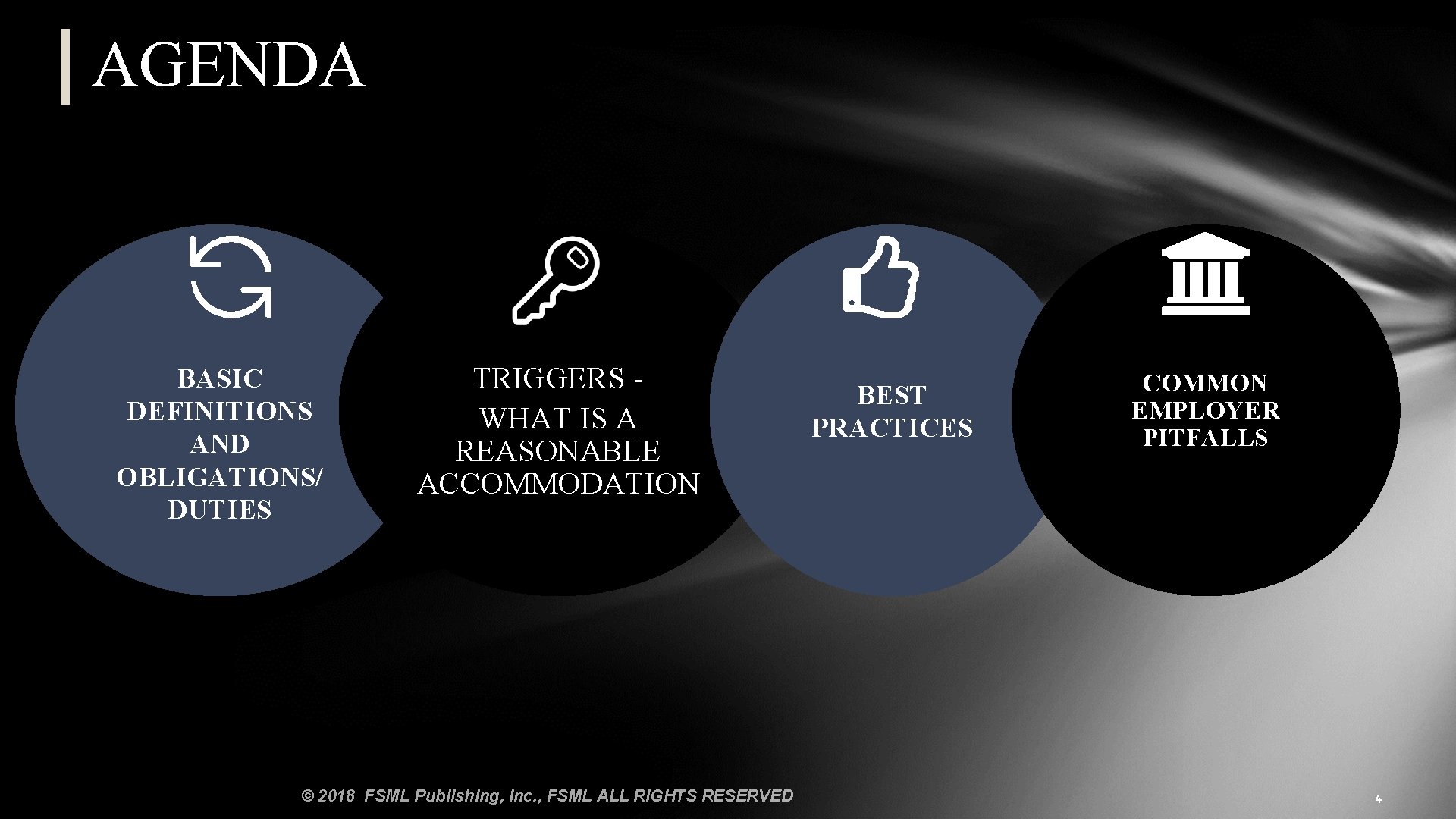
AGENDA BASIC DEFINITIONS AND OBLIGATIONS/ DUTIES TRIGGERS WHAT IS A REASONABLE ACCOMMODATION © 2018 FSML Publishing, Inc. , FSML ALL RIGHTS RESERVED BEST PRACTICES COMMON EMPLOYER PITFALLS AND COMMON PITFALLS 4
BASIC DEFINITIONS AND OBLIGATIONS/ DUTIES 6/11/2018 © 2018 FSML Publishing, Inc. , FSML ALL RIGHTS RESERVED 5
“FEHA” Fair Employment and Housing Act • Protects employees from illegal discrimination and harassment in employment based on race, color, religion, sex (pregnancy or gender), sexual orientation, marital status, national origin, ancestry, mental and physical disability (including HIV/AIDS), medical condition (cancer/genetic characteristics), age (40 and above), denial of family and medical care leave, and denial of pregnancy disability leave. • FEHA also protects employees that are perceived to have any of the above protected characteristics. Physical and mental impairments include conditions that are disabling, potentially disabling, or perceived as disability. 6/11/2018 © 2018 FSML Publishing, Inc. , FSML ALL RIGHTS RESERVED 6
“FEHA” Fair Employment and Housing Act • FEHA also requires employers to 1) reasonably accommodate an employee or job applicant’s religious beliefs and practices, 2) reasonably accommodate employees or job applicants with a physical or mental disability, in order to enable them to perform the essential functions of a job, 3) provide up to four months leave to employees due to pregnancy, childbirth, or a related medical condition, and 4) provide reasonable accommodations required by an employee, on the advice of the employee’s health care provider, related to pregnancy, childbirth, or related medical conditions. • FEHA further prohibits retaliation against a person who opposes, reports, or assists another person in opposing unlawful discrimination. 6/11/2018 © 2018 FSML Publishing, Inc. , FSML ALL RIGHTS RESERVED 7
“ADA” American with Disabilities Act • The ADA became law in 1990. It is one of America’s most comprehensive pieces of civil rights legislation that prohibits discrimination and guarantees that people with disabilities have the same opportunities as everyone else to participate in the mainstream of American life, including, but not limited to enjoying employment opportunities. • To be protected by the ADA, one must have a disability, which is defined by the ADA as a physical or mental impairment that substantially limits one or more major life activities, a person who has a history or record of such an impairment, or a person who is perceived by others as having such an impairment. 6/11/2018 © 2018 FSML Publishing, Inc. , FSML ALL RIGHTS RESERVED 8
KEY DIFFERENCE OF WC, FEHA AND ADA Worker’s Compensation Provides benefits to employees who were injured AT WORK; Determines if work caused injury or illness, if so provide compensation. Workers’ compensation is a benefits program; looks at permanent versus temporary impairment, and rates level of permanent impairment to determine compensation FEHA and ADA Protect employees against discrimination, harassment and retaliation based on disability (and other protected groups). Employer obligation includes conducting an Interactive Process to determine if an accommodation is necessary; Determine if individual is unable to perform essential functions of the job, if so the Interactive Process must be conducted and accommodation may be necessary; no compensation is provided. 6/11/2018 © 2018 FSML Publishing, Inc. , FSML ALL RIGHTS RESERVED 9
“DISABILITY” DEFINED UNDER FEHA/ADA ADA: An individual with a disability is defined by the Americans with Disabilities Act (“ADA”) as a person who has a physical or mental impairment that substantially limits one or more major life activities, (which is virtually everything), a person who has a history or record of such an impairment, or a person who is perceived by others as having such an impairment. FEHA: California expands the definition of “disability” to an impairment that makes one or more major life activities “difficult. ” 6/11/2018 © 2018 FSML Publishing, Inc. , FSML ALL RIGHTS RESERVED 10
“REASONABLE ACCOMODATION” A reasonable accommodation is basically any change or modification to the workplace or the way in which a job is customarily done to enable an employee with a disability or serious medical condition to perform the essential functions of his or her job, or to return to work after a medical leave of absence. 6/11/2018 © 2018 FSML Publishing, Inc. , FSML ALL RIGHTS RESERVED 11
“INTERACTIVE PROCESS” The process that an employer utilizes in order to determine the appropriate reasonable accommodation that will enable an employee with a disability to perform the essential functions of the position. Employers and employees work together to assess whether an employee’s disability can be reasonably accommodated. It is an informal process in which the employee and employer determine the precise limitations created by the disability and how best to respond to the need for accommodation. How do the amended FEHA Regulations define Interactive Process? • A timely, good faith communication between the employer and the applicant or employee in order to explore whether or not the applicant or employee needs reasonable accommodation for the applicant’s or employee’s physical or mental disability to perform the essential functions of the job; and, if so, to explore how the person can be reasonably accommodated. 6/11/2018 © 2018 FSML Publishing, Inc. , FSML ALL RIGHTS RESERVED 12
OBLIGATIONS/DUTIES Duty to Provide • Although the burden to request an accommodation is on the employee or applicant, there are circumstances under which employers may have an obligation to provide an accommodation, without a request to do so, if the employer is on notice of a problem. • Accommodations should be considered pursuant to an interactive process without a specific request if the employer: • Knows or should know that the employee has a mental or physical disability; • Knows or should know that the employee is experiencing workplace problems because of the disability, or • Knows or should know that the disability prevents the employee from requesting a reasonable accommodation. 6/11/2018 © 2018 FSML Publishing, Inc. , FSML ALL RIGHTS RESERVED 13
Duty to Engage Once an accommodation has been requested or the need for an accommodation is obvious, the employer must initiate an interactive process with the employee/applicant. © 2018 FSML Publishing, Inc. , FSML ALL RIGHTS RESERVED 14
ACCOMMODATION OBLIGATIONS An employer is required to consider all reasonable accommodations of which it is aware or that are brought to its attention by the applicant or employee, unless the requested accommodation poses an undue hardship on the employer. The employer must consider the preference of the applicant or employee to be accommodated, but has the right to select and implement an accommodation that is effective for both the employee and the employer. Employers do not have to implement reasonable accommodations that impose an undue hardship –however undue hardship can be difficult to establish. 6/11/2018 © 2018 FSML Publishing, Inc. , FSML ALL RIGHTS RESERVED 15
TRIGGERS WHAT IS A REASONABLE ACCOMMODATION? 6/11/2018 © 2018 FSML Publishing, Inc. , FSML ALL RIGHTS RESERVED 16
TRIGGERS TO POTENTIAL ACCOMODATION/INTERACTIVE PROCESS The interactive process is triggered as soon as the employer becomes aware that the employee may have a mental or physical impairment that limits his/her ability to perform ANY aspect of his/her job. Remember that although the employee may disclose that he/she has an impairment that affects his/her ability to do the job, the employee is NOT required to specifically request an accommodation or disclose that he/she has a disability requiring accommodation. The process may be triggered by any one or a combination of the following situations: • Verbally or in writing by the disabled employee. • An employee regularly misses work, telling the employer that he/she is ill. • An employee sustains a work related injury; the employer receives work restrictions from a medical provider in the workers’ compensation case; the applicant is declared MMI; • A family member, friend, health professional, or other representative may request a reasonable accommodation on behalf of an individual with a disability. • The employee requests a reasonable accommodation, specifically or by reference to his/her limitations. • A manager or supervisor observes that an employee is having some difficulty performing his/her job duties. 6/11/2018 © 2018 FSML Publishing, Inc. , FSML ALL RIGHTS RESERVED 17
EXAMPLES OF A REASONABLE ACCOMMODATION (A) Making existing facilities used by applicants and employees readily accessible to and usable by individuals with disabilities. This may include, but is not limited to, providing accessible break rooms, restrooms, training rooms, or reserved parking places; acquiring or modifying furniture, equipment or devices; or making other similar adjustments in the work environment; (B) Allowing applicants or employees to bring assistive animals to the work site; (C) Transferring an employee to a more accessible worksite; (D) Providing assistive aids and services such as qualified readers or interpreters to an applicant or employee; (E) Job Restructuring. This may include, but is not limited to, reallocation or redistribution of non- essential job functions in a job with multiple responsibilities; (F) Providing a part-time or modified work schedule; (G) Permitting an alteration of when and/or how an essential function is performed; (H) Providing an adjustment or modification of examinations, training materials or policies; 6/11/2018 © 2018 FSML Publishing, Inc. , FSML ALL RIGHTS RESERVED 18
EXAMPLES OF A REASONABLE ACCOMMODATION CONTINUED… (I) Modifying an employer policy; (J) Modifying task completion methods (e. g. , dividing complex tasks into smaller parts); (K) Providing additional training; (L) Permitting an employee to work from home; (M) Providing a paid or unpaid leave for treatment and recovery; (N) Providing reassignment to a vacant position. 19 6/11/2018 © 2018 FSML Publishing, Inc. , FSML ALL RIGHTS RESERVED
NO REASONABLE MODIFIATION AVAILABLE? IF NO EFFECTIVE REASONABLE MODIFICATION IS POSSIBLE FOR THE CURRENT JOB YOU MUST CONSIDER: Transfer to Alternative Vacant Position • Must be qualified for the position, with or without reasonable accommodation; • Entitled to preference over other applicants for the position, if equally qualified; • However, a new position does not need to be created; • Reassignment does not include promotion or bypassing a seniority system. Leave of Absence • • May be a reasonable accommodation provided that the leave is: • Likely to be effective in allowing the employee to return to work at the end of the leave, with or without further reasonable accommodation, and • Does not create an undue hardship for the employer. An employer is not required to provide an indefinite leave of absence as a reasonable accommodation. 6/11/2018 © 2018 FSML Publishing, Inc. , FSML ALL RIGHTS RESERVED 20
BEST PRACTICES 6/11/2018 © 2018 FSML Publishing, Inc. , FSML ALL RIGHTS RESERVED 21
STEP ONE CREATE A DISABILITY MANAGEMENT POLICY Create a disability management policy that includes the interactive process, an interactive process form and reasonable accommodation protocols; train all managers and supervisors on this policy particularly front line managers and supervisors. Inform your employees that a requirement of the FEHA/ADA is that both parties communicate in good faith regarding the interactive process and reasonable accommodations. Advise your employees that if they request an accommodation, you will review their job description with them, explore the difficulties that their disability causes in their performance of the essential job functions and brainstorm over accommodation/alternative vacant positions that could be provided to assist them. On the interactive process form be sure to list all accommodations that were considered/alternative vacant positions, and if employee rejects an accommodation/alternative vacant position, detail the reason why. 6/11/2018 © 2018 FSML Publishing, Inc. , FSML ALL RIGHTS RESERVED 22
STEP TWO CREATE AND PERIODICALLY REVIEW JOB DESCRIPTIONS Create accurate job descriptions- periodically review them to ensure they are accurate; remember job descriptions are vital to conducting the Interactive Process and implementing accommodations. Job Descriptions MUST be up to date and MUST contain all essential functions, and should contain nonessential/marginal functions of the job. Employees should sign their job description on date of hire and at their annual performance review to affirm their agreement as to the essential functions of the job; consider feedback from employees as to whether the job description accurately reflects the essential functions of their job. 6/11/2018 © 2018 FSML Publishing, Inc. , FSML ALL RIGHTS RESERVED 23
STEP THREE TRAIN YOUR SUPERVISORS/MANAGERS Train supervisors/managers to recognize a potential disability concern and what to do when this occurs. Supervisors/managers must understand their role in conducting the interactive process/implementing reasonable accommodations, and in reporting to HR when an accommodation/IP may be needed. Train supervisors/managers on FEHA/ADA, and on the risk of a disability discrimination lawsuit if the employer fails to comply with the obligation to conduct an IP and implement an accommodate, if appropriate. IMPORTANT: TO 6/11/2018 ALSO, TRAIN YOUR SUPERVISORS/MANAGERS NOT TO ASK AN EMPLOYEE IDENTIFY HIS OR HER MEDICAL CONDITION. © 2018 FSML Publishing, Inc. , FSML ALL RIGHTS RESERVED 24
STEP THREE CONT… TRIGGERS FOR CONDUCTING THE INTERACTIVE PROCESS: • An employee tells his/her supervisor “I am having a hard time getting to work on time because I am undergoing medical treatments. ” • A new employee, who uses a wheelchair, tells the employer that the wheelchair cannot fit under the desk in his/her office. • An employee needs to work part time for six months due to fatigue experienced by chemotherapy; A simple request for a new chair or monitor riser without the information that the need is related to a medical condition is probably not sufficient to be an accommodation request. 6/11/2018 © 2018 FSML Publishing, Inc. , FSML ALL RIGHTS RESERVED 25
STEP FOUR ARRANGE A PERSONAL MEETING/CONSULTATION WITH THE EMPLOYEE This is the ESSENCE of the Interactive Process. AN INTERACTIVE DIALOGUE WITH THE EMPLOYEE TO EXPLORE SOLUTIONS. Remember that the information obtained or provided in the meeting is confidential and should be treated the same as medical records in terms of privacy! Both parties must engage in the Interactive Process in good faith; in almost every case it will require multiple follow-up sessions. Who should be there? • Employee • Supervisor • A Human Resource Representative (either supervisor or HR representative is the designated “note taker”) • Employee’s attorney? Employer should allow if employee requests (also a union rep, or family member); employer may want their attorney present also if employee requires his or her attorney. 6/11/2018 © 2018 FSML Publishing, Inc. , FSML ALL RIGHTS RESERVED 26
STEP FIVE OBTAIN MEDICAL CERTIFICATION FROM THE EMPLOYEE’S HEALTH CARE PROVIDER The employer should always require medical certification from the employee’s health care provider if there is a need or request for an accommodation. Medical certification from the health care provider must include: • The name and credentials of the health care provider, which establish that the individual falls within the definition of “health care provider” under the FEHA. • That the employee or applicant has a physical or mental condition that limits a major life activity or a medical condition, and a description of why the employee or applicant needs a reasonable accommodation to have an equal opportunity: to participate in the application process and to be considered for the job, or to perform the employee's job duties, or to enjoy equal benefits and privileges of employment compared to non-disabled employees. The employer or other covered entity shall not ask for unrelated documentation, including in most circumstances, an applicant's or employee's complete medical records, because those records may contain information unrelated to the need for accommodation. Make sure to include the “Safe Harbor” language required by the Genetic Information Nondisclosure Act (GINA) and limit your request to information that is required as a matter of business necessity. Consider conferring with counsel regarding the content of the medical certification. 6/11/2018 © 2018 FSML Publishing, Inc. , FSML ALL RIGHTS RESERVED 27
STEP FIVE CONT… If an applicant or employee provides insufficient documentation in response to the employer's request, the employer must explain why the documentation is insufficient and allow the applicant or employee an opportunity to provide supplemental information in a timely manner from the employee's health care provider. Thereafter, if there is still insufficient documentation, the employer may require an employee to go to an appropriate health care provider of the employer’s choice. • Documentation is insufficient if it does not specify the existence of a FEHA disability and explain the need for reasonable accommodation. Where relevant, such an explanation should include a description of the applicant's or employee's functional limitation(s) to perform the essential job functions. • Documentation also might be insufficient where the health care provider does not have the expertise to confirm the applicant's or employee's disability or need for reasonable accommodation, or other objective factors indicate that the information provided is not credible or is fraudulent. 6/11/2018 © 2018 FSML Publishing, Inc. , FSML ALL RIGHTS RESERVED 28
STEP SIX FOLLOW-UP AND DOCUMENT THE PROCESS The Interactive Process does not end with the initial meeting. Once the employer has implemented a reasonable accommodation, the employer must follow up with the employee on a regular basis to ensure that the accommodation is effective, and if not schedule another interactive process. Document every step and conversation throughout the Interactive Process, even short conversations. It may seem trivial at the time but when defending a claim that you did not provide a reasonable accommodation this information is crucial. Use an interactive process form and have the employee sign the form. The DFEH has a sample form on their website at www. dfeh. ca. gov. FSML can also provide a template if you provide your email address. Keep the information in the employee’s confidential medical file, NOT the personnel file. 6/11/2018 © 2018 FSML Publishing, Inc. , FSML ALL RIGHTS RESERVED 29
COMMON EMPLOYER PITFALLS 6/11/2018 © 2018 FSML Publishing, Inc. , FSML ALL RIGHTS RESERVED 30
INCORRECT ASSUMPTIONS • 100% permanent workers’ compensation accommodate / return to work; – False. disability precludes duty to • One interactive process consultation is sufficient to comply - False; • An employer can require that an employee is 100 percent recovered before RTW (American Airlines recently required to pay $9 million for such a policy) - False. 6/11/2018 © 2018 FSML Publishing, Inc. , FSML ALL RIGHTS RESERVED 31
FAILURE TO EXERCISE PATIENCE The Interactive Process takes time, and the accommodation issue will not be solved quickly. Multiple interactive process sessions will likely be required. 6/11/2018 © 2018 FSML Publishing, Inc. , FSML ALL RIGHTS RESERVED 32
FAILURES IN DOCUMENTATION No documentation, limited notes; No summary or follow up documentation; No signature or agreement of employee; Not documenting follow up meetings; Inaccurate or outdated job descriptions; No explanation as to why an accommodation is denied by employer or turned down by the employee Documentation is unclear, poorly written. 6/11/2018 © 2018 FSML Publishing, Inc. , FSML ALL RIGHTS RESERVED 33
IP IS AN ON-GOING PROCESS Not initiating the interactive process when needed; Not conducting an IP at all-instead there is an internal employer review of how to proceed; Conducting a perfunctory interactive process; If the first choice is ineffective; failure to fully explore all other available accommodations; No follow up. 6/11/2018 © 2018 FSML Publishing, Inc. , FSML ALL RIGHTS RESERVED 34
OTHER MISTAKES Failure to adequately explore alternative vacant positions; Obstructing the process- (e. g. not allowing attorney, union rep, family member to be present- requiring the employee to come into the workplace); Failure to consider employee’s suggested reasonable accommodation. Failure to have a compliant anti-discrimination, harassment and retaliation policy in place and to train all employees on this policy. 6/11/2018 © 2018 FSML Publishing, Inc. , FSML ALL RIGHTS RESERVED 35
EXAMPLES © 2018 FSML Publishing, Inc. , FSML ALL RIGHTS RESERVED 36
A cashier easily becomes fatigued because of lupus and has difficulty making it through her shift. She requests a stool because sitting greatly reduces the fatigue. This accommodation is reasonable because it is a common-sense solution to remove a workplace barrier being required to stand when the job can be effectively performed sitting down. This “reasonable” accommodation is effective because it addresses the employee’s fatigue and enables her to perform her job. However… An employee tells his supervisor he would like a new chair because his present one is uncomfortable. This is a request for a change at work, but his statement is insufficient to put the employer on notice that he is requesting reasonable accommodation. He does not link his need for a new chair with a medication condition. 6/11/2018 © 2018 FSML Publishing, Inc. , FSML ALL RIGHTS RESERVED 37
A cleaning company rotates its staff to different floors on a monthly basis. One crew member has a mental disability which makes it difficult for him to change his daily routine. He asks for a reasonable accommodation and proposes three options: staying on one floor permanently, staying on one floor for two months and then rotating, or allowing a transition period to adjust to a change in floor assignments. The question will be whether granting the accommodation poses an undue hardship on the employer. Remember, an employer may have to provide reasonable accommodation to enable an employee with a disability to meet the required production standard, however, the employer is not required to eliminate an essential function or lower a production standard, although it may do so if it wishes. 6/11/2018 © 2018 FSML Publishing, Inc. , FSML ALL RIGHTS RESERVED 38
An employee with a mental disability distributes mail for a law firm. He frequently mixes up the mail for an attorney confusing “P. Lewis” with “T. Lewis”. The employer is aware of the performance deficiency and suspects that it is due to a disability. The employer also suspects that the employee is unable to ask for a reasonable accommodation because of a mental disability. The employer asks the employee about mixing up the two names and asks if it would be more helpful to spell the first name of each person. When the employee says that would be better, the employer, as a reasonable accommodation, instructs the receptionist to write the full first name. This is an example of the employer having the responsibility to know, without being asked by the employee, that an accommodation may be necessary. 6/11/2018 © 2018 FSML Publishing, Inc. , FSML ALL RIGHTS RESERVED 39
CONCLUSION © 2018 FSML Publishing, Inc. , FSML ALL RIGHTS RESERVED 40
DISCLAIMER AND COPYRIGHT INFORMATION This publication/presentation is only intended to provide educational information about the subject matter covered. It is not intended to, nor does it constitute legal advice. More specifically, it is provided with the understanding that the authors/presenters do not render legal or other professional advice/services. If legal advice or other expert assistance is required, seek the services of a competent professional. Persons using this publication/attending the presentation, who are dealing with specific legal matters, should exercise their own independent judgment and research original sources of authority and local court rules. The authors/presenters make no representations concerning the contents of this publication/presentation and disclaim any warranties of merchantability or fitness for a particular purpose. THIS PRESENTATION MAY NOT BE RECORDED, COPIED, OR DISTRIBUTED WITHOUT THE EXPRESS PERMISSION OF FLOYD SKEREN MANUKIAN LANGEVIN, LLP. 6/11/2018 © 2018 FSML Publishing, Inc. , FSML ALL RIGHTS RESERVED 41