
Key Terms Eurakryotic cells Eukaryote Prokaryotic cells DNA
- Slides: 1
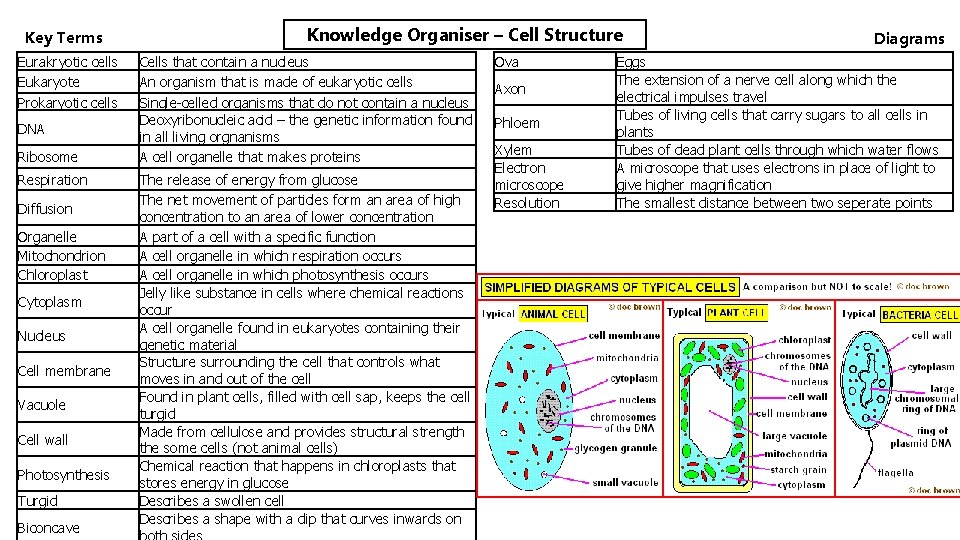
Key Terms Eurakryotic cells Eukaryote Prokaryotic cells DNA Ribosome Respiration Diffusion Organelle Mitochondrion Chloroplast Cytoplasm Nucleus Cell membrane Vacuole Cell wall Photosynthesis Turgid Biconcave Knowledge Organiser – Cell Structure Cells that contain a nucleus An organism that is made of eukaryotic cells Single-celled organisms that do not contain a nucleus Deoxyribonucleic acid – the genetic information found in all living orgnanisms A cell organelle that makes proteins The release of energy from glucose The net movement of particles form an area of high concentration to an area of lower concentration A part of a cell with a specific function A cell organelle in which respiration occurs A cell organelle in which photosynthesis occurs Jelly like substance in cells where chemical reactions occur A cell organelle found in eukaryotes containing their genetic material Structure surrounding the cell that controls what moves in and out of the cell Found in plant cells, filled with cell sap, keeps the cell turgid Made from cellulose and provides structural strength the some cells (not animal cells) Chemical reaction that happens in chloroplasts that stores energy in glucose Describes a swollen cell Describes a shape with a dip that curves inwards on Ova Axon Phloem Xylem Electron microscope Resolution Diagrams Eggs The extension of a nerve cell along which the electrical impulses travel Tubes of living cells that carry sugars to all cells in plants Tubes of dead plant cells through which water flows A microscope that uses electrons in place of light to give higher magnification The smallest distance between two seperate points