
Key stages 3 4 Getting your PSHE education
- Slides: 18
Key stages 3 & 4 Getting your PSHE education ready for statutory Relationships and Sex Education, Health Education and the new Ofsted framework © PSHE Association 2019
What are the new KS 3 & 4 statutory requirements? • The Health Education and Relationships and Sex Education (RSE) aspects of PSHE (personal, social, health and economic) education will be compulsory in all secondary schools from September 2020. • Health Education won’t be a ‘new’ requirement in independent schools, where PSHE education is already compulsory. However, it is expected that independent schools will draw on the new statutory guidance for Health Education when planning their PSHE education. © PSHE Association 2019 Key stages 3 & 4
What does the new statutory guidance cover? • The Department for Education published statutory guidance for Health Education, Relationships Education and RSE in June 2019. • This covers broad areas of particular relevance and concern to children and young people today. It should ensure that every pupil is guaranteed a PSHE education that covers mental health and wellbeing; physical health (including healthy lifestyles and first aid); learning about safe, healthy relationships and sex (including understanding consent, negotiating life online, intimate relationships). © PSHE Association 2019 Key stages 3 & 4
How can schools meet statutory requirements effectively? • Many schools are well on the way to delivering these commitments and should build on, rather than unpick, what they’re already doing well. 85% of schools already teach PSHE that covers health and RSE. The new requirements are about raising and ‘levelling up’ of PSHE standards across all schools in a way that does not cause undue burden on workload and resources. • PSHE education needs regular curriculum time like any other subject. ‘Drop down’ or ‘off timetable’ days can enhance a timetabled programme of regular, planned lessons but are not an appropriate or effective alternative to one. 91% of school leaders surveyed by NAHT agree on the need for regular, timetabled PSHE lessons. (See our guidance on models of PSHE delivery. ) • Schools should tailor their programme to the needs of their pupils and communities in order to be effective. There is no ‘one-size-fits-all solution’: there are many useful resources that schools can use to support their PSHE provision, but PSHE programmes should always be tailored to the needs of a school’s own pupils and community. (See our PSHE planning toolkits for KS 3 & 4. ) © PSHE Association 2019 Key stages 3 & 4
Should schools only cover what’s included in this guidance? • Schools should not just ‘teach to the guidance’, but see it as the basic requirement which forms part of broader PSHE education. • The statutory guidance outlines what schools must cover – though not everything that schools should cover – in PSHE from 2020. The Department for Education (Df. E) says: ‘All elements of PSHE are important and the government continues to recommend PSHE be taught in schools’. • The PSHE Education Programme of Study KS 1 - 5, covers all of the statutory content as well as vital non-statutory content related to economic wellbeing and careers education. © PSHE Association 2019 Key stages 3 & 4
So schools should still teach economic wellbeing & careers through PSHE? • Yes, otherwise the ‘personal’ aspects of economic wellbeing will be lost. PSHE complements the financial education covered through Citizenship and Maths, but covers the personal aspects of economic wellbeing (for example managing risks and pressures relating to gambling, ‘money mules’ or fraud). It also includes vital learning in careers education, digital and media literacy. • Health, relationships, economic wellbeing and successful careers are all linked. PSHE is the glue that binds them together. PSHE gathers all of these aspects of preparing for modern life together into a coherent curriculum subject. • PSHE education is the vehicle through which schools can best ensure they meet many of the Gatsby benchmarks. Df. E data shows that the most common approach to careers education is delivery through PSHE lessons (87%). Therefore, schools should not undo what they are already doing well in this area. © PSHE Association 2019 Key stages 3 & 4
Why is this all so important? • PSHE education has proven impact on life chances and academic success when delivered well, but has suffered from reduced curriculum time and patchy provision. • This strengthening of PSHE education’s status can have a major impact on the quality of PSHE in all schools for all pupils. • These developments mean that all pupils can benefit from an education that keeps them safe, healthy and prepared for the realities of modern life. “The evidence shows that personal, social, health and economic (PSHE) education can improve the physical and psychosocial well-being of pupils. A virtuous cycle can be achieved, whereby pupils with better health and well-being can achieve better academically, which in turn leads to greater success. ” Department for Education review of PSHE education impact and effective practice An extensive 2017 literature review by leading economists found ‘Very strong evidence’ that PSHE (personal, social, health and economic) learning has a positive impact on health, wellbeing and academic attainment. © PSHE Association 2019 Key stages 3 & 4
How can we get the right RSE policy in place? All secondary schools will be required to have a Relationships and Sex Education policy in place. This must be freely available for parents to access, and include: an outline of what will be taught to children within the RSE curriculum a rationale for this learning (for example in relation to safeguarding) a clear procedure for withdrawal from sex education reasons why the school believes children should not be withdrawn from these lessons Download PSHE Association guidance on how to write a comprehensive RSE policy. • • © PSHE Association 2019 Key stages 3 & 4
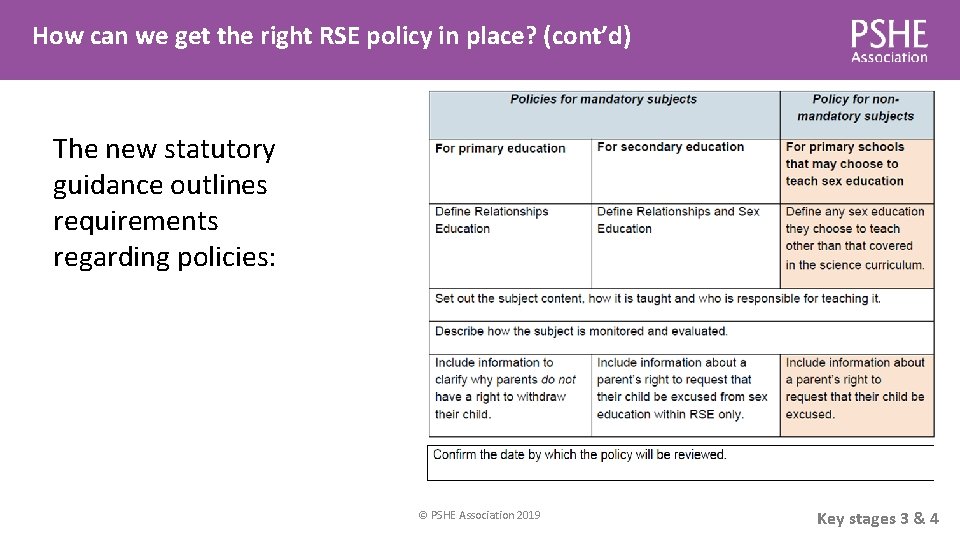
How can we get the right RSE policy in place? (cont’d) The new statutory guidance outlines requirements regarding policies: © PSHE Association 2019 Key stages 3 & 4
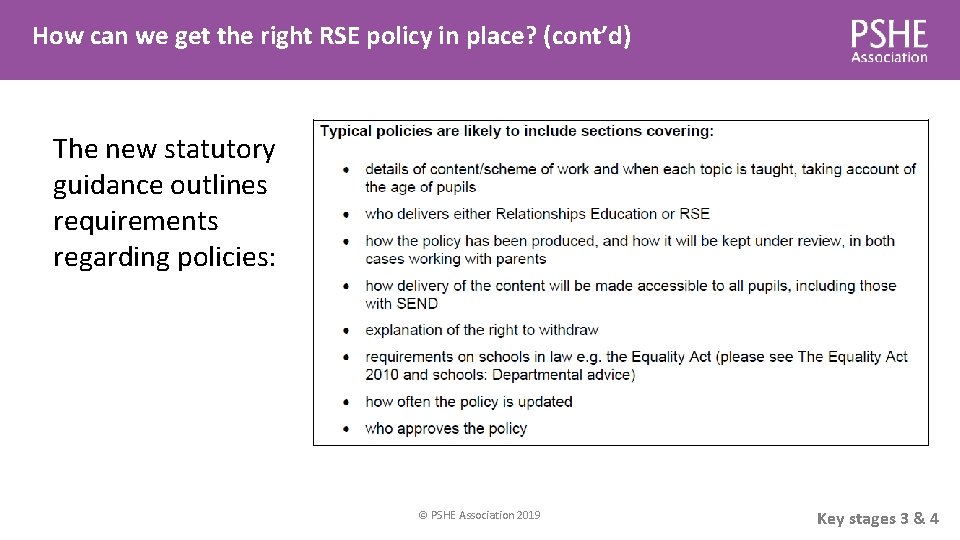
How can we get the right RSE policy in place? (cont’d) The new statutory guidance outlines requirements regarding policies: © PSHE Association 2019 Key stages 3 & 4
What about a policy for Health Education/PSHE education? • Schools do not have to have a policy for Health Education, or for broader PSHE education, but we would recommend having a PSHE policy that includes (or links to) your RSE policy and includes specific information on Health Education. • See our guidance on creating a PSHE education policy for your school © PSHE Association 2019 Key stages 3 & 4
What about engaging with parents? • Open dialogue: It is important to create and maintain an open dialogue between parents and teachers as early as possible. As the Df. E statutory guidance states: ‘Parents should be given every opportunity to understand the purpose and content of Relationships Education and RSE. Good communication and opportunities for parents to understand ask questions about the school’s approach help increase confidence in the curriculum. ’ • It’s not all about sex!: Schools should engage with parents about the whole of the PSHE education curriculum from the beginning of their child’s school career. This will foster a greater understanding of (and support for) a subject that encompasses diverse topics from first aid and healthy eating to mental wellbeing and staying safe online, rather than allowing parents to see this as a subject that’s just about sex. • Mechanisms for engagement: Most schools have existing mechanisms in place to engage parents. They should continue to use these as their means of engaging parents with all aspects of PSHE including RSE and Health Education – there is no requirement that this should involve new or additional mechanisms. © PSHE Association 2019 Key stages 3 & 4
What about engaging with parents? (continued) • PSHE Association guide to parental engagement: This guide will support secondary schools to communicate positively with parents about Relationships and Sex Education and includes a template letter, parent workshop plan and overview of statutory requirements regarding withdrawal of pupils from sex education. © PSHE Association 2019 Key stages 3 & 4
What about engaging with parents? (continued) • Df. E guidance for parents: The Department for Education has published a useful list of FAQs for parents on the new RSE/Relationships Education requirements, and new guides for parents on RSE and Health Education. • Key Df. E requirements: The Df. E is clear that schools should publish relevant policies online, and ensure parents are consulted and examples of resources shared. • What the Df. E says about parents and curriculum content: ‘What is taught, and how, is ultimately a decision for the school and consultation does not provide a parental veto on curriculum content’. © PSHE Association 2019 Key stages 3 & 4
What about parental withdrawal from sex education? • Following discussion with the school, parents can withdraw their child from the ‘sex’ elements of RSE. It is good practice for parents to meet with the Headteacher. • Parents do not have a right to withdraw their child from Health education, Relationships or any other aspect of PSHE education. • There is no right of withdrawal from National Curriculum science which includes elements of sex education such as puberty and reproduction. • Three terms before they turn 16, a student can opt back in to sex education lessons against their parents’ wishes. The school has a duty to provide sex ed. during one of the remaining three terms. Key stages 3 & 4
Does the new Ofsted framework put greater emphasis on PSHE? • Yes, there is more scope for PSHE education to be a focus of inspections under the new framework (including through ‘deep dives’) in providing evidence for key judgements, particularly regarding ‘personal development’. The new Ofsted inspection handbook also refers specifically to the inclusion of the new statutory content in the curriculum, and that ‘if a school is failing to meet its obligations, inspectors will consider this when reaching the personal development judgement’ • Chief Inspector Amanda Spielman said that “In the new inspection model, we are particularly interested in how schools contribute to the personal development of children. This area is now a judgement in its own right. This makes more space in inspection for discussing things like the PSHE lessons in which wider life issues can be explored. • PSHE education also makes a unique contribution to safeguarding, and will support schools to fulfil their statutory duty to teach pupils to keep themselves safe. See the statutory ‘Keeping children safe in education guidance for schools and colleges on safeguarding children. • Read our blog post ‘What does the new Ofsted framework mean for PSHE education? ’ © PSHE Association 2019 Key stages 3 & 4
Useful resources & support • Programme of Study for PSHE Education (Key stages 1 -5) 2020 edition: The national programme of study for the subject, regularly signposted to by the Department for Education for schools to use and updated in January 2020 to support schools to integrate the new statutory content into their broader PSHE programmes. • Programme Builders for PSHE education (Key stages 1 -4): Designed to help schools develop their PSHE education schemes of work, the suite of Programme Builders provide examples of possible curriculum frameworks, setting out what pupils could be taught in each year group, in each half term / term across the year, in order to cover the whole Programme of Study and the new statutory content. • PSHE Association mental health lesson plans and teacher guidance: a suite of lesson plans available in slideshow and pdf. document format. • ‘Preparing for statutory RSE and relationships education’ packs; and the ‘Roadmap to statutory RSE’ (jointly produced by the PSHE Association and the Sex Education Forum). • Our suite of CPD training days on preparing for statutory relationships education, preparing for statutory health education, getting your PSHE education ‘Ofsted ready’ for the new framework, and more. • A range of resources that have gained the PSHE Association Quality Mark. • Guide to parental engagement: practical advice for primary schools on engaging with parents about PSHE education. © PSHE Association 2019 Key stages 1 & 2
About the PSHE Association • The PSHE Association is the national body for personal, social, health and economic (PSHE) education — the school curriculum subject that supports pupils to be healthy, safe and prepared for modern life. PSHE education incorporates health education, relationships education/RSE and economic wellbeing and careers. • A charity and membership organisation, the PSHE Association works to improve PSHE education standards by supporting a national community of over 40, 000 teachers and schools with resources, training and advice. Find out more at www. pshe-association. org. uk. © PSHE Association 2019 Key stages 3 & 4