
Key Stage One Calculation Methods Division Division Vocabulary
Key Stage One Calculation Methods Division
Division Vocabulary • divided by • divided into • share equally • groups of • equal groups of
Counting patterns 0 2 4 6 8 10 12 14 16 18 20 0 3 6 9 12 15 18 21 24 27 30 0 5 10 15 20 25 30 35 40 45 50 0 10 20 30 40 50 60 70 80 90 100 We practise counting in 2 s, 3 s, 5 s and 10 s forwards and backward regularly. This helps with multiplication and division. We always start on 0 (zero).
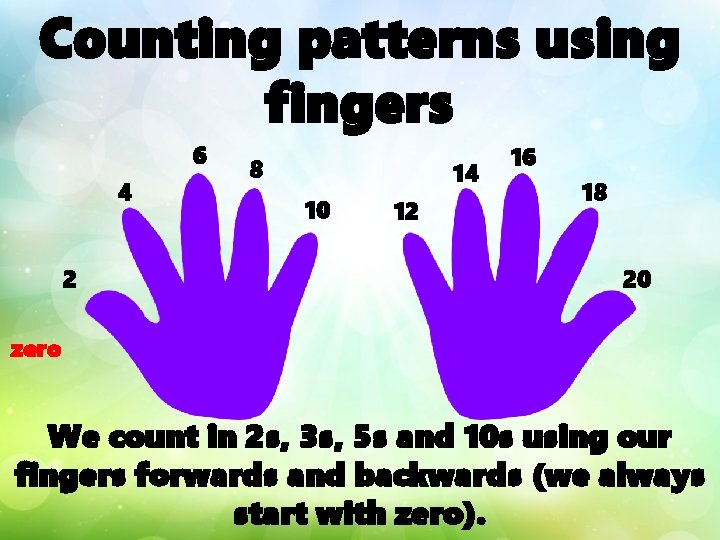
Counting patterns using fingers 6 4 2 8 14 10 12 16 18 20 zero We count in 2 s, 3 s, 5 s and 10 s using our fingers forwards and backwards (we always start with zero).
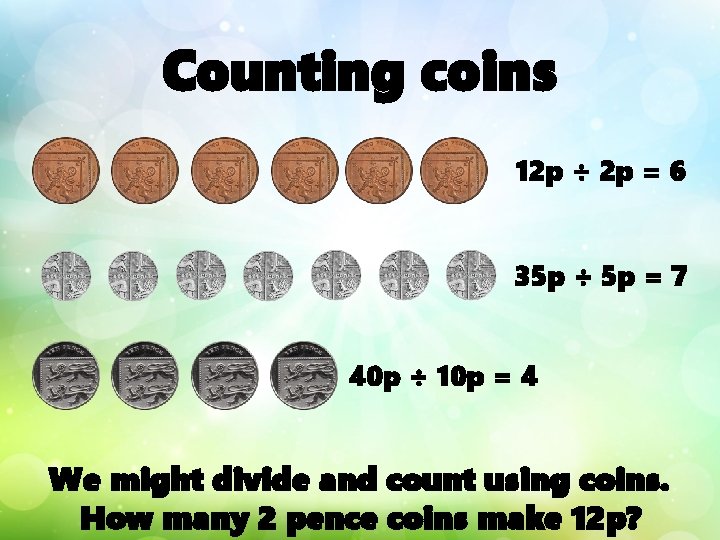
Counting coins 12 p ÷ 2 p = 6 35 p ÷ 5 p = 7 40 p ÷ 10 p = 4 We might divide and count using coins. How many 2 pence coins make 12 p?
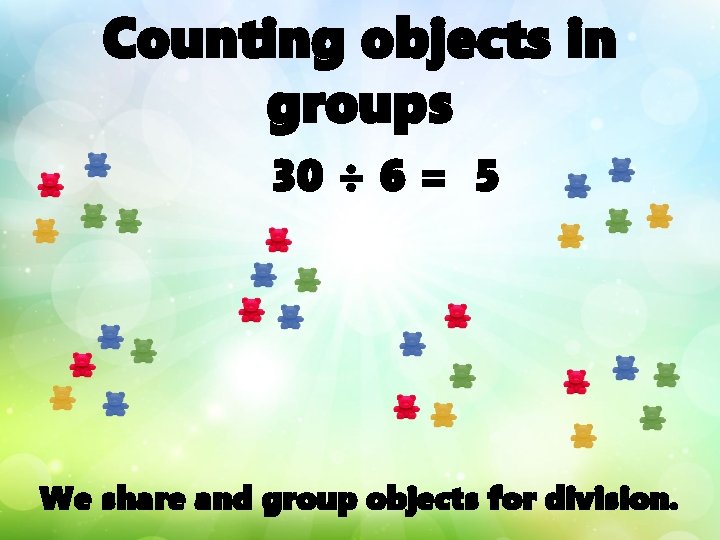
Counting objects in groups 30 ÷ 6 = 5 We share and group objects for division.
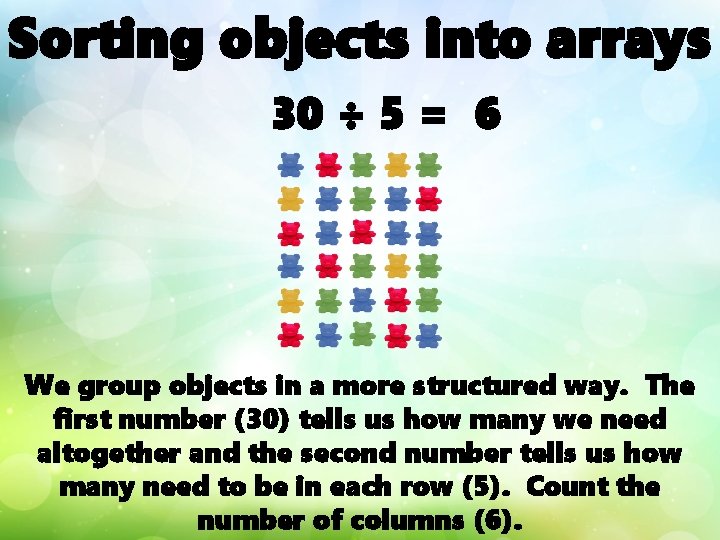
Sorting objects into arrays 30 ÷ 5 = 6 We group objects in a more structured way. The first number (30) tells us how many we need altogether and the second number tells us how many need to be in each row (5). Count the number of columns (6).
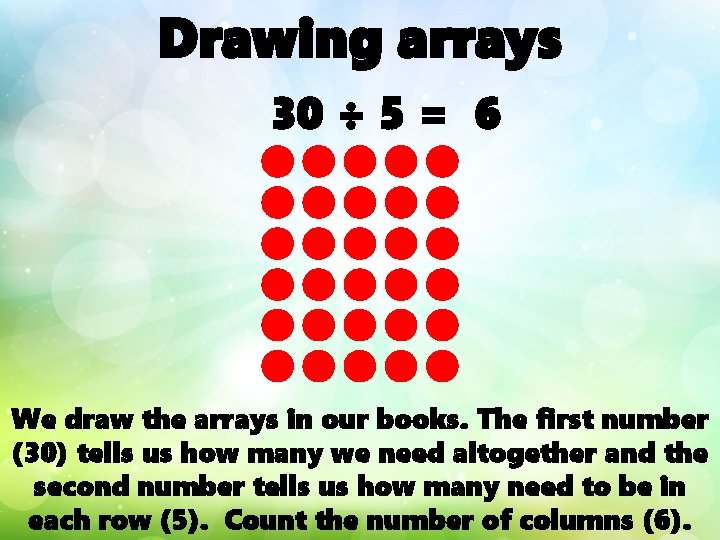
Drawing arrays 30 ÷ 5 = 6 We draw the arrays in our books. The first number (30) tells us how many we need altogether and the second number tells us how many need to be in each row (5). Count the number of columns (6).
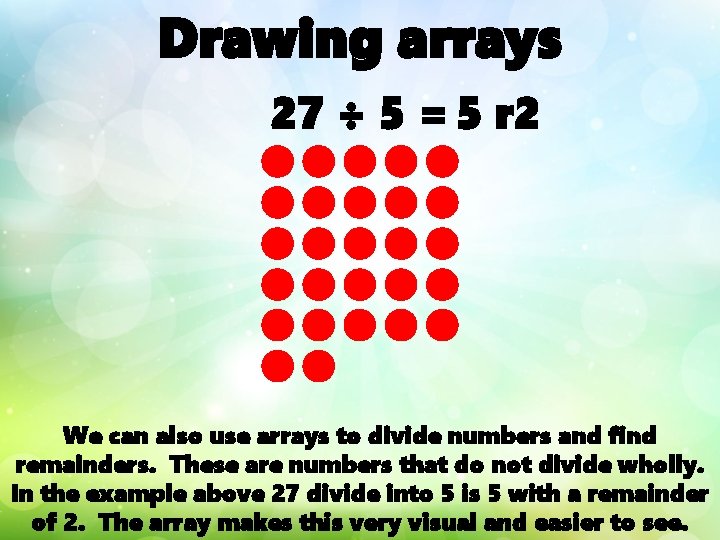
Drawing arrays 27 ÷ 5 = 5 r 2 We can also use arrays to divide numbers and find remainders. These are numbers that do not divide wholly. In the example above 27 divide into 5 is 5 with a remainder of 2. The array makes this very visual and easier to see.
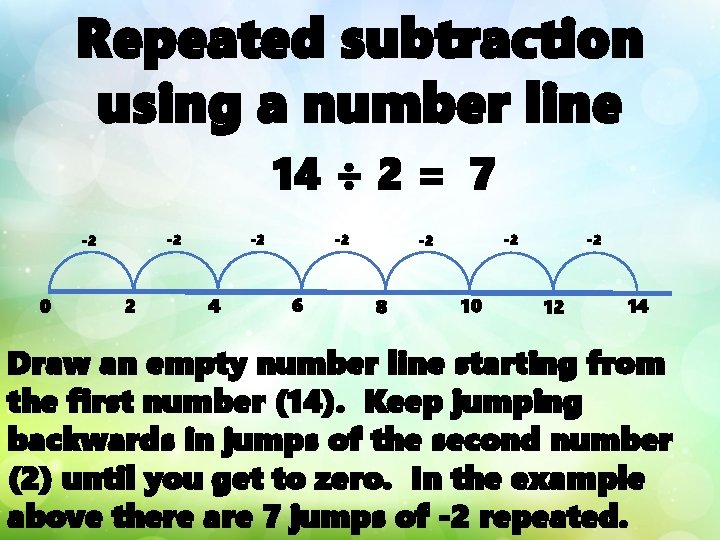
Repeated subtraction using a number line 14 ÷ 2 = 7 -2 -2 0 2 -2 4 -2 6 -2 -2 8 10 -2 12 14 Draw an empty number line starting from the first number (14). Keep jumping backwards in jumps of the second number (2) until you get to zero. In the example above there are 7 jumps of -2 repeated.
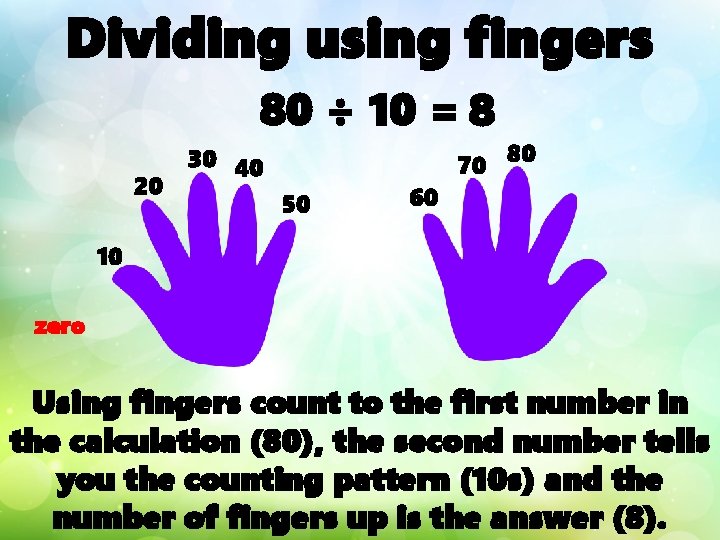
Dividing using fingers 80 ÷ 10 = 8 20 30 40 50 60 70 80 10 zero Using fingers count to the first number in the calculation (80), the second number tells you the counting pattern (10 s) and the number of fingers up is the answer (8).
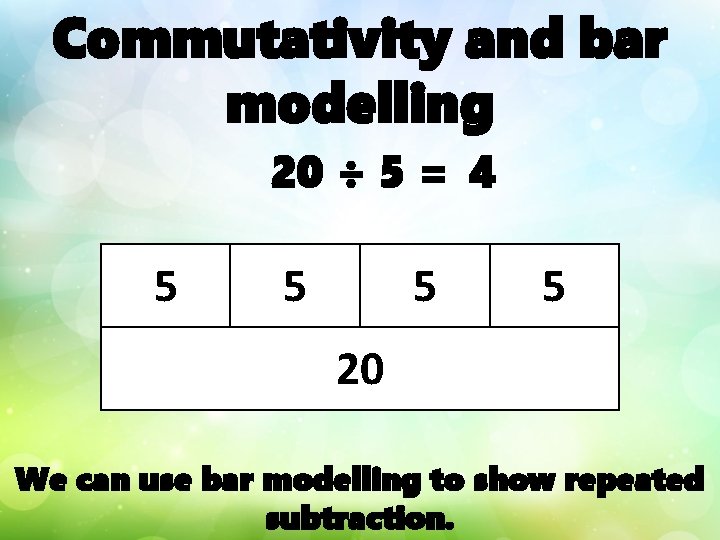
Commutativity and bar modelling 20 ÷ 5 = 4 5 5 20 We can use bar modelling to show repeated subtraction.
- Slides: 12