
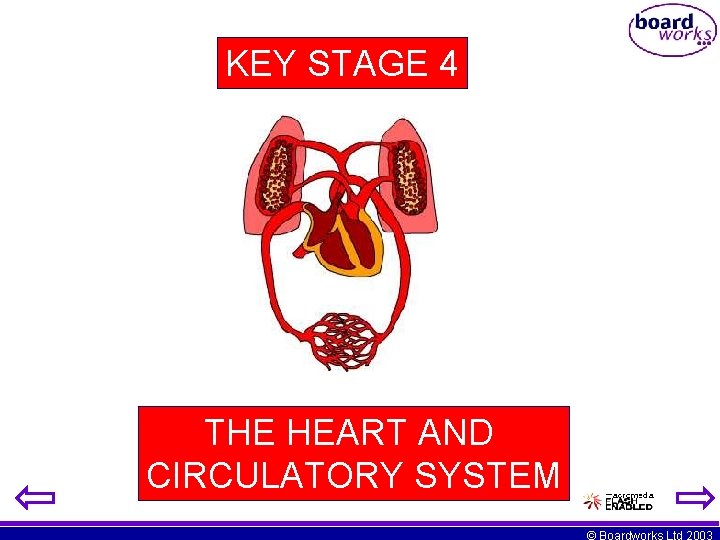
KEY STAGE 4 THE HEART AND CIRCULATORY SYSTEM
- Slides: 48
KEY STAGE 4 THE HEART AND CIRCULATORY SYSTEM © Boardworks Ltd 2003
Teacher’s Notes A slide contains teacher’s notes wherever this icon is displayed To access these notes go to ‘Notes Page View’ (Power. Point 97) or ‘Normal View’ (Power. Point 2000). Notes Page View Normal View Flash Files A flash file has been embedded into the Power. Point slide wherever this icon is displayed – These files are not editable. © Boardworks Ltd 2003
How are substances transported around the body? The next organ system we will be considering can be known by two names…. . Blood system Circulatory system The circulatory system is made of two parts: 1. The heart 2. The blood vessels © Boardworks Ltd 2003
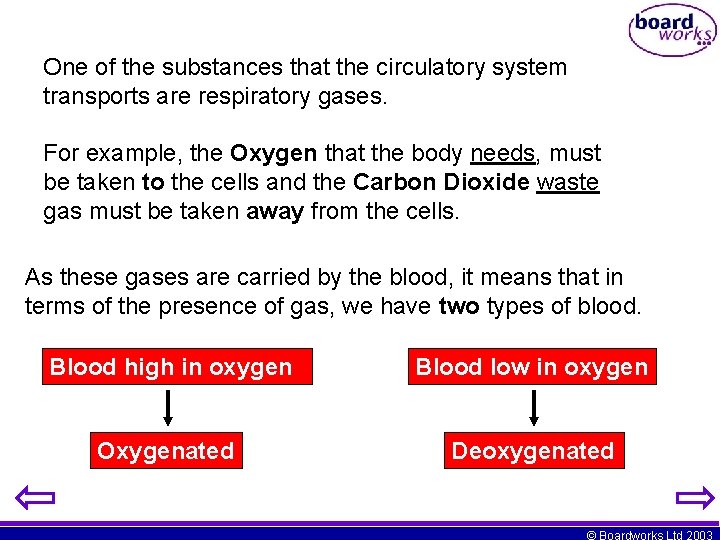
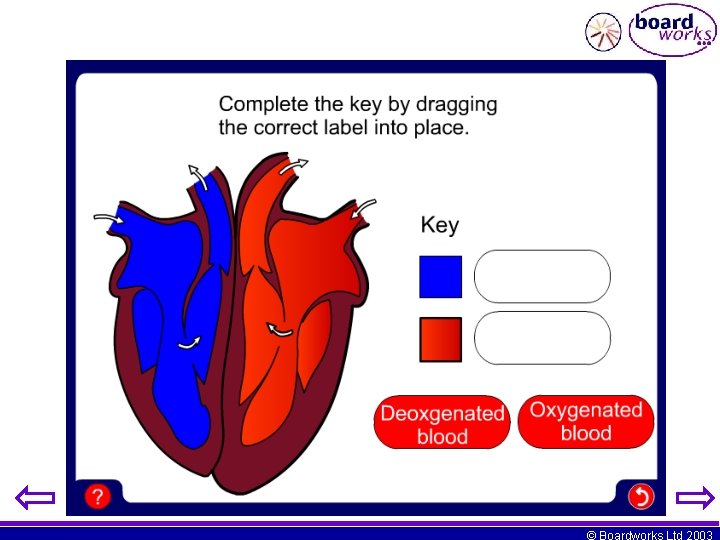
One of the substances that the circulatory system transports are respiratory gases. For example, the Oxygen that the body needs, must be taken to the cells and the Carbon Dioxide waste gas must be taken away from the cells. As these gases are carried by the blood, it means that in terms of the presence of gas, we have two types of blood. Blood high in oxygen Blood low in oxygen Oxygenated Deoxygenated © Boardworks Ltd 2003
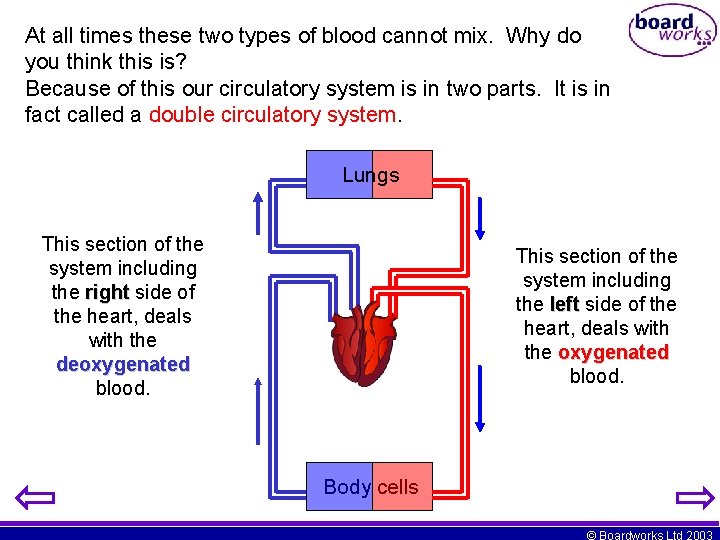
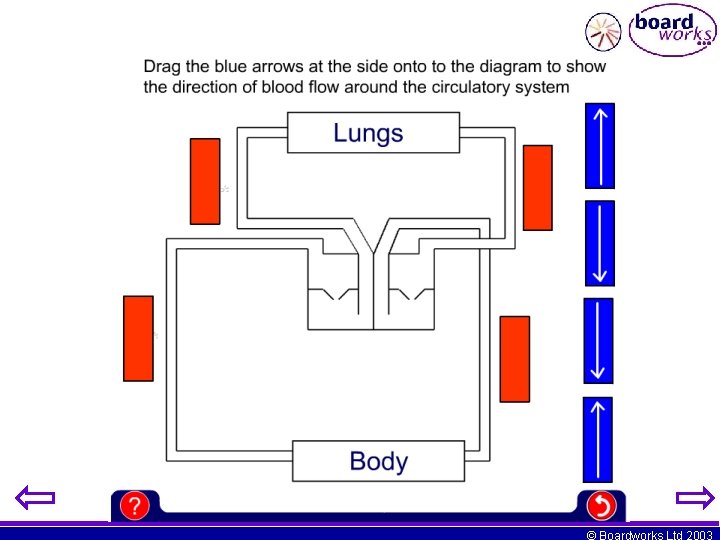
At all times these two types of blood cannot mix. Why do you think this is? Because of this our circulatory system is in two parts. It is in fact called a double circulatory system. Lungs This section of the system including the right side of the heart, deals with the deoxygenated blood. This section of the system including the left side of the heart, deals with the oxygenated blood. Body cells © Boardworks Ltd 2003
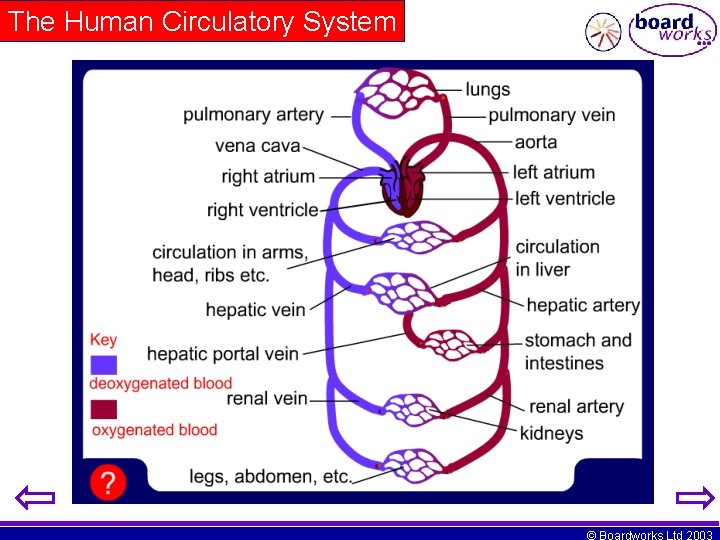
The Human Circulatory System © Boardworks Ltd 2003
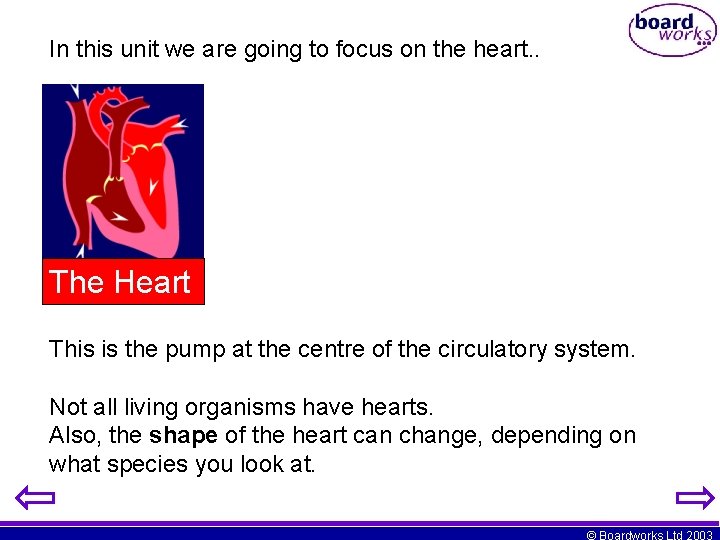
In this unit we are going to focus on the heart. . The Heart This is the pump at the centre of the circulatory system. Not all living organisms have hearts. Also, the shape of the heart can change, depending on what species you look at. © Boardworks Ltd 2003
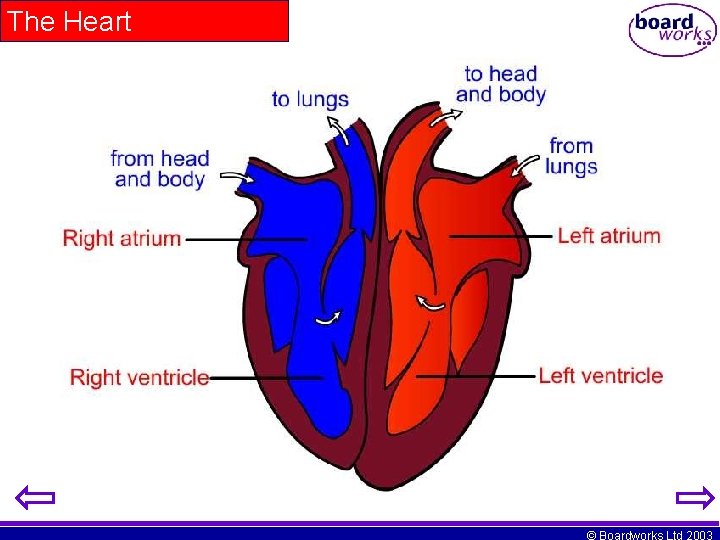
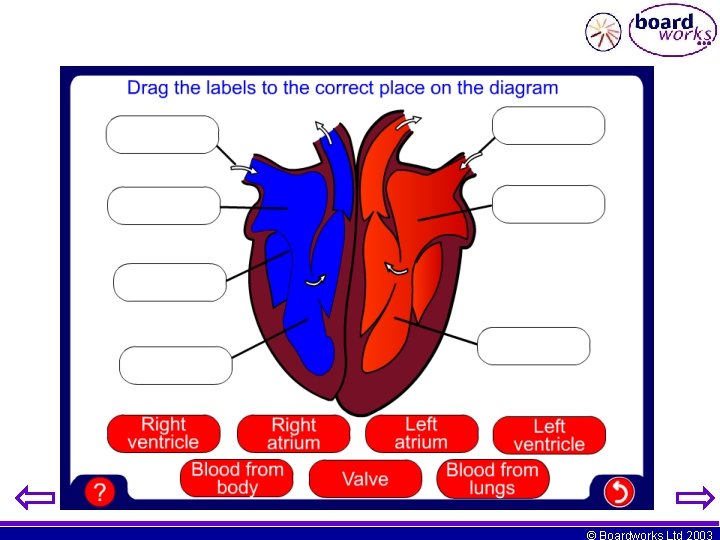
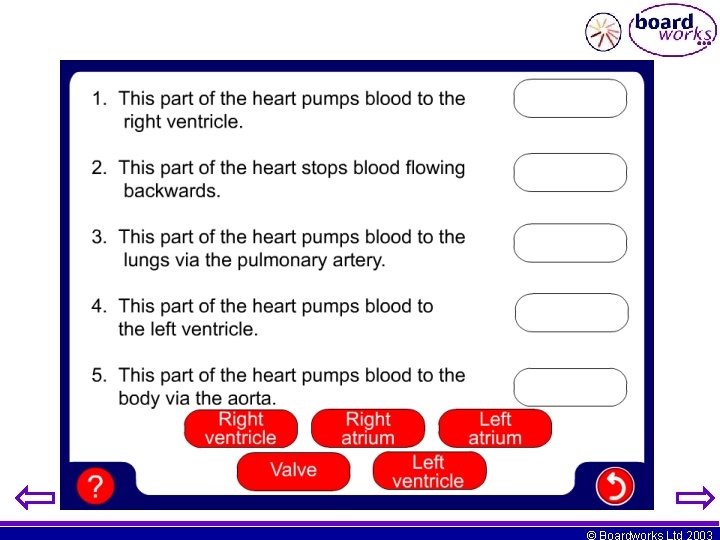
The heart is made almost entirely of muscle. It is unlike any other muscle in your body because it never tires. And even though it is full of blood it still needs it own blood supply. Oxygenated blood is carried to the heart by the coronary arteries. Each side of the heart has two chambers. 1. An top chamber or atrium and 2. A bottom chamber or ventricle Each of these chambers has its own function. Look at the diagram on the next slide to see what that is. © Boardworks Ltd 2003
The Heart © Boardworks Ltd 2003
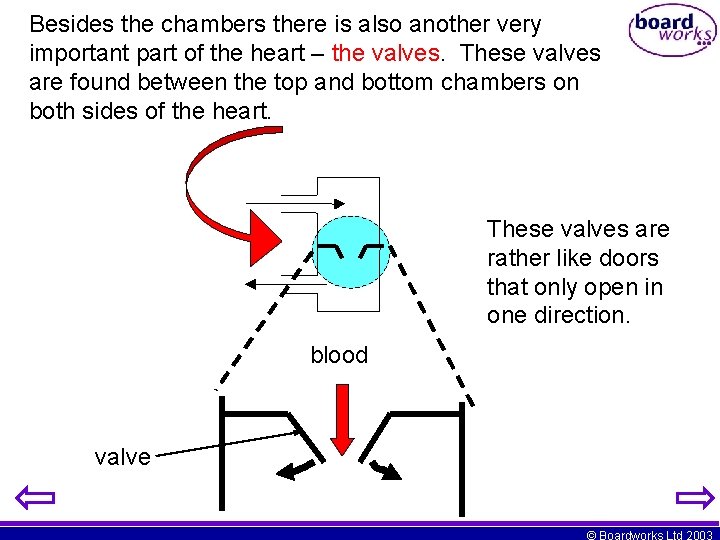
Besides the chambers there is also another very important part of the heart – the valves. These valves are found between the top and bottom chambers on both sides of the heart. These valves are rather like doors that only open in one direction. blood valve © Boardworks Ltd 2003
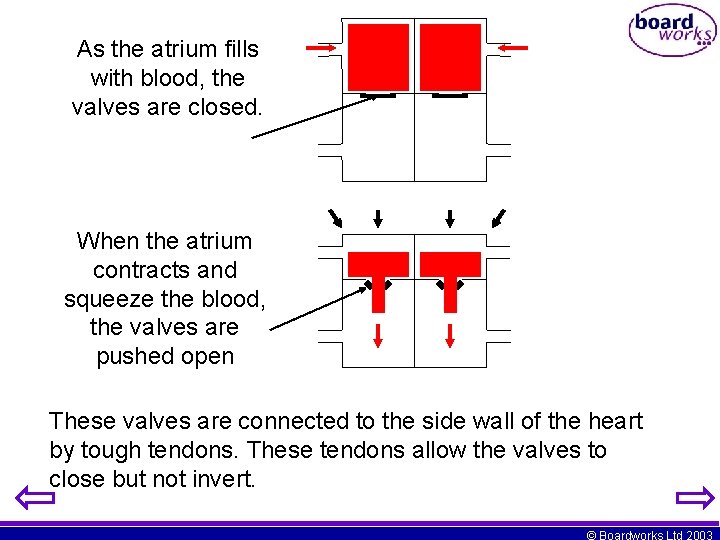
As the atrium fills with blood, the valves are closed. When the atrium contracts and squeeze the blood, the valves are pushed open These valves are connected to the side wall of the heart by tough tendons. These tendons allow the valves to close but not invert. © Boardworks Ltd 2003
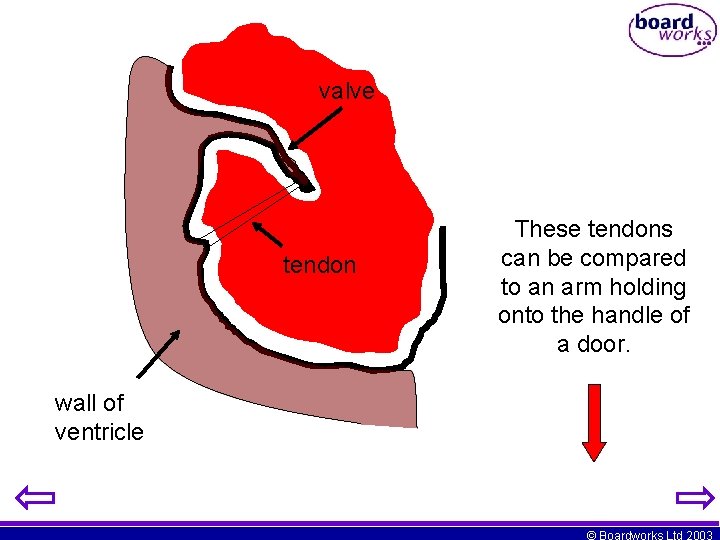
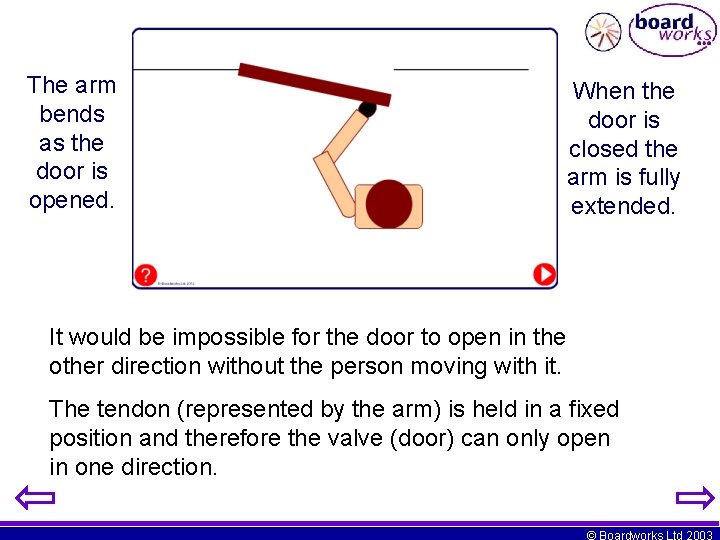
valve tendon These tendons can be compared to an arm holding onto the handle of a door. wall of ventricle © Boardworks Ltd 2003
The arm bends as the door is opened. When the door is closed the arm is fully extended. It would be impossible for the door to open in the other direction without the person moving with it. The tendon (represented by the arm) is held in a fixed position and therefore the valve (door) can only open in one direction. © Boardworks Ltd 2003
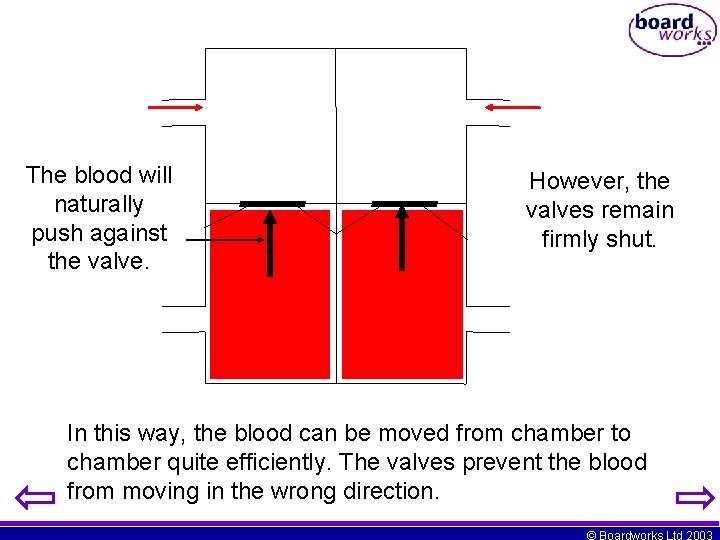
The blood will naturally push against the valve. However, the valves remain firmly shut. In this way, the blood can be moved from chamber to chamber quite efficiently. The valves prevent the blood from moving in the wrong direction. © Boardworks Ltd 2003
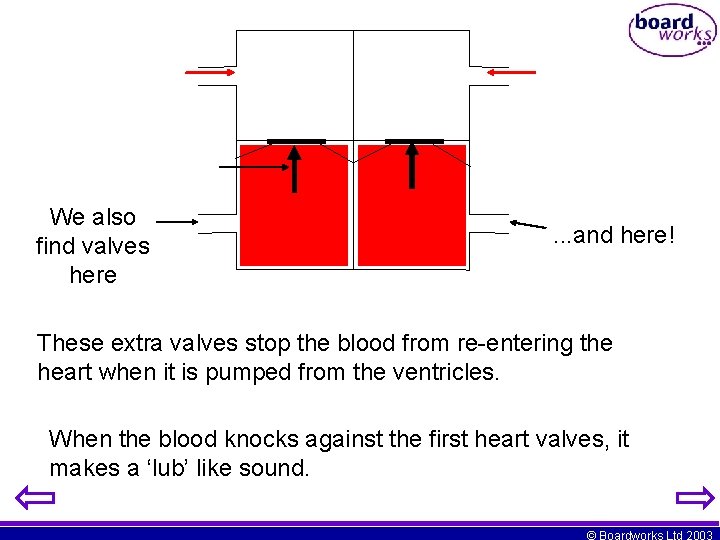
We also find valves here . . . and here! These extra valves stop the blood from re-entering the heart when it is pumped from the ventricles. When the blood knocks against the first heart valves, it makes a ‘lub’ like sound. © Boardworks Ltd 2003
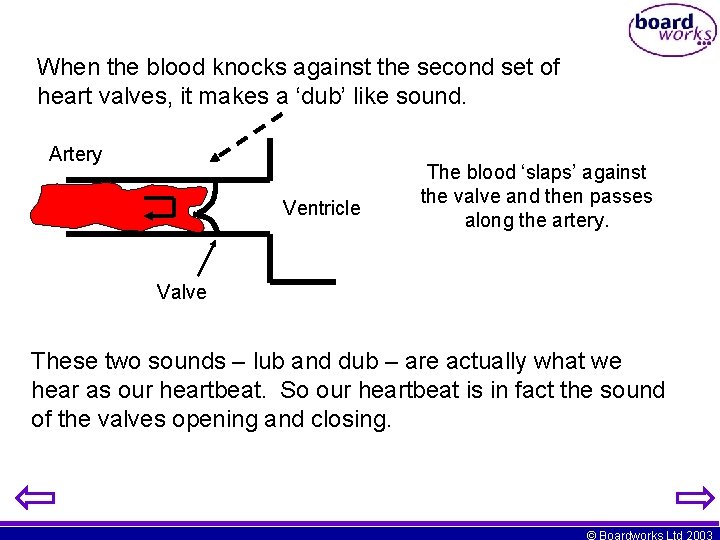
When the blood knocks against the second set of heart valves, it makes a ‘dub’ like sound. Artery Ventricle The blood ‘slaps’ against the valve and then passes along the artery. Valve These two sounds – lub and dub – are actually what we hear as our heartbeat. So our heartbeat is in fact the sound of the valves opening and closing. © Boardworks Ltd 2003
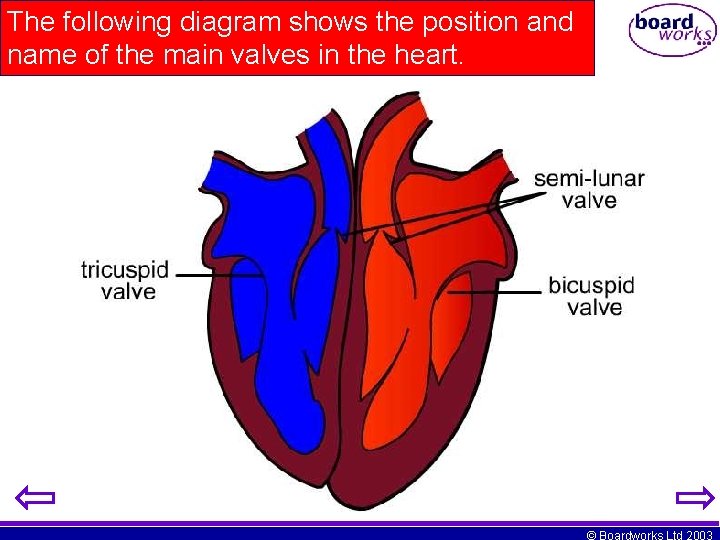
The following diagram shows the position and name of the main valves in the heart. © Boardworks Ltd 2003
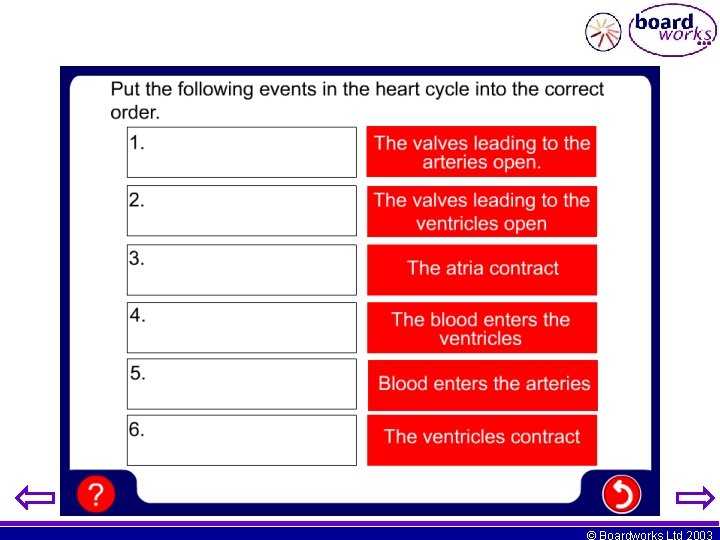
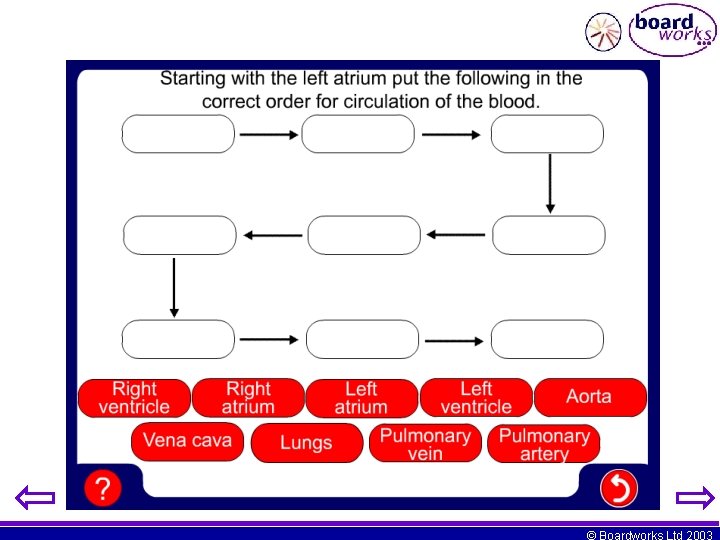
Now that we can name all of the parts of the heart it is time to see how they work to push blood around the body. The heart pumps blood when its muscle contracts. As the muscle contracts the chamber gets smaller and squeeze the blood out. The two sides of the heart work together. The atria contract and relax at the same time, as do the ventricles. The next two slides describe what occurs inside the heart during one heart cycle. © Boardworks Ltd 2003
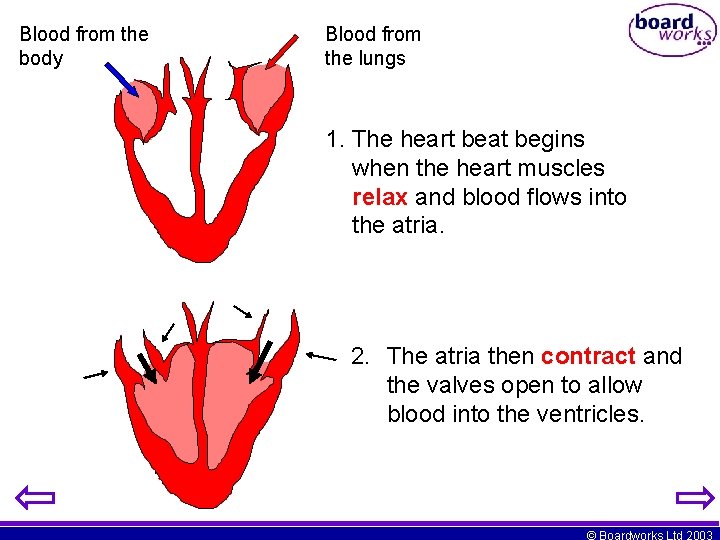
Blood from the body Blood from the lungs 1. The heart beat begins when the heart muscles relax and blood flows into the atria. 2. The atria then contract and the valves open to allow blood into the ventricles. © Boardworks Ltd 2003
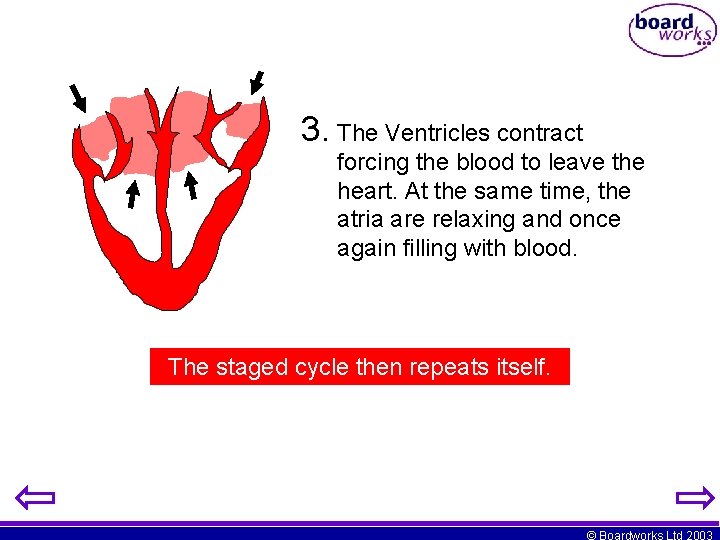
3. The Ventricles contract forcing the blood to leave the heart. At the same time, the atria are relaxing and once again filling with blood. The staged cycle then repeats itself. © Boardworks Ltd 2003
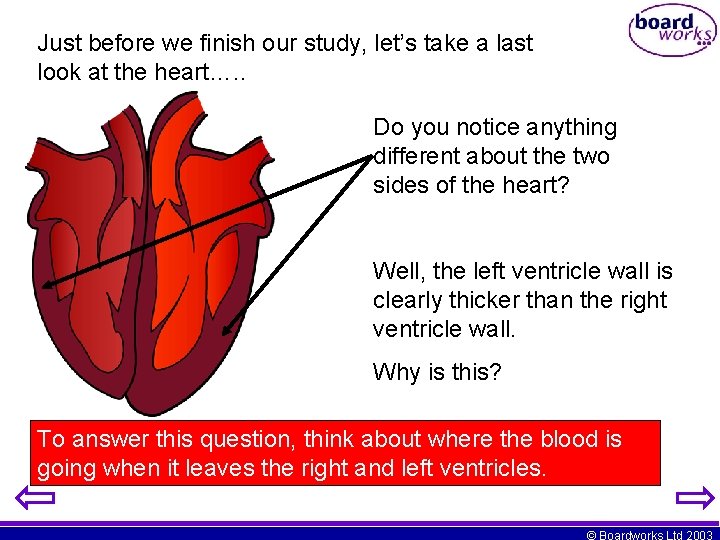
Just before we finish our study, let’s take a last look at the heart…. . Do you notice anything different about the two sides of the heart? Well, the left ventricle wall is clearly thicker than the right ventricle wall. Why is this? To answer this question, think about where the blood is going when it leaves the right and left ventricles. © Boardworks Ltd 2003
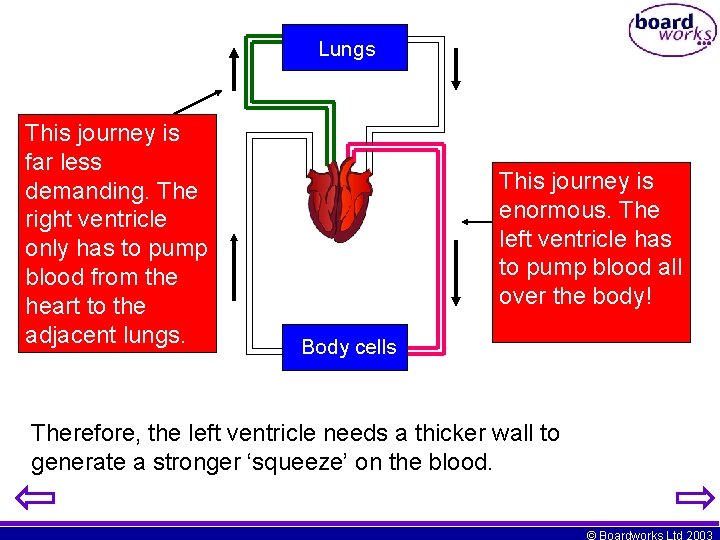
Lungs This journey is far less demanding. The right ventricle only has to pump blood from the heart to the adjacent lungs. This journey is enormous. The left ventricle has to pump blood all over the body! Body cells Therefore, the left ventricle needs a thicker wall to generate a stronger ‘squeeze’ on the blood. © Boardworks Ltd 2003
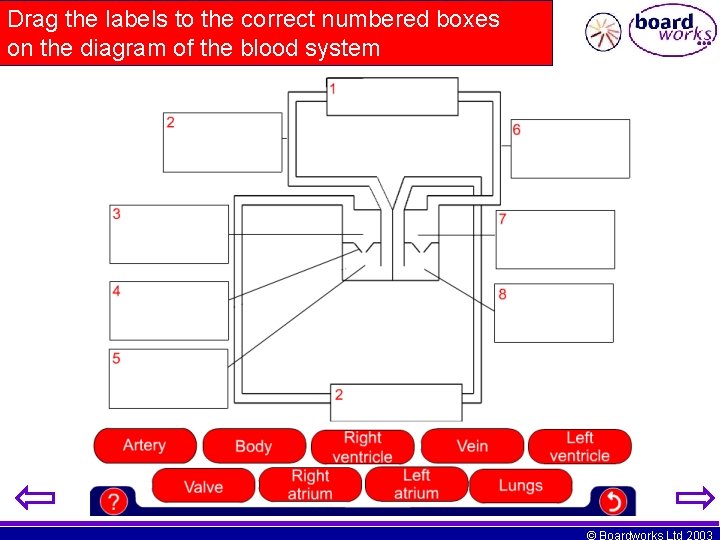
Drag the labels to the correct numbered boxes on the diagram of the blood system © Boardworks Ltd 2003
© Boardworks Ltd 2003
© Boardworks Ltd 2003
© Boardworks Ltd 2003
© Boardworks Ltd 2003
© Boardworks Ltd 2003
© Boardworks Ltd 2003
Multiple choice questions © Boardworks Ltd 2003
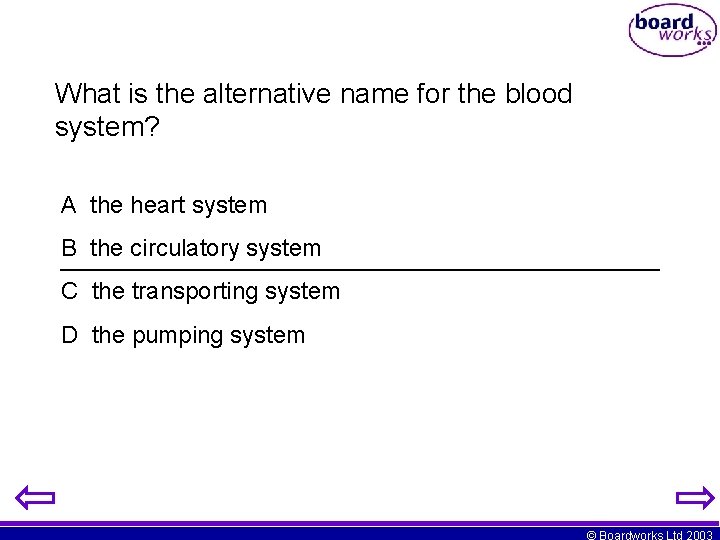
What is the alternative name for the blood system? A the heart system B the circulatory system C the transporting system D the pumping system © Boardworks Ltd 2003
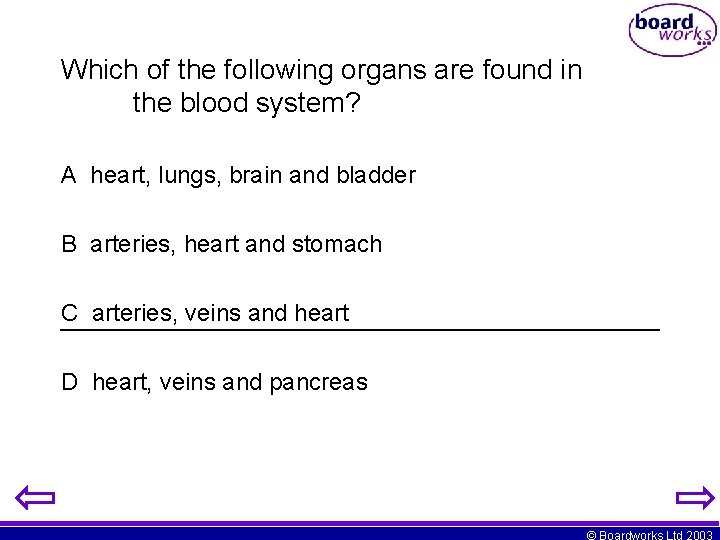
Which of the following organs are found in the blood system? A heart, lungs, brain and bladder B arteries, heart and stomach C arteries, veins and heart D heart, veins and pancreas © Boardworks Ltd 2003
The function of the circulatory system is to. . . A transport substances, such as oxygen and dissolved nutrients, around the body. B support the movement of the body. C digest large molecules of food. D carry chemical messages between the brain and the nerves. © Boardworks Ltd 2003
What is the wall of the heart mainly made from? A. fat tissue B. skin tissue C. nerve tissue D. muscle tissue © Boardworks Ltd 2003
The blood system is often known as the “double circulation” system. Why is this? A The blood carries two vital materials. B There actually two parts to the heart. C The system is divided into two separate circuits. D The blood flows in two directions. © Boardworks Ltd 2003
How many chambers are there in the human heart? A four B it varies from human to human C two D none of the above © Boardworks Ltd 2003
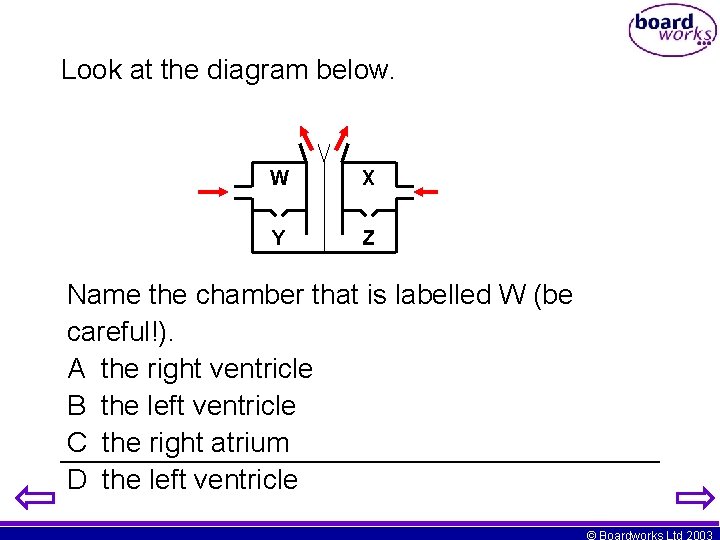
Look at the diagram below. W X Y Z Name the chamber that is labelled W (be careful!). A the right ventricle B the left ventricle C the right atrium D the left ventricle © Boardworks Ltd 2003
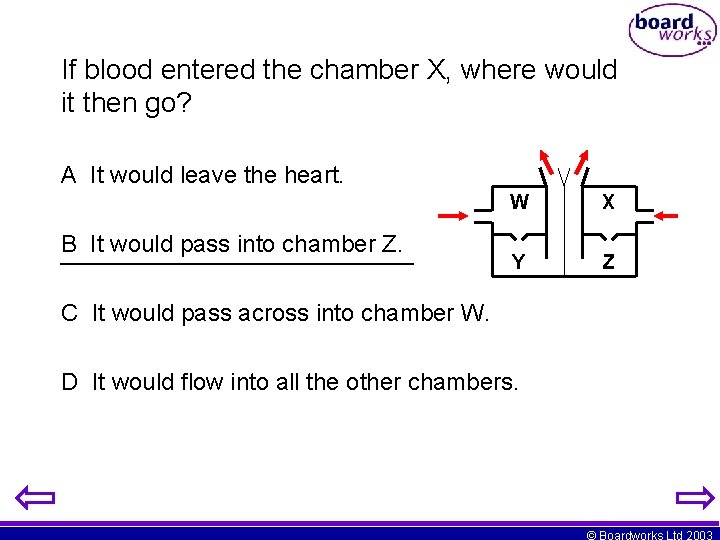
If blood entered the chamber X, where would it then go? A It would leave the heart. B It would pass into chamber Z. W X Y Z C It would pass across into chamber W. D It would flow into all the other chambers. © Boardworks Ltd 2003
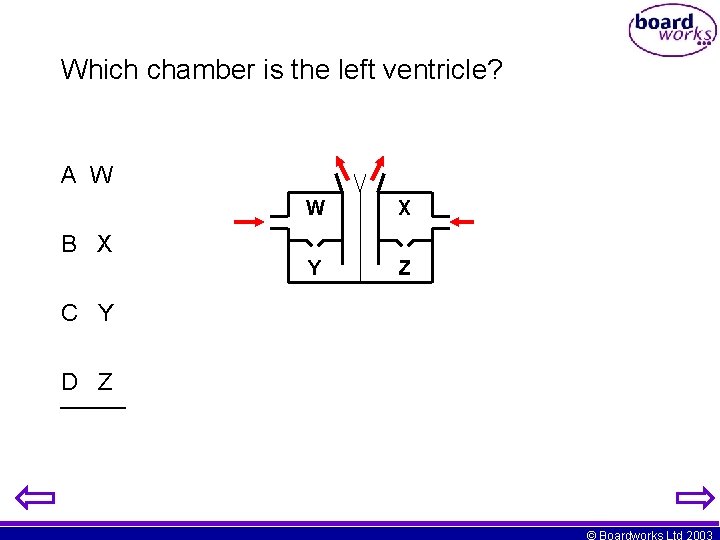
Which chamber is the left ventricle? A W B X W X Y Z C Y D Z © Boardworks Ltd 2003
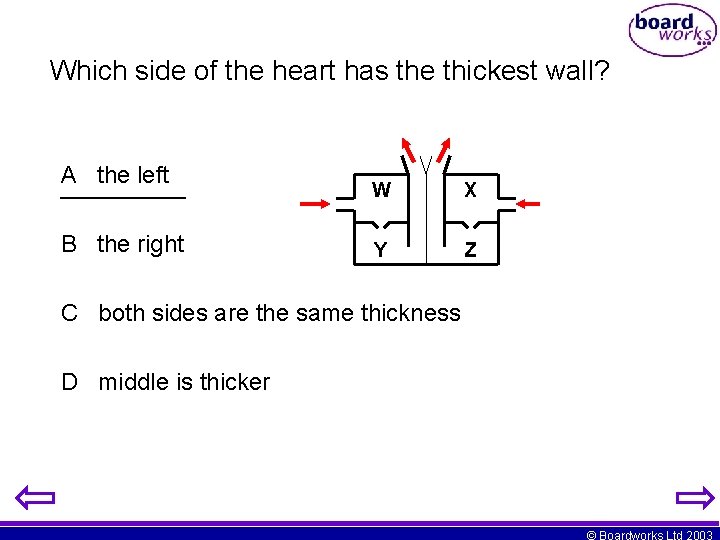
Which side of the heart has the thickest wall? A the left B the right W X Y Z C both sides are the same thickness D middle is thicker © Boardworks Ltd 2003
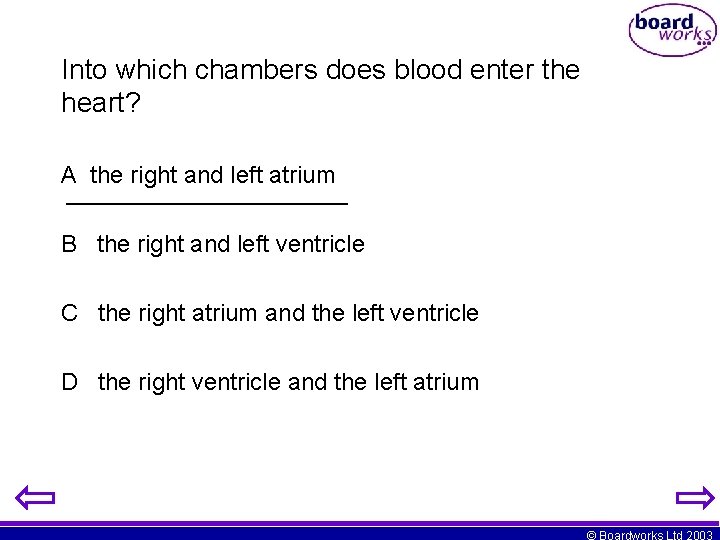
Into which chambers does blood enter the heart? A the right and left atrium B the right and left ventricle C the right atrium and the left ventricle D the right ventricle and the left atrium © Boardworks Ltd 2003
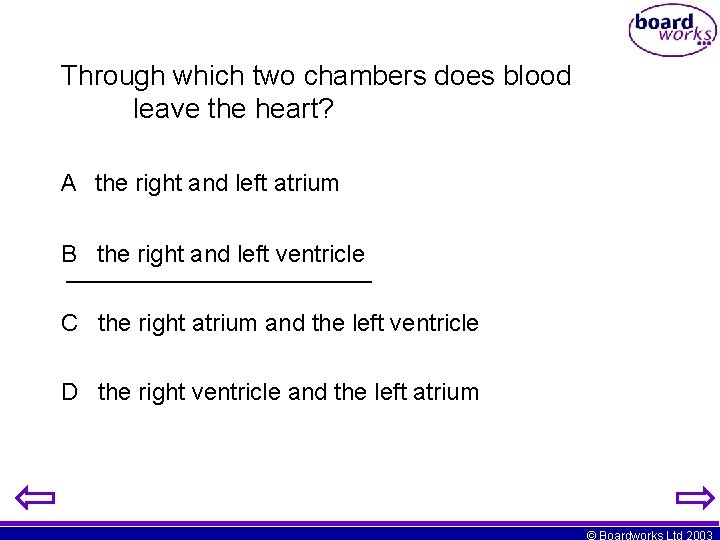
Through which two chambers does blood leave the heart? A the right and left atrium B the right and left ventricle C the right atrium and the left ventricle D the right ventricle and the left atrium © Boardworks Ltd 2003
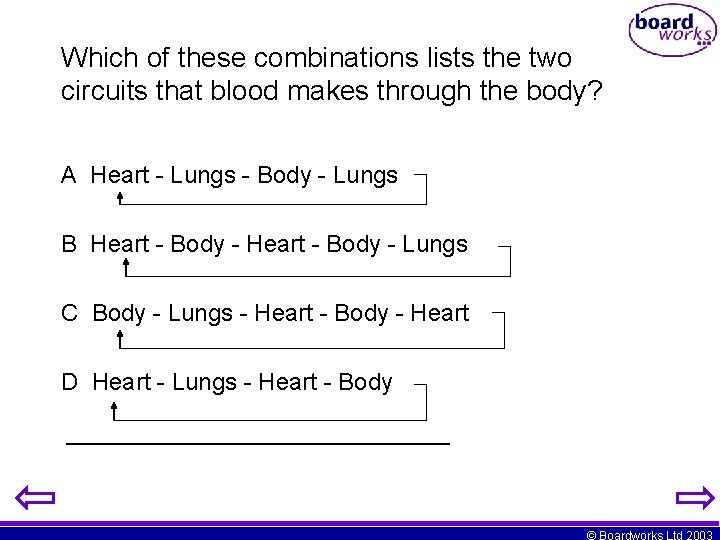
Which of these combinations lists the two circuits that blood makes through the body? A Heart - Lungs - Body - Lungs B Heart - Body - Lungs C Body - Lungs - Heart - Body - Heart D Heart - Lungs - Heart - Body © Boardworks Ltd 2003
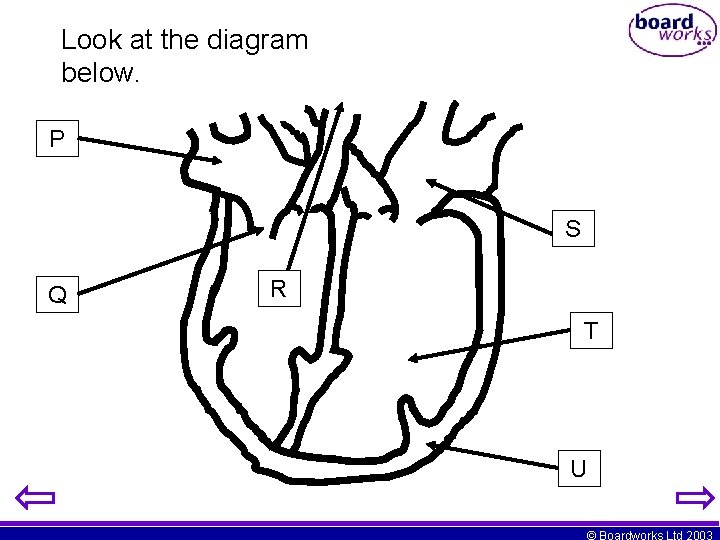
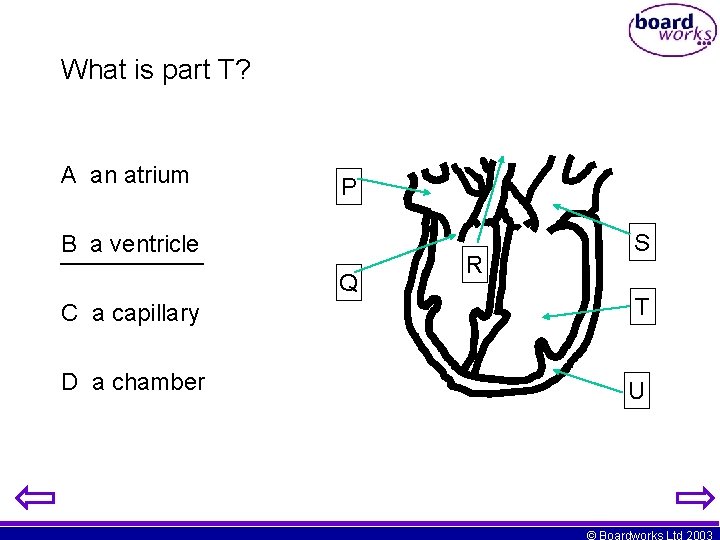
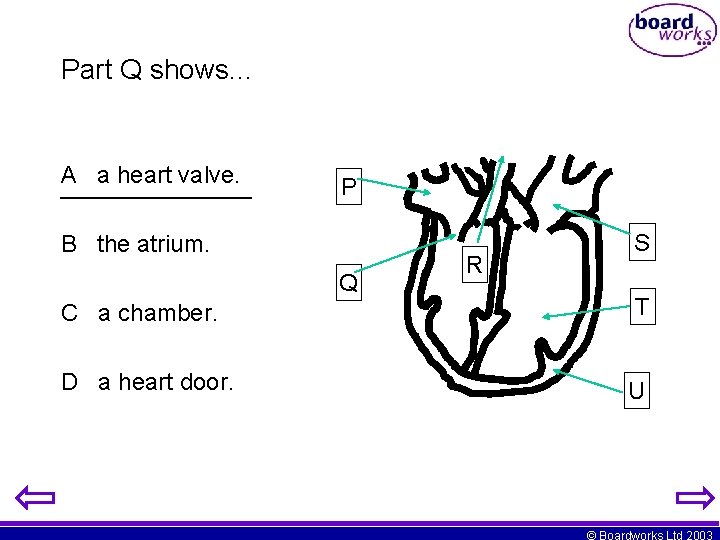
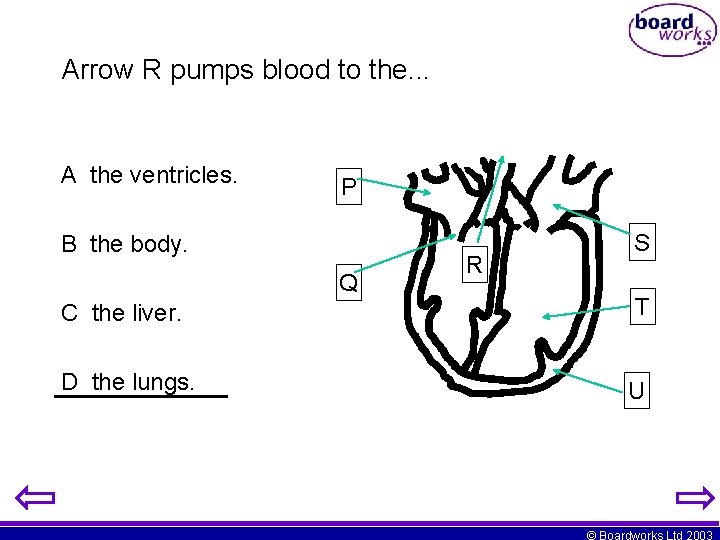
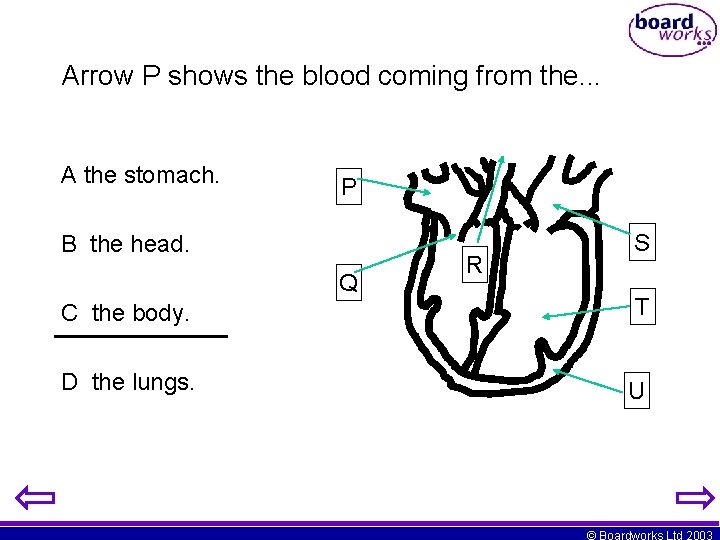
Look at the diagram below. P S Q R T U © Boardworks Ltd 2003
What is part T? A an atrium P B a ventricle Q R S C a capillary T D a chamber U © Boardworks Ltd 2003
Part Q shows. . . A a heart valve. P B the atrium. Q C a chamber. D a heart door. R S T U © Boardworks Ltd 2003
Arrow R pumps blood to the. . . A the ventricles. P B the body. Q R S C the liver. T D the lungs. U © Boardworks Ltd 2003
Arrow P shows the blood coming from the. . . A the stomach. P B the head. Q R S C the body. T D the lungs. U © Boardworks Ltd 2003