
Key Stage 3 English SKIMMING AND SCANNING What


- Slides: 9
Key Stage 3 English SKIMMING AND SCANNING
What is skimming and scanning? They are often confused. Skimming = This is used to obtain the gist (the overall meaning of the text. ) For example you may skim through a website to see if you think it would be useful in research. If it is then you would read this slowly and in more detail to find the information you need. Scanning = This is used to find specific information from a text, such as a particular fact you need to find. Often you will use both skills together.
Skimming • This is a fast reading technique and is threefour times faster than normal reading speed. • People use this if they have a lot of material they need to read in a short amount of time. How to do it: Don’t read it word for word, skim the text for clues! 1. Read the title, subheadings or headings to find out what the text is about. 2. Read the first and last page of each paragraph. 3. Look for key words or phrases.
Scanning Here you look for specific information Some helpful hints: • Write down or think about the key information you want to find. • Repeat the phrase or question in your head as you read to keep your focus. • Look for clues such as capital letters of names, or numbers if you need to find statistics.
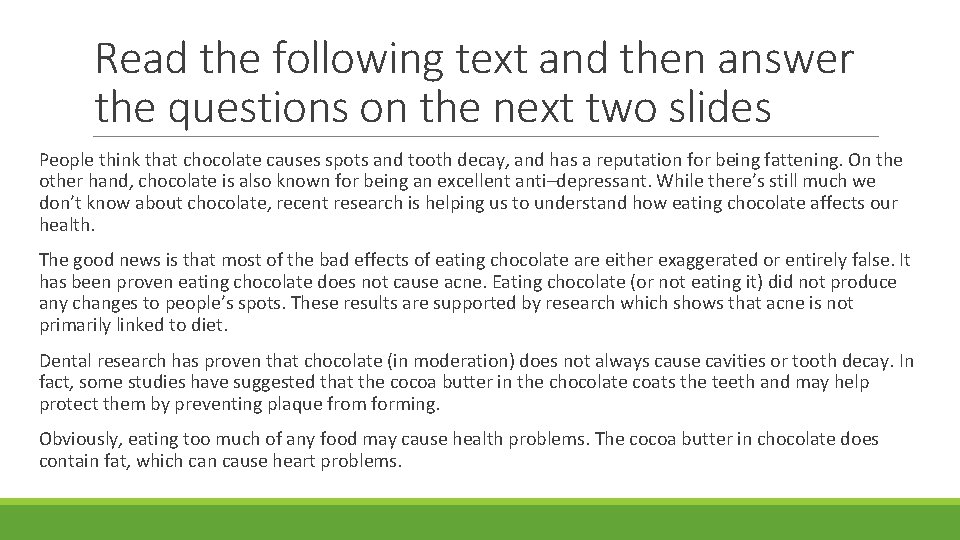
Read the following text and then answer the questions on the next two slides People think that chocolate causes spots and tooth decay, and has a reputation for being fattening. On the other hand, chocolate is also known for being an excellent anti–depressant. While there’s still much we don’t know about chocolate, recent research is helping us to understand how eating chocolate affects our health. The good news is that most of the bad effects of eating chocolate are either exaggerated or entirely false. It has been proven eating chocolate does not cause acne. Eating chocolate (or not eating it) did not produce any changes to people’s spots. These results are supported by research which shows that acne is not primarily linked to diet. Dental research has proven that chocolate (in moderation) does not always cause cavities or tooth decay. In fact, some studies have suggested that the cocoa butter in the chocolate coats the teeth and may help protect them by preventing plaque from forming. Obviously, eating too much of any food may cause health problems. The cocoa butter in chocolate does contain fat, which can cause heart problems.
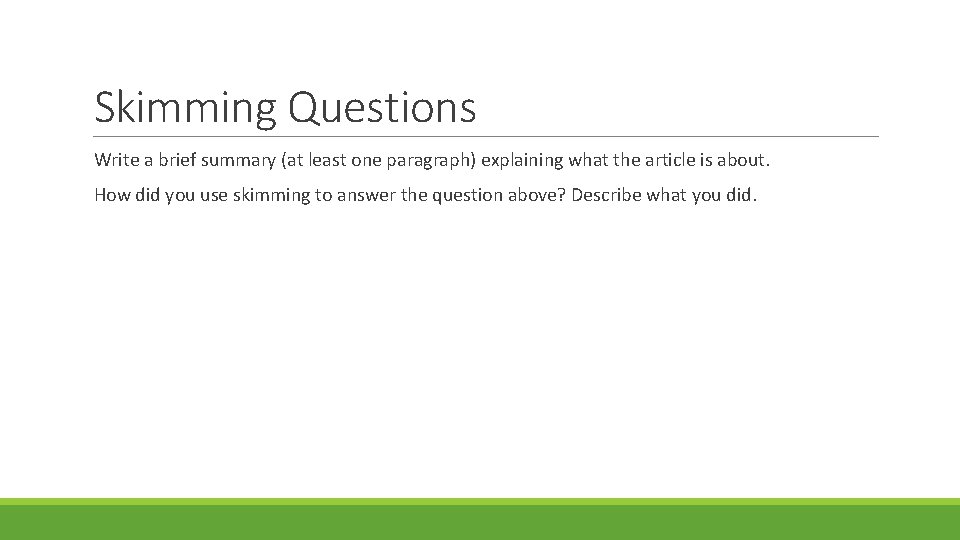
Skimming Questions Write a brief summary (at least one paragraph) explaining what the article is about. How did you use skimming to answer the question above? Describe what you did.
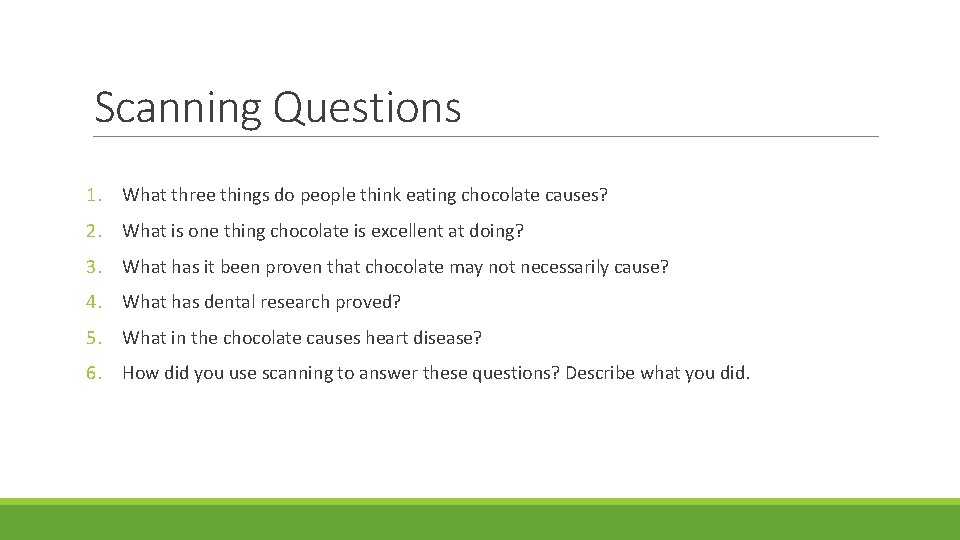
Scanning Questions 1. What three things do people think eating chocolate causes? 2. What is one thing chocolate is excellent at doing? 3. What has it been proven that chocolate may not necessarily cause? 4. What has dental research proved? 5. What in the chocolate causes heart disease? 6. How did you use scanning to answer these questions? Describe what you did.