
Key stage 3 Assessment 11 14 Statutory Assessment
- Slides: 38
Key stage 3 Assessment (11 -14)
Statutory Assessment At Key stage 3 , statutory assessment is through teacher assessment only.
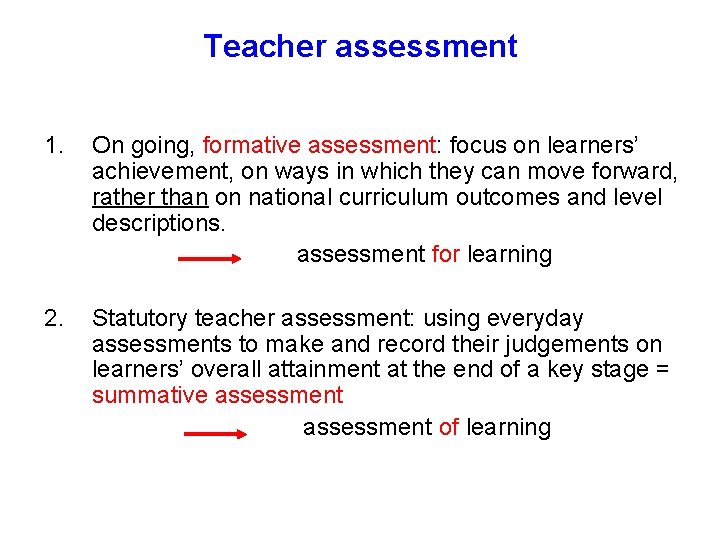
Teacher assessment 1. On going, formative assessment: focus on learners’ achievement, on ways in which they can move forward, rather than on national curriculum outcomes and level descriptions. assessment for learning 2. Statutory teacher assessment: using everyday assessments to make and record their judgements on learners’ overall attainment at the end of a key stage = summative assessment of learning
1. Formative Assessment
Formative assessment day to day teacher assessment • It is an integral part of teaching and learning. • It helps teachers: – build a knowledge of each pupil – develop an understanding of the pupil’s strengths and weaknesses.
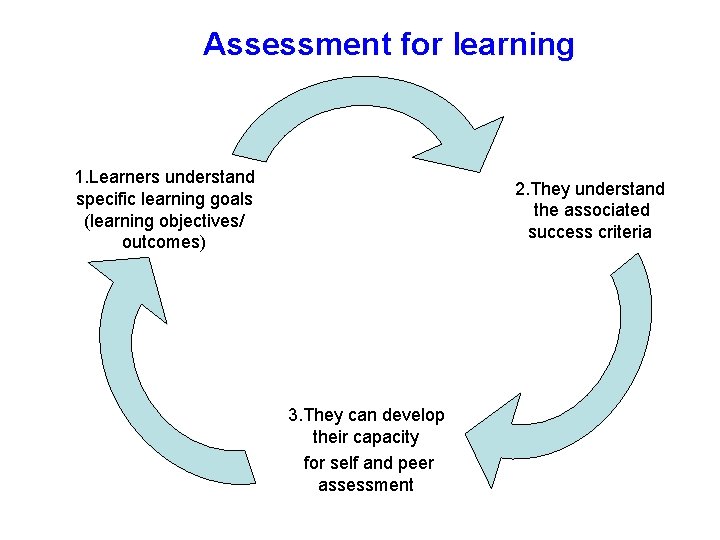
Assessment for learning 1. Learners understand specific learning goals (learning objectives/ outcomes) 2. They understand the associated success criteria 3. They can develop their capacity for self and peer assessment
Assessment for learning • Pupils can set and move towards targets • They can recognise if and when the targets have been reached • Individual targets should be linked : Øto improving the quality of the learner’s work, through formative feedback Øto success criteria for specific tasks. • Targets CANNOT be linked directly with level descriptions as they describe attainment over a range of tasks at the end of the Key stage!
Effective use of assessment information • Helps pupils make progress • Improves the quality of learning and teaching • Sets targets at individual pupils level in order to raise standards. See handout: “Safonau ar gyfer Arferion Asesu yn y Dosbarth”
2. Summative Assessment
Statutory end of Key Stage Assessment Year 9 teachers are required to provide, for each pupil : Ø a level for each attainment target Ø an overall subject level
Guidance on Assessment • Levels have been developed for summative assessment of learning at the end of key stage 3 • The level descriptions in the national curriculum Orders describe the type and range of performance that pupils working at a particular level should characteristically demonstrate. • They provide a holistic view of a number of different characteristics • Each description should be considered in conjunction with the description for adjacent levels.
Guidance on Assessment • Levels refer to a learner’s achievement over time and over a range of work • In deciding on a pupil’s level of attainment at the end of the key stage, teachers should judge which description best fits the pupil’s performance
Guidance on assessment The aim is for a rounded judgement that: • is based on knowledge of how the pupil performs across a range of contexts • takes into account the different strengths and weaknesses of that pupil’s performance • is checked against adjacent level descriptions to ensure that the level awarded is the closest match to the pupil’s performance in each attainment target.
Guidance on assessment In order to arrive at a rounded judgement of a pupil’s performance , in each attainment target, subject departments should ensure that the judgements draw on all of the following: Ø practical and oral work Ø written work completed in class Ø homework Ø school-based tests.
To be noted…. Levels are not designed: • for day to day use with learners A single piece of work : • should NOT be levelled • cannot provide an overall assessment of what level at which the learner is working. • can demonstrate characteristics of a particular level.
To be considered… • A learner’s progress is not necessarily regular or linear. • An average learner will progress 1 level over 2 years, in most subjects • Over frequent “ levelling” of a learner’s work can be counter-productive, , meaningless, demoralising and confusing for learners and parents.
3. Summative assessment: Ensuring consistency in assessment
Ensuring consistency: WAG expectations • Subject teams are encouraged to ensure that teacher assessment is based securely on a collective understanding of the standards set out in the level descriptions. • This shared understanding will be achieved through internal *standardisation and *moderation of pupils work, and which reflect the range of attainment within the school. • The Departmental portfolio is a source of evidence that demonstrate understanding of Level descriptions
Definitions • Standardisation: using sample of learners’ work to enable teachers to reach agreement on levels of attainment, by confirming a shared understanding of a level. • Moderation: at end of key stage : where best fit judgement on 1 individual learner’s attainment is made. • Portfolio: exemplifies the features of a level, for one AT at a time • Profile: exemplifies a pupil’s standards to provide evidence for a best fit level.
Step 1: Planning together 1. Assessment tasks need to be part of the learning plan (not all end of unit tests) 2. Assessment opportunities need to be planned and discussed as a department to ensure consistency in terms of: Ø expectations Ø use of strategies within the department. 3. Assessment tasks give pupils the opportunities to work at the highest possible level. 4. Assessment tasks encourage the development of skills (from Po. S and Skills framework)
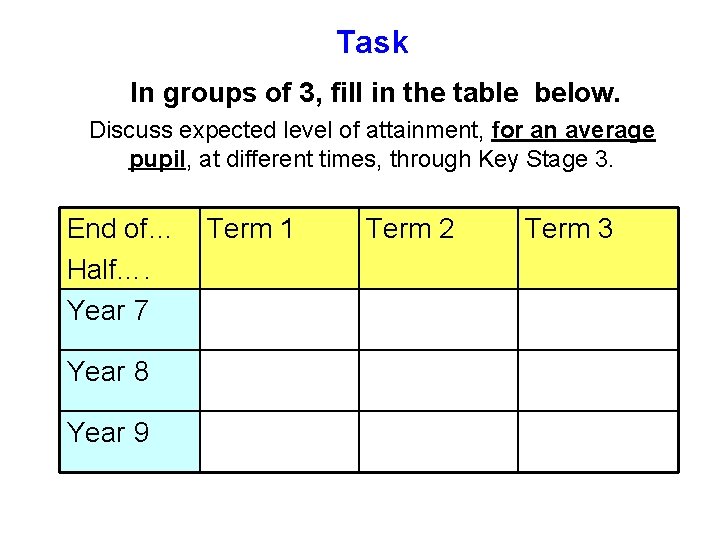
Task In groups of 3, fill in the table below. Discuss expected level of attainment, for an average pupil, at different times, through Key Stage 3. End of… Half…. Year 7 Year 8 Year 9 Term 1 Term 2 Term 3
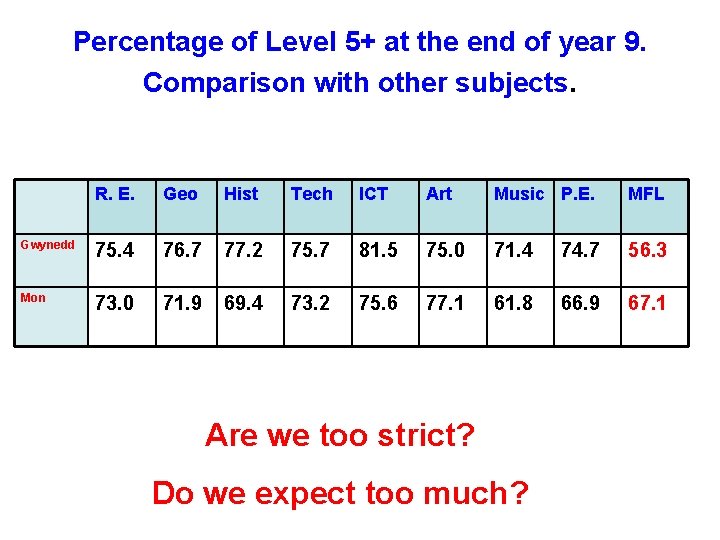
Percentage of Level 5+ at the end of year 9. Comparison with other subjects. R. E. Geo Hist Tech ICT Art Music P. E. MFL Gwynedd 75. 4 76. 7 77. 2 75. 7 81. 5 75. 0 71. 4 74. 7 56. 3 Mon 73. 0 71. 9 69. 4 73. 2 75. 6 77. 1 61. 8 66. 9 67. 1 Are we too strict? Do we expect too much?
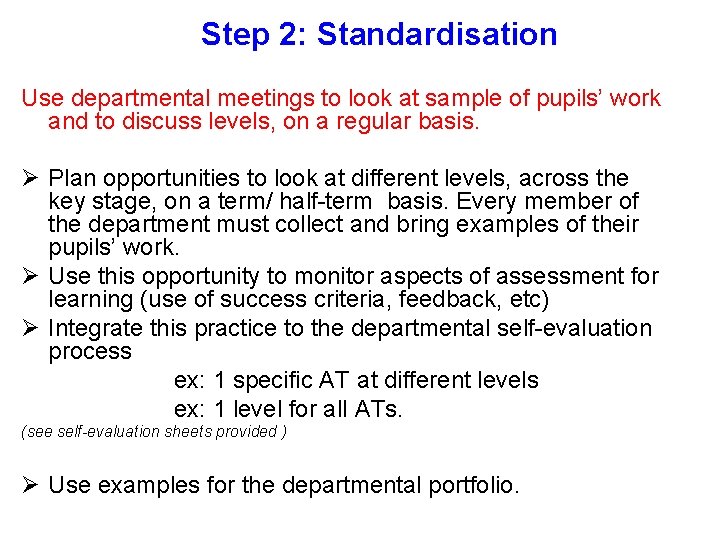
Step 2: Standardisation Use departmental meetings to look at sample of pupils’ work and to discuss levels, on a regular basis. Ø Plan opportunities to look at different levels, across the key stage, on a term/ half-term basis. Every member of the department must collect and bring examples of their pupils’ work. Ø Use this opportunity to monitor aspects of assessment for learning (use of success criteria, feedback, etc) Ø Integrate this practice to the departmental self-evaluation process ex: 1 specific AT at different levels ex: 1 level for all ATs. (see self-evaluation sheets provided ) Ø Use examples for the departmental portfolio.
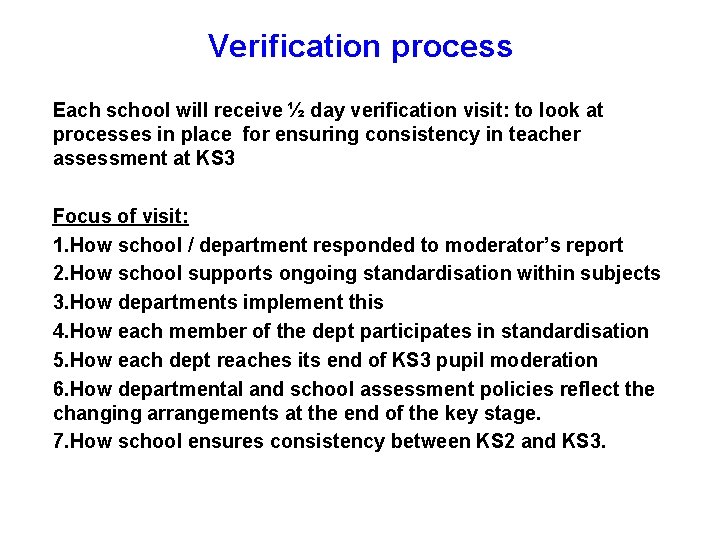
Verification process Each school will receive ½ day verification visit: to look at processes in place for ensuring consistency in teacher assessment at KS 3 Focus of visit: 1. How school / department responded to moderator’s report 2. How school supports ongoing standardisation within subjects 3. How departments implement this 4. How each member of the dept participates in standardisation 5. How each dept reaches its end of KS 3 pupil moderation 6. How departmental and school assessment policies reflect the changing arrangements at the end of the key stage. 7. How school ensures consistency between KS 2 and KS 3.
Implications for Departments Need to review: Ø departmental assessment policy Ø assessment opportunities within each learning units for Key stage 3, in the light of : Ø the changed arrangements at key stage 3 Ø the new levels of attainment Ø The focus on assessment for learning
To be noted…. Elaborate arrangements for: – recording assessments – retaining evidence are not Ø required for national curriculum assessment purposes nor Ø necessary to satisfy Estyn inspections!
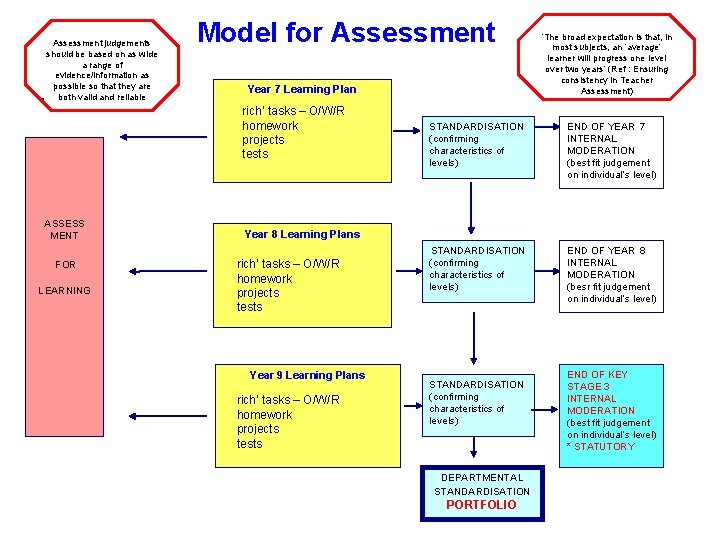
Assessment judgements should be based on as wide a range of evidence/information as possible so that they are both valid and reliable . Model for Assessment Year 7 Learning Plan rich’ tasks – O/W/R homework projects tests ASSESS MENT FOR LEARNING ‘The broad expectation is that, in most subjects, an ‘average’ learner will progress one level over two years’ (Ref : Ensuring consistency in Teacher Assessment) STANDARDISATION (confirming characteristics of levels) END OF YEAR 7 INTERNAL MODERATION (best fit judgement on individual’s level) STANDARDISATION (confirming characteristics of levels) END OF YEAR 8 INTERNAL MODERATION (besr fit judgement on individual’s level) Year 8 Learning Plans rich’ tasks – O/W/R homework projects tests Year 9 Learning Plans rich’ tasks – O/W/R homework projects tests STANDARDISATION (confirming characteristics of levels) DEPARTMENTAL STANDARDISATION PORTFOLIO END OF KEY STAGE 3 INTERNAL MODERATION (best fit judgement on individual’s level) * STATUTORY
Guidance for schools Updated guidance on consistency in teacher assessment, including case studies: “ Ensuring consistency in teacher assessment: Guidance for Key Stages 2 and 3 ” Ø to support schools planning and review of existing procedures.
Ensuring consistency: Headteachers must: • ensure that all pupils have teacher assessment levels recorded for the attainment targets in all the core and appropriate non-core subjects • provide parents with written reports on their child’s progress, and opportunities for discussion, at least once a year Headteachers should ensure that: • for each subject, and within the school as a whole, systems and procedures are in place to support accurate and consistent teacher assessment. • these systems and procedures will need to be focused on internal standardisation to allow teachers within each subject to confirm a shared understanding of national curriculum standards based on an agreed selection of pupils’ work and teacher commentary that shows the links to the level description.
4. Moderation of Teacher Assessment Feedback from Year 1
Developments so far… • The Department for Children, Education, Lifelong Learning and Skills (DCELLS) has put in place arrangements to support schools to secure and strengthen their teacher assessment. • On a phased basis, leading up to 2010, all subject departments will be required to provide sample evidence of teachers’ collective understanding and application of the national curriculum level descriptions. • Non-core subjects: Ø pilot in the school year 2006/07. Ø Year 1 National Roll out (voluntary): 25% of departments for each subject in 2007/08( = 80 depts across Wales) Ø 2008/09: 50% of schools not yet involved Ø 2009/10: remainder
MFL Departments involved in 2007/2008 • • • Ysgol Syr Thomas Jones Ysgol Uwchradd Bodedern Ysgol Eifionydd Ysgol-y-Gader Ysgol Uwchradd Towyn Ysgol Tryfan Ysgol Syr Hugh Owen Ysgol Aberconwy Ysgol Dyffryn Conwy Ysgol -y-Creuddyn
What you need to show • Evidence of assessment across the attainments targets • Accurate understanding of level descriptions • Consistency and standardisation within a department • Easily recorded evidence. • Coverage of areas of experience (2009)
The Portfolio is not… To show individual pupils’ levels of attainment! To show levels of individual task It is… To show department’s understanding of levels!
What you need to send For levels 4, 5, 6, 7: • AT 1: 1 sample, including script • AT 2: 2 samples , both recorded, on different topics Need to identify recordings clearly • AT 3: 1 sample, including the text • AT 4: 2 samples, on different topics, including context and details of support • More than 1 language? • Samples should be representative of a level given to a body of work over a period of time. • Collective understanding of a department is moderated NOT the level of individual pupils • DO NOT SEND MORE THAN REQUIRED
Moderator’s report • • • N: nothing received A: agree Ai: agree but some issues. No need to resubmit. Usually moderator explains why. • I: issues! (ex: no script) moderator not convinced about department’s understanding of level! needs to see sample again
Good practice: Need to select carefully: • Each individual task • The sample of evidence for 1 specific level Need to indicate clearly: • The context • The commentary / annotations see examples of good practice
Task In groups of 3: Referring to the new level descriptions: • Look at a sample of pupils work • Discuss which characteristics of which level can be applied to each task ?