
KEY STAGE 3 and 4 National Curriculum History

- Slides: 13
KEY STAGE 3 and 4 National Curriculum History THE FIRST WORLD WAR 1914 -1918 INTERACTIVE Why did Britain and her allies defeat Germany in the Great War? Playing movies
History Interactive Teaching and Learning Resources These are sample slides. There are no audio, document links or internet links in this sample. See all of our resources at www. historyinteractive. co. uk History Interactive Teaching and Learning © 2013
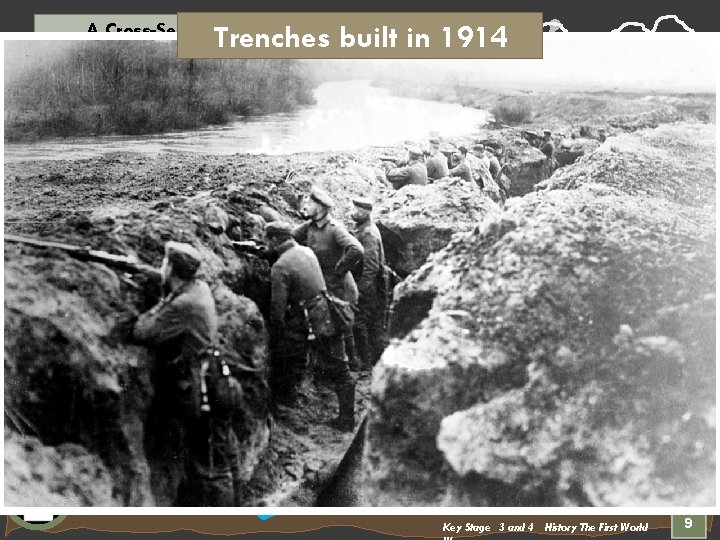
Trenches built in 1914 A Cross-Section of a Trench 1 Trench Warfare was a type of fighting during 6 Sandbags at the front the First World War in PARAPET Sandbags at the back which both sides dug PARADOS ditches protected by Dugout mines and barbed wire. 3 Trenches were usually 85 10 feet deep and 6 feet Fire step Duck boards wide. 2 Barbed wire 4 Key Stage 3 and 4 History The First World 9
NO MAN’S It. LAND IN BELGIUM It was torn up and was from about 200 The area between the two trench lines was called no man’s land. hard to cross due to constant shelling. metres to 2 kilometres or more wide. No Man's Land is the term used by Both sides set up Defended by machine soldiers to describe the ground barbed wire barriers guns and artillery. to prevent enemy between the two charges. opposing trenches. Its width along the Western Front could vary a great deal but generally averaged about 200 -250 metres. Attacking armies would go “over the top” out of their trenches and try to cross no man’s land to break through enemy trenches. The Germans built deep and well designed underground dugouts. NO MAN’S LAND Key Stage 3 and 4 History The First World 10
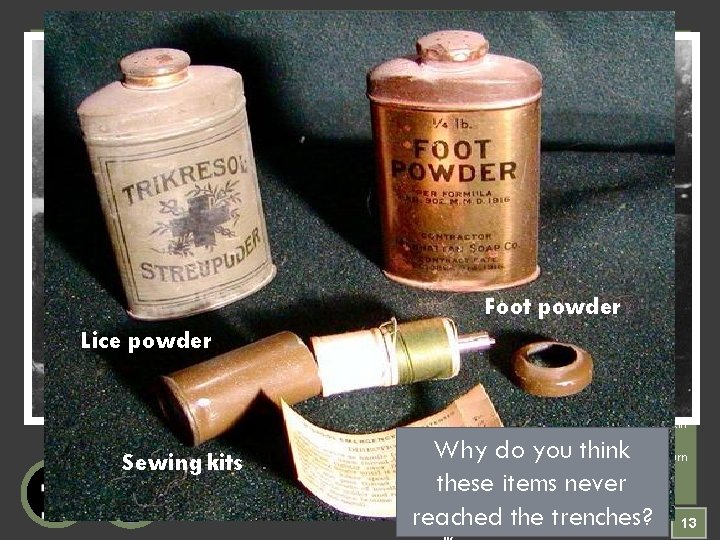
DYSENTERY Dysentery is a disease causing an inflammation of the lining of the large intestines. It causes stomach pains and diarrhoea. This disease struck the men in the trenches as there was no proper sanitation. Latrines [toilets] in the trenches were pits 4 to 5 feet deep and sometimes overflowed. RATS Many men killed in the trenches were buried almost where they fell. These corpses, as well as the food scraps that littered the trenches, attracted rats. With rats came disease. FOOD Soldiers on the Western Front were very critical of the quantity and the quality of food they received. The main food was bully beef (caned corned beef), bread and biscuits. When flour was in short supply bread was made with dried ground turnips. What were trench conditions like? Lice powder SHELL SHOCK Between 1914 and 1918, the British Army identified 80, 000 men as suffering from shell shock, a nervous disease caused by the constant shelling and fear of death. Eventually the men suffered mental breakdowns making it impossible for them to remain in the front line. PATROLS Patrols would often be sent out into No Man’s Land. Some men would be tasked with repairing or adding barbed wire to the front line. Others however would go out to assigned listening posts, hoping to pick up valuable information from the enemy lines. TRENCH FOOT Many soldiers fighting in the First World War suffered from trench foot. This was an infection of the feet caused by cold, wet and unsanitary condition. Soldiers stood for hours in waterlogged trenches without being able to remove wet socks or boots. The feet would gradually go numb and the skin would turn red or blue. If untreated, trench foot could turn gangrenous and result in amputation. Foot powder A severe case of trench foot. Soldiers were supposed to keep their feet dry, rub Why do you powder them. think This Sewing kits oil on them and then these items never was often impossible in the trenches. reached the trenches? Key Stage 3 and 4 History The First World 13
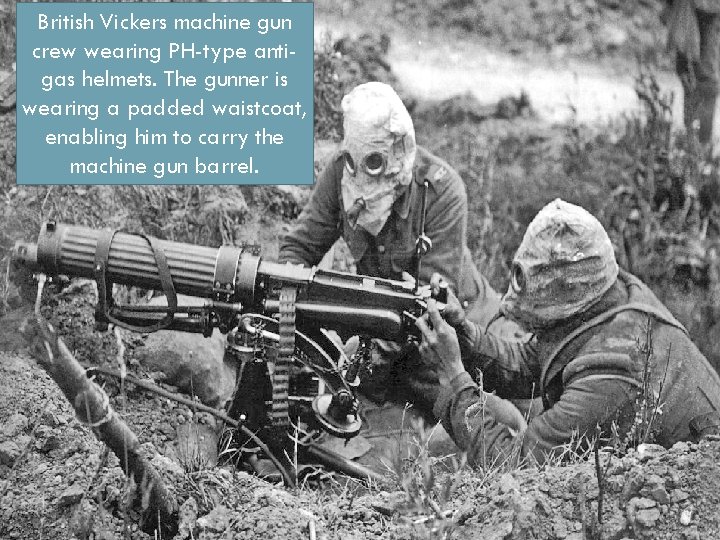
British Vickerscrew machine gun 15 inch Howitzer shells. These shells Artillery unloading Gas Machine Gun crew wearing PH-type antiweigh 1, 400 lbs, their explosion The makes crater averaging Germana. Army first used chlorine gas cylinders The machine gun was one of the most important in April 1915 against the Allies at the Second weapons in the First World War. Itfeet was gas helmets. The gunner iswaterover fifteen deep and fifteen yards across. Battle of Ypres. The use of chlorine gas was soon cooled and could fire standard rifle bullets over wearing a padded waistcoat, followed by more deadly chemical weapons like 1, 000 m. It often had a crew of two men; they could phosgene and mustard gas. The effects took place fire up to 600 bullets Thethe main type of enabling himpertominute. carry 24 to 48 hours after breathing it in. The gas machine gun was the 'Maxim'. This type was the machine gun barrel. produced a yellow liquid, which stayed in the lungs most effective and was used by Germany, Britain and Russia. They were so effective that they were considered as a “weapons of mass destruction. ” and built up until eventually, the soldier died from drowning, because their lungs were flooded. New weapon technology 1914 -1918 Tanks were introduced for the first time by the British in the Battle of the Somme in 1916. However, they proved to be unreliable though. A later model played a vital role during the Allied advances of 1918. Tanks of could flattenbeing barbed A photograph shells wire, cross enemy trenches and act as shields for up by light to weapon the 8 thebrought advancing troops. Tanks wererail a good but there were many[artillery problems. They were on slow the inch howitzers guns] and would often break down. Western Front, 1917. Artillery guns were cannons that fired highexplosive shells. The shells were thin casings and were filled with tiny lead pellets. They were the most important weapon in the war, killing hundreds Anand early British Mark tank thousands of men. Some Iguns couldnear fire at ranges of 1916. up to 18 km. called Thiepval The. Artillery tankguns is fitted "Howitzers" were used to break down enemy with the wire "grenade and defences and trenches. Germanyshield" had the largest gunsteering called ‘Big Bertha'. Big Bertha could fire at the tail, both features heart of Paris from 120 kilometres away. discarded in the next models. Key Stage 3 and 4 History The First World 15 17
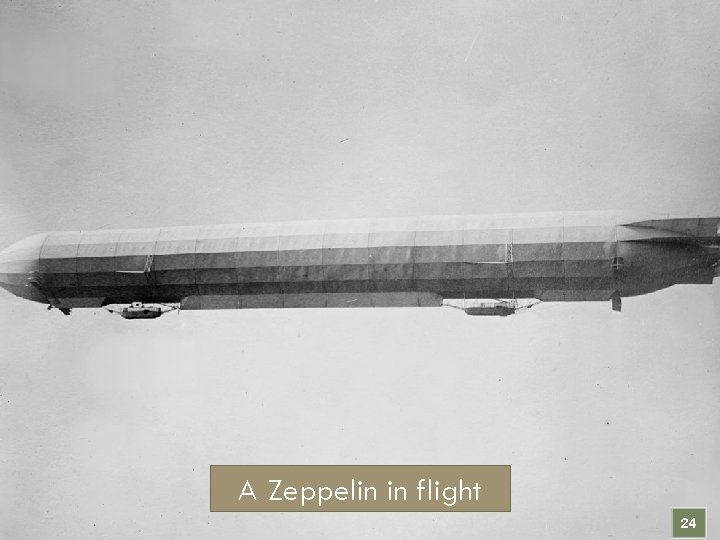
German Bombing and Air Raids 1914 -1918 In January 1915, Zeppelin BOMBING RAIDS GERMAN German battleships Gotha bomber raidsacross Britain. raids begin Forand the. King’s first time in war, theshelled British Scarborough, This started in December Great Yarmouth Bombing from the sea Whitby and Hartlepool 1917. Lynn were the first towns to be people directly Thiswere started innow December in December 1914 hit. Other towns and cities 1914. affected by bombing raids. This killing 119. followed including London. was a German tactic to cause confusion, fear and weaken the German raids were Zeppelinbombing raids morale of the British people. most effective. Bombers attacked This started in January Zeppelins were also used Although these bombing raids London in June 1917 killing 162 1915. for observation. They could including 16 children who dieddamage, their fly over enemy territory caused some impact when their school was hit. All making records of enemy in deciding the war positions and movements. together bomber raids killedthe 835 outcome of with over 1990 injuries. was very limited. Zeppelins could carry more bombs than planes but were easy to shoot down. A Zeppelin in flight Key Stage 3 and 4 History The First World 24
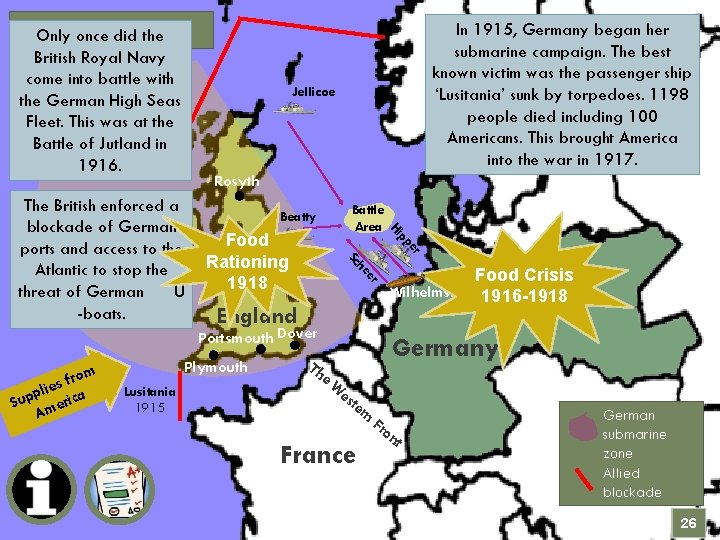
WAR AT Only once did SEA the British Royal Navy come into battle with the German High Seas Fleet. This was at the Battle of Jutland in 1916. In 1915, Germany began her submarine campaign. The best known victim was the passenger ship ‘Lusitania’ sunk by torpedoes. 1198 people died including 100 Americans. This brought America into the war in 1917. Jellicoe Rosyth r e pp Food Rationing 1918 r e he England Portsmouth Dover rom f s plie Sup merica A Plymouth Lusitania 1915 Hi Battle Area Beatty Sc The British enforced a blockade of German ports and access to the Atlantic to stop the threat of German U -boats. Food Crisis Wilhelmshaven 1916 -1918 Germany Th e. W es ter France n Fr on t German submarine zone Allied blockade 26
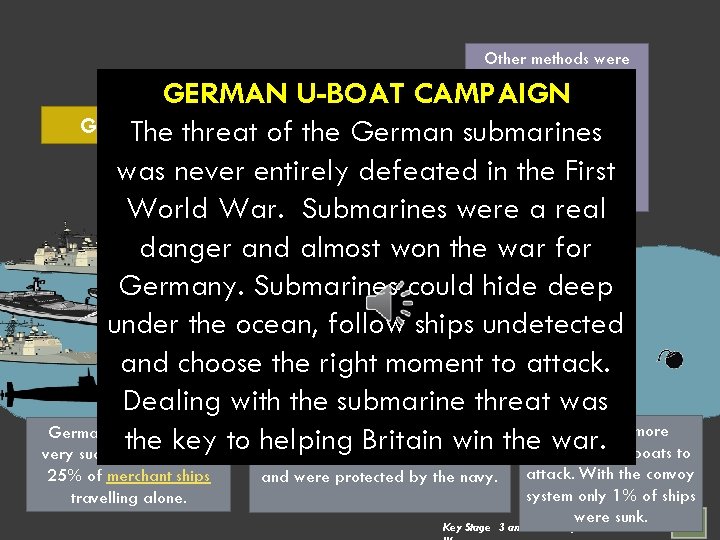
Other methods were used to defeat the German U-boats. These included: - GERMAN U-BOAT CAMPAIGN German The. Submarine threat of. Campaign the German submarines Q-ships was entirely defeated in. Depth thecharges First Once never the German Mines submarine threat had World War. been defeated, it was Submarines were a real harder for Germany to danger and almost won the war for break the blockade and prevent supplies Germany. Submarines could hide deep getting to Britain from under. America. the ocean, follow ships undetected and choose the right moment to attack. Dealing with the submarine threat was It was now more German U-boats were The convoy system was introduced. the key to helping Britain win the war. difficult for U-boats to very successful in sinking Merchant ships travelled together 25% of merchant ships travelling alone. and were protected by the navy. Key Stage attack. With the convoy system only 1% of ships were sunk. 27 3 and 4 History The First World
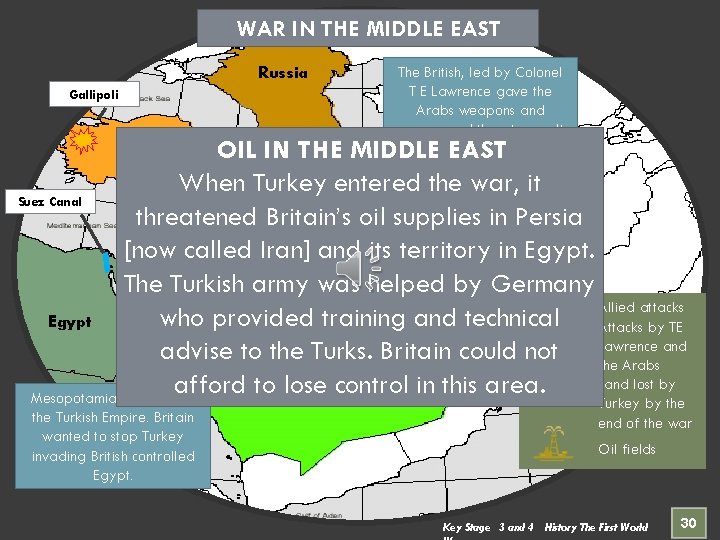
WAR IN THE MIDDLE EAST Russia Gallipoli The British, led by Colonel T E Lawrence gave the Arabs weapons and encouraged them to revolt against Turkey. OIL IN THE MIDDLE EAST When Turkey entered the war, it Suez Canal threatened Britain’s oil supplies in Persia Syria Persia [now called Iran] and its territory in Egypt. The Turkish army was helped by Germany attacks who provided training and technical Allied Egypt Attacks by TE Arabia and advise to the Turks. Britain could not Lawrence the Arabs Land lost by afford to lose control in this area. Mesopotamia was part of Turkey Ottoman Empire ota sop Me a mi the Turkish Empire. Britain wanted to stop Turkey invading British controlled Egypt. Turkey by the end of the war Oil fields Key Stage 3 and 4 History The First World 30
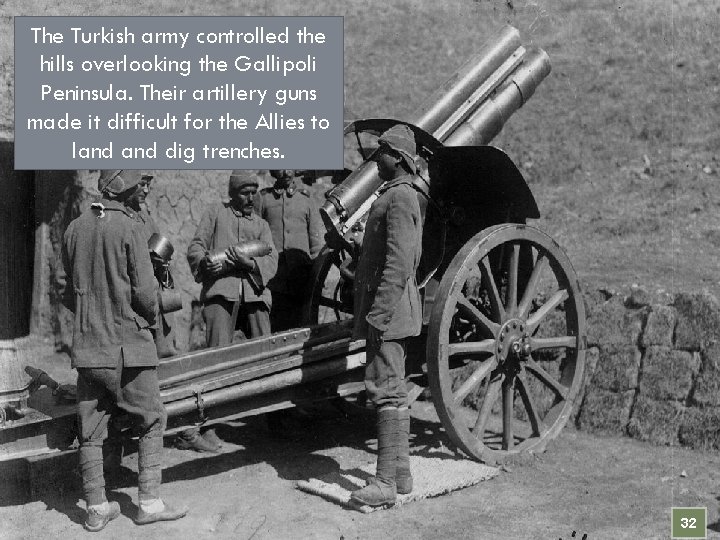
The Turkish army the CAMPAIGN Trenches dug by the Allies during THEcontrolled GALLIPOLI hills overlooking the Gallipoli Campaign. 1915 The Battle of Gallipoli Peninsula. Their artillerytook guns Gallipoli was one of the Allies’ place on the Turkish peninsula of made it difficult for the Allies to taken in April Gallipoli in 1915 great WWI. disasters in the First. Ground land dig during trenches. Ground taken in March Why did the Allies find it difficult to dig trenches on the Gallipoli beaches? Turkish forts World War. Gallipoli was the Turkish mines plan thought up by Winston. Allied attack March Allied attack April I L Churchill to. IPOend the war early L L The aim of this battle was to by creating a new war front GA capture the Ottoman capital of that the Central Powers could Constantinople not cope with. The British army TURKEY and navy were forced Temperature evacuate Gallipoli. St ra es ell an Cape Helles rd Anzac Cove Da Suvla Bay its The British navy attack Gallipoli coast and land soldiers on the beaches. 40º Key Stage 3 and 4 History The First World 32
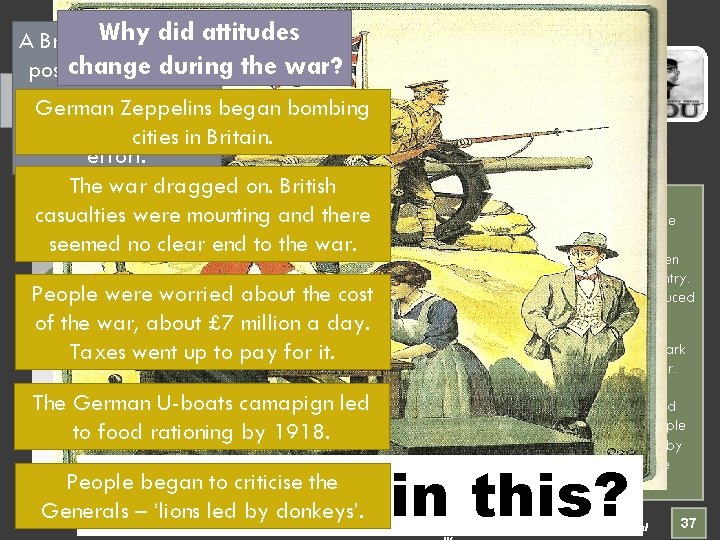
did attitudes A British Why government change during the war? poster used during the First World War Support forbegan the bombing war German Zeppelins to promote cities the war in Britain. effort. The war dragged on. British Did people’s attitude to the war change? casualties. Previous werewars mounting and had involved onlythere the fighters or those unlucky enough to be nearby. The wasto Britain’s first ‘total war’. This meant that the whole country was seemed First no World clear. War end the war. involved. At the start of the war, the government faced very little opposition. Most men wanted a chance to show what they could do and how much they supported their country. were worried the 8 million cost refused to enlist when conscription was introduced Only 16, 000 out ofabout a possible in 1916. People of the war, about £ 7 million a day. censorship propaganda, Taxes. Using went up toand pay for it. the government deliberately kept people in the dark about what was really going on. The Battle of the Somme was a turning point however. The British people soon learnt that half a million soldiers died for just a few square The German U-boats camapign led 1916, Prime Minister Asquith was replaced kilometres of gained territory. In December by Lloyd George who was very critical of leadership in the army. By 1917, most people to food rationing by 1918. in Britain were sick of the war and wanted to see an end of it. People were affected by rationing and the bombing raids. As the war dragged on, they lost heart. In 1918, the of war was withthe relief and enthusiasm. Peopleendbegan togreeted criticise Are YOU in this? Generals – ‘lions led by donkeys’. Key Stage 3 and 4 History The First World 37
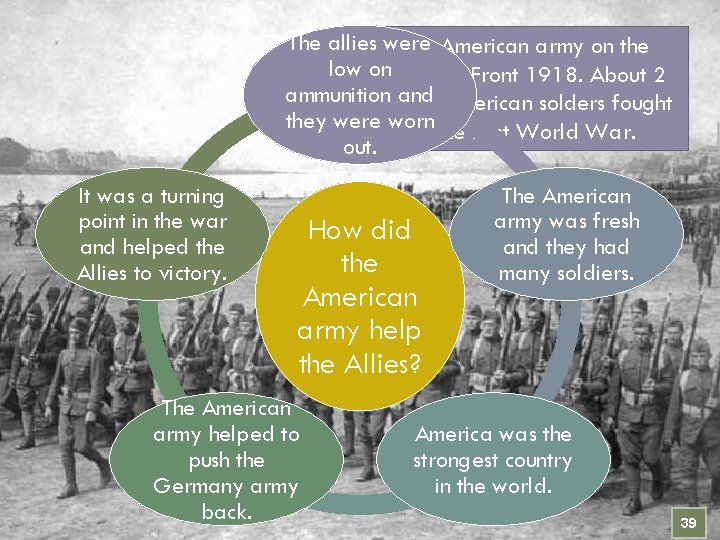
HOW THE WAR ENDED It was a turning point England in the war and helped the Allies to victory. America enters the war in April 1917. Paris The allies were The American army on the signs a low on. Western Front 1918. Russia About 2 treaty with ammunition and American solders Germany and million fought leaves the war they were worn in the First Worldin. War. March 1918. out. The collapse of Russia Germany. The American The Kaiser was fresh How did escapes army to Holland. and they had the Germany soldiers. American army help. Austriathe Allies? Hungary Germany surrenders on 11/11/1918. This was called the armistice. France The American America was the army helped to Germany launched the British, French and The German army the Ludendorff Offensivepush in American country forces begin a breaks through British strongest Germany army incounter-attack the world. forcing March 1918 in an and French trenches attempt to win the war. back. nearly reaching Paris. the German army back. 39