
Key Stage 1 Maths Workshop Addition and Subtraction
Key Stage 1 Maths Workshop Addition and Subtraction
Addition • Combining two or more groups to give a total or sum • Increasing an amount. Also: • Inverse of subtraction • Commutative i. e. 5 + 3 = 3 + 5 • Associative i. e. 5 + 3 + 7 = 5 + (3 + 7) This means that calculations can be rearranged.
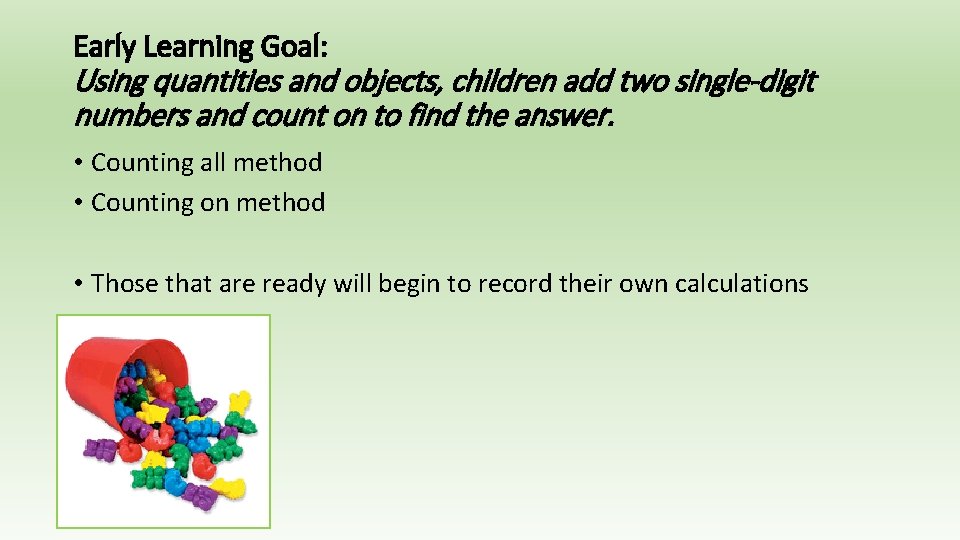
Early Learning Goal: Using quantities and objects, children add two single-digit numbers and count on to find the answer. • Counting all method • Counting on method • Those that are ready will begin to record their own calculations
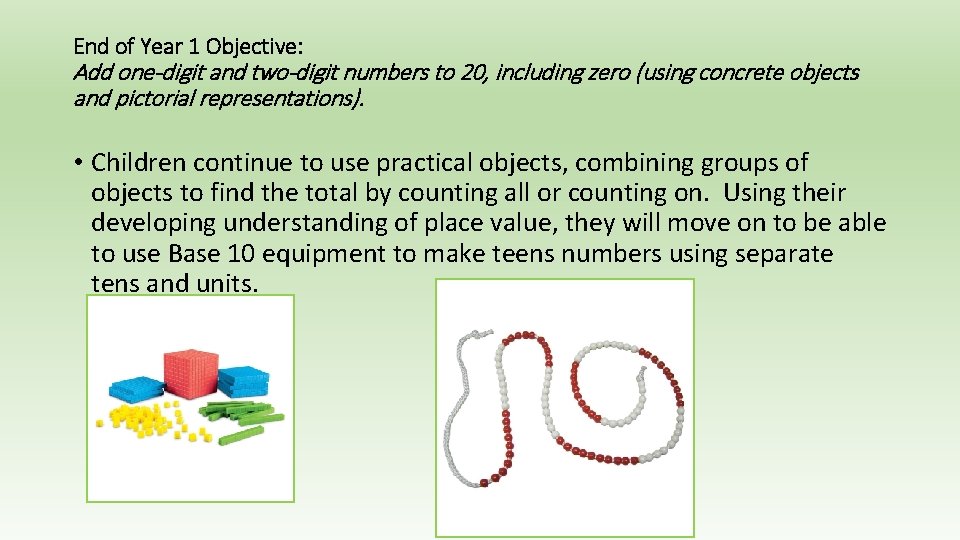
End of Year 1 Objective: Add one-digit and two-digit numbers to 20, including zero (using concrete objects and pictorial representations). • Children continue to use practical objects, combining groups of objects to find the total by counting all or counting on. Using their developing understanding of place value, they will move on to be able to use Base 10 equipment to make teens numbers using separate tens and units.

End of Year Objective: Add numbers using concrete objects, pictorial representations, and mentally, including: a two-digit number and ones; a two-digit number and tens; two-digit numbers; three one-digit numbers . • Children continue to use Base 10 equipment to support their calculations. For example, when calculating 32 + 21, they can make the individual amounts, counting tens first then units. A. B.
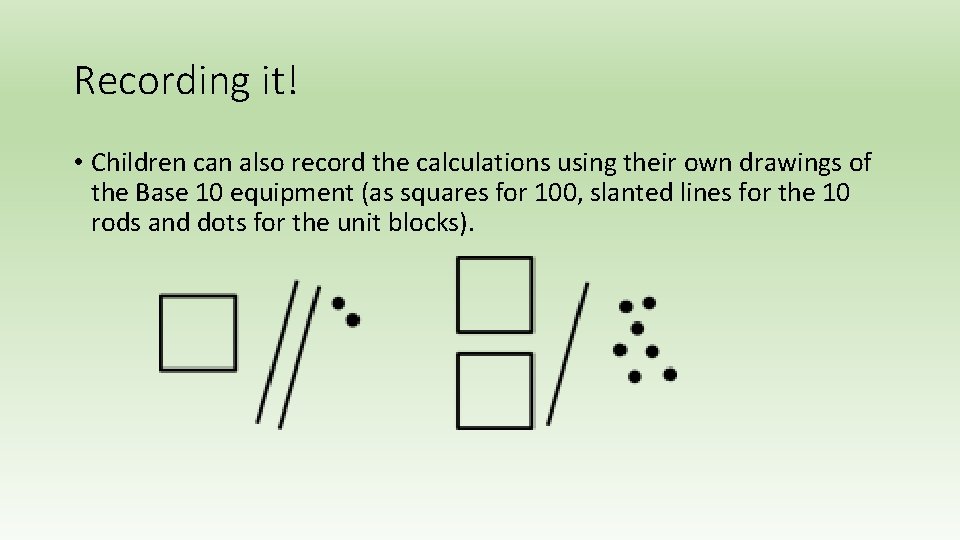
Recording it! • Children can also record the calculations using their own drawings of the Base 10 equipment (as squares for 100, slanted lines for the 10 rods and dots for the unit blocks).
Subtraction • Removal of an amount from a larger group (take away) • Comparison of two amounts (difference) Children also need to understand work with certain principles, i. e. that it is: • the inverse of addition • not commutative i. e. 5 - 3 is not the same as 3 - 5 • not associative i. e. 10 - 3 - 2 is not the same as 10 - (3 - 2)
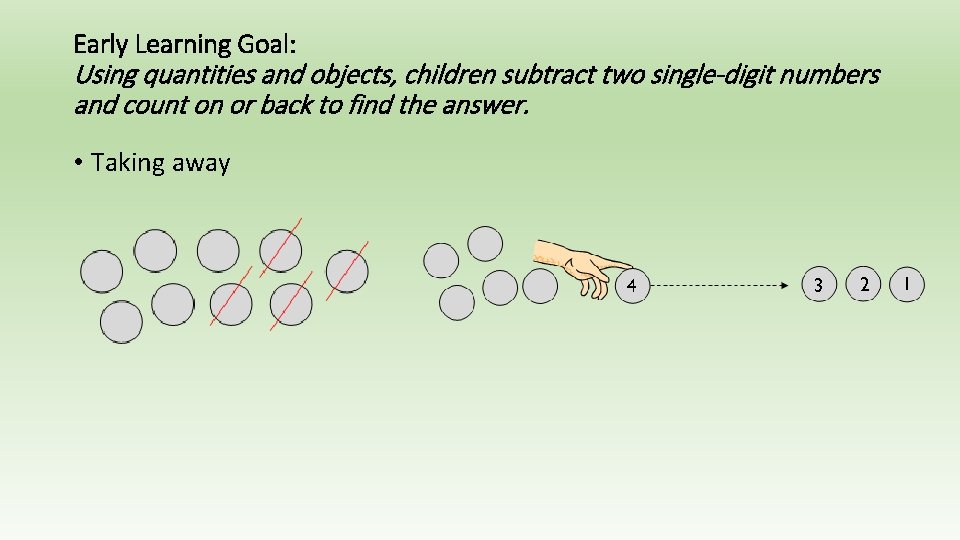
Early Learning Goal: Using quantities and objects, children subtract two single-digit numbers and count on or back to find the answer. • Taking away
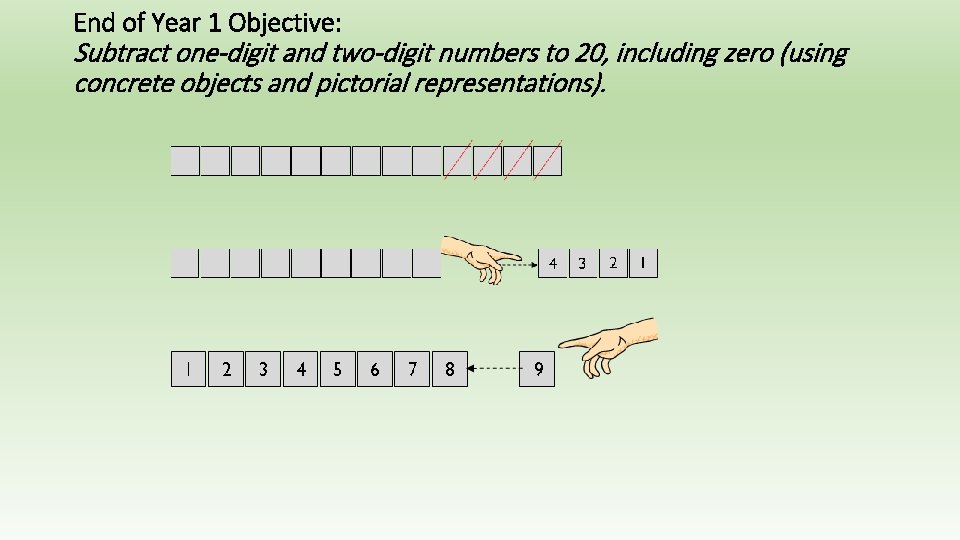
End of Year 1 Objective: Subtract one-digit and two-digit numbers to 20, including zero (using concrete objects and pictorial representations).
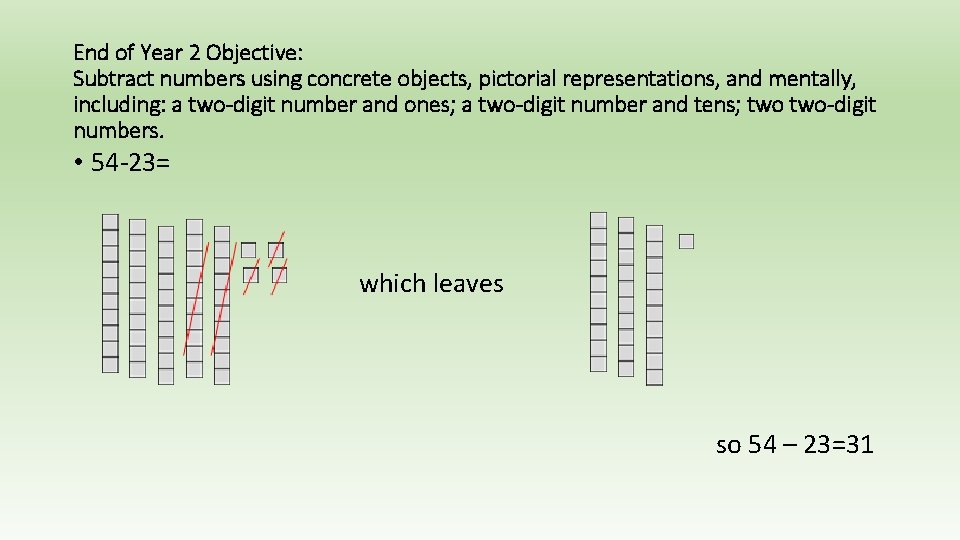
End of Year 2 Objective: Subtract numbers using concrete objects, pictorial representations, and mentally, including: a two-digit number and ones; a two-digit number and tens; two-digit numbers. • 54 -23= which leaves so 54 – 23=31
Recording it! • Children can also record the calculations using their own drawings of the Base 10 equipment (as we did with the addition earlier)
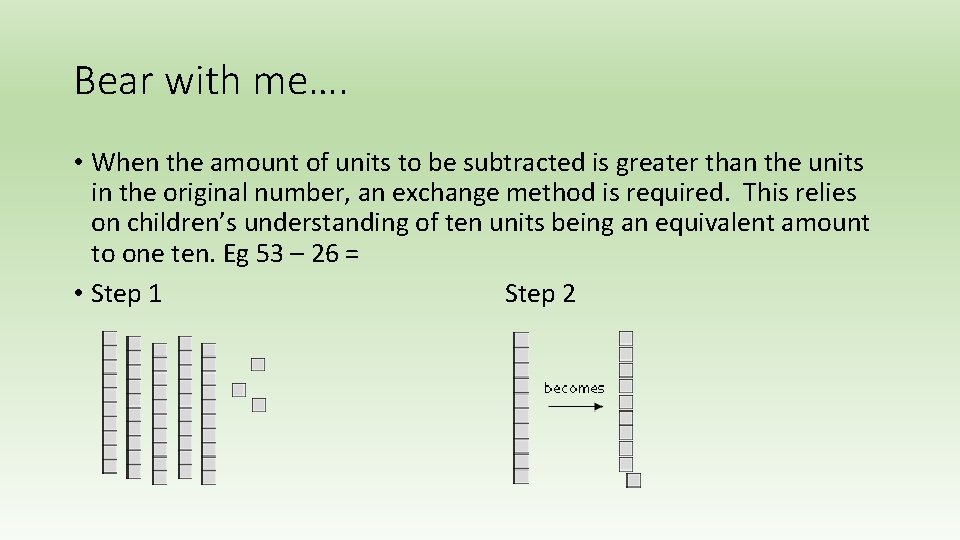
Bear with me…. • When the amount of units to be subtracted is greater than the units in the original number, an exchange method is required. This relies on children’s understanding of ten units being an equivalent amount to one ten. Eg 53 – 26 = • Step 1 Step 2
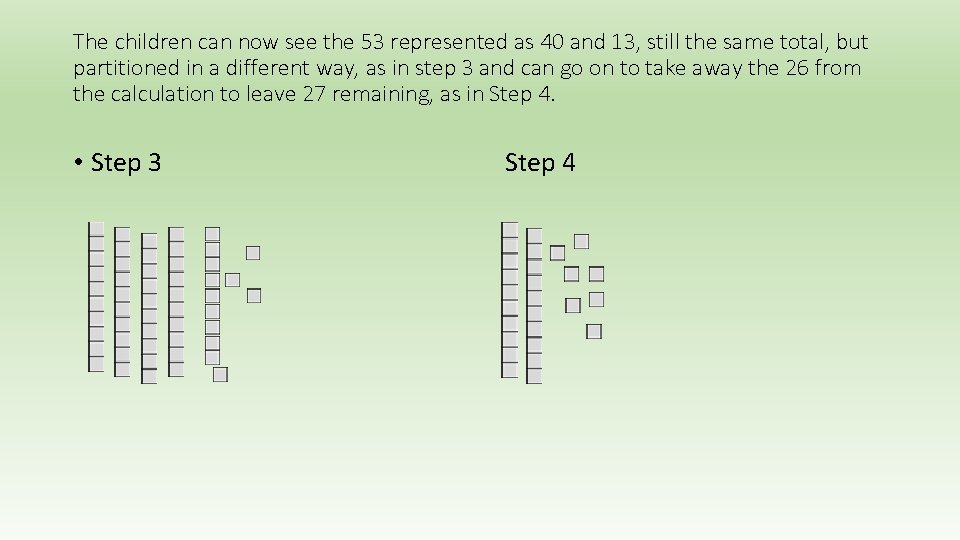
The children can now see the 53 represented as 40 and 13, still the same total, but partitioned in a different way, as in step 3 and can go on to take away the 26 from the calculation to leave 27 remaining, as in Step 4. • Step 3 Step 4
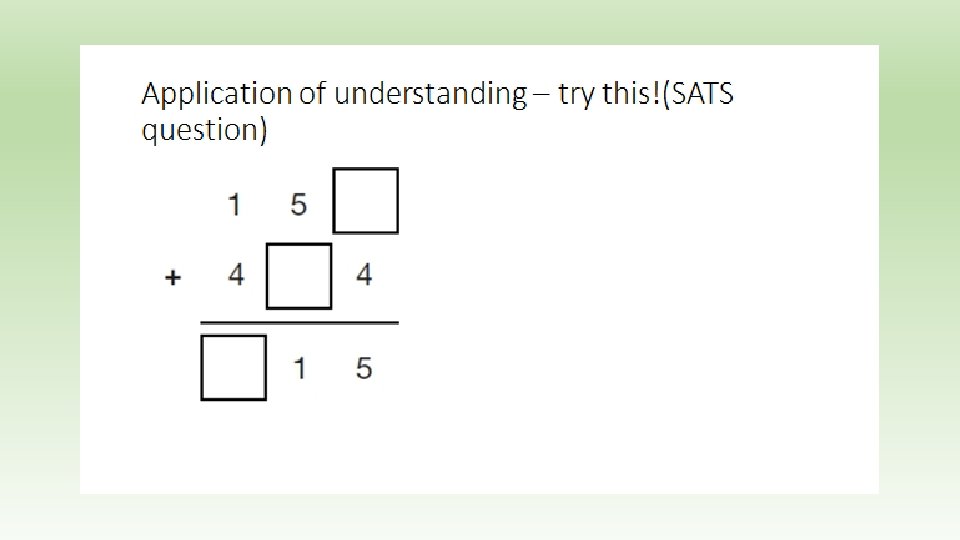
Your turn! We look forward to seeing you next term at our multiplication and division workshop – please look out for the date in our newsletters nearer the time.
- Slides: 15