
Key Stage 1 Curriculum and Assessment changes Wyndham
- Slides: 30
Key Stage 1 Curriculum and Assessment changes
Wyndham Park’s vision Our vision is to develop deep learning through everyone’s unique talents; giving each child a rainbow of experiences to take them through life.
Our aims • To seek out and nurture each child’s individual strengths, skills and interests • To inspire and motivate children through engaging and creative teaching • To create a safe environment in which children are confident, resilient and able to learn from their mistakes • To encourage children to work co-operatively, showing kindness and respect to others • To provide a range of learning opportunities to allow children to deepen their knowledge and understanding through a variety of real life contexts • To ensure children leave Wyndham Park with a full, broad and balanced education across all areas of the curriculum • To give children opportunities to become responsible, honest and trustworthy young people • To work alongside parents, carers, SRET and the wider community to help each child grow positively
Our values Kindness Respect Resilience Teamwork
Your involvement • Supporting our vision, aims and values at home • Being involved in your child’s education • Getting involved with WPSA and raising funds for ‘rainbow experiences’ • Becoming part of our governing body
National Curriculum • Primary curriculum applies to children in Years 1 -6. • Introduced in September 2014. Current Year 2 children are the first children to have been taught the new curriculum throughout. • The curriculum is structured into core and foundation subjects. • Matters, skills and processes to be taught are set out in the programmes of study. • The National Curriculum contains a mixed structure. • “The National Curriculum provides an outline of core knowledge around which teachers can develop exciting and stimulating lessons to promote the development of pupils’ knowledge, understanding and skills as part of the wider school curriculum. ”
Our Curriculum • We are following Chris Quigley’s Essentials Curriculum. • Structured into ‘milestones’ that last for two years: • Milestone 1 – Years 1 & 2 • Milestone 2 – Years 3 &4 • Milestone 3 – Years 5 &6 • Children will move from the Early Years Foundation Stage curriculum in Reception to milestone 1 in Years 1 & 2. • Milestones allows for progression of skills and depth within subject strands.
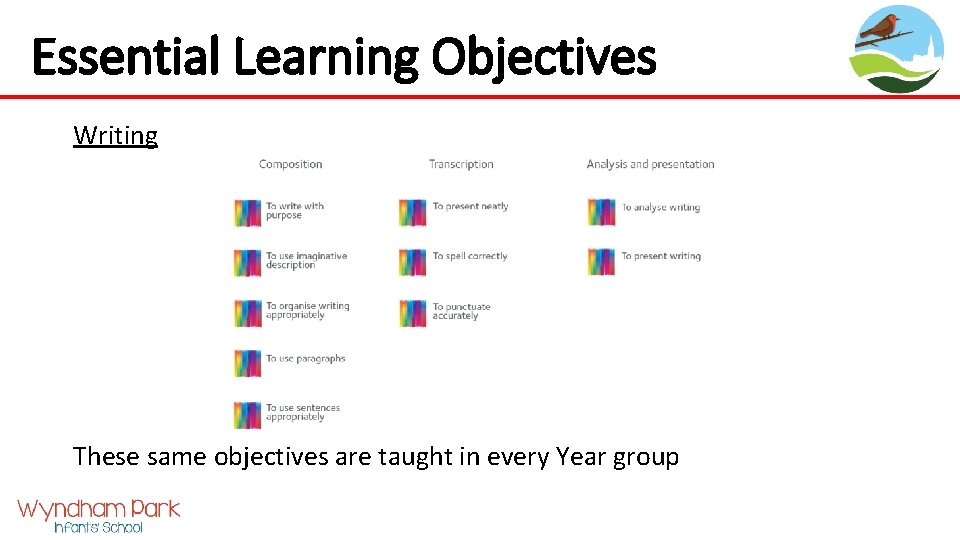
Essential Learning Objectives Writing These same objectives are taught in every Year group
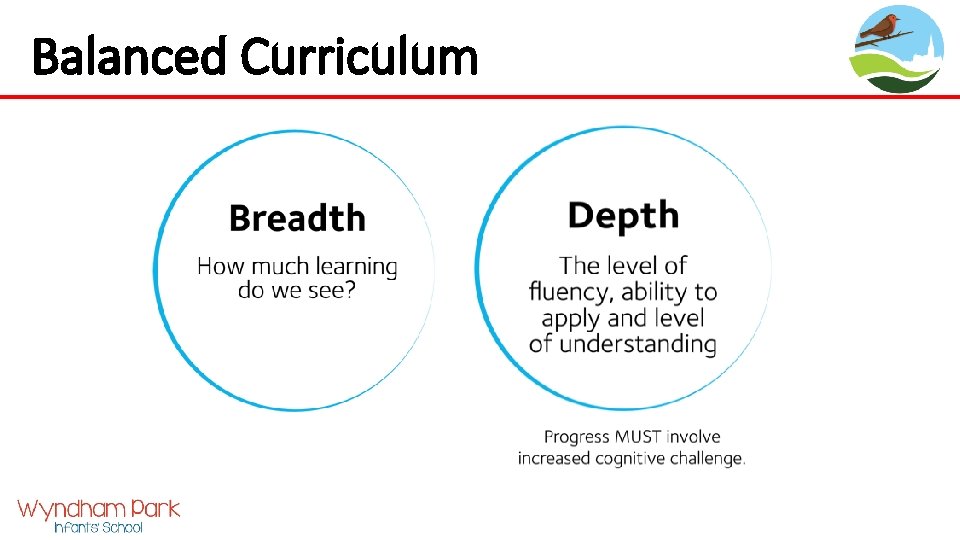
Balanced Curriculum
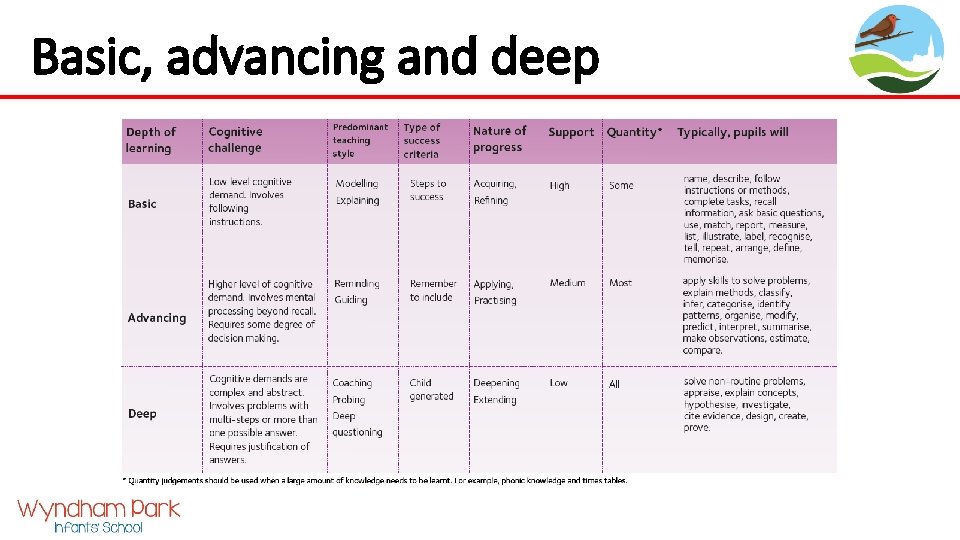
Cognitive challenge • Differentiation in class through cognitive challenge in order to deepen understanding rather than just increase knowledge. • Children may be basic, advancing or deep in different aspects of each subject area. • Opportunities in Year 1 will mainly focus on basic and advancing teaching and learning. • Year 2 will allow for advancing and deep teaching and learning for those children who are ready. • It’s important not to accelerate learning but to deepen understanding.
Basic, advancing and deep
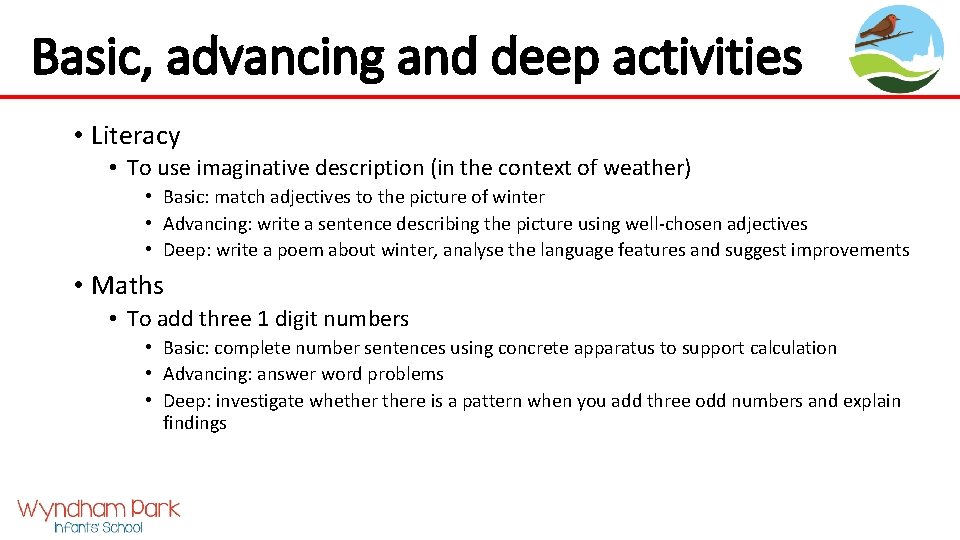
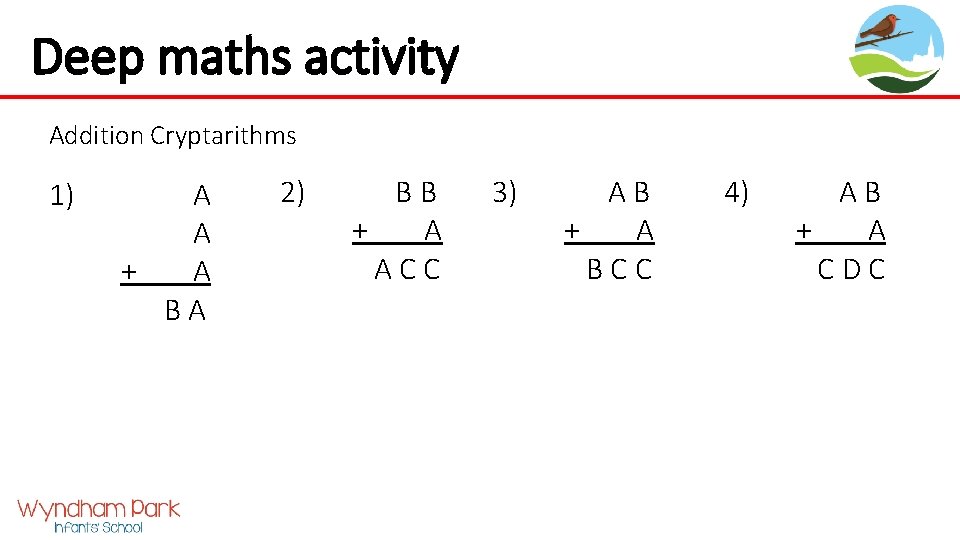
Basic, advancing and deep activities • Literacy • To use imaginative description (in the context of weather) • Basic: match adjectives to the picture of winter • Advancing: write a sentence describing the picture using well-chosen adjectives • Deep: write a poem about winter, analyse the language features and suggest improvements • Maths • To add three 1 digit numbers • Basic: complete number sentences using concrete apparatus to support calculation • Advancing: answer word problems • Deep: investigate whethere is a pattern when you add three odd numbers and explain findings
Deep maths activity Addition Cryptarithms 1) A A + A BA 2) BB + A ACC 3) AB + A BCC 4) AB + A CDC
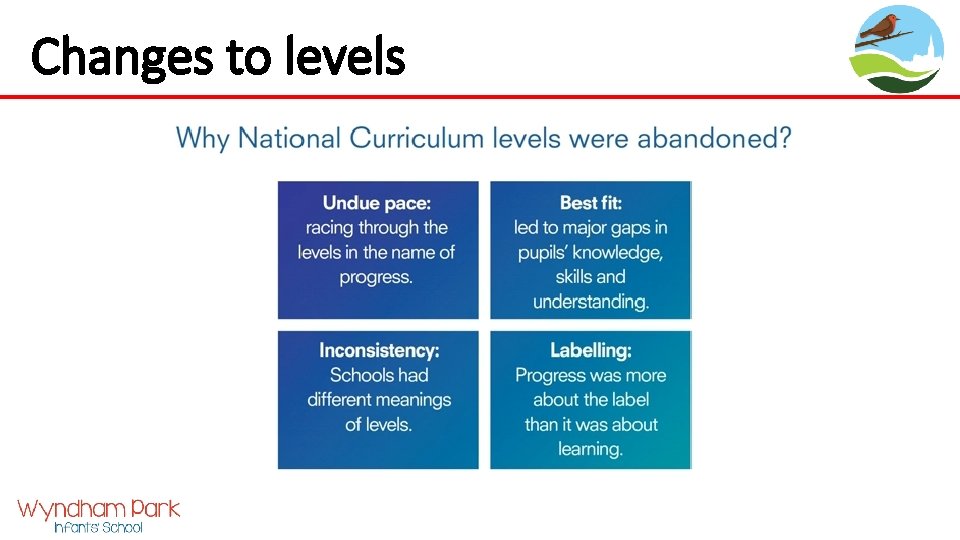
Changes to levels
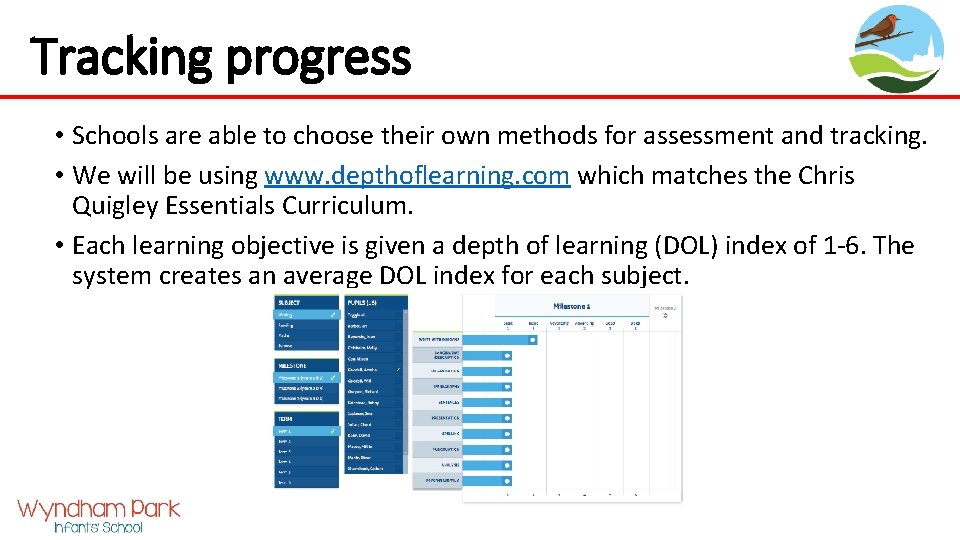
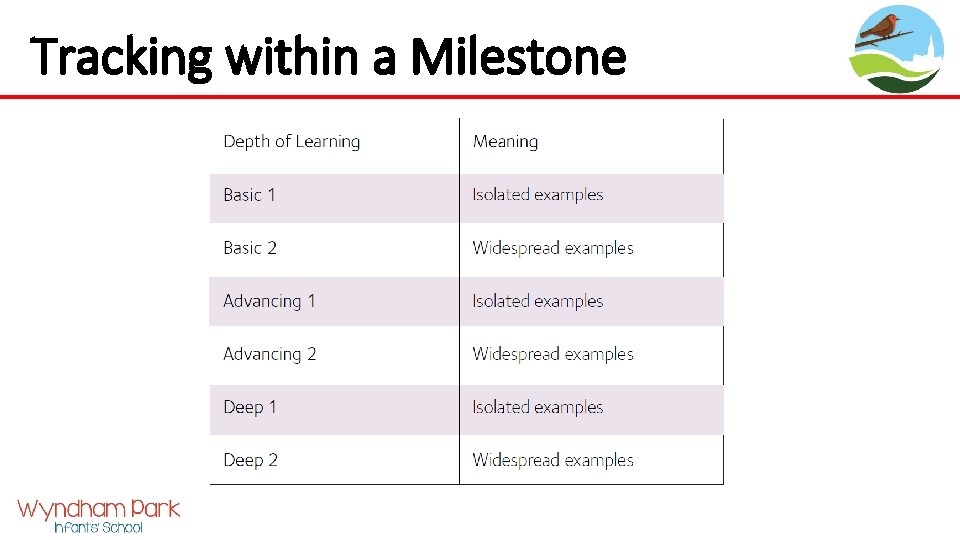
Tracking progress • Schools are able to choose their own methods for assessment and tracking. • We will be using www. depthoflearning. com which matches the Chris Quigley Essentials Curriculum. • Each learning objective is given a depth of learning (DOL) index of 1 -6. The system creates an average DOL index for each subject.
Tracking within a Milestone
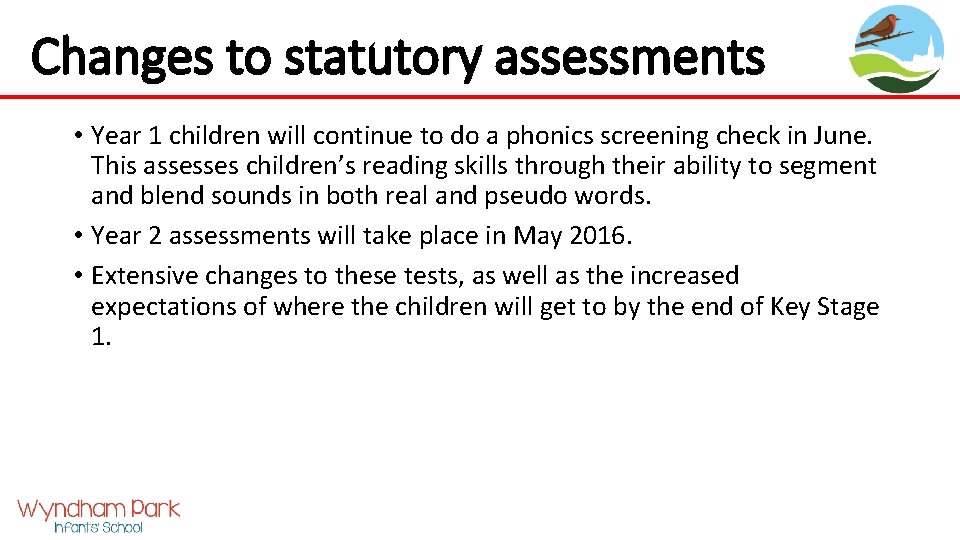
Changes to statutory assessments • Year 1 children will continue to do a phonics screening check in June. This assesses children’s reading skills through their ability to segment and blend sounds in both real and pseudo words. • Year 2 assessments will take place in May 2016. • Extensive changes to these tests, as well as the increased expectations of where the children will get to by the end of Key Stage 1.
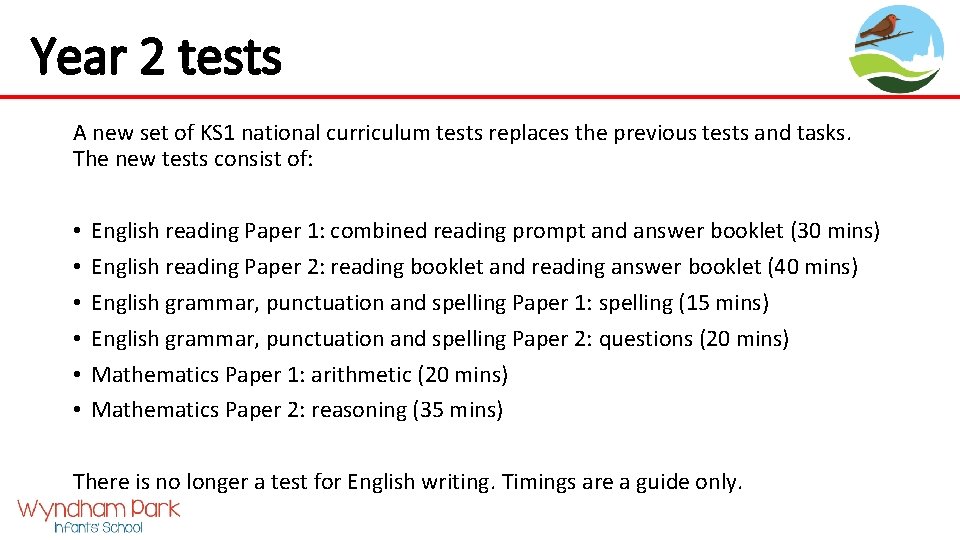
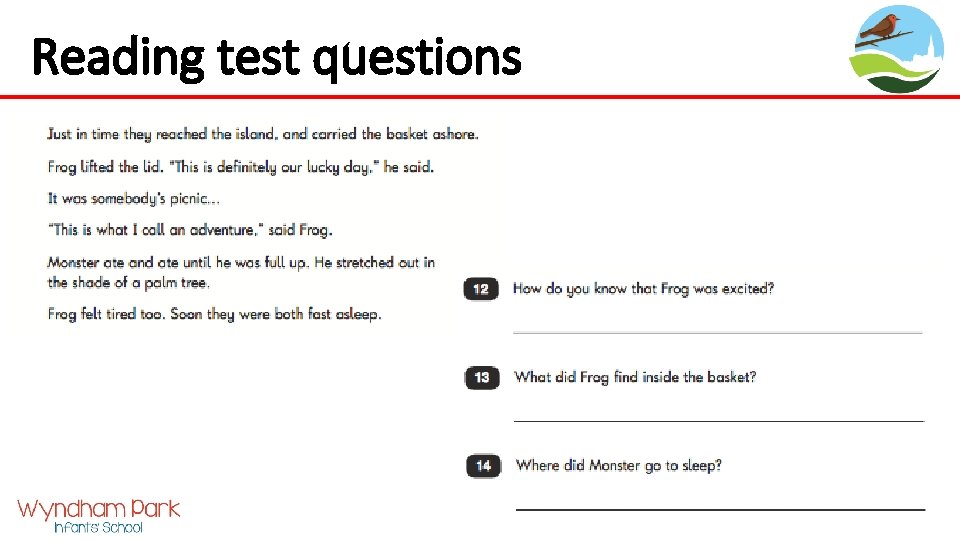
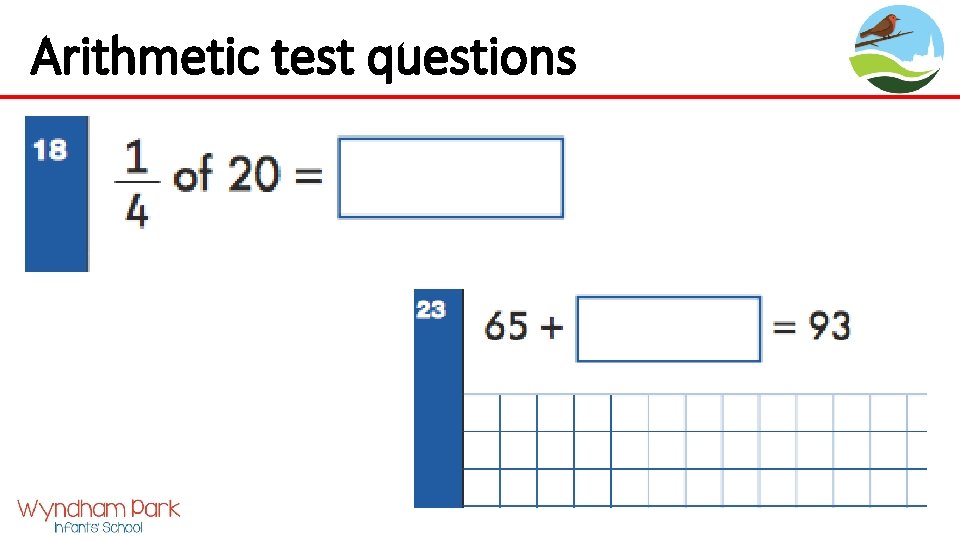
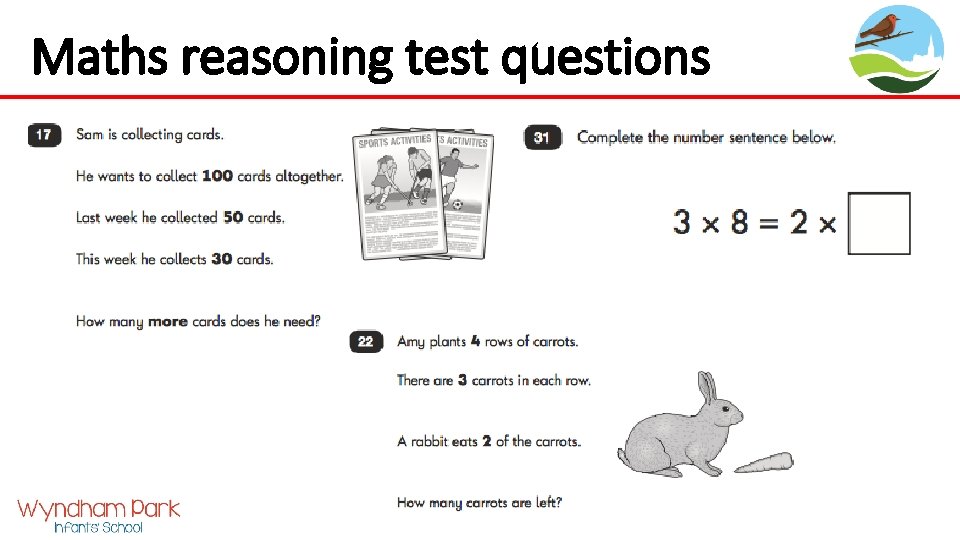
Year 2 tests A new set of KS 1 national curriculum tests replaces the previous tests and tasks. The new tests consist of: • • • English reading Paper 1: combined reading prompt and answer booklet (30 mins) English reading Paper 2: reading booklet and reading answer booklet (40 mins) English grammar, punctuation and spelling Paper 1: spelling (15 mins) English grammar, punctuation and spelling Paper 2: questions (20 mins) Mathematics Paper 1: arithmetic (20 mins) Mathematics Paper 2: reasoning (35 mins) There is no longer a test for English writing. Timings are a guide only.
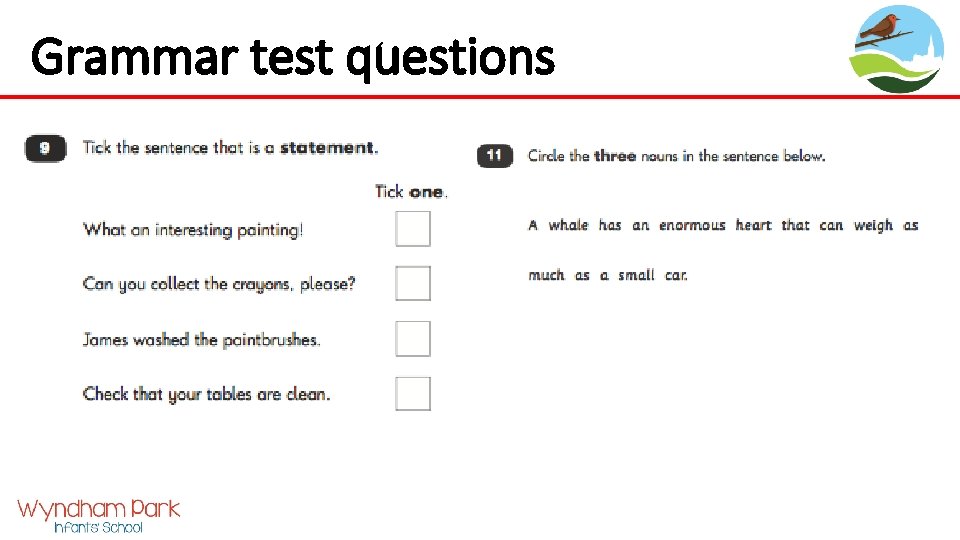
Grammar test questions
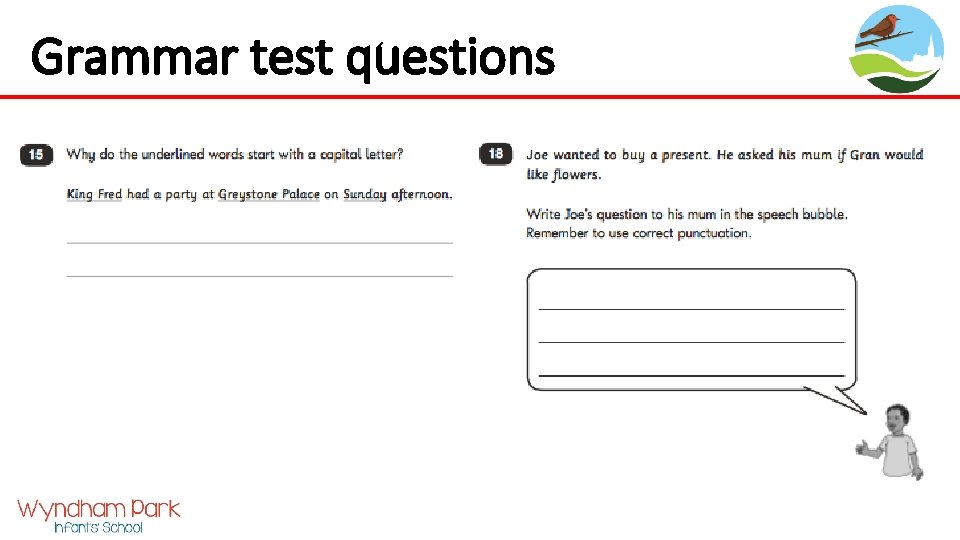
Grammar test questions
Reading test questions
Arithmetic test questions
Maths reasoning test questions
Scaled scores • For the KS 1 tests a scaled score of 100 will always represent the ‘expected standard’. • A pupil’s scaled score will be based on their raw score. The raw score is the total number of marks a pupil receives in a test, based on the number of questions they answered correctly. The pupil’s raw score will be translated into a scaled score using a conversion table. • Conversion tables will be published after the tests have been administered. • Scaled scores allow for comparison of results year on year.
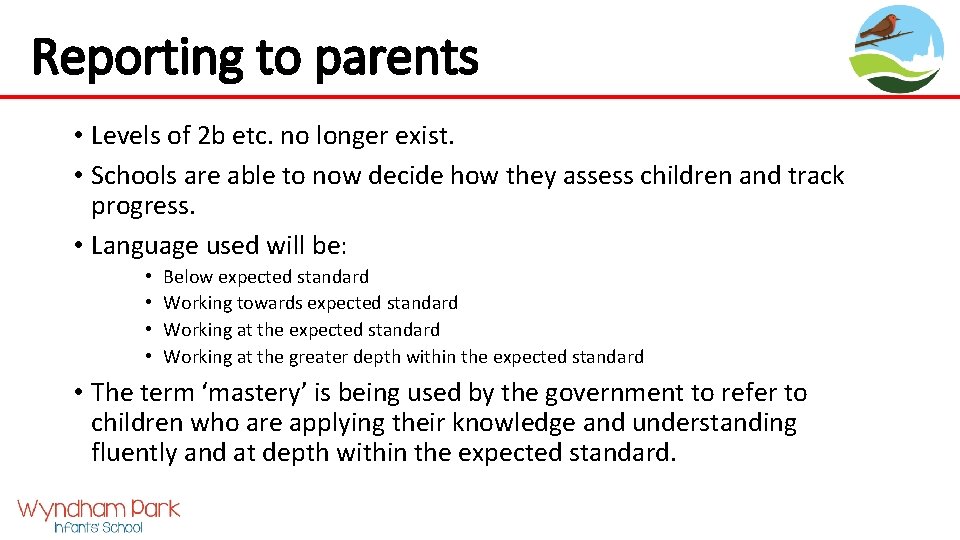
Reporting to parents • Levels of 2 b etc. no longer exist. • Schools are able to now decide how they assess children and track progress. • Language used will be: • • Below expected standard Working towards expected standard Working at the greater depth within the expected standard • The term ‘mastery’ is being used by the government to refer to children who are applying their knowledge and understanding fluently and at depth within the expected standard.
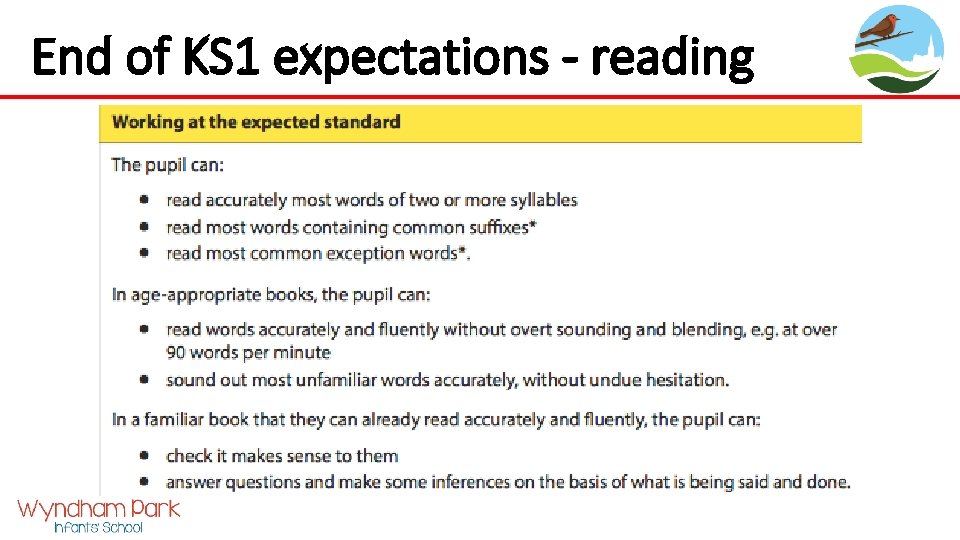
End of KS 1 expectations - reading
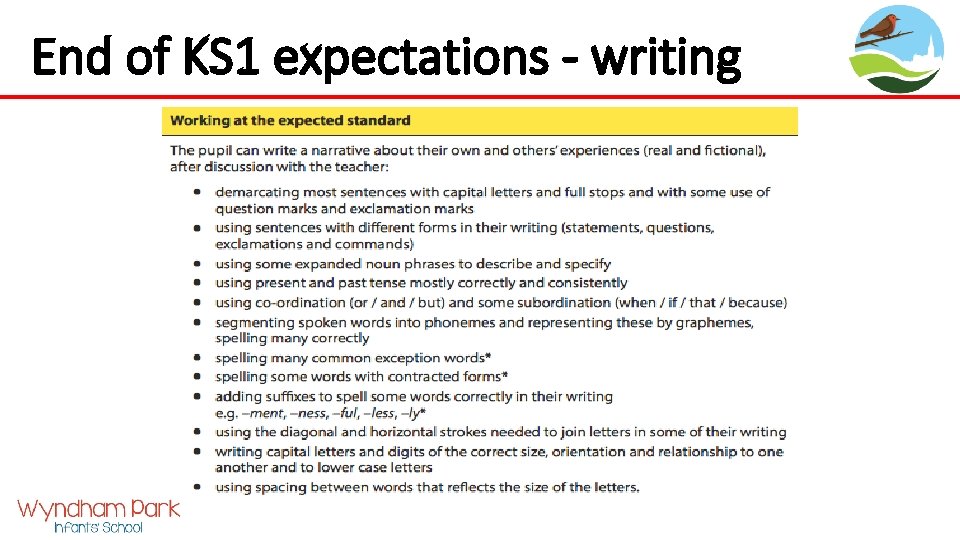
End of KS 1 expectations - writing
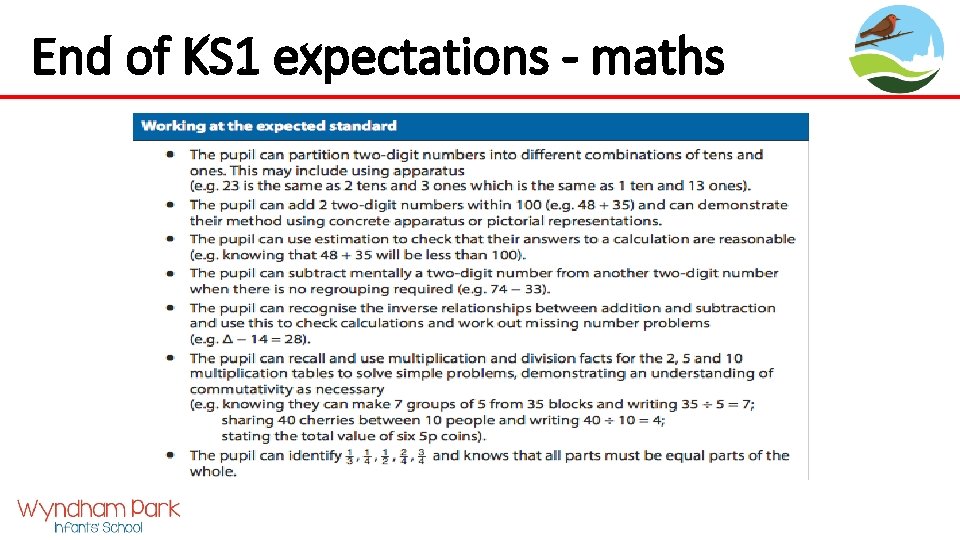
End of KS 1 expectations - maths
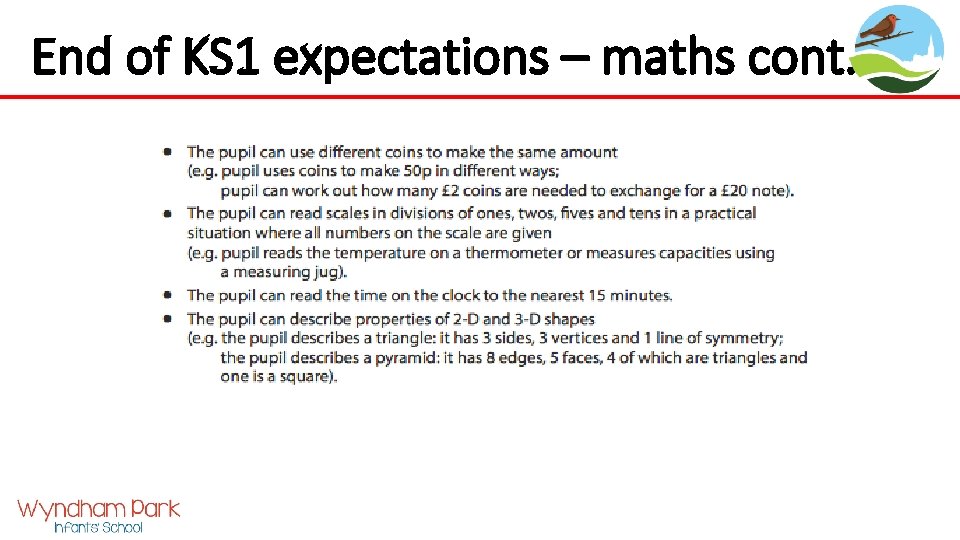
End of KS 1 expectations – maths cont.
Further information • This is all new for us too! • This presentation will be available on our school website. • Copies of the interim teacher assessment frameworks will also be available on our website. • Some key school policies are currently being updated in light of all these changes and will be made available on the website as soon as this process has taken place. Does anyone have any questions?