
Key Requirements of the Construction General Permit Scott
- Slides: 33
Key Requirements of the Construction General Permit Scott Taylor, P. E. , CISEC Stormwater
Permit Fast Facts • 285 page permit • All reporting is publicly available through SMARTS • Requires self-reporting, which may lead to enforcement • Substantial fines for noncompliance • ~7, 000 active projects in CA • Requires runoff sampling for some projects (RL 2, 3, nonvisible) Stormwater
Project Fast Facts • All projects greater than one acre (DSA) must: § § § § § Conduct risk level determination Register for permit coverage Pay the first annual fee Develop a SWPPP Implement the SWPPP during construction Stabilize all disturbed areas after construction Construct post-construction BMPs/maintenance plan Submit annual reports Terminate permit coverage Stormwater
Past Enforcement Actions (Or, Why Should You Care? ) �Walmart, $3. 1 million �EPA, 2004, for failure to obtain stormwater permits and implement BMPs �Richmond American + other companies, $928, 500 �EPA, 2003, for failure to obtain stormwater permits, develop/implement SWPPPs, implement BMPs to minimize sediment discharge, and conduct site inspections �City of San Diego, $532, 000 �RWQCB, 2000, for failure to curb erosion from City roadway �Caltrans, $1, 600, 000 �RWQCB, 2011, for failure to implement effective BMPs Stormwater
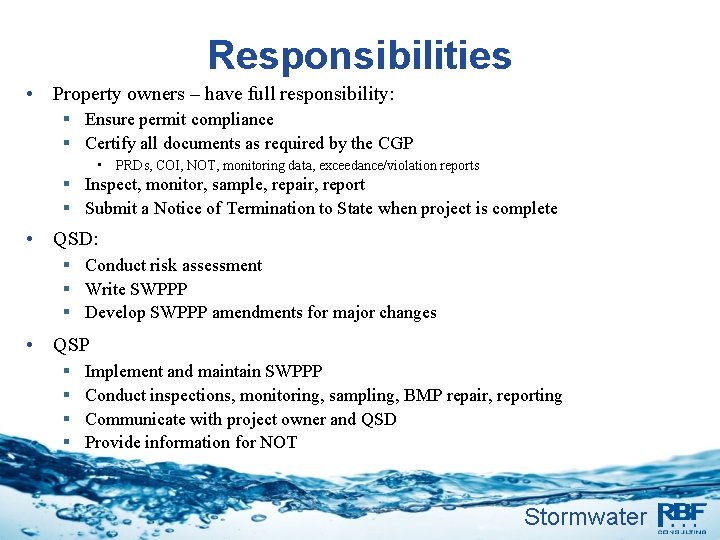
Responsibilities • Property owners – have full responsibility: § Ensure permit compliance § Certify all documents as required by the CGP • PRDs, COI, NOT, monitoring data, exceedance/violation reports § Inspect, monitor, sample, repair, report § Submit a Notice of Termination to State when project is complete • QSD: § Conduct risk assessment § Write SWPPP § Develop SWPPP amendments for major changes • QSP § § Implement and maintain SWPPP Conduct inspections, monitoring, sampling, BMP repair, reporting Communicate with project owner and QSD Provide information for NOT Stormwater
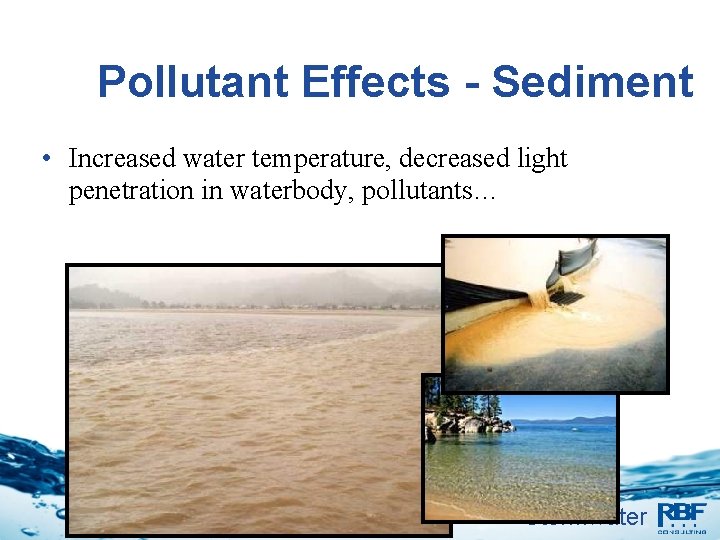
Pollutant Effects - Sediment • Increased water temperature, decreased light penetration in waterbody, pollutants… 6 Stormwater
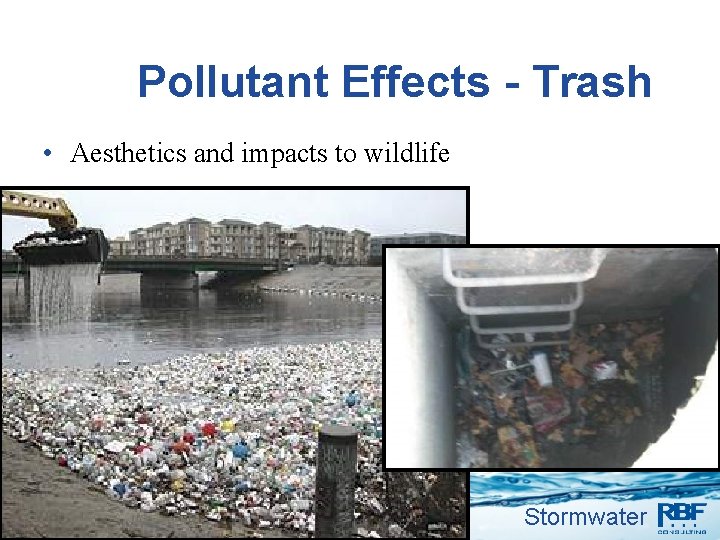
Pollutant Effects - Trash • Aesthetics and impacts to wildlife 7 Stormwater
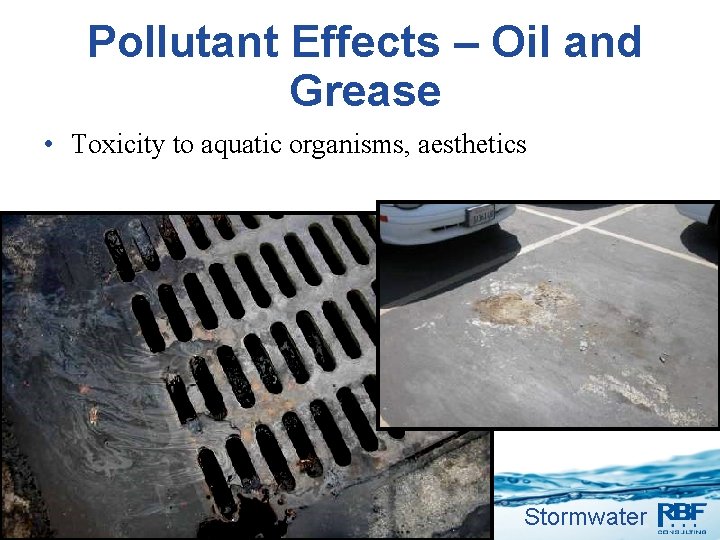
Pollutant Effects – Oil and Grease • Toxicity to aquatic organisms, aesthetics 8 Stormwater
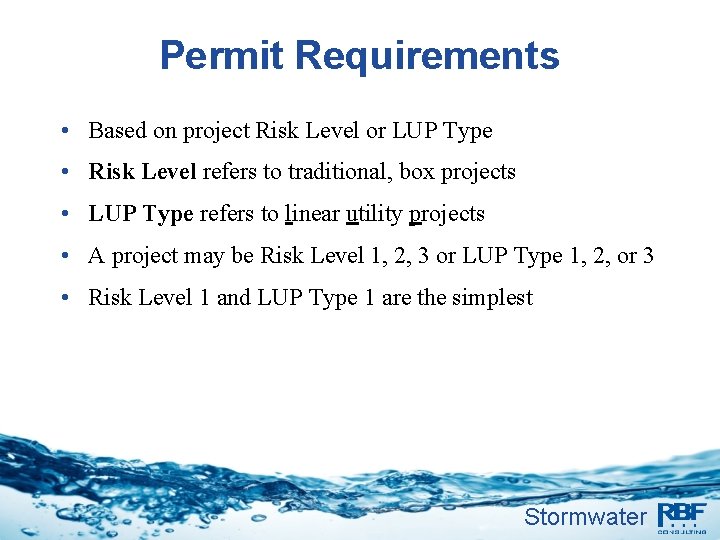
Permit Requirements • Based on project Risk Level or LUP Type • Risk Level refers to traditional, box projects • LUP Type refers to linear utility projects • A project may be Risk Level 1, 2, 3 or LUP Type 1, 2, or 3 • Risk Level 1 and LUP Type 1 are the simplest Stormwater
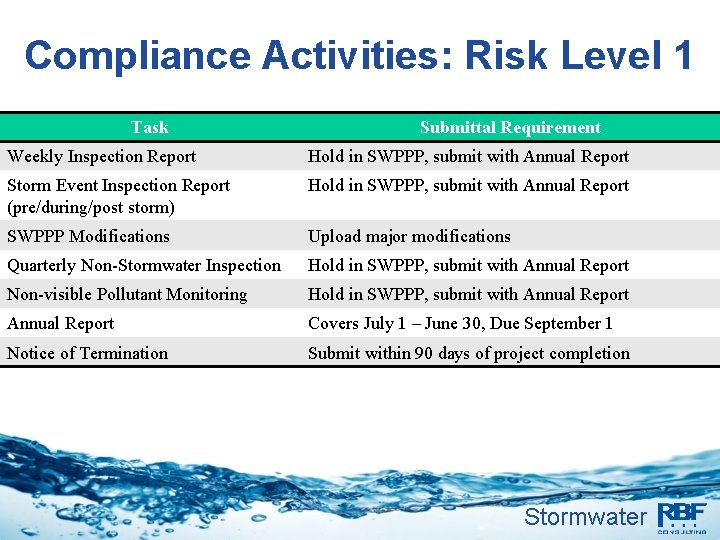
Compliance Activities: Risk Level 1 Task Submittal Requirement Weekly Inspection Report Hold in SWPPP, submit with Annual Report Storm Event Inspection Report (pre/during/post storm) Hold in SWPPP, submit with Annual Report SWPPP Modifications Upload major modifications Quarterly Non-Stormwater Inspection Hold in SWPPP, submit with Annual Report Non-visible Pollutant Monitoring Hold in SWPPP, submit with Annual Report Covers July 1 – June 30, Due September 1 Notice of Termination Submit within 90 days of project completion Stormwater
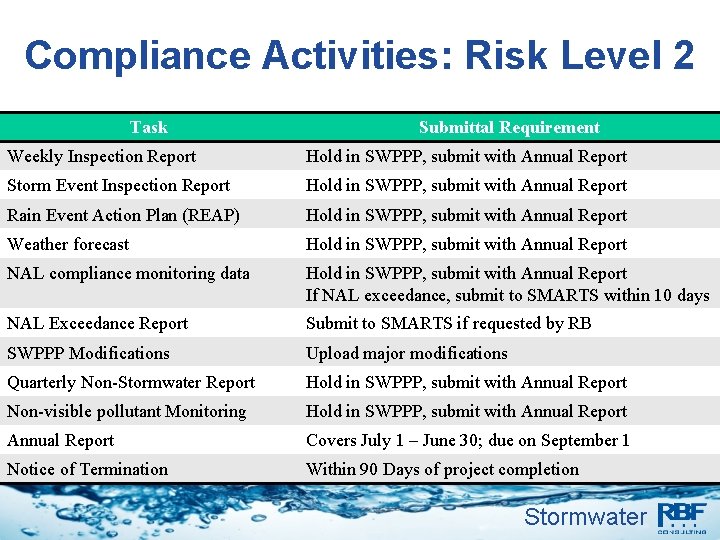
Compliance Activities: Risk Level 2 Task Submittal Requirement Weekly Inspection Report Hold in SWPPP, submit with Annual Report Storm Event Inspection Report Hold in SWPPP, submit with Annual Report Rain Event Action Plan (REAP) Hold in SWPPP, submit with Annual Report Weather forecast Hold in SWPPP, submit with Annual Report NAL compliance monitoring data Hold in SWPPP, submit with Annual Report If NAL exceedance, submit to SMARTS within 10 days NAL Exceedance Report Submit to SMARTS if requested by RB SWPPP Modifications Upload major modifications Quarterly Non-Stormwater Report Hold in SWPPP, submit with Annual Report Non-visible pollutant Monitoring Hold in SWPPP, submit with Annual Report Covers July 1 – June 30; due on September 1 Notice of Termination Within 90 Days of project completion Stormwater
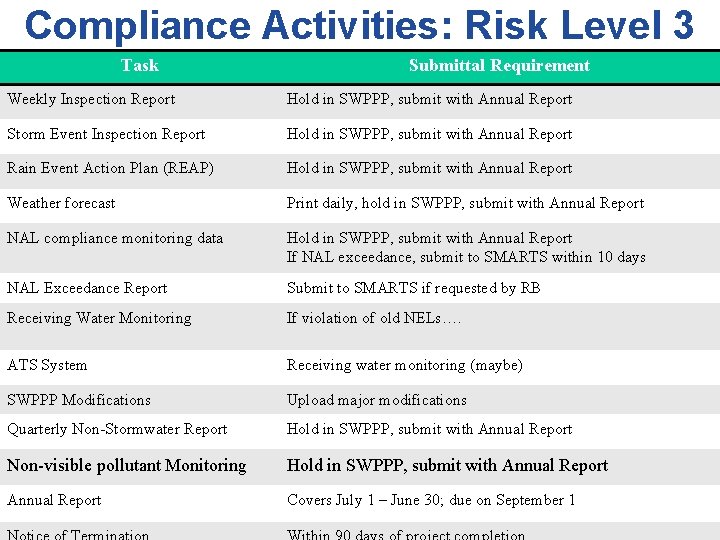
Compliance Activities: Risk Level 3 Task Submittal Requirement Weekly Inspection Report Hold in SWPPP, submit with Annual Report Storm Event Inspection Report Hold in SWPPP, submit with Annual Report Rain Event Action Plan (REAP) Hold in SWPPP, submit with Annual Report Weather forecast Print daily, hold in SWPPP, submit with Annual Report NAL compliance monitoring data Hold in SWPPP, submit with Annual Report If NAL exceedance, submit to SMARTS within 10 days NAL Exceedance Report Submit to SMARTS if requested by RB Receiving Water Monitoring If violation of old NELs…. ATS System Receiving water monitoring (maybe) SWPPP Modifications Upload major modifications Quarterly Non-Stormwater Report Hold in SWPPP, submit with Annual Report Non-visible pollutant Monitoring Hold in SWPPP, submit with Annual Report Covers July 1 – June 30; due on September 1 Stormwater
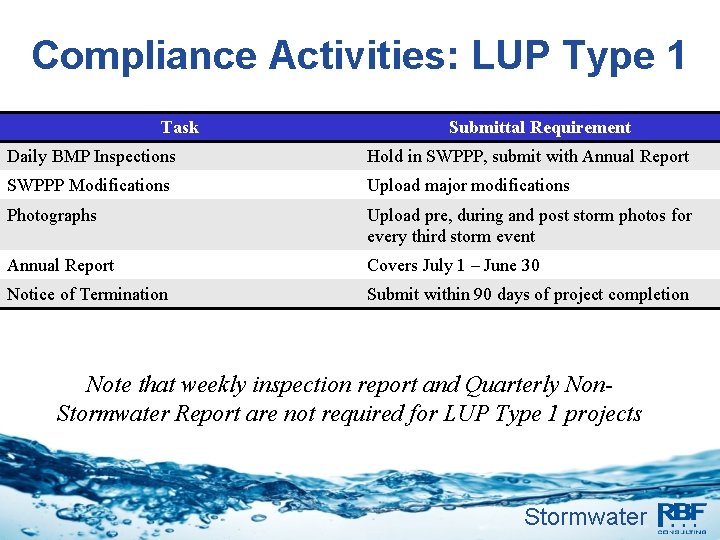
Compliance Activities: LUP Type 1 Task Submittal Requirement Daily BMP Inspections Hold in SWPPP, submit with Annual Report SWPPP Modifications Upload major modifications Photographs Upload pre, during and post storm photos for every third storm event Annual Report Covers July 1 – June 30 Notice of Termination Submit within 90 days of project completion Note that weekly inspection report and Quarterly Non. Stormwater Report are not required for LUP Type 1 projects Stormwater
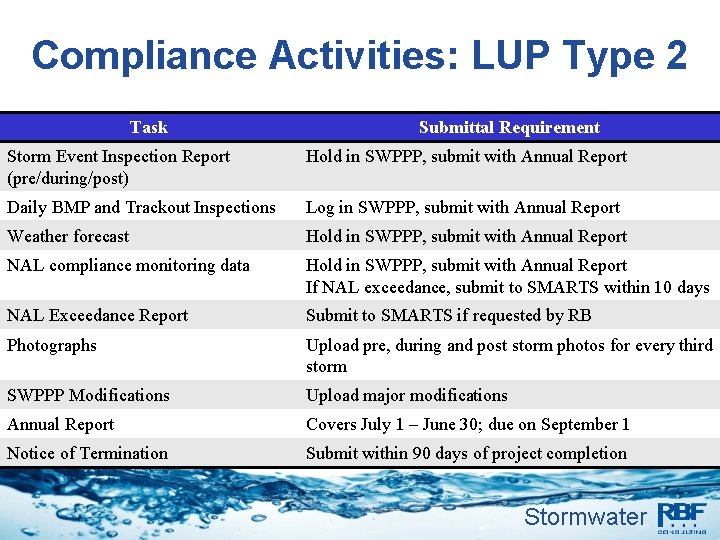
Compliance Activities: LUP Type 2 Task Submittal Requirement Storm Event Inspection Report (pre/during/post) Hold in SWPPP, submit with Annual Report Daily BMP and Trackout Inspections Log in SWPPP, submit with Annual Report Weather forecast Hold in SWPPP, submit with Annual Report NAL compliance monitoring data Hold in SWPPP, submit with Annual Report If NAL exceedance, submit to SMARTS within 10 days NAL Exceedance Report Submit to SMARTS if requested by RB Photographs Upload pre, during and post storm photos for every third storm SWPPP Modifications Upload major modifications Annual Report Covers July 1 – June 30; due on September 1 Notice of Termination Submit within 90 days of project completion Stormwater
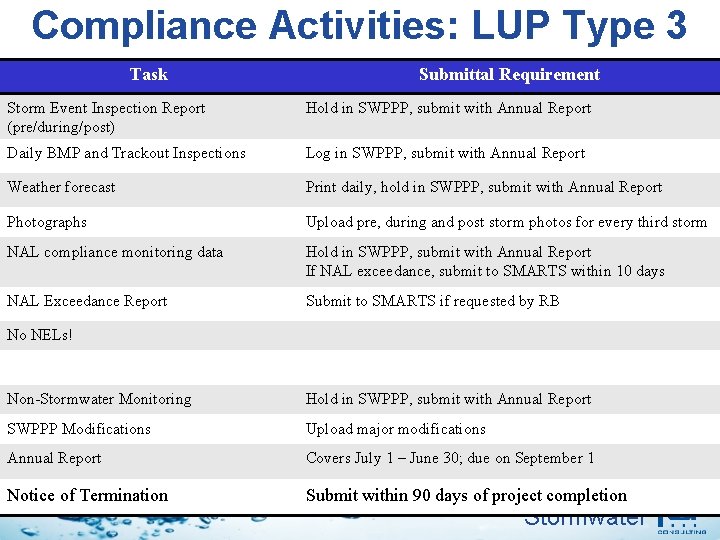
Compliance Activities: LUP Type 3 Task Submittal Requirement Storm Event Inspection Report (pre/during/post) Hold in SWPPP, submit with Annual Report Daily BMP and Trackout Inspections Log in SWPPP, submit with Annual Report Weather forecast Print daily, hold in SWPPP, submit with Annual Report Photographs Upload pre, during and post storm photos for every third storm NAL compliance monitoring data Hold in SWPPP, submit with Annual Report If NAL exceedance, submit to SMARTS within 10 days NAL Exceedance Report Submit to SMARTS if requested by RB No NELs! Non-Stormwater Monitoring Hold in SWPPP, submit with Annual Report SWPPP Modifications Upload major modifications Annual Report Covers July 1 – June 30; due on September 1 Notice of Termination Submit within 90 days of project completion Stormwater
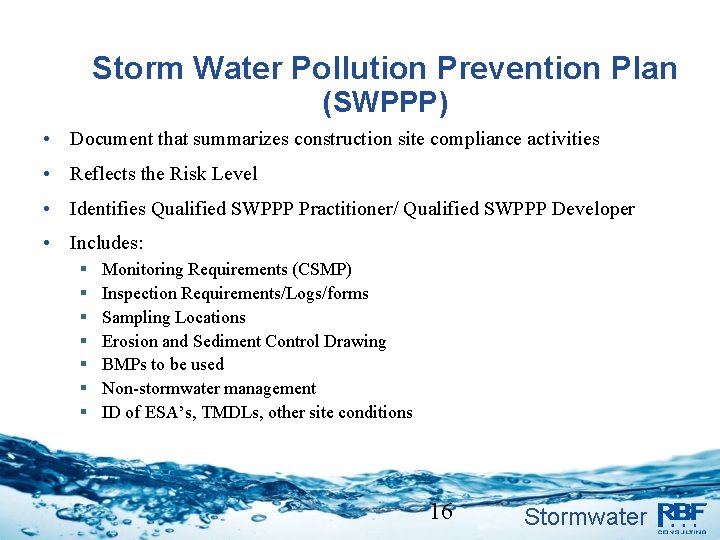
Storm Water Pollution Prevention Plan (SWPPP) • Document that summarizes construction site compliance activities • Reflects the Risk Level • Identifies Qualified SWPPP Practitioner/ Qualified SWPPP Developer • Includes: § § § § Monitoring Requirements (CSMP) Inspection Requirements/Logs/forms Sampling Locations Erosion and Sediment Control Drawing BMPs to be used Non-stormwater management ID of ESA’s, TMDLs, other site conditions 16 Stormwater
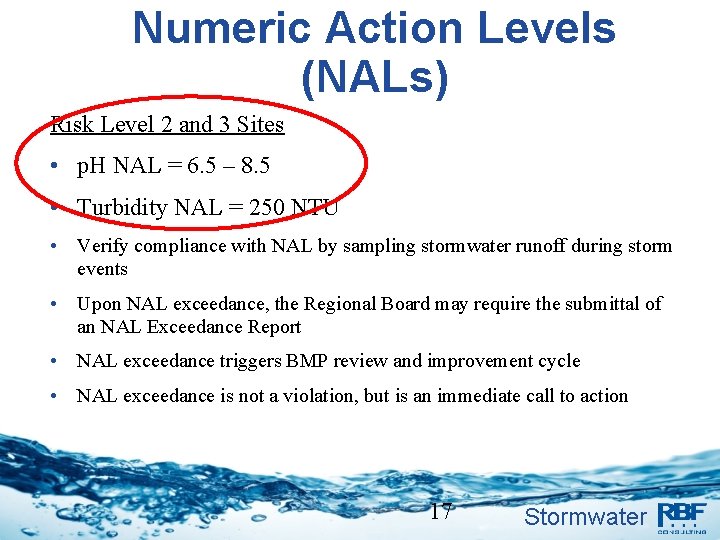
Numeric Action Levels (NALs) Risk Level 2 and 3 Sites • p. H NAL = 6. 5 – 8. 5 • Turbidity NAL = 250 NTU • Verify compliance with NAL by sampling stormwater runoff during storm events • Upon NAL exceedance, the Regional Board may require the submittal of an NAL Exceedance Report • NAL exceedance triggers BMP review and improvement cycle • NAL exceedance is not a violation, but is an immediate call to action 17 Stormwater
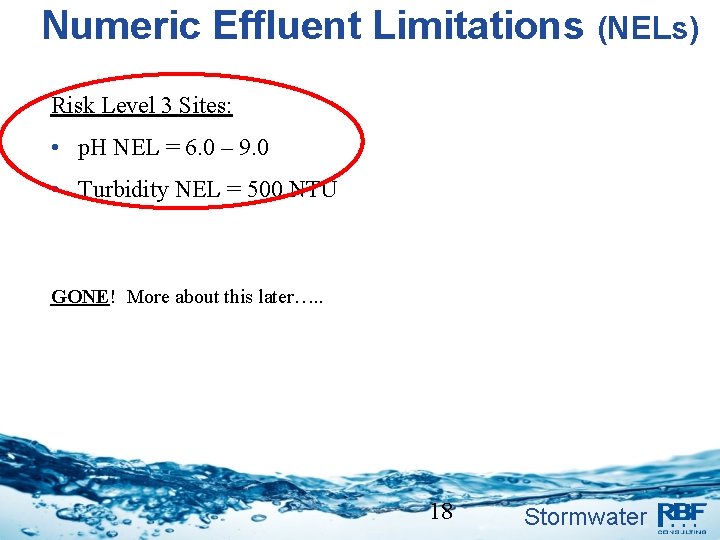
Numeric Effluent Limitations (NELs) Risk Level 3 Sites: • p. H NEL = 6. 0 – 9. 0 • Turbidity NEL = 500 NTU GONE! More about this later…. . 18 Stormwater
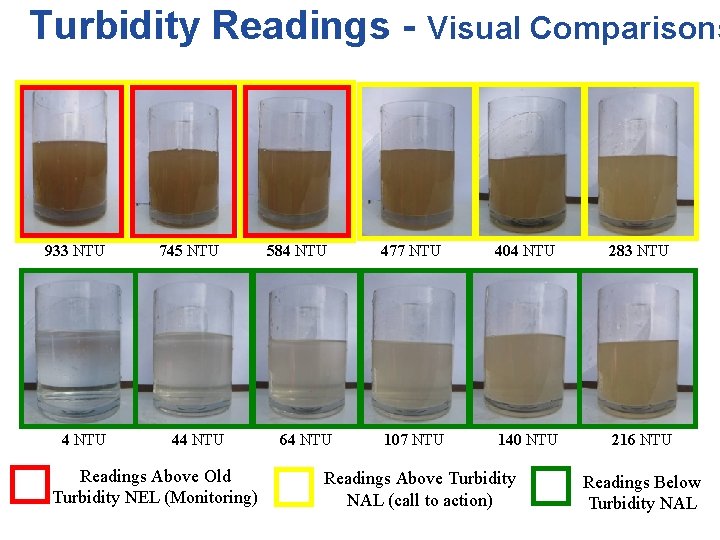
Turbidity Readings - Visual Comparisons 933 NTU 4 NTU 745 NTU 44 NTU Readings Above Old Turbidity NEL (Monitoring) 584 NTU 64 NTU 477 NTU 404 NTU 283 NTU 107 NTU 140 NTU 216 NTU Readings Above 19 Turbidity NAL (call to action) Readings Below Turbidity NAL Stormwater
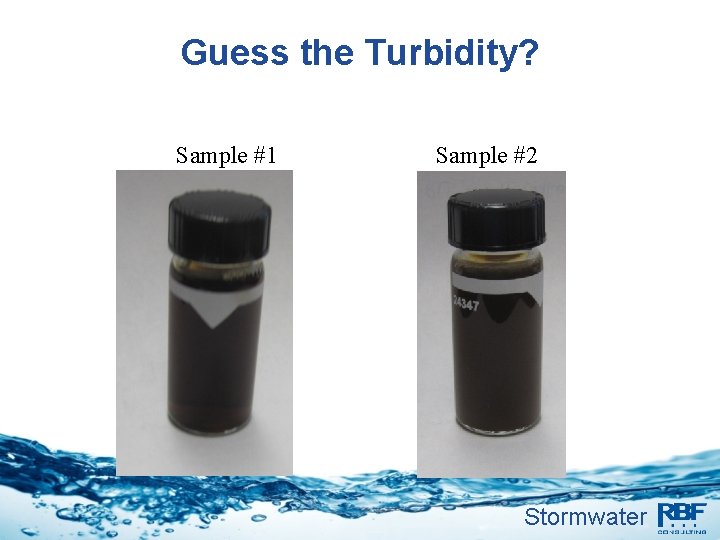
Guess the Turbidity? Sample #1 Sample #2 Stormwater
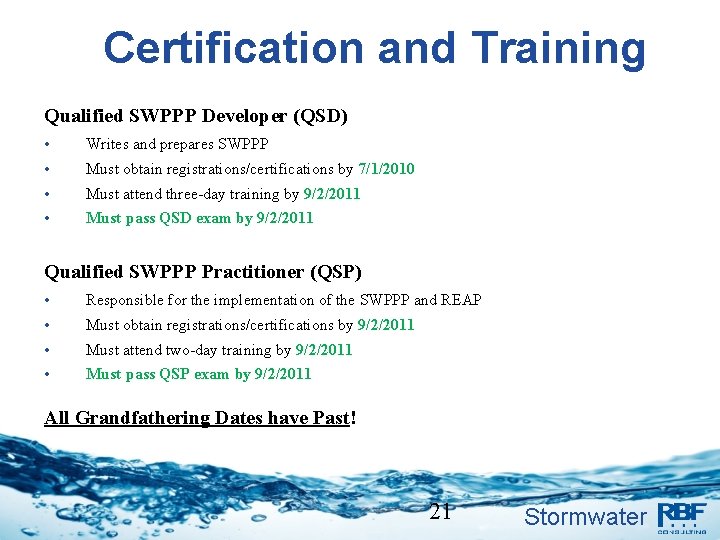
Certification and Training Qualified SWPPP Developer (QSD) • Writes and prepares SWPPP • Must obtain registrations/certifications by 7/1/2010 • Must attend three-day training by 9/2/2011 • Must pass QSD exam by 9/2/2011 Qualified SWPPP Practitioner (QSP) • Responsible for the implementation of the SWPPP and REAP • Must obtain registrations/certifications by 9/2/2011 • Must attend two-day training by 9/2/2011 • Must pass QSP exam by 9/2/2011 All Grandfathering Dates have Past! 21 Stormwater
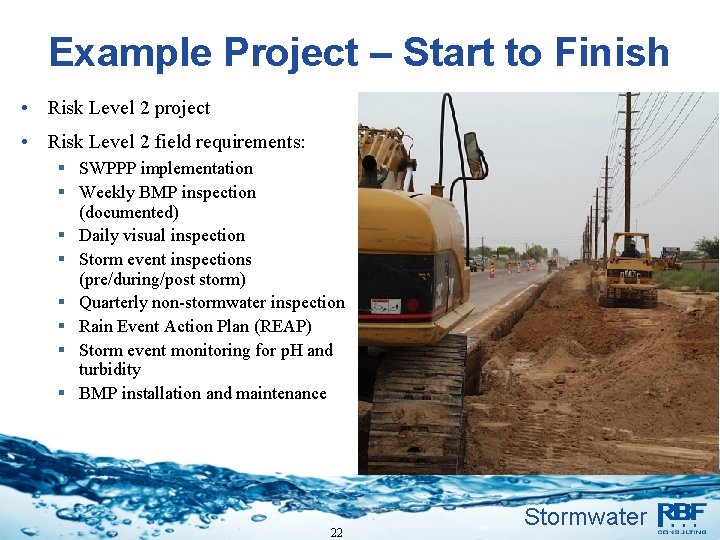
Example Project – Start to Finish • Risk Level 2 project • Risk Level 2 field requirements: § SWPPP implementation § Weekly BMP inspection (documented) § Daily visual inspection § Storm event inspections (pre/during/post storm) § Quarterly non-stormwater inspection § Rain Event Action Plan (REAP) § Storm event monitoring for p. H and turbidity § BMP installation and maintenance 22 Stormwater
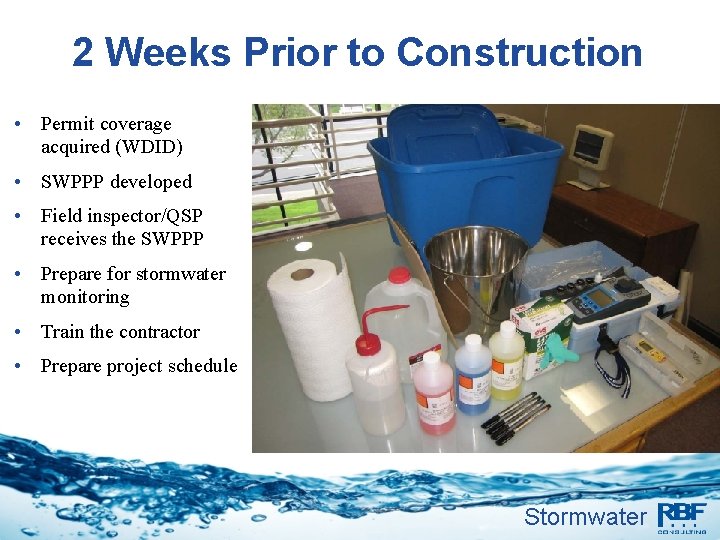
2 Weeks Prior to Construction • Permit coverage acquired (WDID) • SWPPP developed • Field inspector/QSP receives the SWPPP • Prepare for stormwater monitoring • Train the contractor • Prepare project schedule Stormwater
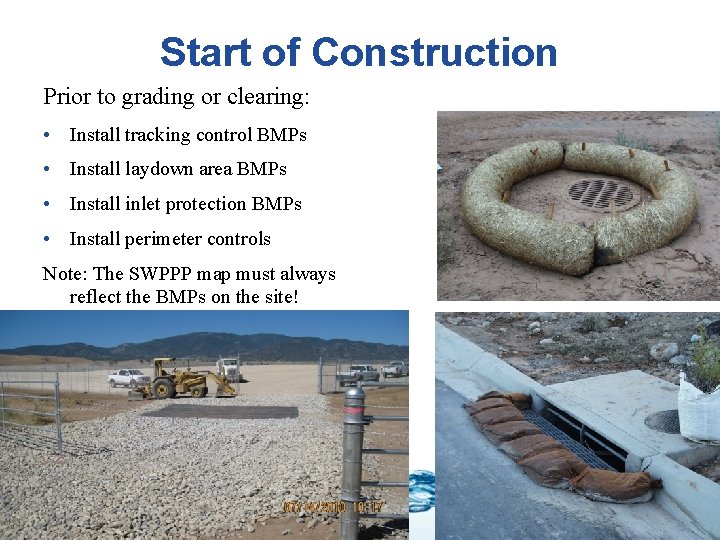
Start of Construction Prior to grading or clearing: • Install tracking control BMPs • Install laydown area BMPs • Install inlet protection BMPs • Install perimeter controls Note: The SWPPP map must always reflect the BMPs on the site! 24 Stormwater
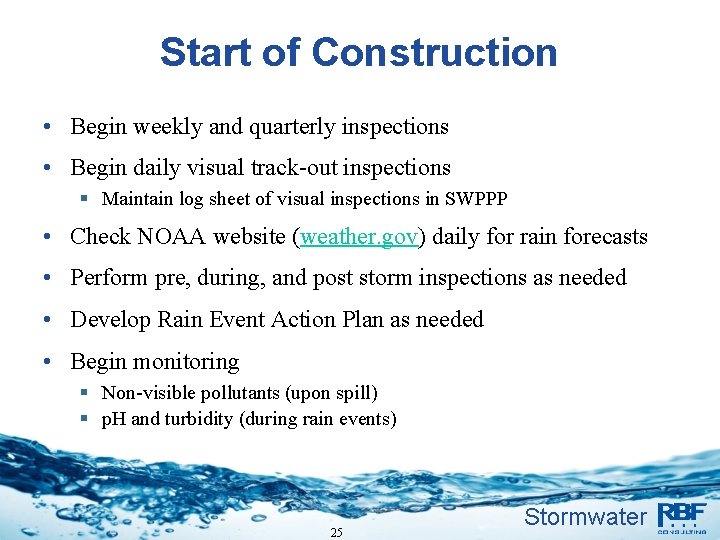
Start of Construction • Begin weekly and quarterly inspections • Begin daily visual track-out inspections § Maintain log sheet of visual inspections in SWPPP • Check NOAA website (weather. gov) daily for rain forecasts • Perform pre, during, and post storm inspections as needed • Develop Rain Event Action Plan as needed • Begin monitoring § Non-visible pollutants (upon spill) § p. H and turbidity (during rain events) 25 Stormwater
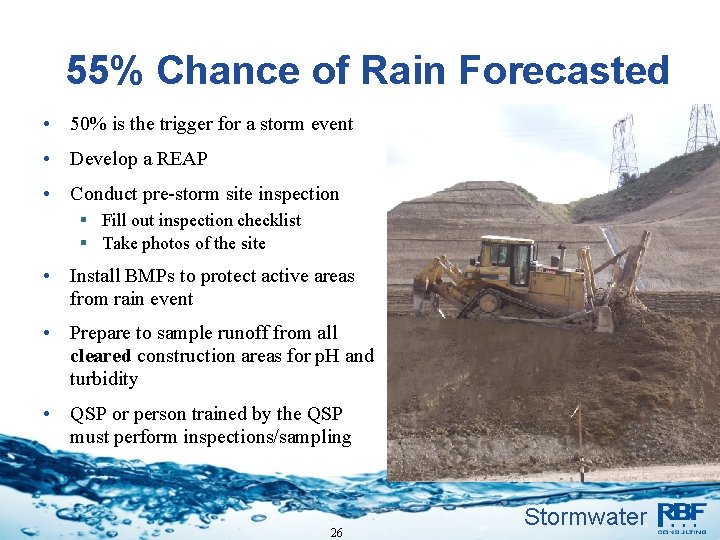
55% Chance of Rain Forecasted • 50% is the trigger for a storm event • Develop a REAP • Conduct pre-storm site inspection § Fill out inspection checklist § Take photos of the site • Install BMPs to protect active areas from rain event • Prepare to sample runoff from all cleared construction areas for p. H and turbidity • QSP or person trained by the QSP must perform inspections/sampling 26 Stormwater
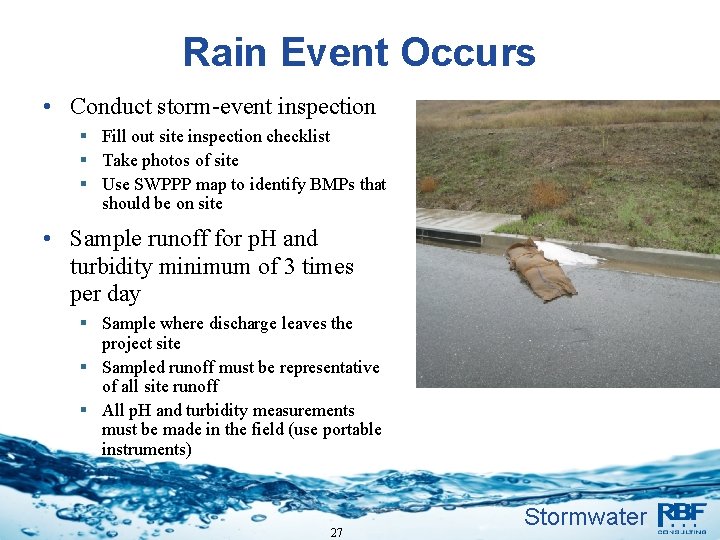
Rain Event Occurs • Conduct storm-event inspection § Fill out site inspection checklist § Take photos of site § Use SWPPP map to identify BMPs that should be on site • Sample runoff for p. H and turbidity minimum of 3 times per day § Sample where discharge leaves the project site § Sampled runoff must be representative of all site runoff § All p. H and turbidity measurements must be made in the field (use portable instruments) 27 Stormwater
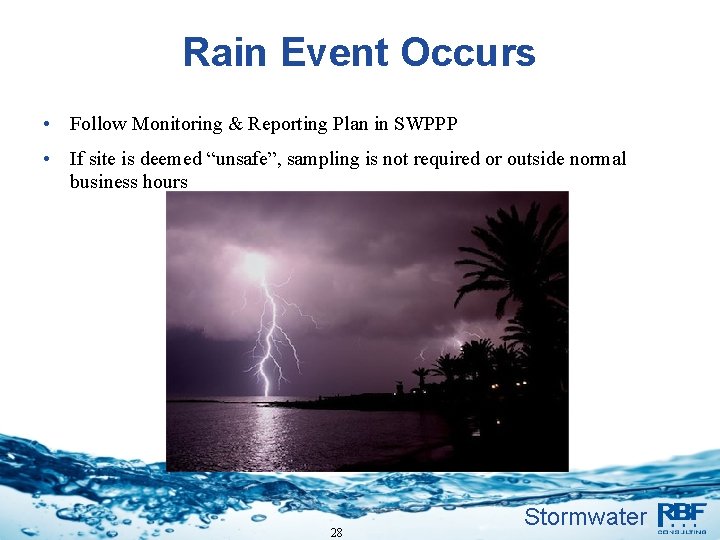
Rain Event Occurs • Follow Monitoring & Reporting Plan in SWPPP • If site is deemed “unsafe”, sampling is not required or outside normal business hours 28 Stormwater
Post-Storm • Conduct post-storm inspection within 48 hours § Fill out inspection checklist § Take photos of site • Repair BMPs as needed (w/in 72 hrs) • Coordinate with QSP to deliver monitoring results § p. H and turbidity data must be uploaded to SMARTS if there are exceedances of the Numeric Action Levels • Store all completed inspection records in the SWPPP § Records must be maintained for 3 years from date of origination 29 Stormwater
Construction Operations • Stop inspecting and monitoring at completed/stabilized areas of the project (with proper documentation) with COI • Continue BMP maintenance • Continue to check NOAA website (noaa. gov) for rain event forecasts • If a Regional Board inspector visits your project, you MUST allow them access, and show them your SWPPP • If you have questions on the SWPPP or the permit, call your City stormwater coordinator 30 Stormwater
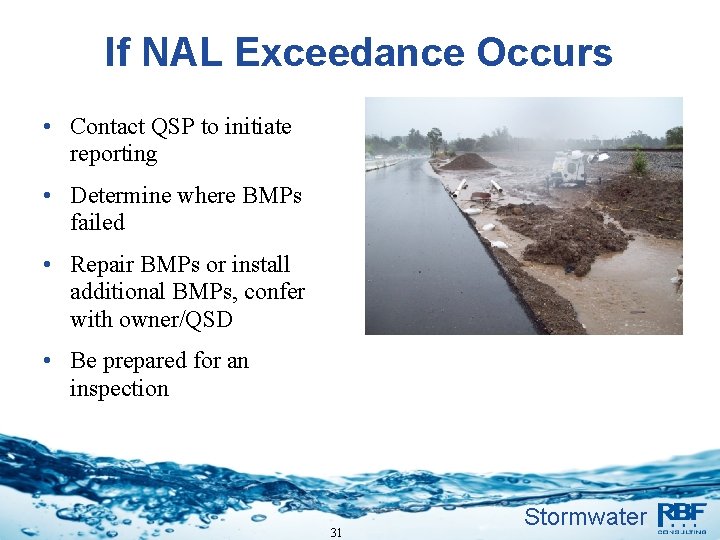
If NAL Exceedance Occurs • Contact QSP to initiate reporting • Determine where BMPs failed • Repair BMPs or install additional BMPs, confer with owner/QSD • Be prepared for an inspection 31 Stormwater
Tips for Achieving Compliance • Ensure that the QSP completes all administrative requirements § Inspections, SWPPP maintenance • The SWPPP map should always show exactly which BMPs are installed. It’s the first thing an inspector will ask to see during an inspection! • Never allow trackout • Prevent trash from blowing off the site • Concrete washouts must be water tight • Always be forthright with Regional Board inspectors. • If a BMP breaks, somebody has to fix it! (within 72 hrs) Stormwater
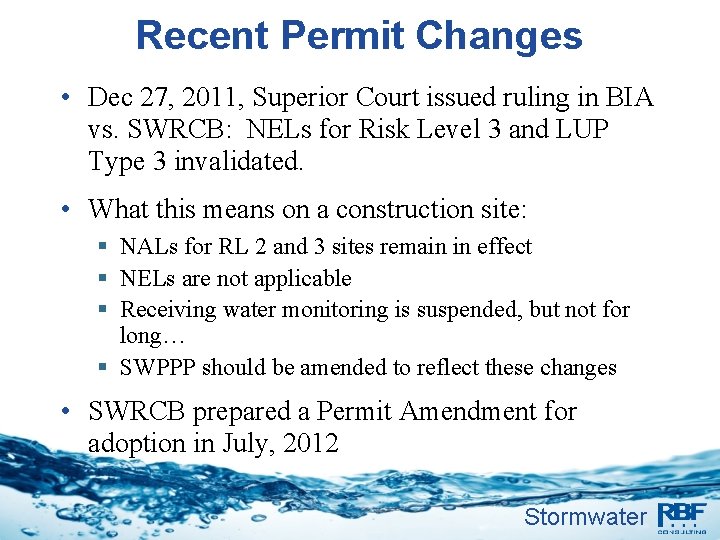
Recent Permit Changes • Dec 27, 2011, Superior Court issued ruling in BIA vs. SWRCB: NELs for Risk Level 3 and LUP Type 3 invalidated. • What this means on a construction site: § NALs for RL 2 and 3 sites remain in effect § NELs are not applicable § Receiving water monitoring is suspended, but not for long… § SWPPP should be amended to reflect these changes • SWRCB prepared a Permit Amendment for adoption in July, 2012 Stormwater