
KEY PROCESS AREAS KPAs As Defined by SOFTWARE
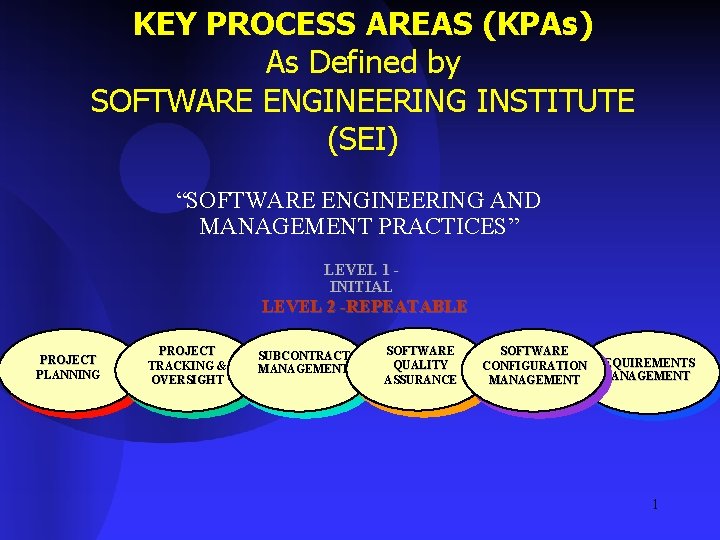
KEY PROCESS AREAS (KPAs) As Defined by SOFTWARE ENGINEERING INSTITUTE (SEI) “SOFTWARE ENGINEERING AND MANAGEMENT PRACTICES” LEVEL 1 INITIAL LEVEL 2 -REPEATABLE PROJECT PLANNING PROJECT TRACKING & OVERSIGHT SUBCONTRACT MANAGEMENT SOFTWARE QUALITY ASSURANCE SOFTWARE CONFIGURATION REQUIREMENTS MANAGEMENT 1
Requirement Management and CMM • Requirements Management KPA Goals – The software requirements are controlled to establish a baseline for software engineering and management use. – Software plans, products, and activities are kept consistent with the software requirements 2

The Requirement Problem • The goal of software development is to develop quality software – on time and on budget – that meets customers’ real needs • Project success depends on good requirement management • Requirement errors are the most common type of software development errors and the most costly to fix 3
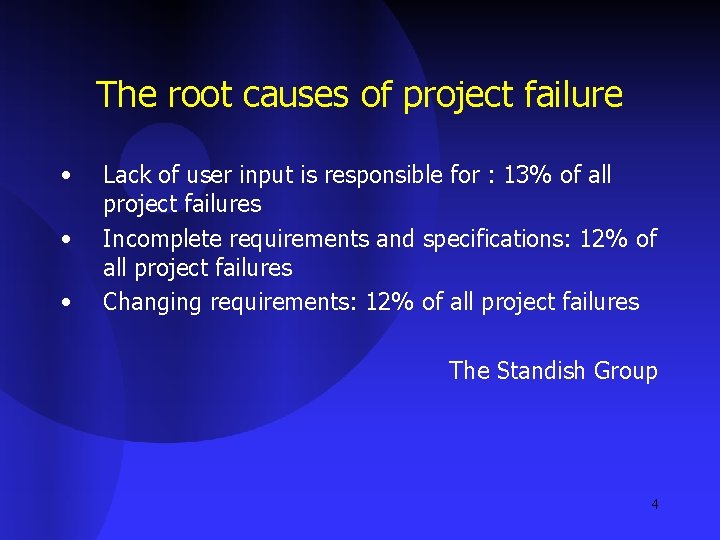
The root causes of project failure • • • Lack of user input is responsible for : 13% of all project failures Incomplete requirements and specifications: 12% of all project failures Changing requirements: 12% of all project failures The Standish Group 4
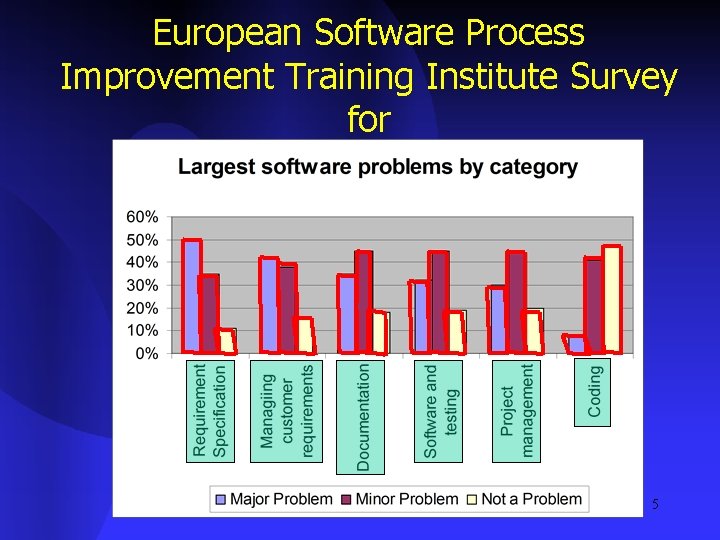
European Software Process Improvement Training Institute Survey for Largest Software problems 5
Requirement Management A systematic approach to eliciting, organizing, and documenting the requirements of the system, and a process that establishes and maintains agreement between the customer and the project team on the changing requirements of the system. 6
Requirement Management • Establishing and maintaining an agreement with the customer on the requirement for the software project. It involves – Defining the requirement baseline – Reviewing proposed requirement changes and evaluating the likely impact of each proposed change before deciding whether to approve it – Incorporating approved requirement changes in the project in a controlled manner 7
Requirement Management – Keeping project plans current with the requirements – Negotiating new commitments based on estimated impact on changed requirements – Tracing individual requirements to their corresponding design, source code, and test cases – Tracking requirement status and change activity throughout the project 8
Requirement Attributes • Go beyond the description of intended functionality • Attributes are used to establish a context and background for each requirement • Can be used to filter, sort, or query to view selected subset of the requirements 9
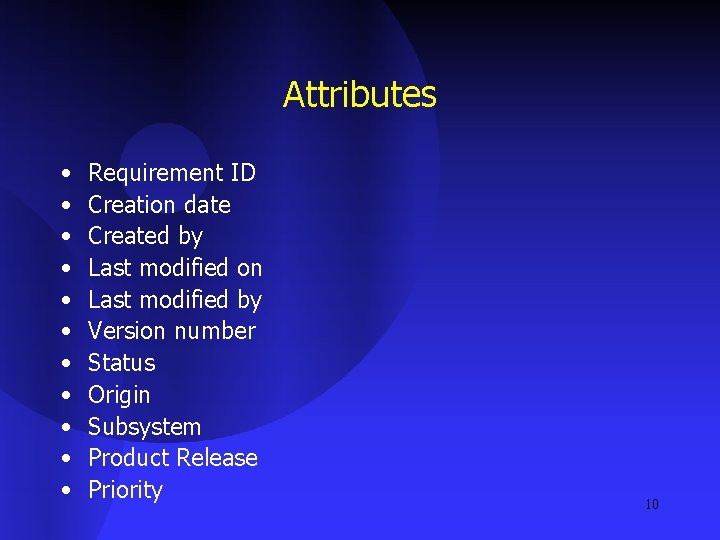
Attributes • • • Requirement ID Creation date Created by Last modified on Last modified by Version number Status Origin Subsystem Product Release Priority 10

Requirement Status 1. Proposed – The requirement has been requested by a source who has the authority to provide requirements 2. Approved – The requirement has been analyzed, its impact on the rest of the project has been estimated, and it has been allocated to the baseline for a specific build number or product release. The software development group has committed to implement the requirement 11
Continued 3. Implemented – The code that implements the requirement has been designed, written, and unit tested 12
Requirement Status 4. Verified – The implemented requirement has been verified through the selected approach, such as testing or inspection. The requirement has been traced to pertinent test cases. The requirement is now considered complete 5. Deleted – A planned requirement has been deleted from the baseline. Include an explanation of why and by whom the decision was made to delete the requirement 13
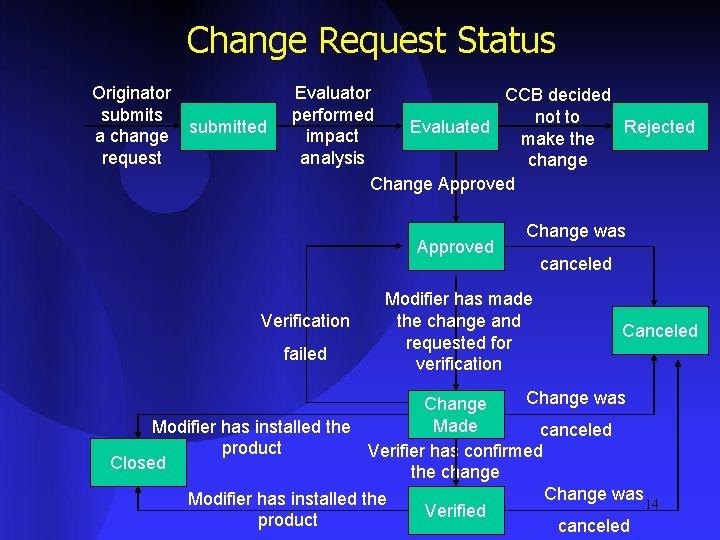
Change Request Status Originator submits submitted a change request Evaluator CCB decided performed not to Evaluated Rejected impact make the analysis change Change Approved Verification failed Change was Modifier has made the change and requested for verification canceled Change was Change Made Modifier has installed the canceled product Verifier has confirmed Closed the change Change was Modifier has installed the 14 Verified product canceled

15
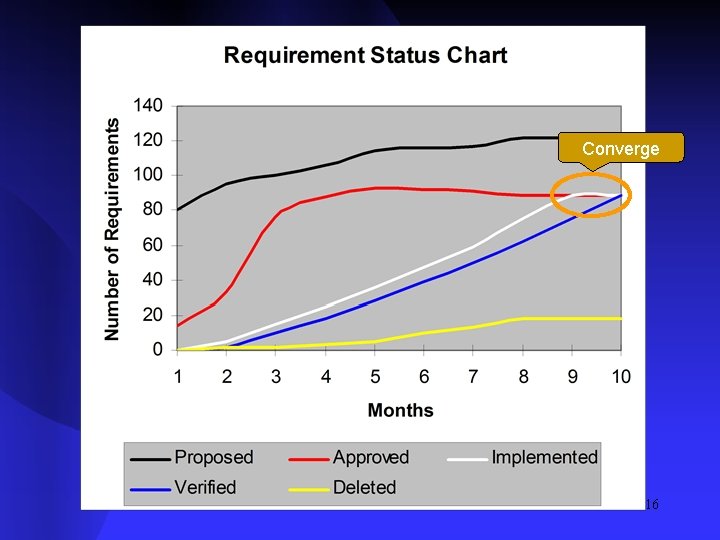
Converge 16
Managing Scope Creep 17
Changing Requirements - 1 • Requirements will change, no matter what • Software organizations and professionals must learn to manage changing requirements • A major issue in requirements engineering is the rate at which requirements change once the requirements phase has “officially” ended 18

Software Engineering II Lecture 36 Fakhar Lodhi 19
Recap 20
- Slides: 20