
Key Principles for Interpreting the Holy Scriptures Biblical
Key Principles for Interpreting the Holy Scriptures (Biblical Hermeneutics) ©Jiří Moskala, Th. D. , Ph. D. Dean, Seventh-day Adventist Theological Seminary Professor of Old Testament Exegesis and Theology Andrews University
• We are dealing with life and death, because our eternal life depends on a right understanding of the Word of God. • We need and want to interpret the Bible in a responsible way. • However, people too often do whatever they wish with the Bible. • Many claim that the Bible says this and that but it may be far from the truth. • Some interpretative statements are very clearly wrong, others are more subtle (for example: even the Bible says that there is no God; the Bible is against the Triune God teaching; the biblical account on Creation is a mythological story; Genesis 1 -2 teaches theistic evolution; Jesus is eternally subordinated to the heavenly Father; the Holy Spirit is not God but only a force/power; etc. ) • There are so many wild or smart interpretations … contradictory statements… all based on the biblical text … • It is very dangerous to do theological constructs …
• How should we interpret the Bible so we can be sure that the result of our reading/exegeting produces a correct understanding of God’s word?
What is biblical hermeneutics (comparison with exegesis and preaching or giving Bible studies)? • Hermeneutics is a science and a holy art of interpreting the biblical text in order to ascertain its meaning. • This process is subject to specific rules. Interpreters cannot and should not do whatever they wish! • Hermeneutics is like a cookbook: exegesis like preparing the dough and a baking process, and exposition (preaching or teaching) like a serving of the freshly baked bread or a cake.
• Importance of Biblical hermeneutics (Luke 24: 27; John 1: 18; 5: 39 -40; Acts 8: 31; Rom 10: 14) • It is not enough to only read or quote the biblical text; the message needs to be interpreted (not only to “read the Bible as it is” [EGW: against allegorizing and spiritualizing of the plain historical or prophetical biblical texts]).
John 5: 39– 40 – Impossible Possibility • It is necessary to explain the Bible. • Even though the disciples of Jesus knew many biblical passages by heart, yet they did not understand that the Hebrew Scriptures testified about the Messiah Jesus. “You search the Scriptures, for in them you think you have eternal life; and these are they which testify of Me. But you are not willing to come to Me that you may have life” (NKJV).
Luke 24: 27 “And beginning with Moses and all the Prophets, he interpreted to them in all the Scriptures the things concerning himself. ” (ESV) • καὶ ἀρξάμενος ἀπὸ Μωϋσέως καὶ ἀπὸ πάντων τῶν προφητῶν διερμήνευσεν αὐτοῖς ἐν πάσαις ταῖς γραφαῖς τὰ περὶ ἑαυτοῦ. (BGT) [διερμήνευσεν verb indicative aorist active 3 rd person singular from διερμηνεύω]
John 1: 18 – Christ was exegeting His Father “No one has ever seen God; the only God, who is at the Father's side, he has made him known. ” (ESV) • “No one has seen God at any time; the only begotten God who is in the bosom of the Father, He has explained Him. ” (NAU) • “No one has seen God at any time. The only begotten Son, who is in the bosom of the Father, He has declared Him. ” (NKJV) • Θεὸν οὐδεὶς ἑώρακεν πώποτε· μονογενὴς θεὸς ὁ ὢν εἰς τὸν κόλπον τοῦ πατρὸς ἐκεῖνος ἐξηγήσατο. (BGT) [verb indicative aorist middle deponent 3 rd person singular from ἐξηγέομαι = to explain, declare] • Christ was doing proper exegesis!
Acts 8: 31 • "How can I, " he [an Ethiopian eunuch, a court official] said, "unless someone explains it to me? " So he invited Philip to come up and sit with him. (NIV) • The verb “explain” is a translation of the Greek word hodegeō which means “lead, ” “guide, ” “explain, ” “teach, ” or “instruct. ”
What is the first task in doing exegesis? • The first task in doing exegesis is a prayer. We need to be guided by the Holy Spirit when interpreting the biblical text, because He is the ultimate author of the Holy Scripture. • We need to recognize and define our presuppositions and worldview. • A practical hermeneutical outcome is built on the historicalgrammatical-theological method of interpreting Scripture. • As the Church we accept this approach to the Bible in contrast to the historical-critical method.
The Historical-Grammatical-Theological Method • For further study see the “Methods of Bible Study” document voted by the General Conference Committee Annual Council, “Bible Study: Presuppositions, Principles, and Methods, ” Rio de Janeiro, October 12, 1986, published in the Adventist Review, January 22, 1987 (available online at https: //adventistbiblicalresearch. org/materials/bible-interpretationhermeneutics/methods-bible-study). This method has various names: the historical-grammatical method or historical-grammatical-literary-theological method.
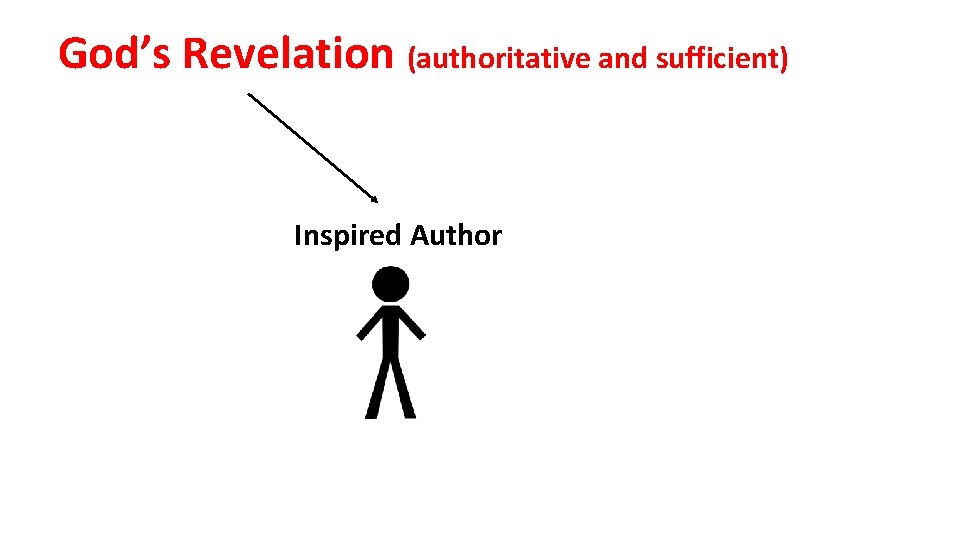
God’s Revelation (authoritative and sufficient) Inspired Author
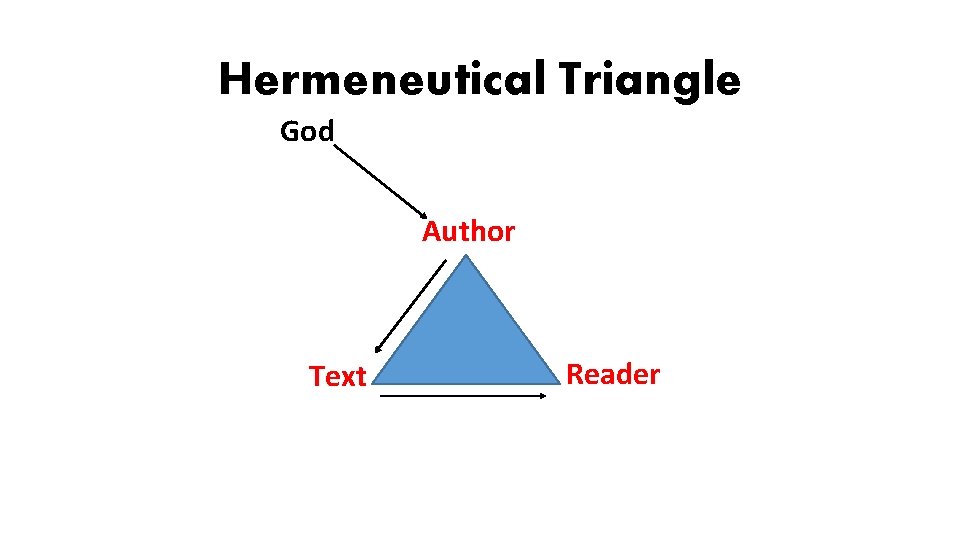
Hermeneutical Triangle God Author Text Reader

Author Text Reader
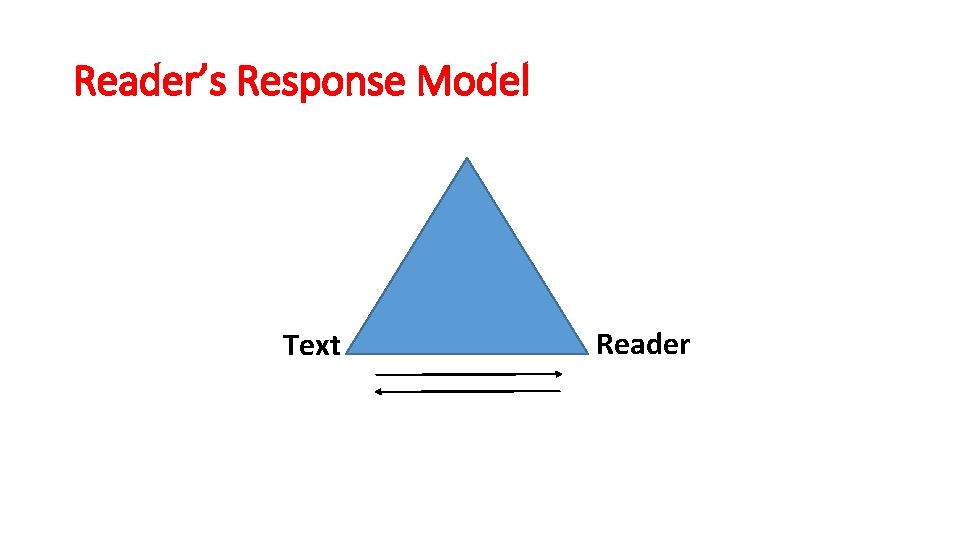
Reader’s Response Model Text Reader
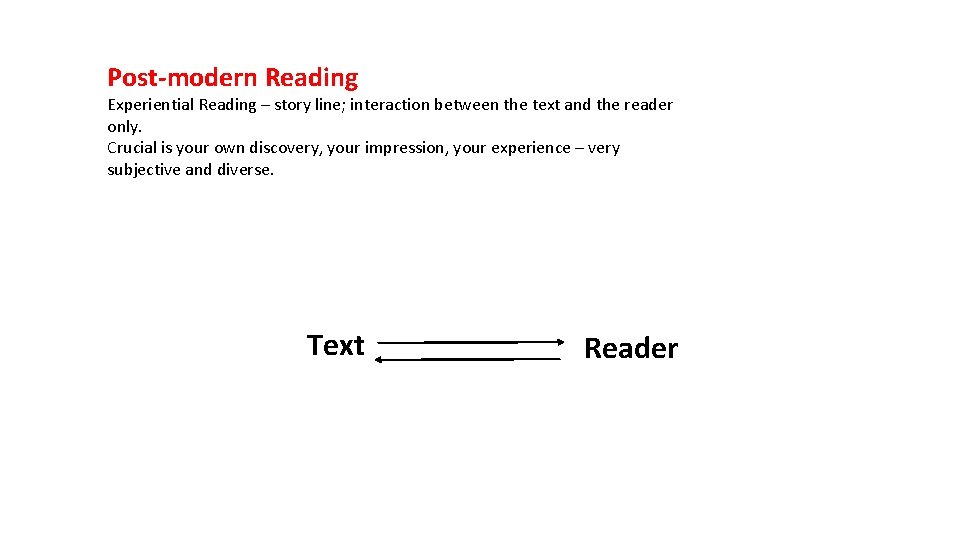
Post-modern Reading Experiential Reading – story line; interaction between the text and the reader only. Crucial is your own discovery, your impression, your experience – very subjective and diverse. Text Reader
Warning • Do not jump too quickly to the application of the biblical text. • We need to first understand what the text is really saying. • What the text meant (in the past for the original audience) • What the text means (for us today in 2017)
I. Historical Background: Seven W’s 1. Who – recognition and identification of the author (Moses, David, Isaiah, Jeremiah, Ezekiel, Daniel, the Twelves)
I. Historical Background: Seven W’s 1. Who - Author (Moses, David, Isaiah, Jeremiah, Ezekiel, Daniel, the Twelves) 2. When - Time (before or after sin; before or after flood; patriarchal period; Exodus; monarchy; prophetical period; Babylonian exile; intertestamental period; New Testament era; etc. ): customs, habits, laws, culture, language, family life, birth, wedding, burial ceremonies, etc.
I. Historical Background: Seven W’s 1. Who - Author (Moses, David, Isaiah, Jeremiah, Ezekiel, Daniel, the Twelves) 2. When - Time (before or after sin; patriarchal period; Exodus; monarchy; prophetical period; Babylonian exile; intertestamental period; New Testament era; etc. ) 3. Where – Place (Jerusalem; Egypt; Babylon; Assyria; etc. )
I. Historical Background: Seven W’s 1. Who - Author (Moses, David, Isaiah, Jeremiah, Ezekiel, Daniel, the Twelves) 2. When - Time (before or after sin; patriarchal period; Exodus; monarchy; prophetical period; Babylonian exile; intertestamental period; New Testament era; etc. ) 3. Where – Place (Jerusalem; Egypt; Babylon; Assyria; etc. ) 4. To Whom – Audience: their life and thinking; problem
I. Historical Background: Seven W’s 1. Who - Author (Moses, David, Isaiah, Jeremiah, Ezekiel, Daniel, the Twelves) 2. When - Time (before or after sin; patriarchal period; Exodus; monarchy; prophetical period; Babylonian exile; intertestamental period; New Testament era; etc. ) 3. Where – Place (Jerusalem; Egypt; Babylon; Assyria; etc. ) 4. To Whom – Audience 5. Why – Intention, purpose (Paul and James) The intent of the first and the second Creation accounts points to the Sabbath and Marriage as their focus, i. e. , vertical and horizontal relationships and dimensions of our life; the purpose of the Fall account is to demonstrate God’s grace in the midst of His judgments; etc.
I. Historical Background: Seven W’s 1. Who - Author (Moses, David, Isaiah, Jeremiah, Ezekiel, Daniel, the Twelves) 2. When - Time (before or after sin; patriarchal period; Exodus; monarchy; prophetical period; Babylonian exile; intertestamental period; New Testament era; etc. ) 3. Where – Place (Jerusalem; Egypt; Babylon; Assyria; etc. ) 4. To Whom – Audience 5. Why – Intention, purpose 6. What – Basic message; try to summarize it into 1 -2 sentences
I. Historical Background: Seven W’s 1. Who - Author (Moses, David, Isaiah, Jeremiah, Ezekiel, Daniel, the Twelves) 2. When - Time (before or after sin; patriarchal period; Exodus; monarchy; prophetical period; Babylonian exile; intertestamental period; New Testament era; etc. ) 3. Where – Place (Jerusalem; Egypt; Babylon; Assyria; etc. ) 4. To Whom – Audience 5. Why – Intention, purpose 6. What – Basic message; try to summarize it into 1 -2 sentences 7. So What – What difference does it make?
II. Grammatical and Literary Studies • Words (translation; meaning; statistics; rare words; etc. ) • Rakia’ – firmament, sky, expanse • Days in Genesis 1 • Plants like wheat – what kind of wheat are we talking about?
Archaeological Open-Air Museum at Březno u Loun, Czech Republic • They have done some experiments with different kinds of ancient wheat. • They report that they planted wheat which is more than 7, 000 years old (from 5, 600 BC until the 6 th century AD). • They scientifically measured its quality. • These kinds of wheat had a different composition of gluten and had other important elements. • Michal Hejcman from the Czech Agriculture University stated about their first results: “These wheat have higher amounts of minerals like phosphorus, zinc, copper, potassium, magnesium, and calcium. It was a very nutritious diet for our ancestors who everyday did not have meat for their food. ” • This ancient wheat was a good replacement of meat.
II. Grammatical and Literary Studies • Words (translation; meaning; statistics; rare words; etc. ) • Rakia’ – firmament, sky, expanse • Wheat – what kind of wheat are we talking about? • Grammar (past, present, future tense; prophetic perfect; emphasis – position of words; repetitions; key words; etc. ) • Already Martin Luther said that theology is grammar. • John 1: 1 -3, 14 (vss. 1 -2 written in imperfect, later in v. 3, 14 in aorist).
Gen 2: 19 “The Lord had formed out of ground all the wild animals and all the birds in the sky. He brought them to the man to see what he would name them …” Or “The Lord formed out of ground …”
• Gen 1: 2 a – And the earth was … (contrast with verse 1) • Gen 1: 1 -3 • What does mean the word “and” in verses 2 and 3? “In the beginning God created the heavens and the earth. 2 Now the earth was formless and empty, darkness was over the surface of the deep, and the Spirit of God was hovering over the waters. 3 And God said, "Let there be light, " and there was light. ” (NIV)
II. Grammatical and Literary Studies • Words (translation; meaning; statistics; rare words; etc. ) • Rakia’ – firmament, sky, expanse • Wheat – what kind of wheat are we talking about? • Grammar (past, present, future tense; prophetic perfect; emphasis – position of words; repetitions; key words; etc. ) • Sentences (syntax - combination of words; unique expressions; idiomatic expressions)
Eternal Gospel • How many times does this expression occur in the Bible?
• It is a hapax legomenon – only in Rev 14: 6
Gen 1: 2 -3 The first verses of the Bible provide the first definition of true life. Life can happen only where the Spirit of God (Gen 1: 2 b) and the Word of God (Gen 1: 3) come together and reign (in the first Creation account, the phrase “and God said” occurs ten times!). Spirit of God + Word of God = Life This is correct not only for the creation of a physical life but also for the birth of a spiritual life. A person can be born again only when he or she is born from above—when this person opens himself or herself to the influence of the Holy Spirit (John 3: 5 -8; Rom 8: 14; Titus 3: 5) and believes in the Word of God (John 1: 12 -13; 1 Pet 1: 23; James 1: 18). The doctrine of regeneration has its root in the biblical Creation story.
II. Grammatical and Literary Studies • Words (translation; meaning; statistics; rare words; etc. ) • Rakia’ – firmament, sky, expanse • Wheat – what kind of wheat are we talking about? • Grammar (past, present, future tense; prophetic perfect; emphasis – position of words; repetitions; key words; etc. ) • Sentences (syntax - combination of words; unique expressions; idiomatic expressions) • Context – a king among all rules; immediate and larger context
II. Grammatical and Literary Studies • Words (translation; meaning; statistics; rare words; etc. ) • Rakia’ – firmament, sky, expanse • Wheat – what kind of wheat are we talking about? • Grammar (past, present, future tense; prophetic perfect; emphasis – position of words; repetitions; key words; etc. ) • Sentences (syntax - combination of words; unique expressions; idiomatic expressions) • Context – a king among all rules; immediate and larger context • Intra- and Inter-textuality (intra-textuality and inter-textuality)
II. Grammatical and Literary Studies • Words (translation; meaning; statistics; rare words; etc. ) • Rakia – firmament, sky, expanse • Wheat – what kind of wheat are we talking about? • Grammar (past, present, future tense; prophetic perfect; emphasis – position of words; repetitions; key words; etc. ) • Sentences (syntax - combination of words; unique expressions; idiomatic expressions) • Context – a king among all rules; immediate and larger context • Intertextuality (intra-textuality and inter-textuality) • Literary structure and features
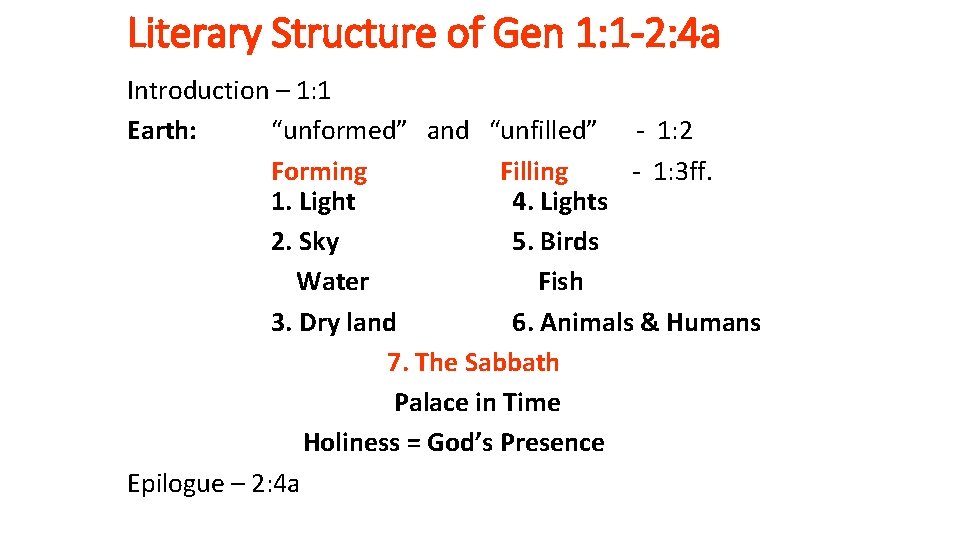
Literary Structure of Gen 1: 1 -2: 4 a Introduction – 1: 1 Earth: “unformed” and “unfilled” - 1: 2 Forming Filling - 1: 3 ff. 1. Light 4. Lights 2. Sky 5. Birds Water Fish 3. Dry land 6. Animals & Humans 7. The Sabbath Palace in Time Holiness = God’s Presence Epilogue – 2: 4 a
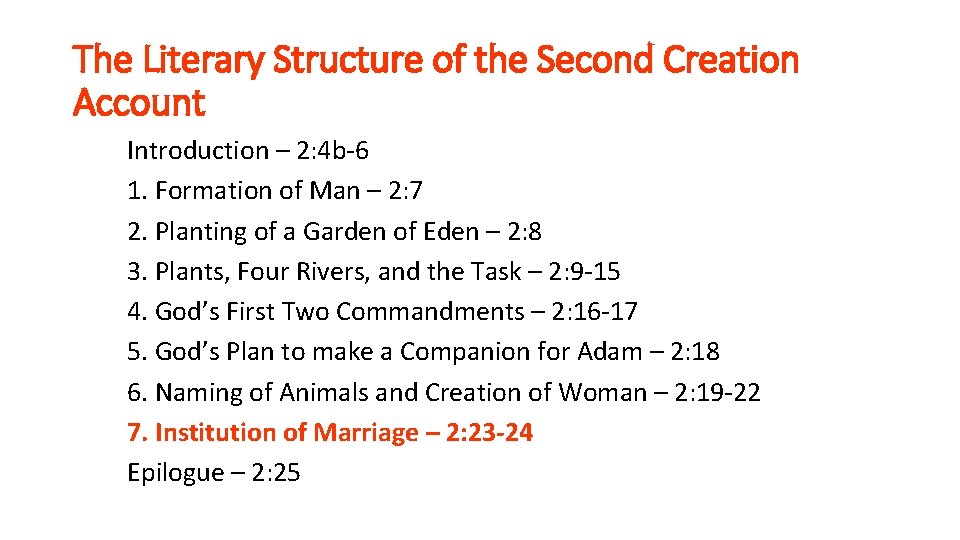
The Literary Structure of the Second Creation Account Introduction – 2: 4 b-6 1. Formation of Man – 2: 7 2. Planting of a Garden of Eden – 2: 8 3. Plants, Four Rivers, and the Task – 2: 9 -15 4. God’s First Two Commandments – 2: 16 -17 5. God’s Plan to make a Companion for Adam – 2: 18 6. Naming of Animals and Creation of Woman – 2: 19 -22 7. Institution of Marriage – 2: 23 -24 Epilogue – 2: 25
Gen 6 -9 • The culmination point of the Flood account is the COVENANT.
The Literary Structure The literary structure of a book often is an aid to interpreting it. The parallel nature of Daniel's prophecies is an example (see prophecies in chapters 2, 7, 8, 9, 10 -12). Parallel structure of Genesis 1 and 2 (similarities, differences, uniqueness, etc. ).
II. Grammatical and Literary Studies • Words (translation; meaning; statistics; rare words; etc. ) • Rakia’ – firmament, sky, expanse • Wheat – what kind of wheat are we talking about? • Grammar (past, present, future tense; prophetic perfect; emphasis – position of words; repetitions; key words; etc. ) • Sentences (syntax - combination of words; unique expressions; idiomatic expressions) • Context – a king among all rules; immediate and larger context • Intertextuality (intra-textuality and inter-textuality) • Literary structure and features • Literary genre (narrative; poetry; wisdom; prayer; song; parable; prophecy; geology; history; etc. )
What kind of literary genre is Genesis 1 -2?
Gen 2: 4 • It is a genealogy (Heb. toledot) • Historical and factual account as other genealogies are historical in the book of Genesis – for example, genealogy of Adam, Noah, Abraham (Terah) or Joseph (Jacob).
III. Theological Hermeneutics – Putting Pieces Together
Seeing the Big Picture Biblical Metanarrative: ØUnderstanding of the Great Controversy (spiritual warfare); recognizing the key issues and events in that controversy. ØAccepting the close interrelationship/connection between the Old and New Testaments. ØThe Plan of Salvation perspective (Creation – De-Creation/Fall – Re. Creation Model).
Relational Hermeneutics We were created into relationship with God, to cultivate/enjoy His presence and live in total dependence on Him. Sin reverses this creation purpose by breaking this relationship with God. However, Christ’s redemption restores us into the right and intimate relationship with God. • “You yourselves have seen what I did to Egypt, and how I carried you on eagles' wings and brought you to myself. ” (Exod 19: 4 NIV) • “Return to Me” (Isa 45: 22; Joel 2: 12) • “And I, when I am lifted up from the earth, will draw all people to myself. ” (John 12: 32 NIV)
III. Theological Hermeneutics – Putting Pieces Together Fundamental approaches: • Sola Scriptura – the Bible is always the highest judge
III. Theological Hermeneutics – Putting Pieces Together Fundamental approaches: • Sola Scriptura • Tota Scriptura – unity of the Bible; relationship between Old and New Testaments; covenants
III. Theological Hermeneutics – Putting Pieces Together Fundamental approaches: • Sola Scriptura • Tota Scriptura – unity of the Bible; relationship between Old and New Testaments; covenants • Prima Scriptura (relations to nature; science; the Spirit of Prophecy – writings of Ellen G. White)
III. Theological Hermeneutics – Putting Pieces Together Fundamental approaches: • Sola Scriptura • Tota Scriptura – unity of the Bible; relationship between Old and New Testaments; covenants • Prima Scriptura (relations to nature; science; the Spirit of Prophecy – writings of Ellen G. White) • Analogia Scriptura
III. Theological Hermeneutics – Putting Pieces Together Fundamental approaches: • Sola Scriptura • Tota Scriptura – unity of the Bible; relationship between Old and New Testaments; covenants • Prima Scriptura (relations to nature; science; the Spirit of Prophecy – writings of Ellen G. White) • Analogia Scriptura • Scriptura sui ipsius interpres
III. Theological Hermeneutics – Putting Pieces Together Fundamental approaches: • Sola Scriptura • Tota Scriptura – unity of the Bible; relationship between Old and New Testaments; covenants • Prima Scriptura (relations to nature; science; the Spirit of Prophecy – writings of Ellen G. White) • Analogia Scriptura • Scriptura sui ipsius interpres • Literal versus literalistic reading of Scripture
III. Theological Hermeneutics – Putting Pieces Together Fundamental approaches: • Sola Scriptura • Tota Scriptura – unity of the Bible; relationship between Old and New Testaments; covenants • Prima Scriptura (relations to nature; science; the Spirit of Prophecy – writings of Ellen G. White) • Analogia Scriptura • Scriptura sui ipsius interpres • Literal versus literalistic reading of Scripture • Indicative and Imperative of the Gospel – with sola gratia, sola fide, solo Christo, soli Deo Gloria, sola caritas.
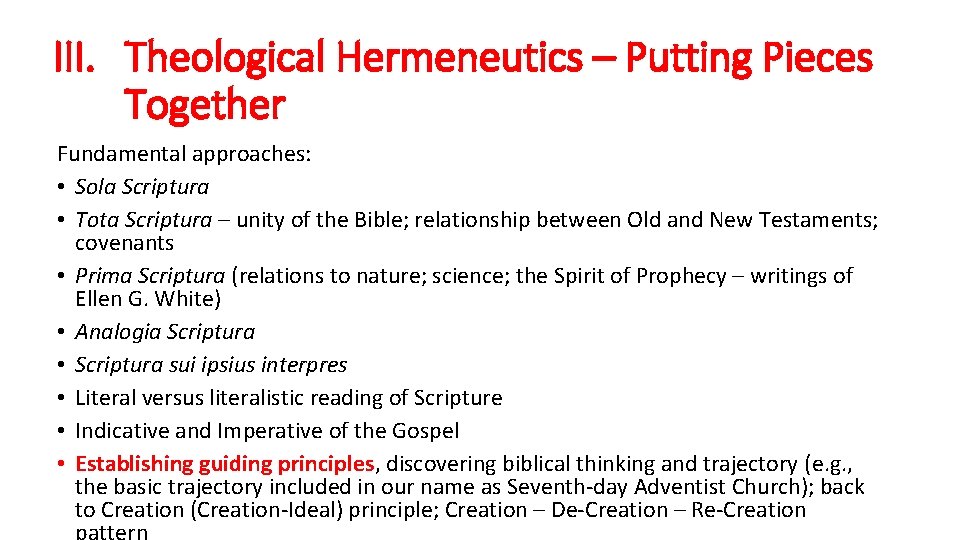
III. Theological Hermeneutics – Putting Pieces Together Fundamental approaches: • Sola Scriptura • Tota Scriptura – unity of the Bible; relationship between Old and New Testaments; covenants • Prima Scriptura (relations to nature; science; the Spirit of Prophecy – writings of Ellen G. White) • Analogia Scriptura • Scriptura sui ipsius interpres • Literal versus literalistic reading of Scripture • Indicative and Imperative of the Gospel • Establishing guiding principles, discovering biblical thinking and trajectory (e. g. , the basic trajectory included in our name as Seventh-day Adventist Church); back to Creation (Creation-Ideal) principle; Creation – De-Creation – Re-Creation
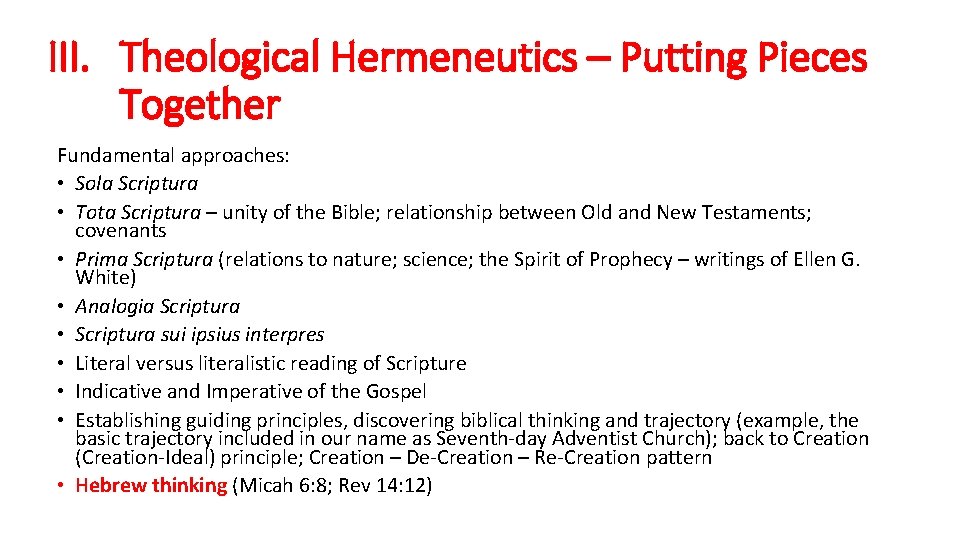
III. Theological Hermeneutics – Putting Pieces Together Fundamental approaches: • Sola Scriptura • Tota Scriptura – unity of the Bible; relationship between Old and New Testaments; covenants • Prima Scriptura (relations to nature; science; the Spirit of Prophecy – writings of Ellen G. White) • Analogia Scriptura • Scriptura sui ipsius interpres • Literal versus literalistic reading of Scripture • Indicative and Imperative of the Gospel • Establishing guiding principles, discovering biblical thinking and trajectory (example, the basic trajectory included in our name as Seventh-day Adventist Church); back to Creation (Creation-Ideal) principle; Creation – De-Creation – Re-Creation pattern • Hebrew thinking (Micah 6: 8; Rev 14: 12)
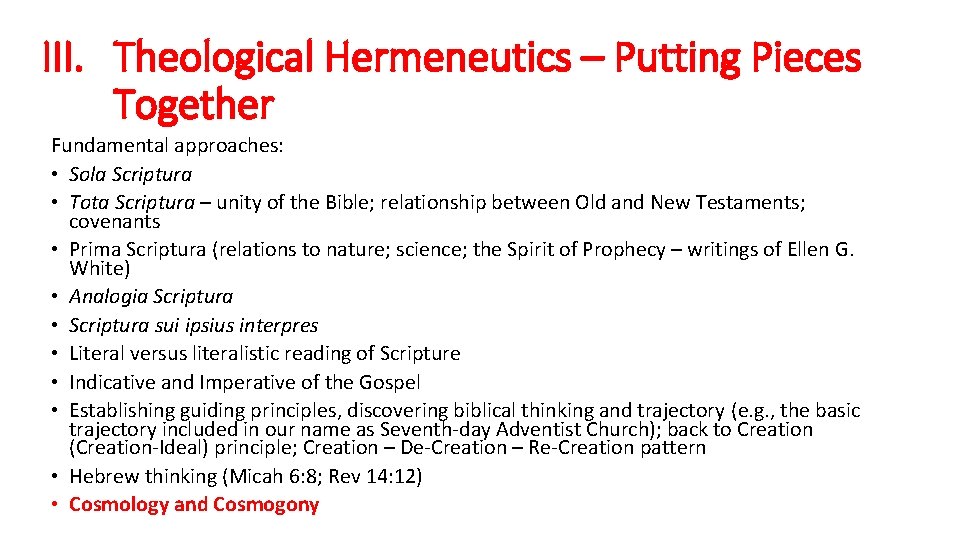
III. Theological Hermeneutics – Putting Pieces Together Fundamental approaches: • Sola Scriptura • Tota Scriptura – unity of the Bible; relationship between Old and New Testaments; covenants • Prima Scriptura (relations to nature; science; the Spirit of Prophecy – writings of Ellen G. White) • Analogia Scriptura • Scriptura sui ipsius interpres • Literal versus literalistic reading of Scripture • Indicative and Imperative of the Gospel • Establishing guiding principles, discovering biblical thinking and trajectory (e. g. , the basic trajectory included in our name as Seventh-day Adventist Church); back to Creation (Creation-Ideal) principle; Creation – De-Creation – Re-Creation pattern • Hebrew thinking (Micah 6: 8; Rev 14: 12) • Cosmology and Cosmogony
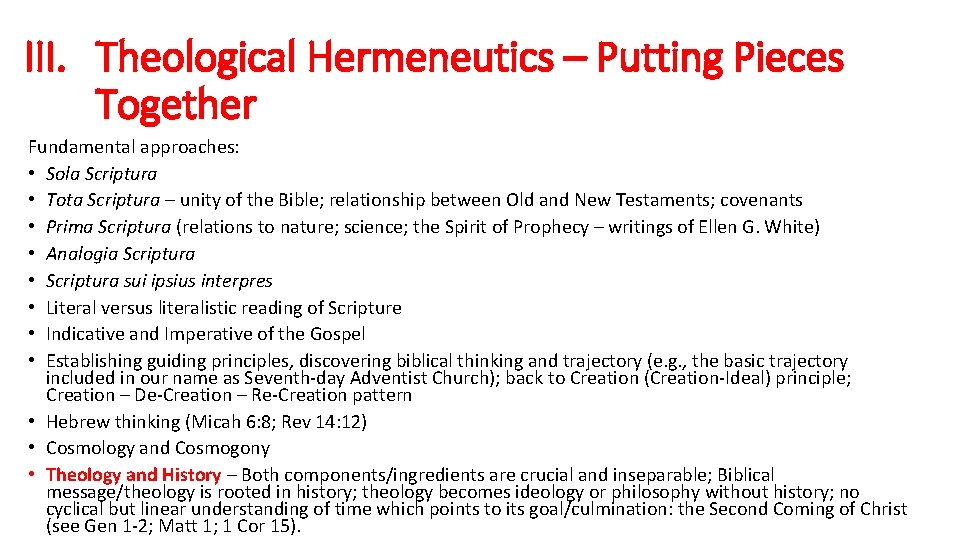
III. Theological Hermeneutics – Putting Pieces Together Fundamental approaches: • Sola Scriptura • Tota Scriptura – unity of the Bible; relationship between Old and New Testaments; covenants • Prima Scriptura (relations to nature; science; the Spirit of Prophecy – writings of Ellen G. White) • Analogia Scriptura • Scriptura sui ipsius interpres • Literal versus literalistic reading of Scripture • Indicative and Imperative of the Gospel • Establishing guiding principles, discovering biblical thinking and trajectory (e. g. , the basic trajectory included in our name as Seventh-day Adventist Church); back to Creation (Creation-Ideal) principle; Creation – De-Creation – Re-Creation pattern • Hebrew thinking (Micah 6: 8; Rev 14: 12) • Cosmology and Cosmogony • Theology and History – Both components/ingredients are crucial and inseparable; Biblical message/theology is rooted in history; theology becomes ideology or philosophy without history; no cyclical but linear understanding of time which points to its goal/culmination: the Second Coming of Christ (see Gen 1 -2; Matt 1; 1 Cor 15).
III. Theological Hermeneutics – Putting Pieces Together Fundamental approaches: • Sola Scriptura • Tota Scriptura – unity of the Bible; relationship between Old and New Testaments; covenants • Prima Scriptura (relations to nature; science; the Spirit of Prophecy – writings of Ellen G. White) • Analogia Scriptura • Scriptura sui ipsius interpres • Literal versus literalistic reading of Scripture • Indicative and Imperative of the Gospel • Establishing guiding principles, discovering biblical thinking and trajectory (e. g. , the basic trajectory included in our name as Seventh-day Adventist Church); back to Creation (Creation. Ideal) principle; Creation – De-Creation – Re-Creation pattern • Hebrew thinking (Micah 6: 8; Rev 14: 12) • Cosmology and Cosmogony • Growing in the grace and knowledge (2 Pet 3: 18) – ecclesia reformata et semper reformanda secundum Verbum Dei
Interpretation of the Bible Is in Crisis • Recognize proper connections. The literary context is always crucial! • Be consistent! • Do not be selective! • Be brutally honest in your studies and conclusions! • Please do exegesis, and not eisegesis!
Acts 17: 11 “Now the Berean Jews were of more noble character than those in Thessalonica, for they received the message with great eagerness and examined the Scriptures every day to see if what Paul said was true. ” (NIV)
For more details, see my articles on Hermeneutics and Genesis 1 -2: Moskala, Jiří. “Toward Consistent Adventist Hermeneutics: From Creation through De-Creation to Re-Creation. ” Pages 1 -38 in Women and Ordination: Biblical and Historical Studies. Edited by John W. Reeve. Nampa, ID: Pacific Press, 2015. Moskala, Jiří. “A Fresh Look at Two Genesis Creation Accounts: Contradictions? ” Andrews University Seminary Studies 49, no. 1 (Spring 2011): 45– 65. Moskala, Jiří. “Interpretation of bere’šît in the Context of Genesis 1: 1– 3. ” Andrews University Seminary Studies 49, no. 1 (Spring 2011): 33– 44.
- Slides: 61