
Key Population Cascade Development Analysis Global Strategic Information

Key Population Cascade Development & Analysis Global Strategic Information, Global Health Sciences University of California, San Francisco 2/22/2021
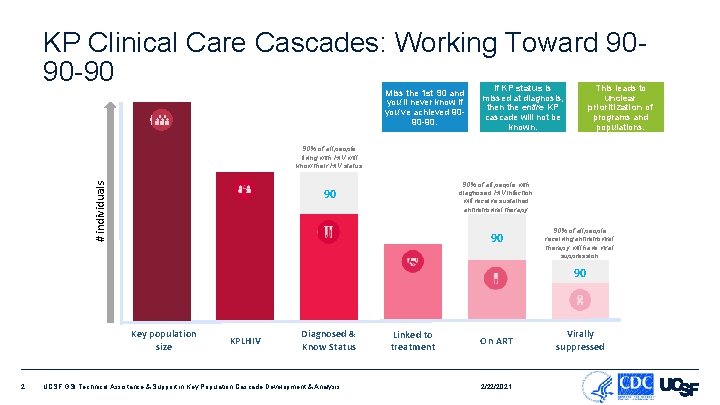
KP Clinical Care Cascades: Working Toward 9090 -90 Miss the 1 st 90 and you’ll never know if you’ve achieved 9090 -90. If KP status is missed at diagnosis, then the entire KP cascade will not be known. This leads to unclear prioritization of programs and populations. # individuals 90% of all people living with HIV will know their HIV status 90% of all people with diagnosed HIV infection will receive sustained antiretroviral therapy 90 90 90% of all people receiving antiretroviral therapy will have viral suppression 90 Key population size 2 KPLHIV Diagnosed & Know Status UCSF GSI Technical Assistance & Support in Key Population Cascade Development & Analysis Linked to treatment On ART 2/22/2021 Virally suppressed

Current work Strengthening use of cascade data (Cascade Monitoring & Analysis) • • Developing cascades from current KP data sources Developing planning size estimates for setting targets among KPs Triangulating surveillance and program data sources for creating KP cascades Building capacity of country staff to develop and analyze KP cascades Strengthening data collection systems (Cascade System Strengthening) • Identifying gaps and implementing best practices to strengthen community & facility-based routine data collection tools and management systems • Creating enhanced indicators (e. g. , Linkage, population subsets) • Going beyond currently available data for enhanced Cascade Monitoring 3 UCSF GSI Technical Assistance & Support in Key Population Cascade Development & Analysis 2/22/2021

Cascade Denominator Development: Key Population Size Estimation # individuals Activities can address highlighted bars Key pop. size Overview Implementation & Stakeholder Consensus § MSM, FSW, and PWID § MSM and FSW § FSW only § Other (street children) • 4 Methods Novel Approaches Regional Trainings UCSF GSI Technical Assistance & Support in Key Population Cascade Development & Analysis KPLHIV Diagnosed & know status Linked to treatment On ART Virally suppressed Provide technical assistance on key population size estimation (PSE), including facilitating trainings on best approaches for conducting PSE, as well as in implementing PSE activities in different countries. Much of this work is done to help develop planning size estimates for setting targets among KPs. 20+, including literature review, proxy measures, stakeholder consensus, Delphi, service multiplier, etc. Anchored multiplier (Wesson method), sequential sampling, multiple sample capture recapture (MSCR), reverse tracking, modified Priorities for Local AIDS Control Efforts (PLACE), systematic reviews 2/22/2021
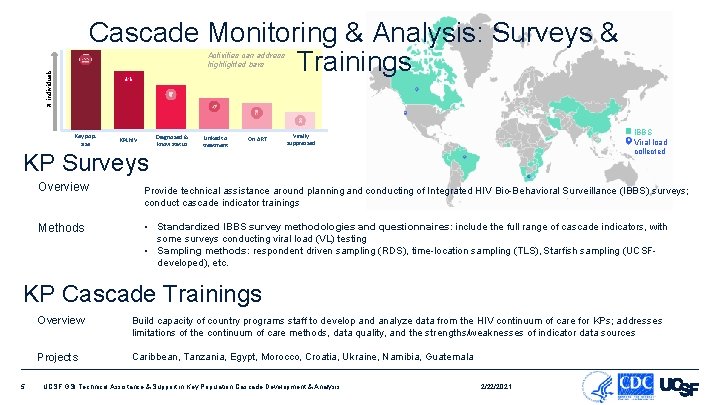
Cascade Monitoring & Analysis: Surveys & Trainings # individuals Activities can address highlighted bars Key pop. size Diagnosed & know status KPLHIV Linked to treatment On ART IBBS Viral load collected Virally suppressed KP Surveys Overview Provide technical assistance around planning and conducting of Integrated HIV Bio-Behavioral Surveillance (IBBS) surveys; conduct cascade indicator trainings Methods • Standardized IBBS survey methodologies and questionnaires: include the full range of cascade indicators, with some surveys conducting viral load (VL) testing • Sampling methods: respondent driven sampling (RDS), time-location sampling (TLS), Starfish sampling (UCSFdeveloped), etc. KP Cascade Trainings 5 Overview Build capacity of country programs staff to develop and analyze data from the HIV continuum of care for KPs; addresses limitations of the continuum of care methods, data quality, and the strengths/weaknesses of indicator data sources Projects Caribbean, Tanzania, Egypt, Morocco, Croatia, Ukraine, Namibia, Guatemala UCSF GSI Technical Assistance & Support in Key Population Cascade Development & Analysis 2/22/2021

Cascade Monitoring & Analysis: Data Triangulation for Cascades Overview Integration of multiple, incomplete, heterogeneous data sources (e. g. , epidemiological data, program data, literature, stakeholder input, etc. ) to develop KP cascades, with efforts to disaggregate by age, subnational unit, etc. ; includes the comparison of surveillance cascades with program cascades in addition to integrated cascades. Projects Kenya, South Africa, Zambia, Ethiopia, Guatemala, Tanzania (planned) Case Study Assumptions and data sources: MSM in South Africa (Scheibe et al 2017) • MSM Pop Size – Three scenarios: 2%, 3. 5%, 5% of adult men # individuals • HIV prevalence – Extrapolated from IBBS RDS surveys • Diagnosed – Estimated from frequency of testing in IBBS • On ART and Virally Suppressed – Based on general population of men in household survey Key pop. size KPLHIV Diagnosed & know status On ART Virally suppressed Very stakeholder-driven approach • 30 stakeholders from government, NAC, academia, MSM programs, community members • Reviewed data, assumptions, iterative from 2013 - 2015 • Came to consensus on current situation and data gaps to be filled Scheibe et al. Modelling the UNAIDS 90 -90 -90 treatment cascade for gay, bisexual and other men who have sex with men in South Africa: using the findings of a data triangulation process to map a way forward. AIDS and Behavior, 2017 6 UCSF GSI Technical Assistance & Support in Key Population Cascade Development & Analysis

Cascade Feasibility: System Strengthening for Enhanced Cascade Monitoring Project Goal: Strengthening routine data collection systems (paper or electronic) to collect individual-level data from disparate sources to track an individual course through the HIV cascade, including KP/PP categorization. • Components: HIV testing, enrollment in care, ART, and viral suppression • Includes (but not limited to) case-based surveillance systems • Countries: Dominican Republic, Ukraine, Uganda, Mozambique 7 UCSF GSI Technical Assistance & Support in Key Population Cascade Development & Analysis 2/22/2021
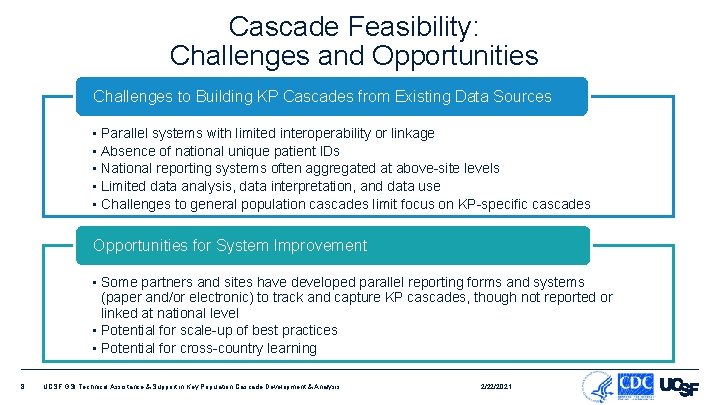
Cascade Feasibility: Challenges and Opportunities Challenges to Building KP Cascades from Existing Data Sources • Parallel systems with limited interoperability or linkage • Absence of national unique patient IDs • National reporting systems often aggregated at above-site levels • Limited data analysis, data interpretation, and data use • Challenges to general population cascades limit focus on KP-specific cascades Opportunities for System Improvement • Some partners and sites have developed parallel reporting forms and systems (paper and/or electronic) to track and capture KP cascades, though not reported or linked at national level • Potential for scale-up of best practices • Potential for cross-country learning 8 UCSF GSI Technical Assistance & Support in Key Population Cascade Development & Analysis 2/22/2021

Cascade Feasibility: Project Overview Phase 1: Rapid Formative Assessment • To what degree does the centralized data system capture patient-level data from different sources? • Sensitivity? • Completeness? • Accuracy? 9 Phase 2: Implementation of System Improvements • To what degree can complete HIV cascades be assembled at an individual patient-level from the central database system? • Integrated intake forms and database fields for population categorization • Trainings for facility staff on patient screening, data collection practices • Patient-level cascade identifiers and indicators • Data quality assurance standards • Data sharing agreements for key data elements required to construct KP/PP cascades Phase 3: Post-Implementation Data Quality Assessments Phase 4: Dissemination of Key Findings UCSF GSI Technical Assistance & Support in Key Population Cascade Development & Analysis 2/22/2021
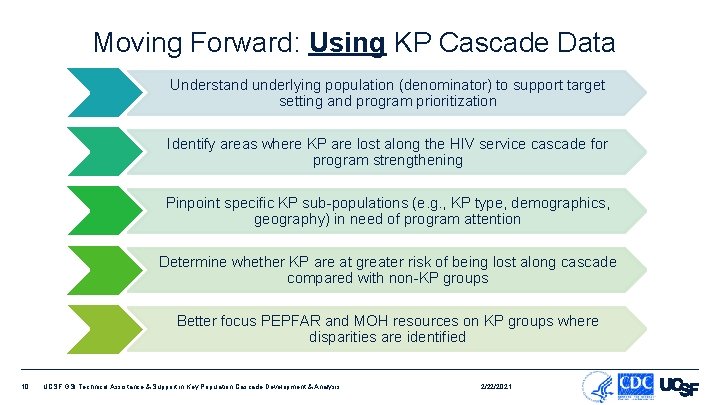
Moving Forward: Using KP Cascade Data Understand underlying population (denominator) to support target setting and program prioritization Identify areas where KP are lost along the HIV service cascade for program strengthening Pinpoint specific KP sub-populations (e. g. , KP type, demographics, geography) in need of program attention Determine whether KP are at greater risk of being lost along cascade compared with non-KP groups Better focus PEPFAR and MOH resources on KP groups where disparities are identified 10 UCSF GSI Technical Assistance & Support in Key Population Cascade Development & Analysis 2/22/2021
- Slides: 10