
Key Performance Indicators What are they Why do
- Slides: 36
Key Performance Indicators What are they? Why do they matter? How to define them? – training slides February 2018
Copyright attribution © 2019 by Pierre Bienvenüe, Impi Business Improvement Solutions. KPI and Catchball. This work is licensed under the Creative Commons Attribution-Share. Alike 4. 0 International License. To view a copy of this license, visit http: //creativecommons. org/licenses/by-sa/4. 0/ 2 Integrated Business Transformation
Purpose of the presentation Ensure common understanding of: § What is a KPI? § Process of defining and cascading KPIs § How to define KPIs Stimulate the engagement of all leaders
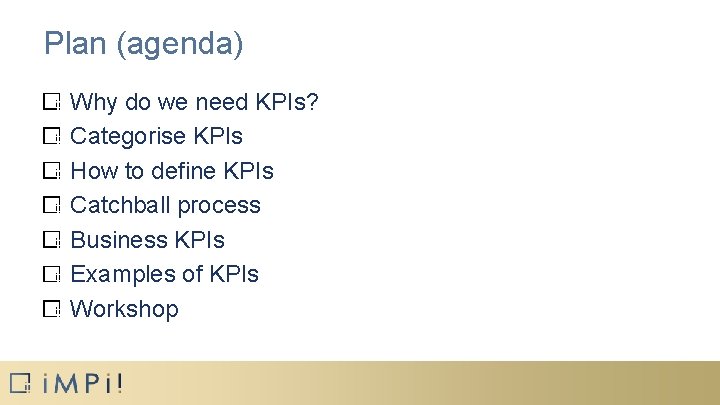
Plan (agenda) Why do we need KPIs? Categorise KPIs How to define KPIs Catchball process Business KPIs Examples of KPIs Workshop
Why do we need KPIs?
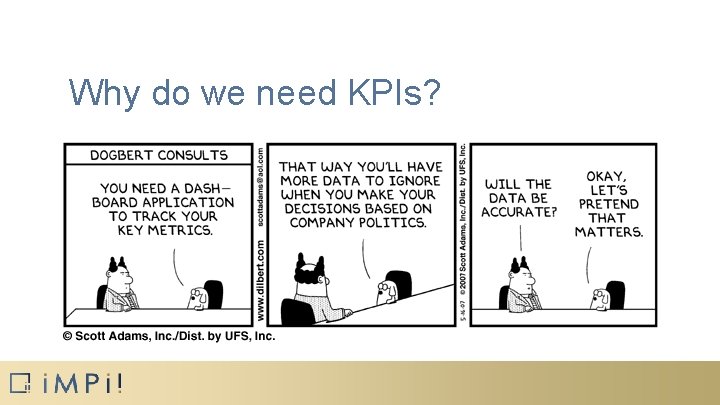
Why do we need KPIs? What gets measured gets managed Vertical Alignment: get everyone on the same page Stimulate engagement and improvement at all levels Focus on what is essential: KEY Performance Indicators
Why do we need KPIs? (cont. ) Essential drivers of improvement
KEY Performance Indicators Essential drivers of improvement
Categorise KPIs Short interval control (SIC) Leading – Lagging indicators Different levels – focus, time horizon and process capability Specific/common/generic/compliance
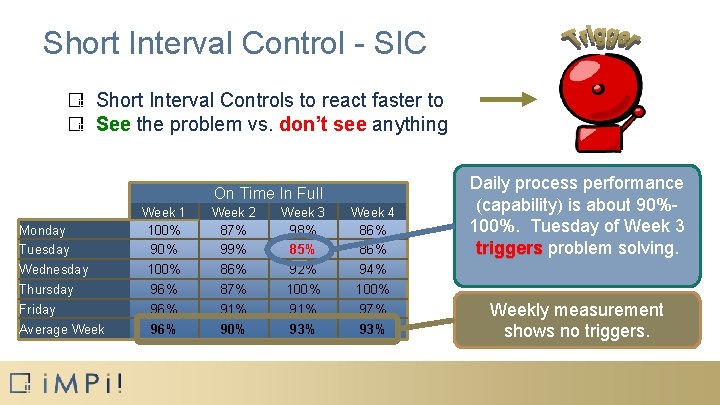
Short Interval Control - SIC Short Interval Controls to react faster to See the problem vs. don’t see anything On Time In Full Monday Week 1 100% Week 2 87% Week 3 98% Week 4 86% Tuesday 90% 99% 85% 86% Wednesday 100% 86% 92% 94% Thursday 96% 87% 100% Friday 96% 91% 97% Average Week 96% 90% 93% Daily process performance (capability) is about 90%100%. Tuesday of Week 3 triggers problem solving. Weekly measurement shows no triggers.
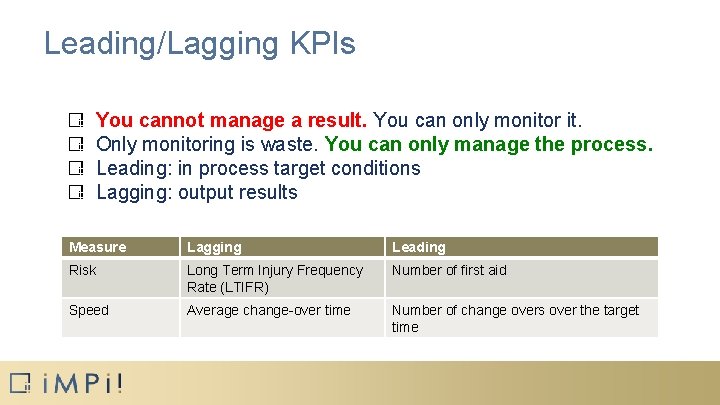
Leading/Lagging KPIs You cannot manage a result. You can only monitor it. Only monitoring is waste. You can only manage the process. Leading: in process target conditions Lagging: output results Measure Lagging Leading Risk Long Term Injury Frequency Rate (LTIFR) Number of first aid Speed Average change-over time Number of change overs over the target time
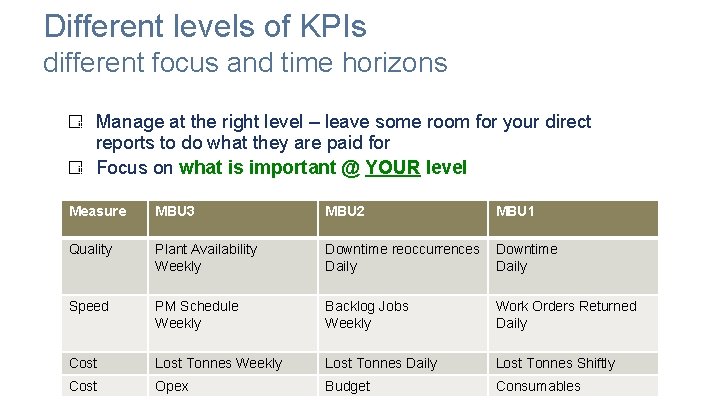
Different levels of KPIs different focus and time horizons Manage at the right level – leave some room for your direct reports to do what they are paid for Focus on what is important @ YOUR level Measure MBU 3 MBU 2 MBU 1 Quality Plant Availability Weekly Downtime reoccurrences Daily Downtime Daily Speed PM Schedule Weekly Backlog Jobs Weekly Work Orders Returned Daily Cost Lost Tonnes Weekly Lost Tonnes Daily Lost Tonnes Shiftly Cost Opex Budget Consumables
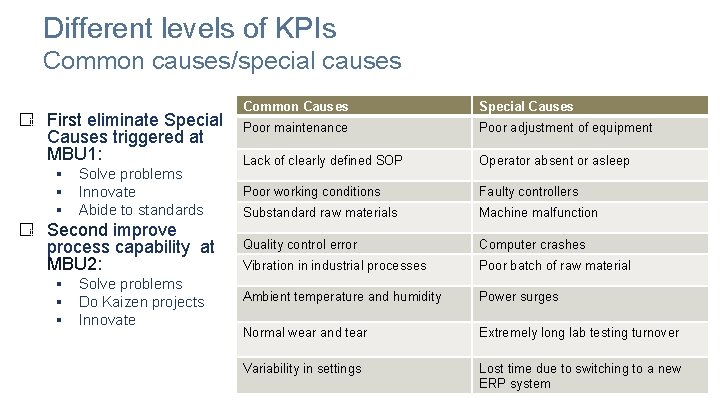
Different levels of KPIs Common causes/special causes First eliminate Special Causes triggered at MBU 1: § Solve problems § Innovate § Abide to standards Second improve process capability at MBU 2: § Solve problems § Do Kaizen projects § Innovate Common Causes Special Causes Poor maintenance Poor adjustment of equipment Lack of clearly defined SOP Operator absent or asleep Poor working conditions Faulty controllers Substandard raw materials Machine malfunction Quality control error Computer crashes Vibration in industrial processes Poor batch of raw material Ambient temperature and humidity Power surges Normal wear and tear Extremely long lab testing turnover Variability in settings Lost time due to switching to a new ERP system
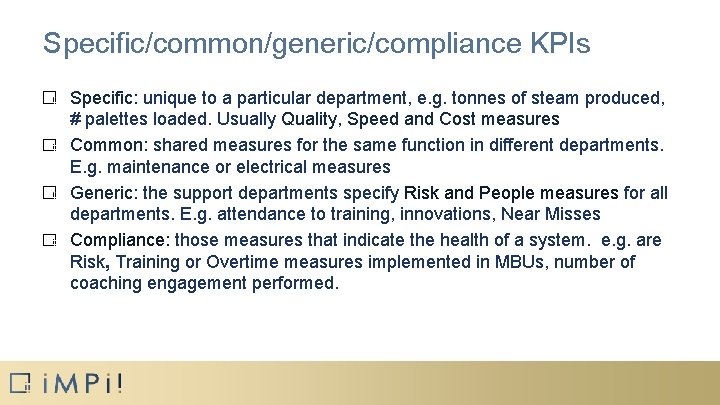
Specific/common/generic/compliance KPIs Specific: unique to a particular department, e. g. tonnes of steam produced, # palettes loaded. Usually Quality, Speed and Cost measures Common: shared measures for the same function in different departments. E. g. maintenance or electrical measures Generic: the support departments specify Risk and People measures for all departments. E. g. attendance to training, innovations, Near Misses Compliance: those measures that indicate the health of a system. e. g. are Risk, Training or Overtime measures implemented in MBUs, number of coaching engagement performed.
Define KPIs: Focus on what is important @ YOUR level
How to define KPIs Choose a KPI Choose a target
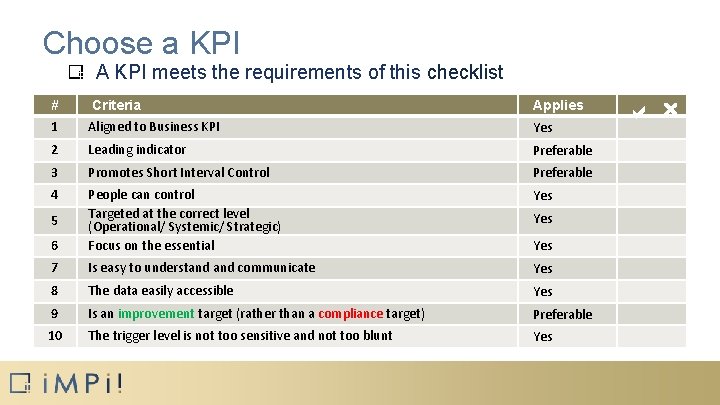
Choose a KPI A KPI meets the requirements of this checklist # Criteria Applies 1 Aligned to Business KPI Yes 2 Leading indicator Preferable 3 Promotes Short Interval Control Preferable 4 Yes 6 People can control Targeted at the correct level (Operational/ Systemic/ Strategic) Focus on the essential 7 Is easy to understand communicate Yes 8 The data easily accessible Yes 9 Is an improvement target (rather than a compliance target) Preferable 10 The trigger level is not too sensitive and not too blunt Yes 5 Yes ar
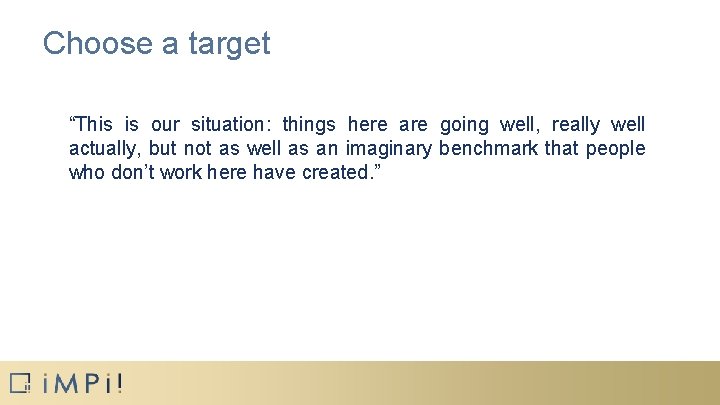
Choose a target “This is our situation: things here are going well, really well actually, but not as well as an imaginary benchmark that people who don’t work here have created. ”
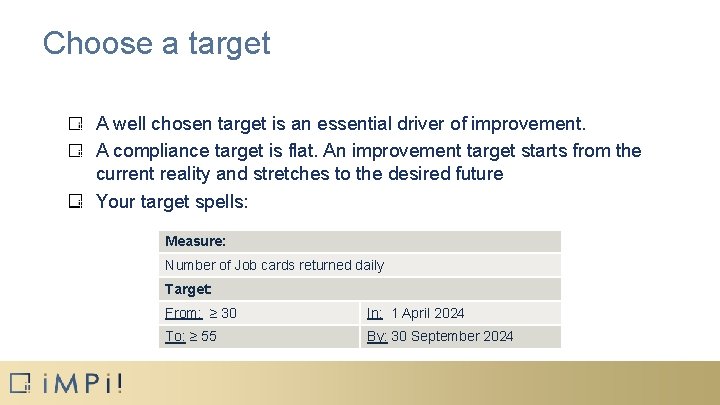
Choose a target A well chosen target is an essential driver of improvement. A compliance target is flat. An improvement target starts from the current reality and stretches to the desired future Your target spells: Measure: Number of Job cards returned daily Target: From: ≥ 30 In: 1 April 2024 To: ≥ 55 By: 30 September 2024
Template for defining a KPI
Define a KPI: Focus on improvement
Catchball Process Get engagement Ensure alignment
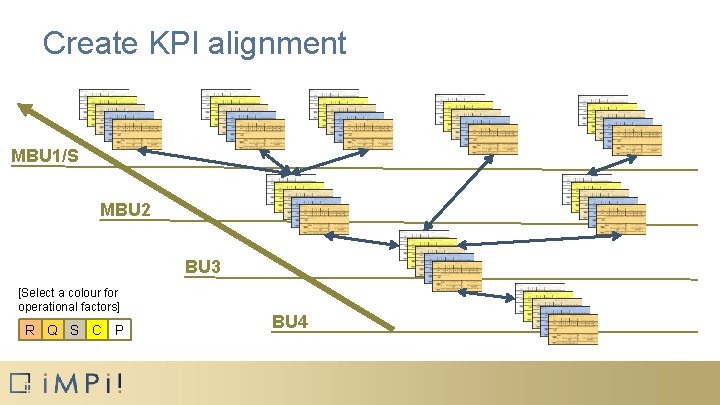
Create KPI alignment MBU 1/S MBU 2 BU 3 [Select a colour for operational factors] R Q S C P BU 4
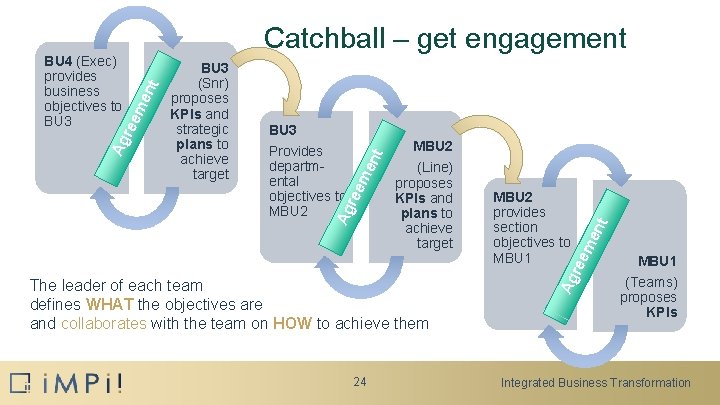
The leader of each team defines WHAT the objectives are and collaborates with the team on HOW to achieve them 24 t MBU 2 provides section objectives to MBU 1 me n (Line) proposes KPIs and plans to achieve target ree Ag MBU 2 Ag Provides departmental objectives to MBU 2 t BU 3 ree BU 3 (Snr) proposes KPIs and strategic plans to achieve target me n nt me Ag ree BU 4 (Exec) provides business objectives to BU 3 Catchball – get engagement MBU 1 (Teams) proposes KPIs Integrated Business Transformation
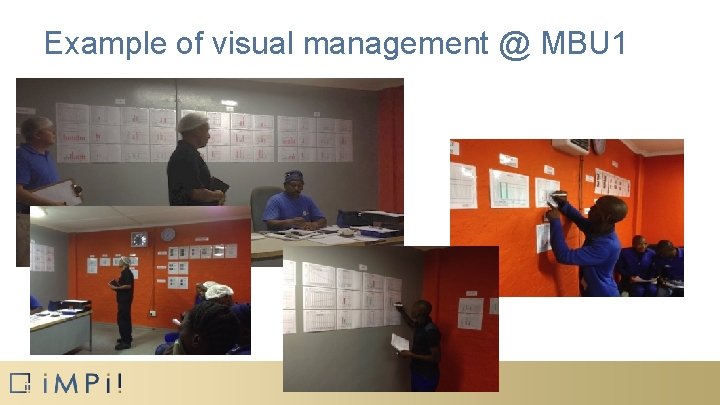
Example of visual management @ MBU 1
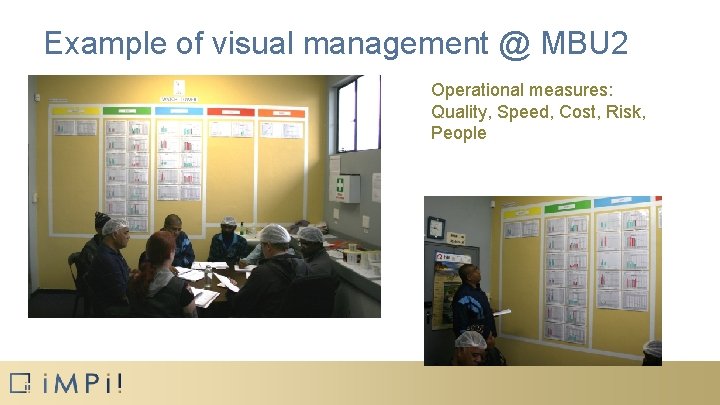
Example of visual management @ MBU 2 Operational measures: Quality, Speed, Cost, Risk, People
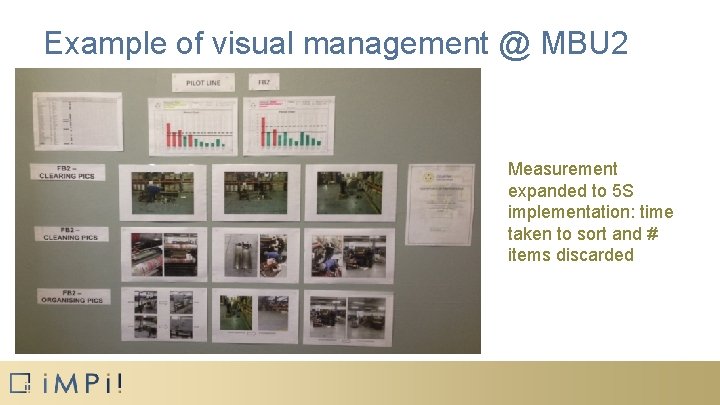
Example of visual management @ MBU 2 Measurement expanded to 5 S implementation: time taken to sort and # items discarded
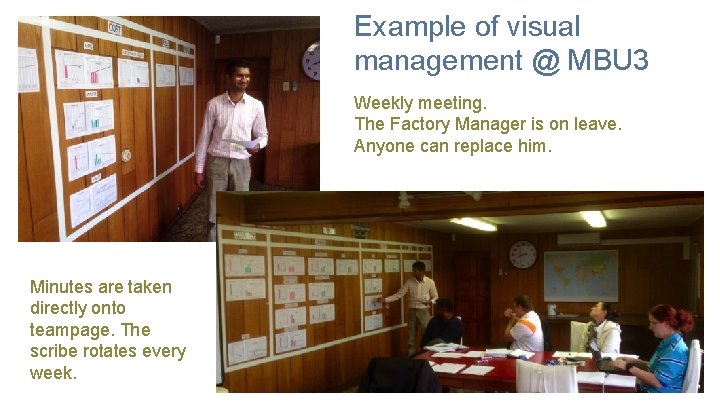
Example of visual management @ MBU 3 Weekly meeting. The Factory Manager is on leave. Anyone can replace him. Minutes are taken directly onto teampage. The scribe rotates every week.
Catchball Process Get engagement Ensure alignment
Business Objectives Financial Year 20 YY
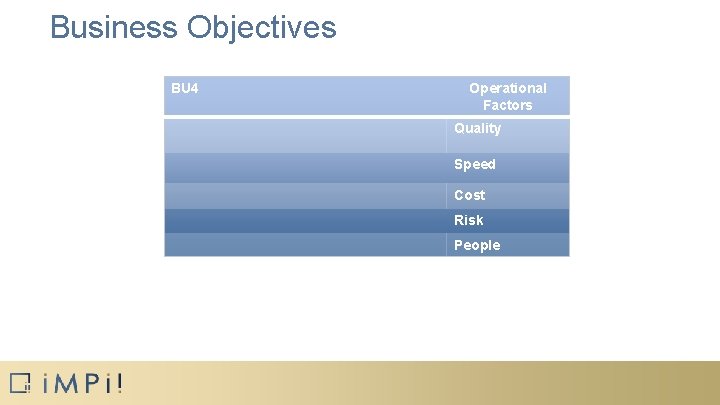
Business Objectives BU 4 Operational Factors Quality Speed Cost Risk People
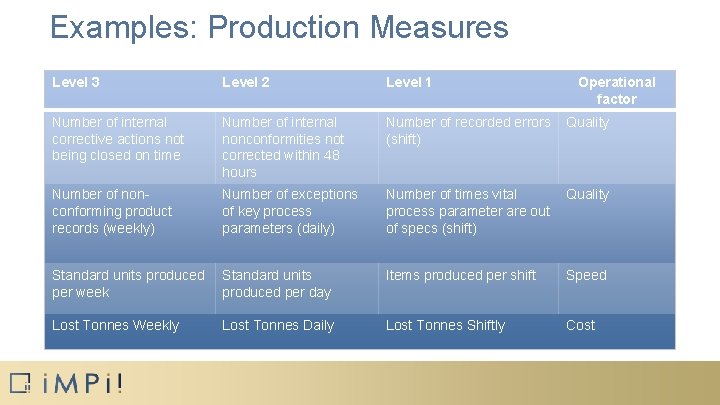
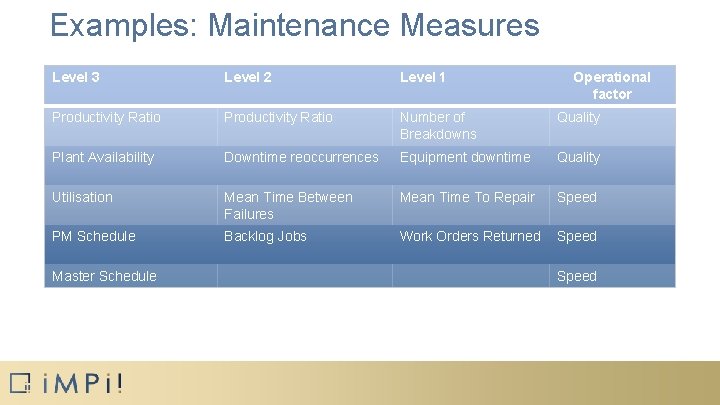
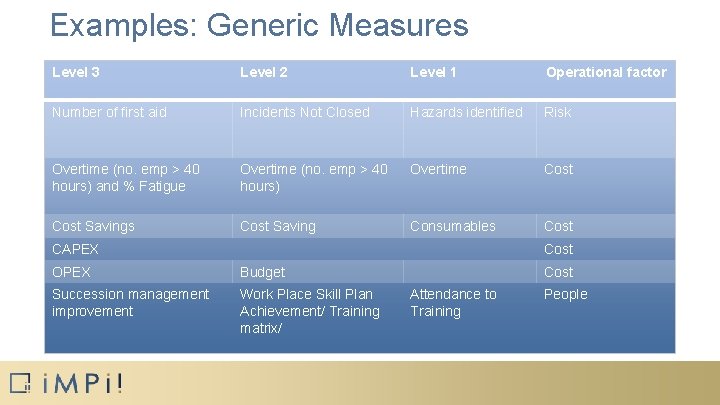
Examples of KPIs For Process and Maintenance Focussing on Quality, Speed, Cost. Risk and People to be defined by SHEQ, HR, CI
Examples: Production Measures Level 3 Level 2 Level 1 Operational factor Number of internal corrective actions not being closed on time Number of internal nonconformities not corrected within 48 hours Number of recorded errors (shift) Quality Number of nonconforming product records (weekly) Number of exceptions of key process parameters (daily) Number of times vital process parameter are out of specs (shift) Quality Standard units produced per week Standard units produced per day Items produced per shift Speed Lost Tonnes Weekly Lost Tonnes Daily Lost Tonnes Shiftly Cost
Examples: Maintenance Measures Level 3 Level 2 Level 1 Productivity Ratio Number of Breakdowns Quality Plant Availability Downtime reoccurrences Equipment downtime Quality Utilisation Mean Time Between Failures Mean Time To Repair Speed PM Schedule Backlog Jobs Work Orders Returned Speed Master Schedule Operational factor Speed
Examples: Generic Measures Level 3 Level 2 Level 1 Operational factor Number of first aid Incidents Not Closed Hazards identified Risk Overtime (no. emp > 40 hours) and % Fatigue Overtime (no. emp > 40 hours) Overtime Cost Savings Cost Saving Consumables Cost CAPEX Cost OPEX Budget Succession management improvement Work Place Skill Plan Achievement/ Training matrix/ Cost Attendance to Training People
Workshop Now define the KPIs for your department