
Key OHS Acts Two aims To prevent occupational
- Slides: 33
Key OHS Acts • Two aims: • • • To prevent occupational health hazards To ensure the health & safety of all employees OHS legislation is enacted by Parliaments to set minimum standards of performance & behaviour in the community. Some form of penalty may apply where failure to observe or comply with the legislation occurs. The 3 key Acts are: • • – – – Occupational Health & Safety (Commonwealth Employment) Act, 1991 Safety rehabilitation and Compensation Act, 1988 State/Territory Occupational Health & Safety Act OH&S Summary FNSICGEN 304 B Version 1 May 11 2009
Commonwealth Employment Act • Covers employees of Government departments, agencies & authorities. • Administered by Comcare – Commission for the Safety, Rehabilitation & Compensation of Commonwealth Employees. • Commonwealth inspectors are used to investigate a department’s health & safety procedures. • Details approved codes of practice which are in alignment with the legislation of the States & Territories. OH&S Summary FNSICGEN 304 B Version 1 May 11 2009
Safety, Rehabilitation & Compensation Act, 1988 • Relates to the rehabilitation of employees of the Commonwealth & certain corporations & to worker’s compensation for those employees. • Establishes a fully funded premium based system & a licensed self insurance based system of compensation & rehabilitation for employees injured in the course of their employment. • Provides a comprehensive benefit structure that includes: – Payment of reasonable cost of medical treatment – Income replacement for periods of incapacity – Payment of lump sums for permanent impairments OH&S Summary FNSICGEN 304 B Version 1 May 11 2009
State/Territory OHS Act • Employees & employers in each state & territory are covered by separate acts. • All acts cover duty of care requirements for employers & employees. • In NSW the legislation is Occupational Health & Safety Act, 2000 & Occupational Health & Safety Regulations, 2001. • In NSW the OHS authority is NSW Workcover Authority. OH&S Summary FNSICGEN 304 B Version 1 May 11 2009
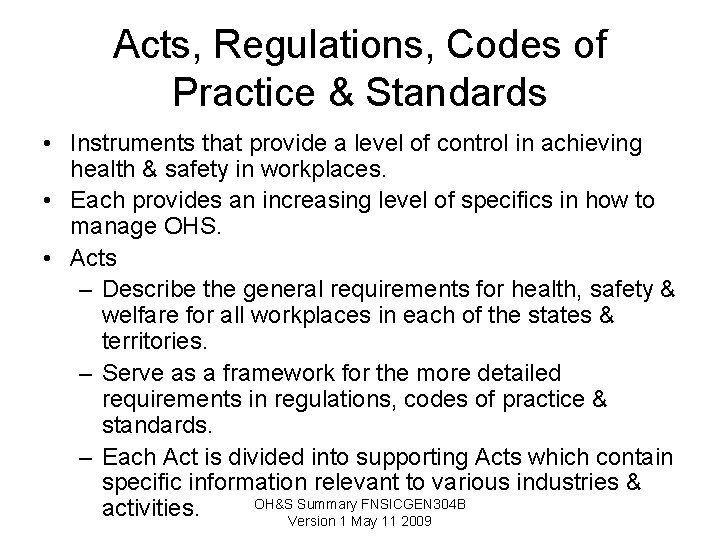
Acts, Regulations, Codes of Practice & Standards • Instruments that provide a level of control in achieving health & safety in workplaces. • Each provides an increasing level of specifics in how to manage OHS. • Acts – Describe the general requirements for health, safety & welfare for all workplaces in each of the states & territories. – Serve as a framework for the more detailed requirements in regulations, codes of practice & standards. – Each Act is divided into supporting Acts which contain specific information relevant to various industries & OH&S Summary FNSICGEN 304 B activities. Version 1 May 11 2009
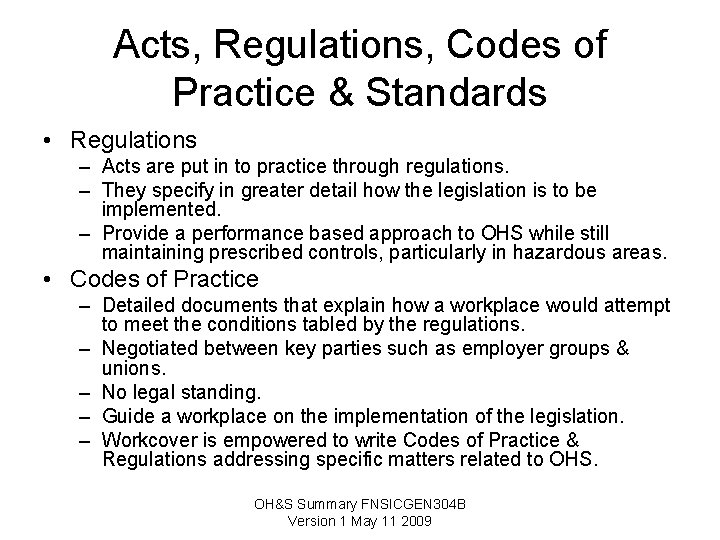
Acts, Regulations, Codes of Practice & Standards • Regulations – Acts are put in to practice through regulations. – They specify in greater detail how the legislation is to be implemented. – Provide a performance based approach to OHS while still maintaining prescribed controls, particularly in hazardous areas. • Codes of Practice – Detailed documents that explain how a workplace would attempt to meet the conditions tabled by the regulations. – Negotiated between key parties such as employer groups & unions. – No legal standing. – Guide a workplace on the implementation of the legislation. – Workcover is empowered to write Codes of Practice & Regulations addressing specific matters related to OHS. OH&S Summary FNSICGEN 304 B Version 1 May 11 2009
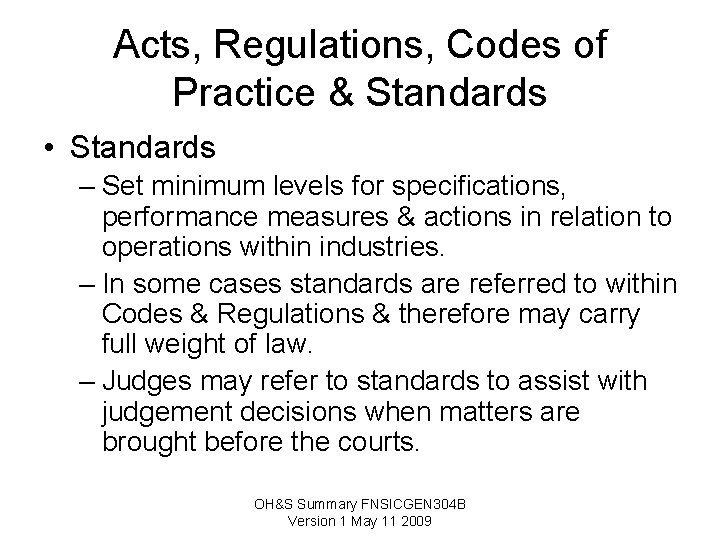
Acts, Regulations, Codes of Practice & Standards • Standards – Set minimum levels for specifications, performance measures & actions in relation to operations within industries. – In some cases standards are referred to within Codes & Regulations & therefore may carry full weight of law. – Judges may refer to standards to assist with judgement decisions when matters are brought before the courts. OH&S Summary FNSICGEN 304 B Version 1 May 11 2009
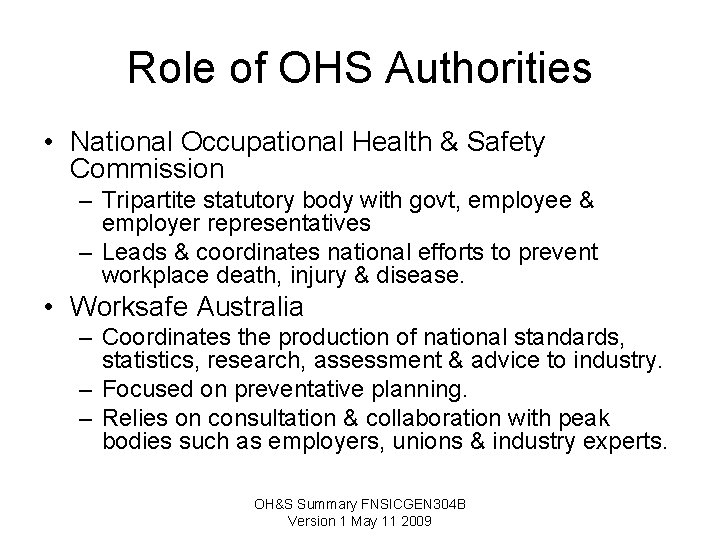
Role of OHS Authorities • National Occupational Health & Safety Commission – Tripartite statutory body with govt, employee & employer representatives – Leads & coordinates national efforts to prevent workplace death, injury & disease. • Worksafe Australia – Coordinates the production of national standards, statistics, research, assessment & advice to industry. – Focused on preventative planning. – Relies on consultation & collaboration with peak bodies such as employers, unions & industry experts. OH&S Summary FNSICGEN 304 B Version 1 May 11 2009
Role of OHS Authorities • Comcare Australia – Focuses on the health & safety of Australian Public Service workers – Administers OHS(CE)Act, 1991 & SRC Act, 1988 – Four key functions • Develop & distribute OHS information to employees & employers • Ensure public service activities are conducted within the commonwealth Act for OHS • Provide advice on the care of those injured by workplace accidents • Compensate injured public servants OH&S Summary FNSICGEN 304 B Version 1 May 11 2009
Role of OHS Authorities • State/Territory Work Health Authority – Each state manages their OHS policies through an organisation called Workcover. – Workcover strives to promote a culture of safety through extensive public awareness programs, education & other communication activities. – Has power to prosecute individuals & companies which fail to meet workplace OHS responsibilities. – Support injured workers to remain at work or return to work following injury. OH&S Summary FNSICGEN 304 B Version 1 May 11 2009
Role of OHS Authorities • The Australian Council of Trade Unions, OHS Unit – Primarily concerned with workers’ health & safety – Provide advice & support on OHS matters to all workers – Take up OHS issues with employers on behalf of individuals – Consulting with employers on issues concerned with OHS OH&S Summary FNSICGEN 304 B Version 1 May 11 2009
OHS Inspectors • OHS legislation can be enforced through use of inspectors. • Legislation gives inspectors power to inspect workplaces at any time and direct employers and employees to rectify or address any activity they deem to be unsafe. • Inspectors attempt to work with employers by giving them whatever time is practical & reasonable in addressing an OHS issue. • If situation deemed dangerous they have the power to shut down an activity or operation until the matter has been addressed. • They can fine employers & employees for breaches of OHS regulations. • Workcover enforces law in NSW in all enterprises except Commonwealth operations. OH&S Summary FNSICGEN 304 B Version May 11 2009 • Comcare enforces law in 1 Commonwealth workplaces.
OHS Policy • A workplace OHS policy is a document that details how OHS will be managed. • An effective workplace policy will include: – How to carry out workplace activities in a safe manner – How employees can report safety hazards that they have identified – How identified hazards will be assessed & controlled – How to provide safe entry, access & exit for all persons in the work environment – How training & information will be made available to develop knowledge of all workers in OHS matters – How employers can consult with employees – How to keep employees informed and involved in any decisions that affect their health & safety OH&S Summary FNSICGEN 304 B Version 1 May 11 2009
Employer Responsibilities • Employers have a ‘duty of care’ to ensure the workplace is safe for everyone. • Key duties of employers include: – Ensuring that equipment is in safe working order – Ensuring that workplace activities are carried out in a safe manner – Ensuring that the work environment provides safe entry, access & exit – Ensuring that information, instruction & training is made available to all employees OH&S Summary FNSICGEN 304 B Version 1 May 11 2009
Employee Responsibilities • Employees have a responsibility to participate in all aspects of workplace OHS • Some employee responsibilities include: – To cooperate with employers to ensure the business adheres to OHS legislation – To ensure their actions don’t endanger others – To ensure that their activities do not diminish the safety of equipment & materials – To ensure that they do not fail to support anyone in danger, ill or injured – To identify & report any workplace incidents or hazards to their supervisor OH&S Summary FNSICGEN 304 B Version 1 May 11 2009
Consultation • Employers must consult their employees when they are: – Making changes to work premises, methods, systems, plants or substances – Drawing up procedures for consultation with employees – Assessing reviewing or eliminating workplace risks – Considering facilities for employee’s welfare OH&S Summary FNSICGEN 304 B Version 1 May 11 2009
What is Consultation? • The sharing of experiences, ideas, knowledge and understanding of all individuals in an organisation to plan, develop, manage & maintain OHS systems. • For consultation to be effective it requires: – The sharing of current, relevant OHS information – Opportunity for all parties to express views over OHS issues as they occur in the workplace – Thee views to be encouraged and have systems by which they can be received & recorded OH&S Summary FNSICGEN 304 B Version 1 May 11 2009
Good Practice Consultation • Can produce: – Informed & effective decision making amongst managers through the collection of data & ideas from a wider cross section of the organisation – Increased employee commitment to OHS through heightened awareness of issues & decisions & ownership of outcomes – Improved transparency on OHS issues builds trust between managers & staff as each party can gain greater understanding of differing view points – Greater levels of satisfaction as employees feel valued by the organisation – Safer workplaces impact on productivity & cost reduction OH&S Summary FNSICGEN 304 B Version 1 May 11 2009
Key Factors For Effective Consultation • Establish direct communication systems with all employees • Make available all relevant information • Encourage & value input • Seek input prior to any decision making • Encourage by listening not telling • Show professional respect for differing views • Provide appropriate training in consultation skills OH&S Summary FNSICGEN 304 B Version 1 May 11 2009
OHS Committees • Can be formed if there are 20 or more employees or if Workcover directs the workplace to establish one. • An OHS representative can also be appointed at the request of one or more employees or at Workcover’s recommendation. • Workplaces can also have other agreed arrangements. OH&S Summary FNSICGEN 304 B Version 1 May 11 2009
OHS Committee’s Role • Provide advice & guidance on any OHS issue in the workplace • Prevent or resolve unsafe practices through consultation with employers • Inspect all accidents & injuries • Inspect workplaces at least every three months • OHS committees must be trained and given time off t attend training OH&S Summary FNSICGEN 304 B Version 1 May 11 2009
OHS Management System • An OHS management system refers to a documented, coordinated plan designed to ensure that hazards & the risks associated with them are managed as effectively as possible. OH&S Summary FNSICGEN 304 B Version 1 May 11 2009
Developing an OHS Management System 1. Determine who is responsible for health & safety 2. Incorporate OHS into all organisational activities 3. Involve employees in the process 4. Develop procedures 5. Training 6. Monitor & review the system OH&S Summary FNSICGEN 304 B Version 1 May 11 2009
Key Performance Indicators • Number of mishaps, accidents, injuries • Number of training workshops • Number of employees attending these workshops • Reports on evacuation trials • Surveys on employees’ attitudes to OHS • Number of recommendations made by the OHS committee • Number of innovations in place as a result of the OHS committee OH&S Summary FNSICGEN 304 B Version 1 May 11 2009
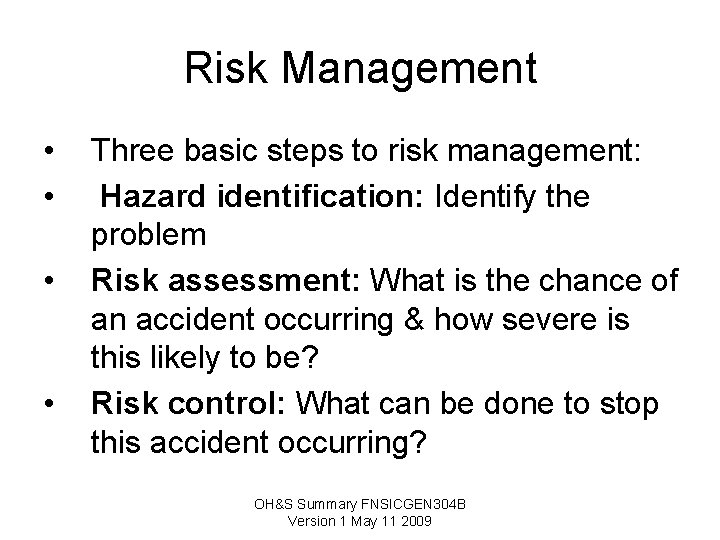
Risk Management • • Three basic steps to risk management: Hazard identification: Identify the problem Risk assessment: What is the chance of an accident occurring & how severe is this likely to be? Risk control: What can be done to stop this accident occurring? OH&S Summary FNSICGEN 304 B Version 1 May 11 2009
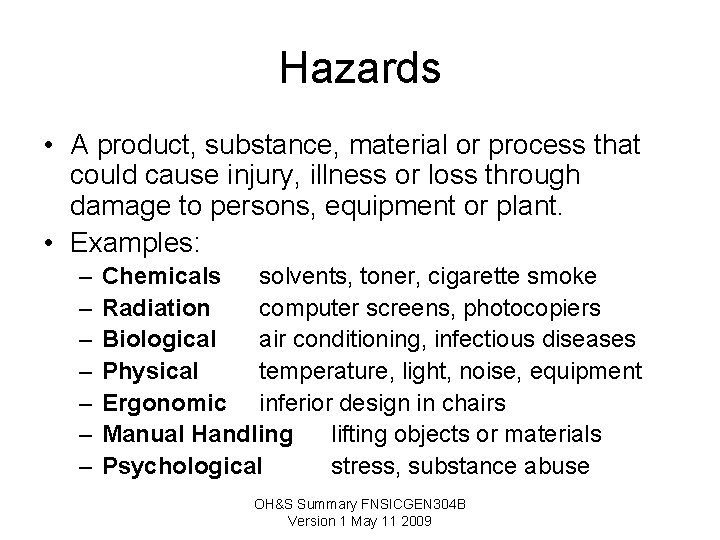
Hazards • A product, substance, material or process that could cause injury, illness or loss through damage to persons, equipment or plant. • Examples: – – – – Chemicals solvents, toner, cigarette smoke Radiation computer screens, photocopiers Biological air conditioning, infectious diseases Physical temperature, light, noise, equipment Ergonomic inferior design in chairs Manual Handling lifting objects or materials Psychological stress, substance abuse OH&S Summary FNSICGEN 304 B Version 1 May 11 2009
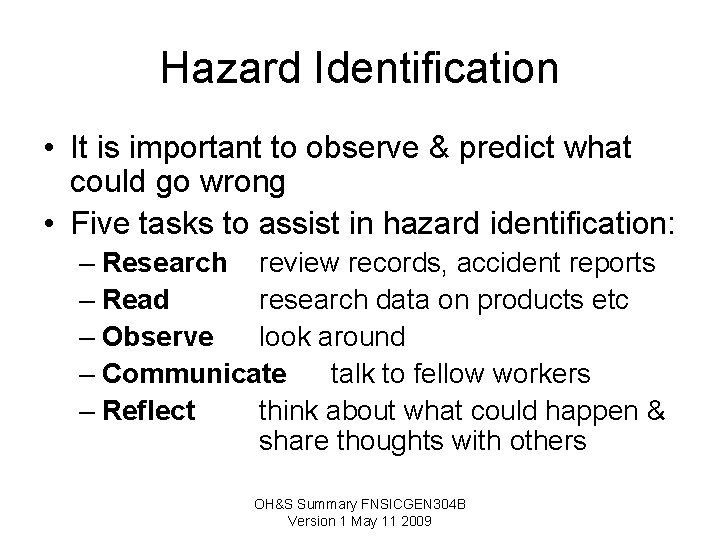
Hazard Identification • It is important to observe & predict what could go wrong • Five tasks to assist in hazard identification: – Research review records, accident reports – Read research data on products etc – Observe look around – Communicate talk to fellow workers – Reflect think about what could happen & share thoughts with others OH&S Summary FNSICGEN 304 B Version 1 May 11 2009
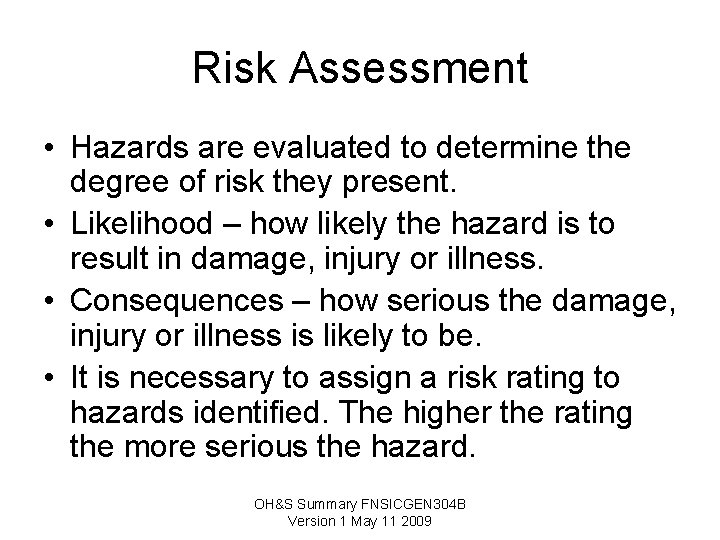
Risk Assessment • Hazards are evaluated to determine the degree of risk they present. • Likelihood – how likely the hazard is to result in damage, injury or illness. • Consequences – how serious the damage, injury or illness is likely to be. • It is necessary to assign a risk rating to hazards identified. The higher the rating the more serious the hazard. OH&S Summary FNSICGEN 304 B Version 1 May 11 2009
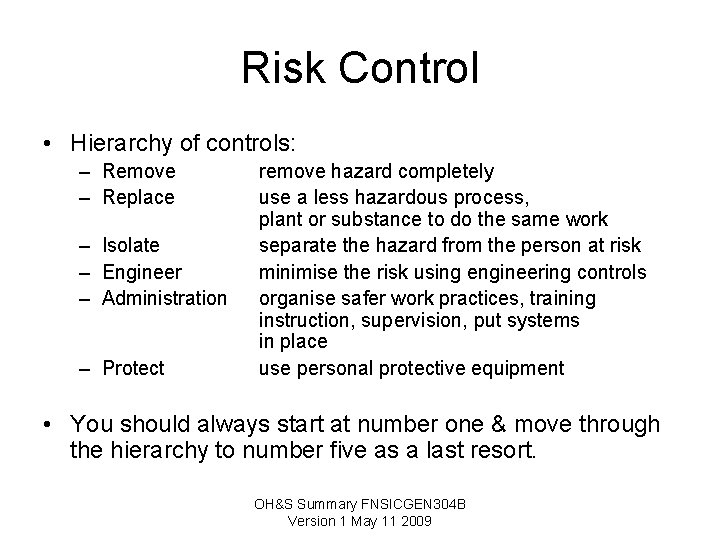
Risk Control • Hierarchy of controls: – Remove – Replace – Isolate – Engineer – Administration – Protect remove hazard completely use a less hazardous process, plant or substance to do the same work separate the hazard from the person at risk minimise the risk using engineering controls organise safer work practices, training instruction, supervision, put systems in place use personal protective equipment • You should always start at number one & move through the hierarchy to number five as a last resort. OH&S Summary FNSICGEN 304 B Version 1 May 11 2009
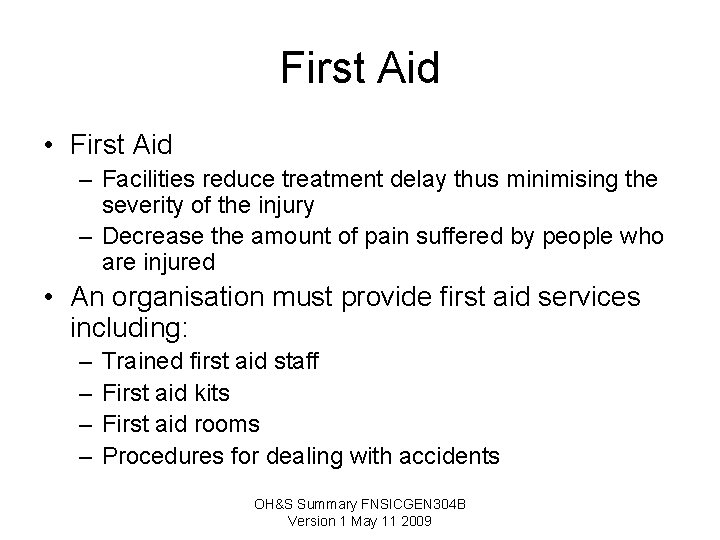
First Aid • First Aid – Facilities reduce treatment delay thus minimising the severity of the injury – Decrease the amount of pain suffered by people who are injured • An organisation must provide first aid services including: – – Trained first aid staff First aid kits First aid rooms Procedures for dealing with accidents OH&S Summary FNSICGEN 304 B Version 1 May 11 2009
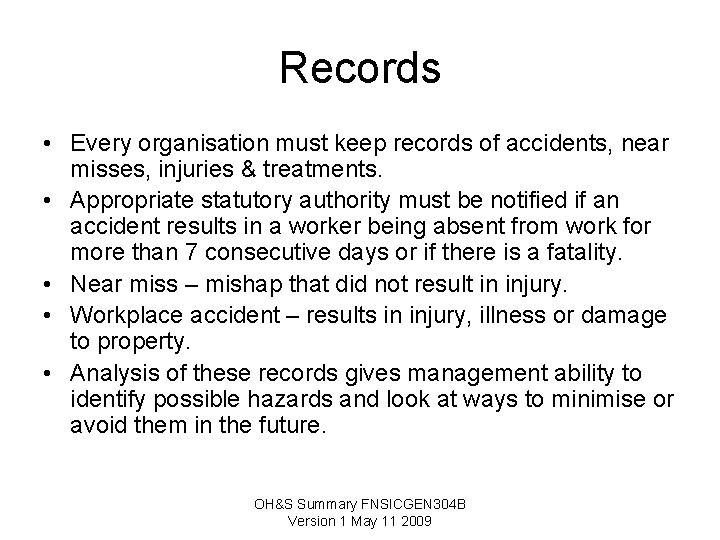
Records • Every organisation must keep records of accidents, near misses, injuries & treatments. • Appropriate statutory authority must be notified if an accident results in a worker being absent from work for more than 7 consecutive days or if there is a fatality. • Near miss – mishap that did not result in injury. • Workplace accident – results in injury, illness or damage to property. • Analysis of these records gives management ability to identify possible hazards and look at ways to minimise or avoid them in the future. OH&S Summary FNSICGEN 304 B Version 1 May 11 2009
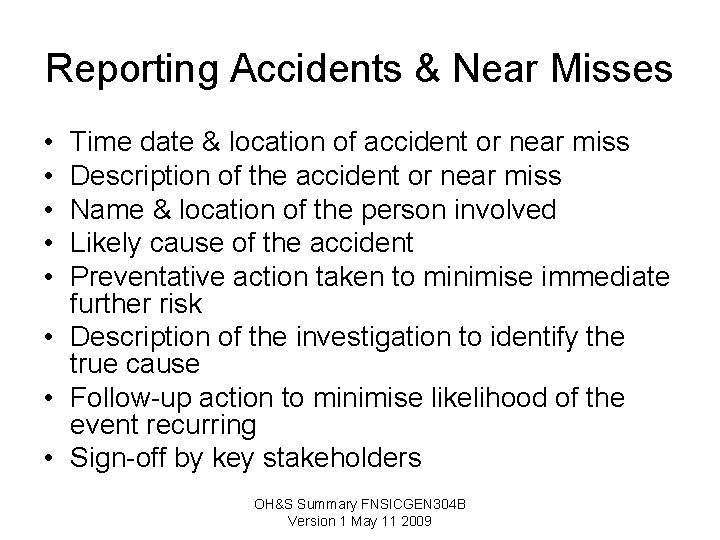
Reporting Accidents & Near Misses • • • Time date & location of accident or near miss Description of the accident or near miss Name & location of the person involved Likely cause of the accident Preventative action taken to minimise immediate further risk • Description of the investigation to identify the true cause • Follow-up action to minimise likelihood of the event recurring • Sign-off by key stakeholders OH&S Summary FNSICGEN 304 B Version 1 May 11 2009
Emergency Plan • The objective of this plan is to ensure that: – There is a set of procedures documented – Designated persons are given specific roles & responsibilities – Employees are aware of these procedures • It is the responsibility of each individual to: – Read procedures for your organisation so you are aware of steps & know what to do – Locate all fire exits near your area of work – Ensure that all fire exits are functioning & that immediate access is not limited in any way. OH&S Summary FNSICGEN 304 B Version 1 May 11 2009