
Key Messages and Talking Points Master Slide Deck
- Slides: 23
Key Messages and Talking Points Master Slide Deck Version 1 Prepared for: 17 Feb 2012
Table of Contents Page 1. Introduction 2 2. ctc. Link Definition 3 3. ctc. Link Project Scope 4 4. Benefits 6 5. Leadership Involvement 7 6. Stakeholder Involvement 10 7. Cost and Funding 13 8. Pace of Implementation / Project Timeline 15 9. Rationale for Purchasing an Enterprise Resource Planning (ERP) System 17 10. Standardization 18 11. Impact on the CTC Community 19 12. Why Now 20 13. Critical Success Factors 21 14. How to Get Involved 22
Introduction Document Usage Communication Team members are being asked to support standard and consistent communications throughout the project. This document has been created for use by ctc. Link college communications coordinators and their college team members to develop and disseminate communications regarding the ctc. Link to stakeholders. Document Maintenance Key Messages and Talking Points will be updated on a regular basis to reflect the current project status and address new stakeholder needs as they are identified. Suggestions regarding changes to this document should be provided to: Janelle Runyon ctc. Link Communications Lead jrunyon@sbctc. edu (360) 704 -1014 Document Storage and Access The most recent version of this document may be found at: http: //sbctc. edu/docs/collegeaccess/it/_i-ctc. Link-resources. aspx
ctc. Link Definition Key Message ctc. Link is a web-based Enterprise Talking Points ctc. Link is the implementation of a new, integrated software solution to support the educational and business processes of the entire community and technical college system. System-wide data will be stored in one, central location and all 34 colleges will use the same software to access information and resources. Business processes will be standardized across the CTC community, allowing the colleges to operate as a connected whole, while still maintaining individual college identity. Resource Planning (ERP) system that will be deployed to all CTCs and SBCTC to provide standardization and support improved service delivery and efficiency across the following business processes: For students: admissions, registration, degree audit, advising, tuition and fee payment, financial aid, and workflow technology. For faculty & staff: student records, streamlined grading and advising processes, room scheduling, tuition and financial aid processing, advising, student tracking, enrollment reporting, transcripts, state and federal reporting, accounts receivable/payable, payroll, purchasing, employee recruitment tools, benefits administration and workflow technology.
ctc. Link Project Scope Key Message The ctc. Link Project includes the selection, procurement, and implementation of the CTC enterprise resource planning (ERP) solution that most effectively addresses the CTCs’ defined business and technical requirements (see ctc. Link Definition for scope of functionality to be included by the ERP). Critical to project success will be the improvement and standardization of business processes in alignment with selected ctc. Link software and industry best practices. Talking Points ctc. Link is a large and complex project that will require multiple phases executed over approximately six years. Project phases include: – System selection and procurement – System design and implementation – First. Link College(s) (pilots) – Deployment All 34 colleges will implement the same solution, configured to meet unique campus needs as appropriate. Existing systems being replaced by ctc. Link will be shut down following successful acceptance of the new solution by end users.
ctc. Link Project Scope (continued) Key Message The ctc. Link Project includes the selection, procurement, and implementation of the CTC enterprise resource planning (ERP) solution that most effectively addresses the CTCs’ defined business and technical requirements (see ctc. Link Definition for scope of functionality). Critical to project success will be the improvement and standardization of business processes in alignment with selected ctc. Link software and industry best practices. Talking Points The major project tasks include: hardware and software installation and configuration, platform infrastructures, ERP application suite licensing, data migrations, functional and business process analysis and configurations, integration with external interfaces, functional user testing, First. Link (pilot) college implementation, extensive user training and ongoing support services. ctc. Link will be deployed to colleges in multiple waves. Required project resources will include both business and technical CTCs’ staff along with ERP and implementation contractor resources, as needed. An independent resource will also be contracted to provide external quality assurance.
Benefits Key Message The implementation of the ctc. Link ERP solution will: provide improved administrative support (functional capabilities and processes) to all CTC campuses and SBCTC, improve efficiencies by implementing best practices and consistent/standardized processes, provide CTCs with the flexibility to modify processes as its business needs change, and remove the dependence on legacy systems nearing the end of their lifecycle. Talking Points Specific benefits of ctc. Link include: Students will have a single electronic record with one ID number, available to all 34 colleges Future students will have one admission application process regardless of where or when they decide to attend New and returning students will have a single financial aid application process Students will be able to monitor their ‘time to degree’ and advisors can audit the process Students will have access to a centralized catalog of courses Faculty and staff will have a single electronic record with one ID number Colleges will be able to consolidate purchasing and payroll processing
Leadership Involvement Key Message CTCs and SBCTC leaders are fully committed to the ctc. Link project as exhibited by their internal and external advocacy efforts, presentations to the Legislature, and allocation of budget and staff resources to this critical initiative Presidents (WACTC) have fully supported ctc. Link and, as a WACTC body, have approved the overall project. Talking Points Leadership will ensure the ctc. Link Project has the required resources and buy-in and support from stakeholders. Leaders will communicate results and request full participation from key stakeholders as needed. Each college president has formed a ctc. Link project team that is responsible for managing ctc. Link activities and keeping the president informed and engaged as needed. Presidents formally adopted the project’s guiding principles and the ctc. Link funding mechanism. They have also affirmed value of the project throughout the system’s budget-cutting process.
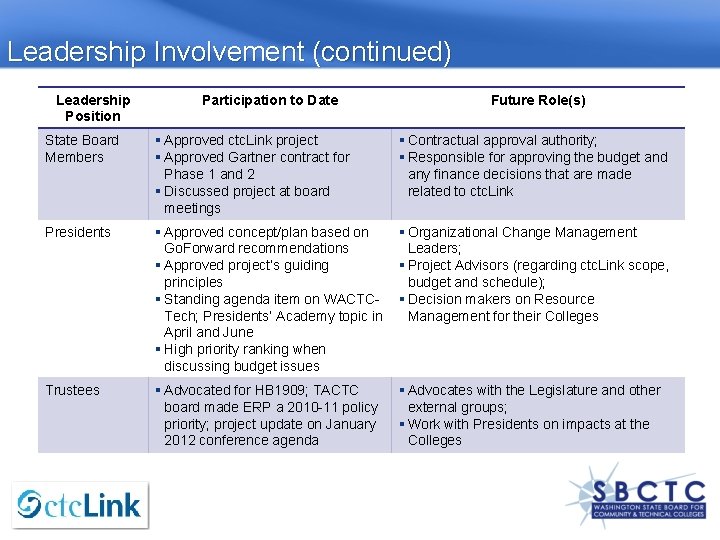
Leadership Involvement (continued) Leadership Position Participation to Date Future Role(s) State Board Members § Approved ctc. Link project § Approved Gartner contract for Phase 1 and 2 § Discussed project at board meetings § Contractual approval authority; § Responsible for approving the budget and any finance decisions that are made related to ctc. Link Presidents § Approved concept/plan based on Go. Forward recommendations § Approved project’s guiding principles § Standing agenda item on WACTCTech; Presidents’ Academy topic in April and June § High priority ranking when discussing budget issues § Organizational Change Management Leaders; § Project Advisors (regarding ctc. Link scope, budget and schedule); § Decision makers on Resource Management for their Colleges Trustees § Advocated for HB 1909; TACTC board made ERP a 2010 -11 policy priority; project update on January 2012 conference agenda § Advocates with the Legislature and other external groups; § Work with Presidents on impacts at the Colleges
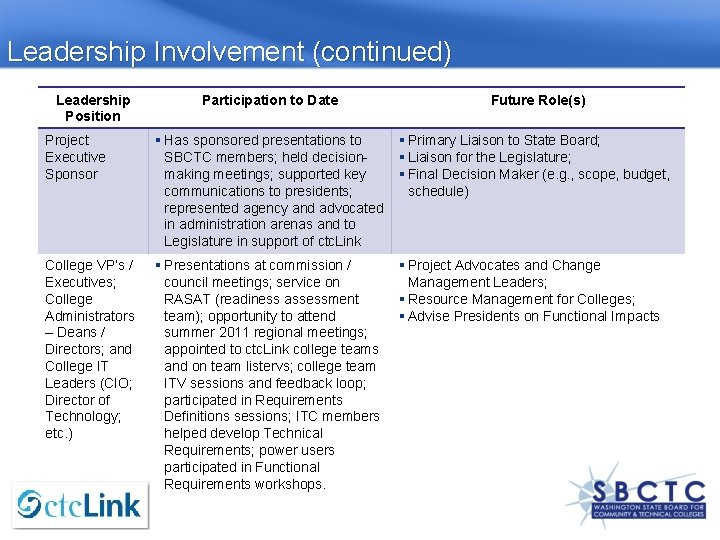
Leadership Involvement (continued) Leadership Position Participation to Date Future Role(s) Project Executive Sponsor § Has sponsored presentations to SBCTC members; held decisionmaking meetings; supported key communications to presidents; represented agency and advocated in administration arenas and to Legislature in support of ctc. Link § Primary Liaison to State Board; § Liaison for the Legislature; § Final Decision Maker (e. g. , scope, budget, schedule) College VP’s / Executives; College Administrators – Deans / Directors; and College IT Leaders (CIO; Director of Technology; etc. ) § Presentations at commission / council meetings; service on RASAT (readiness assessment team); opportunity to attend summer 2011 regional meetings; appointed to ctc. Link college teams and on team listervs; college team ITV sessions and feedback loop; participated in Requirements Definitions sessions; ITC members helped develop Technical Requirements; power users participated in Functional Requirements workshops. § Project Advocates and Change Management Leaders; § Resource Management for Colleges; § Advise Presidents on Functional Impacts
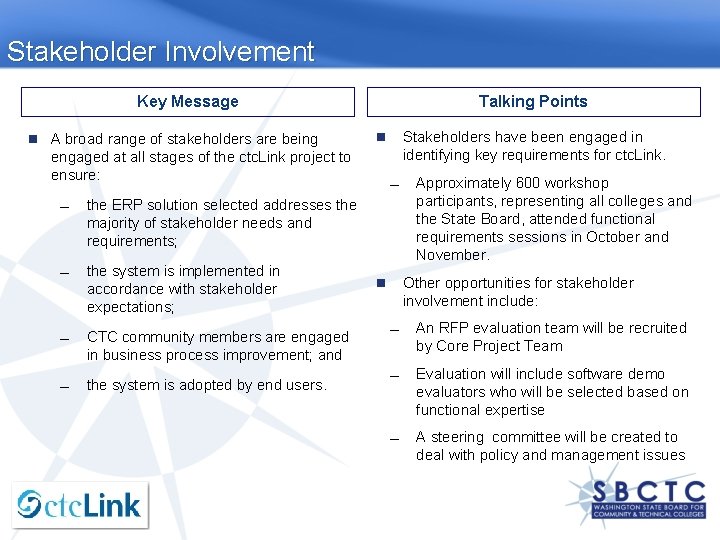
Stakeholder Involvement Key Message A broad range of stakeholders are being Talking Points Stakeholders have been engaged in identifying key requirements for ctc. Link. engaged at all stages of the ctc. Link project to ensure: the ERP solution selected addresses the majority of stakeholder needs and requirements; the system is implemented in accordance with stakeholder expectations; CTC community members are engaged in business process improvement; and the system is adopted by end users. Approximately 600 workshop participants, representing all colleges and the State Board, attended functional requirements sessions in October and November. Other opportunities for stakeholder involvement include: An RFP evaluation team will be recruited by Core Project Team Evaluation will include software demo evaluators who will be selected based on functional expertise A steering committee will be created to deal with policy and management issues
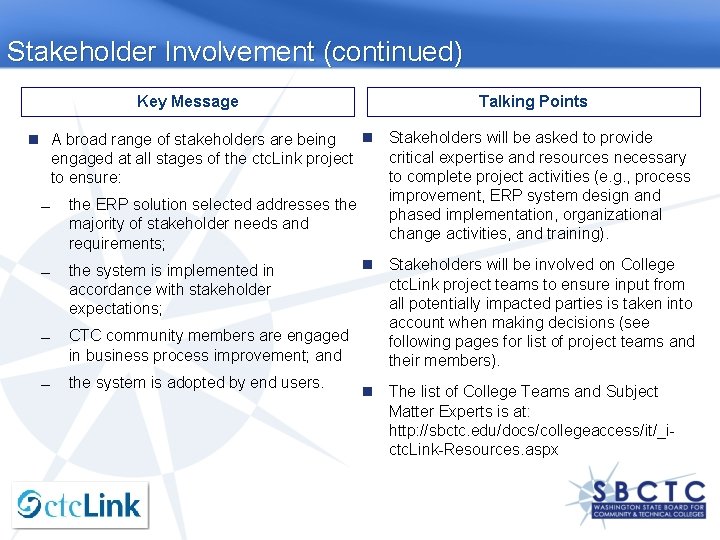
Stakeholder Involvement (continued) Key Message A broad range of stakeholders are being Talking Points Stakeholders will be asked to provide critical expertise and resources necessary to complete project activities (e. g. , process improvement, ERP system design and phased implementation, organizational change activities, and training). Stakeholders will be involved on College ctc. Link project teams to ensure input from all potentially impacted parties is taken into account when making decisions (see following pages for list of project teams and their members). The list of College Teams and Subject Matter Experts is at: http: //sbctc. edu/docs/collegeaccess/it/_ictc. Link-Resources. aspx engaged at all stages of the ctc. Link project to ensure: the ERP solution selected addresses the majority of stakeholder needs and requirements; the system is implemented in accordance with stakeholder expectations; CTC community members are engaged in business process improvement; and the system is adopted by end users.
Cost and Funding Key Message The ctc. Link project is estimated to cost a Talking Points In 2011, the Legislature recognized the value of technology initiatives by establishing the CTC Innovation Account. This account is funded by depositing up to 3 percent of tuition into the account. SBCTC has requested legislative authority to sell up to $50 million in Certificates of Participation for financing over the life of the project, which will be repaid from the Innovation Account. The implementation of this ERP solution has been approved by the SBCTC board and WACTC (CTC Presidents) The funding mechanism for ctc. Link was approved with the adoption of HB 1909 during the 2011 legislative session and is included in the Governor’s proposed 2012 supplemental capital budget. total of $100 million over a six-year implementation timeline. The $100 million equates to about $3 million per college. A significant portion of the total cost will be financed and paid back across 15 years. Ongoing maintenance of the ERP solution is estimated to cost approximately $6 million per year.
Cost and Funding (continued) Key Message The ctc. Link project is estimated to cost a Talking Points Initial cost estimates were prepared by Gartner, Inc. and are documented within the “ERP Program – Preliminary Cost Estimation”. The actual cost of the ERP implementation will be impacted by many factors including availability of internal resources, proposed implementation approach, distribution of responsibilities among project resources, degree of process change that will be required, data quality, training requirements, etc. As a result, a highly reliable estimate will be dependent on the proposals received from the ERP vendors / system integrators in response to the CTCs RFP. total of $100 million over a six-year implementation timeline. The $100 million equates to about $3 million per college. A significant portion of the total cost will be financed and paid back across 15 years. Ongoing maintenance of the ERP solution is estimated to cost approximately $6 million per year.
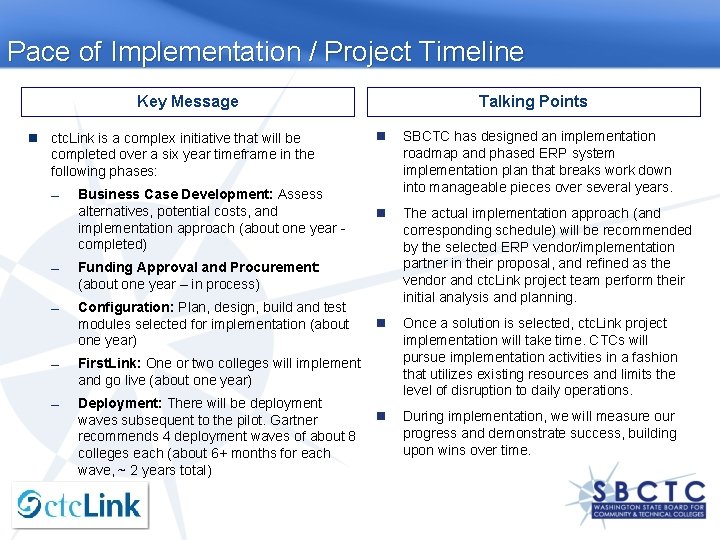
Pace of Implementation / Project Timeline Key Message ctc. Link is a complex initiative that will be Talking Points SBCTC has designed an implementation roadmap and phased ERP system implementation plan that breaks work down into manageable pieces over several years. The actual implementation approach (and corresponding schedule) will be recommended by the selected ERP vendor/implementation partner in their proposal, and refined as the vendor and ctc. Link project team perform their initial analysis and planning. Once a solution is selected, ctc. Link project implementation will take time. CTCs will pursue implementation activities in a fashion that utilizes existing resources and limits the level of disruption to daily operations. During implementation, we will measure our progress and demonstrate success, building upon wins over time. completed over a six year timeframe in the following phases: Business Case Development: Assess alternatives, potential costs, and implementation approach (about one year completed) Funding Approval and Procurement: (about one year – in process) Configuration: Plan, design, build and test modules selected for implementation (about one year) First. Link: One or two colleges will implement and go live (about one year) Deployment: There will be deployment waves subsequent to the pilot. Gartner recommends 4 deployment waves of about 8 colleges each (about 6+ months for each wave, ~ 2 years total)
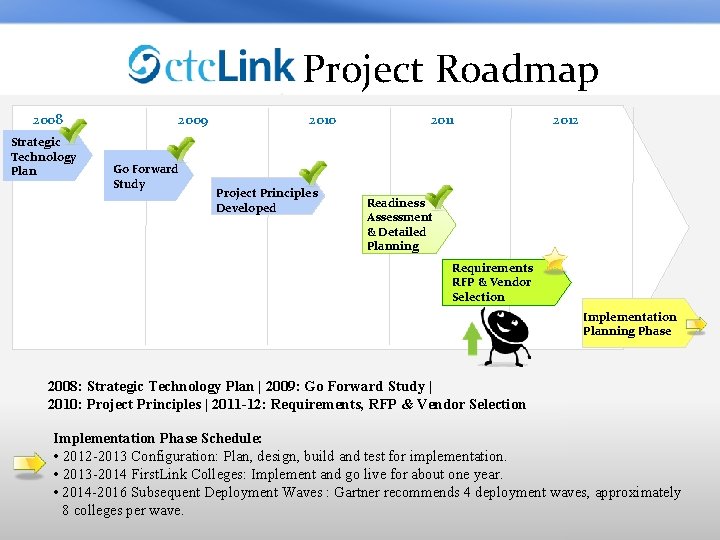
Project Roadmap 2008 Strategic Technology Plan 2009 Go Forward Study 2010 Project Principles Developed 2011 2012 Readiness Assessment & Detailed Planning Requirements RFP & Vendor Selection Implementation Planning Phase 2008: Strategic Technology Plan | 2009: Go Forward Study | 2010: Project Principles | 2011 -12: Requirements, RFP & Vendor Selection Implementation Phase Schedule: • 2012 -2013 Configuration: Plan, design, build and test for implementation. • 2013 -2014 First. Link Colleges: Implement and go live for about one year. • 2014 -2016 Subsequent Deployment Waves : Gartner recommends 4 deployment waves, approximately 8 colleges per wave.
Rationale for Purchasing an Enterprise Resource Planning (ERP) System Key Message CTCs’ existing systems do not adequately Talking Points Washington CTCs' current computer software and associated business processes are more than 30 years old, limiting the 34 colleges’ collective ability to implement additional system-wide efficiencies and support the current and future information needs of students, faculty and staff. ctc. Link will enable the CTC community to: Improve efficiencies by implementing best practices and common, consistent processes address student, faculty and staff business requirements including: Ability to provide one single source for accurate and timely data. Provide access to information from anywhere at anytime. Support efficiency and effectiveness of staff due to standardization of select administrative processes. Provide flexibility to respond to changing business requirements. Fulfill new data requests from other agencies Keep pace with current and future innovations in teaching and learning
Standardization Key Message CTCs will use ctc. Link to achieve standardization of administrative processes in alignment with industry best practices, thereby generating greater efficiencies that benefit the whole community. Talking Points CTCs will procure an ERP solution that can be configured to meet the majority of CTCs’ specific needs. Colleges will be required to work together to develop common administrative processes that will benefit student, faculty and staff collaboration and effectiveness. College unique needs will be met through configuration of the solution, not customization. As a result, CTCs will be able to take advantage of industry best practices and effectively manage system maintenance and upgrades made available through the software vendor. Customization (i. e. , change system code) will be conducted to address no more than 5% of required functionality, using clear business cases to justify the need for customization, ensuring the investment generates greater benefits.
Impact on the CTC Community Key Message ctc. Link will allow the CTC community to Talking Points Students, faculty and staff will have 24/7 access to a full range of online, self-service tools, including: streamline business processes, improve the quality of data, and provide students, faculty and staff with up to date technology tools improving the efficiency and effectiveness of administrative processes. Students will have single electronic record with one ID number, available to all 34 colleges Future students will have one admission application process regardless of where or when they decide to attend New and returning students will have a single financial aid application process Students will be able to monitor their ‘time to degree’ and advisors can audit the process Students will have access to a centralized catalog of courses Faculty and staff will have a single electronic record with one ID number Colleges will be able to consolidate purchasing and payroll processing CTCs will fundamentally change their business practices as related to management and use of data and information
Why Now Key Message CTCs must start now to effectively address Talking Points Current computer software and associated business processes are more than 30 years old, limiting the 34 colleges’ collective ability to implement additional system-wide efficiencies and support the current and future information needs of students, faculty and staff. The current system is a patchwork of some state-provided and some locallydeveloped processes that are uneven, sometimes incompatible with one another, and increasingly labor-intensive to maintain. ctc. Link will provided tools for business process transformation, resulting in a dramatic increase in effectiveness and efficiency. the current system and business improvement requirements identified by leadership since: The most recent upgrade of system infrastructure only provides a temporary solution Students, faculty and staff require additional administrative functionality not available through existing systems CTCs must address efficiency and effectiveness issues requiring staff to do more with less as the economic conditions have changed
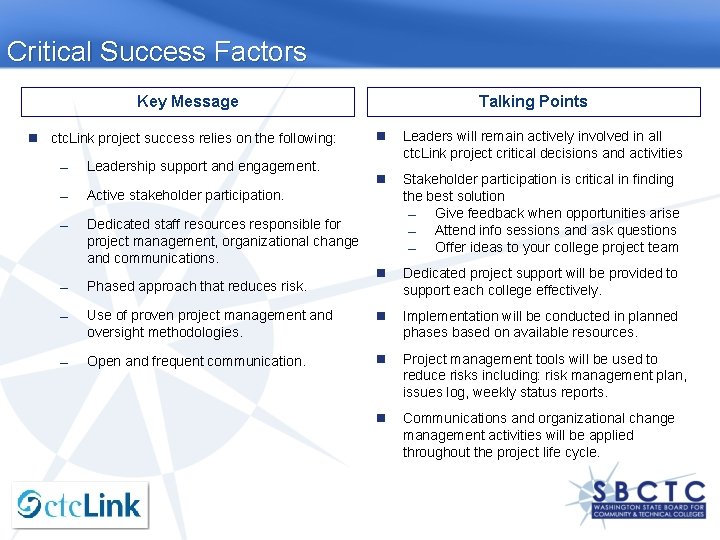
Critical Success Factors Key Message ctc. Link project success relies on the following: Talking Points Leaders will remain actively involved in all ctc. Link project critical decisions and activities Stakeholder participation is critical in finding the best solution Give feedback when opportunities arise Attend info sessions and ask questions Offer ideas to your college project team Dedicated project support will be provided to support each college effectively. Leadership support and engagement. Active stakeholder participation. Dedicated staff resources responsible for project management, organizational change and communications. Phased approach that reduces risk. Use of proven project management and oversight methodologies. Implementation will be conducted in planned phases based on available resources. Open and frequent communication. Project management tools will be used to reduce risks including: risk management plan, issues log, weekly status reports. Communications and organizational change management activities will be applied throughout the project life cycle.
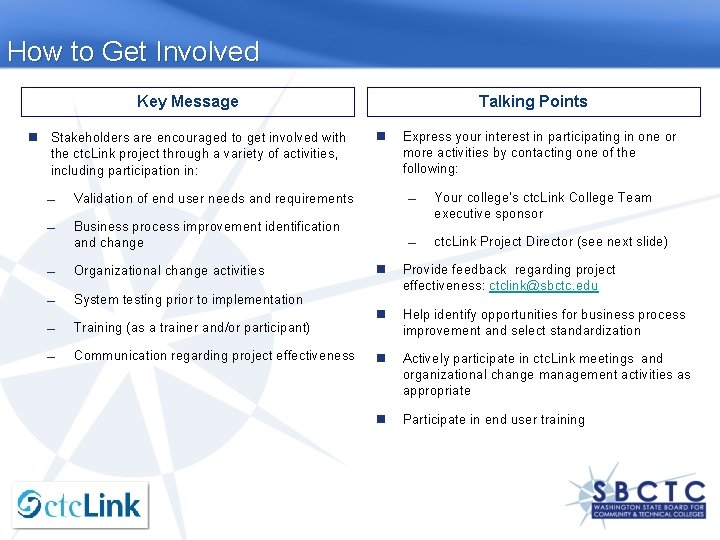
How to Get Involved Key Message Stakeholders are encouraged to get involved with the ctc. Link project through a variety of activities, including participation in: Talking Points Express your interest in participating in one or more activities by contacting one of the following: Validation of end user needs and requirements Business process improvement identification and change Your college’s ctc. Link College Team executive sponsor ctc. Link Project Director (see next slide) Organizational change activities System testing prior to implementation Training (as a trainer and/or participant) Communication regarding project effectiveness Provide feedback regarding project effectiveness: ctclink@sbctc. edu Help identify opportunities for business process improvement and select standardization Actively participate in ctc. Link meetings and organizational change management activities as appropriate Participate in end user training
Key Contacts Janelle Runyon ctc. Link Communications Lead 360. 704. 1014 jrunyon@sbctc. edu Barbara Martin ctc. Link Project Director 425. 803. 9729 bmartin@sbctc. edu