
Key Issues Where are states distributed Why are
Key Issues • • Where are states distributed? Why are nation-states difficult to create? Why do boundaries cause problems? Why do states cooperate and compete with each other? © 2014 Pearson Education, Inc.
Learning Outcomes • 8. 1. 1: Explain the three eras of rapid growth in UN membership. • 8. 1. 2: Explain why it is difficult to determine if some territories are states. • 8. 1. 3: Explain the concept of a nation-state and how it differs from earlier ways to govern. • 8. 2. 1: Understand the difference between a nation-state and a multinational state. © 2014 Pearson Education, Inc.
Learning Outcomes • 8. 2. 2: Describe differences among states formerly in the Soviet Union. • 8. 2. 3: Describe patterns of distribution of ethnicities in Russia and the Caucasus. • 8. 2. 4: Explain the concept of colonies and describe their current distribution. • 8. 3. 1: Describe the types of physical boundaries between states. • 8. 3. 2: Describe the types of cultural boundaries between states. © 2014 Pearson Education, Inc.
Learning Outcomes • 8. 3. 3: Describe fives shapes of states. • 8. 3. 4: Describe differences among the three regime types. • 8. 3. 5: Explain the concept of gerrymandering and three ways that it is done. • 8. 4. 1: Describe the principal alliances in Europe during the Cold War era. • 8. 4. 2: Describe the principal economic alliances in Europe in the period since World War II. © 2014 Pearson Education, Inc.
Learning Outcomes • 8. 4. 3: Explain the concept of terrorism. • 8. 4. 4: Describe ways that states have sponsored terrorism. © 2014 Pearson Education, Inc.
Where Are States Distributed? • A state is an area organized into a political unit and ruled by an established government that has control over its internal and foreign affairs. – Occupies defined territory – Permanent population • A state has sovereignty, which means independence from control of its internal affairs by other states. © 2014 Pearson Education, Inc.
Where Are States Distributed? • The United Nations – Created at end of World War II to serve the role of a facilitator for discussions regarding international problems. – At times, UN has intervened in conflicts between or within member states. – UN Membership increased rapidly on three occasions. 1. 1955: 16 mostly European countries joined as a result of the Nazi Germany breakup. 2. 1960: 17 mostly former African colonies joined. 3. 1990 -1993: 26 countries joined as a result of Soviet Union and Yugoslavia breakup. © 2014 Pearson Education, Inc.
Where Are States Distributed? • Challenges in Defining States – Disagreement exists about actual number of sovereign states as a result of historical disputes involving more than one claim to a territory. • China – Most other countries consider China (People’s Republic of China) and Taiwan (Republic of China) as separate and sovereign states. – China’s government considers Taiwan part of China. • Western Sahara (Sahrawi Republic) – Most African countries consider Western Sahara a sovereign state. – Morocco claims the territory. » Built a 2, 700 km. (1, 700 mi) wall around it to keep rebels out. © 2014 Pearson Education, Inc.
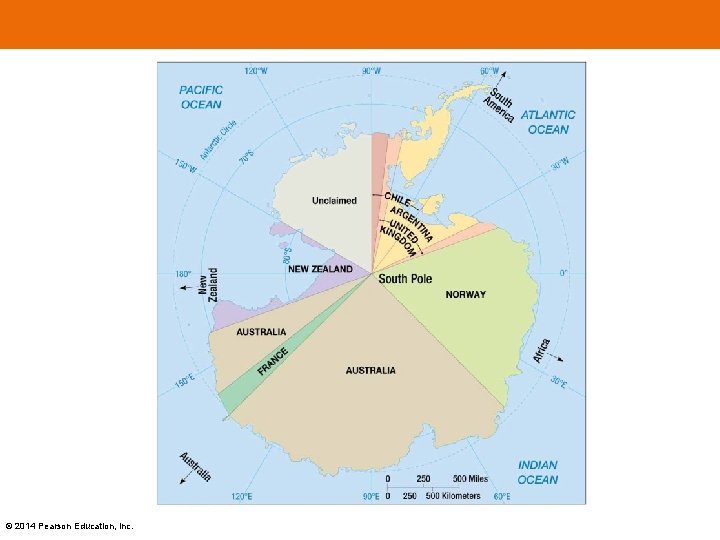
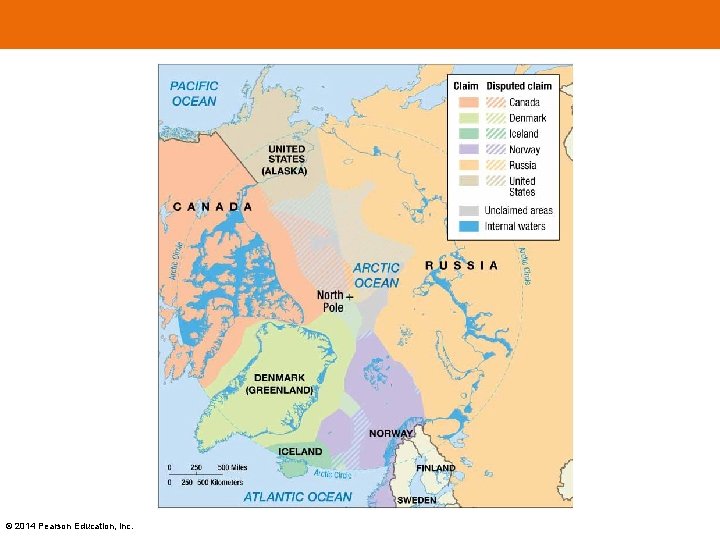
Where Are States Distributed? • Challenges in Defining States • Polar Regions: Many Claims – Several states claim portion of the South Pole region » Argentina, Australia, Chile, France, New Zealand, Norway, and the U. K. – Some claims in the South Pole region are overlapping and conflicting » Argentina, Chile, and the U. K. – U. S. , Russia, and many other states do not recognize claims to Antarctica. – 1982 United Nations Convention on the Law of the Sea permitted countries to submit claims inside the Arctic Circle by 2009. © 2014 Pearson Education, Inc.
© 2014 Pearson Education, Inc.
© 2014 Pearson Education, Inc.
Where Are States Distributed? • Development of the State Concept – Development of states traced to the Fertile Crescent. – Evolution of States • First states were known as city-states, which are sovereign states that are comprised of towns and their surrounding countryside. – Walls delineated boundaries. – Area immediately outside walls controlled by city to produce food for urban residents. • Medieval States – Gained military dominance of individual city-states led to the formation of empires. e. g. Roman Empire – Roman Empire collapse in 5 th century led to its land being parceled up and controlled by various monarchies. © 2014 Pearson Education, Inc.
Where Are States Distributed? • Development of the State Concept • Nation-States in Europe – A nation-state is a state this territory corresponds to that occupied by a particular ethnicity. » The concept that ethnicities have the right to govern themselves is known as self-determination. – After WWI, leaders of the victorious countries met at the Versailles Peace Conference to redraw the map of Europe. » Language most important criterion to create new European states and to adjust existing boundaries. » Nation-states created by Versailles conference lasted through most of 20 th century with little adjustment. © 2014 Pearson Education, Inc.
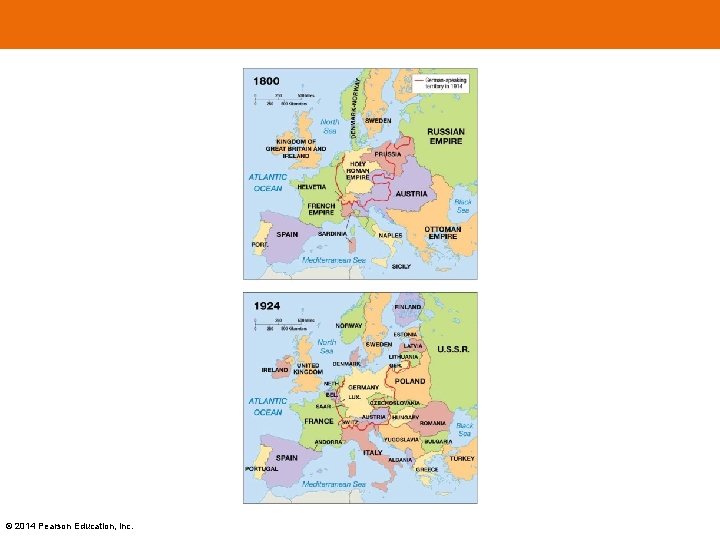
© 2014 Pearson Education, Inc.

Why Are Nation-states Difficult to Create? • Nation-states and Multinational States – A state that contains more than one ethnicity is a multi-ethnic state. • Multitude of ethnicities in some cases all contribute cultural features to the formation of a single nationality. e. g. United States of America – A multinational state is a country that contains more than one ethnicity with traditions of selfdetermination. e. g. Russia © 2014 Pearson Education, Inc.
Why Are Nation-states Difficult to Create? • Nation-states and Multinational States – Nation-States in Europe • Denmark – 90% of population are ethnic Danes – Nearly all Danes speak Danish » Nearly all world’s Danish speakers live in Denmark • Slovenia – 83% of population are ethnic Slovenes – Nearly all of the world’s Slovenes live in Slovenia © 2014 Pearson Education, Inc.
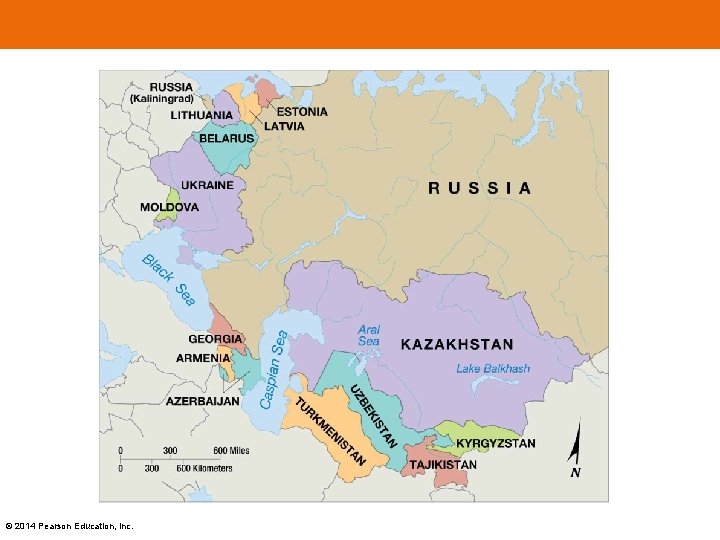
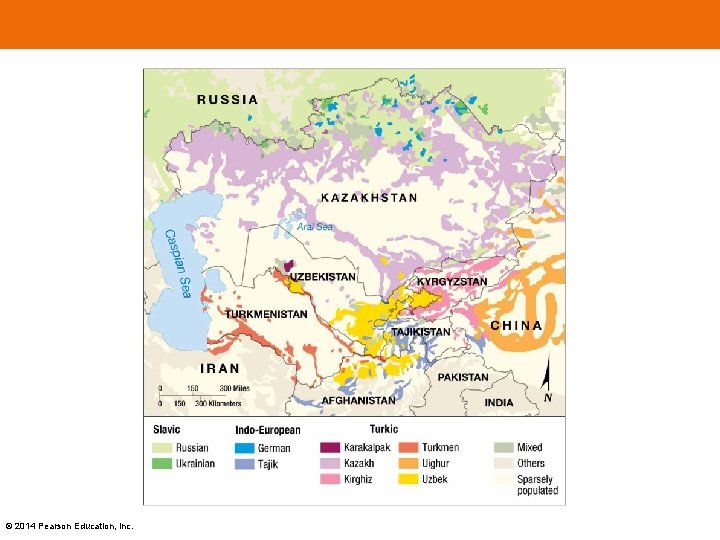
Why Are Nation-states Difficult to Create? • Independent Nation-States in Former Soviet Republics – Former Soviet Union consisted of 15 republics based on its 15 largest ethnicities. – 15 republics became 15 independent states consisting of five groups. © 2014 Pearson Education, Inc.
© 2014 Pearson Education, Inc.
Why Are Nation-states Difficult to Create? • Independent Nation-States in Former Soviet Republics • Three Baltic States – Estonia » Mostly Protestant (Lutheran) » Speak a Uralic language related to Finnish – Latvia » Mostly Protestant (Lutheran) » Speak a language of the Baltic group – Lithuania » Mostly Roman Catholic » Speak a language of the Baltic group within the Balto-Slavic branch of the Indo-European language family © 2014 Pearson Education, Inc.
Why Are Nation-states Difficult to Create? • Independent Nation-States in Former Soviet Republics • Three European States 1. 2. 3. – – Belarus Ukraine Moldova Three states speak similar East Slavic languages All are predominantly Orthodox Christians. » Some western Ukrainians are Roman Catholics • Five Central Asian States – © 2014 Pearson Education, Inc. Turkmenistan and Uzbekistan » Predominantly Muslims » Speak an Altaic language
Why Are Nation-states Difficult to Create? • Independent Nation-States in Former Soviet Republics • Five Central Asian States cont’d – Kyrgyzstan » Predominantly Muslims » Speak an Altaic language – Kazakhstan » Predominantly Muslims » Speak an Altaic language – Tajikistan » Predominantly Muslims » Speak a language in the Indic group of the Indo. Iranian branch of Indo-European language family. © 2014 Pearson Education, Inc.
© 2014 Pearson Education, Inc.
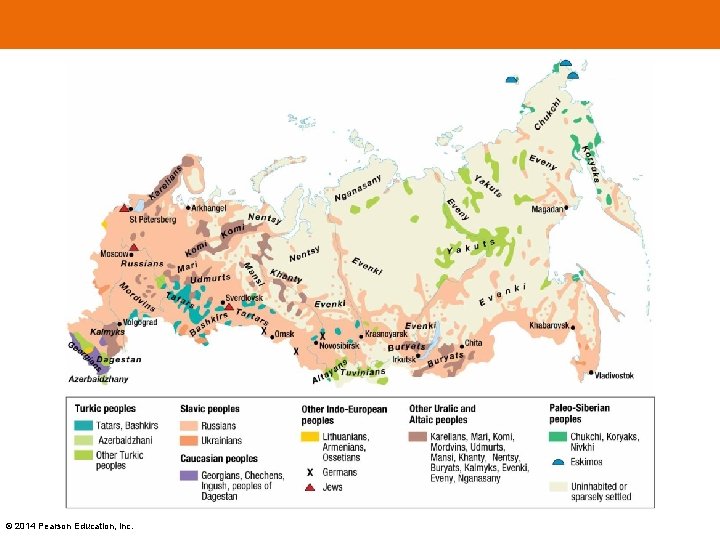
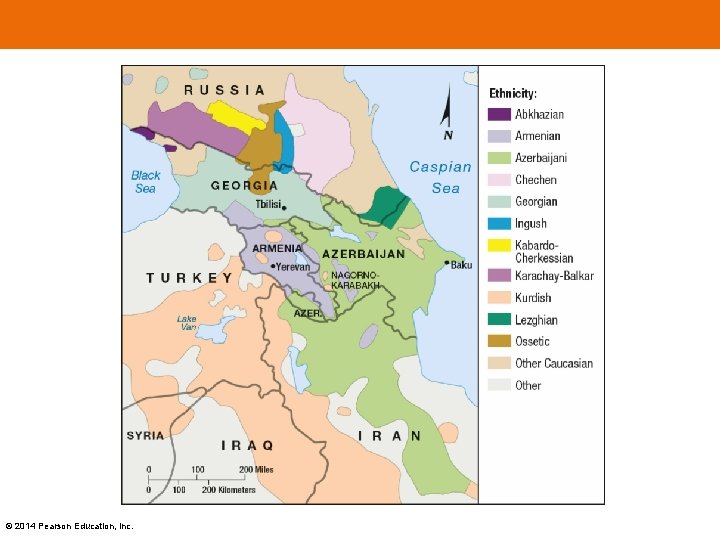
Why Are Nation-states Difficult to Create? • The Largest Multinational State: Russia – Russia’s 39 ethnicities are clustered in two principal locations. 1. Along borders with neighboring states – Buryats and Tuvinian near Mongolia – Chechens, Dagestani, Kabardins, and Ossetians near the Azerbaijan and Georgia 2. Clustered in the center of Russia, especially between the Volga River basin and the Ural Mountains. – Most numerous ethnicities include Bashkirs, Chuvash, and Tatars. © 2014 Pearson Education, Inc.
© 2014 Pearson Education, Inc.
Why Are Nation-states Difficult to Create? • The Largest Multinational State: Russia – Turmoil in the Caucasus • Caucasus region is situated between the Black and Caspian seas. – Home to several ethnicities including Azeris, Armenians, and Georgians. – With the breakup of the region into independent countries, long-simmering conflicts among ethnicities have erupted into armed conflicts. © 2014 Pearson Education, Inc.
© 2014 Pearson Education, Inc.
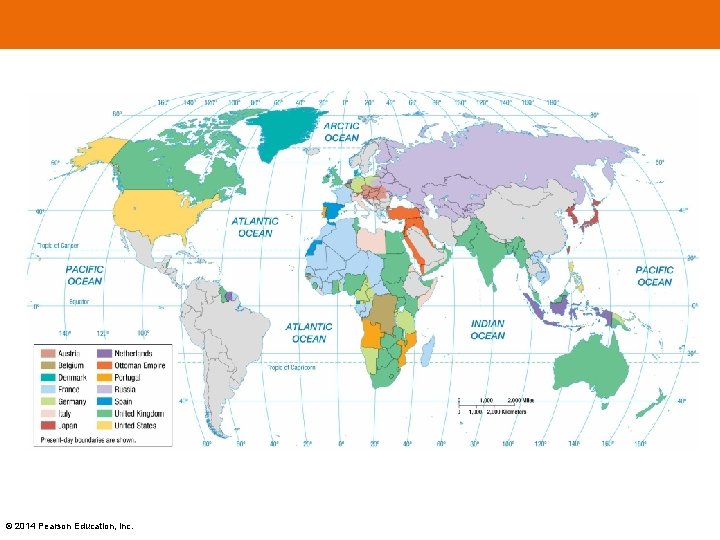
Why Are Nation-states Difficult to Create? • Colonies – Colonialism • A colony is a territory that is legally tied to a sovereign state rather than being completely independent. – Sovereign state may run only its military and foreign policy. – Sovereign state may also control its internal affairs. • European states came to control much of the world through colonialism, an effort by one country to establish settlement in a territory and to impose its political, economic, ad cultural principles on that territory. © 2014 Pearson Education, Inc.
© 2014 Pearson Education, Inc.
Why Are Nation-states Difficult to Create? • Colonies – The Remaining Colonies • U. S. Department of State lists 68 places in the world that it calls dependencies and areas of special sovereignty. – 43 indigenous populations – 25 with no permanent population – Most current colonies are islands in the Pacific Ocean and Caribbean Sea. » Ex. Puerto Rico, a commonwealth of the U. S. , is home to 4 million residents who are U. S. citizens, but they do not participate in U. S. election or have a voting member of Congress. © 2014 Pearson Education, Inc.
- Slides: 29