
Key issues when measuring and valuing health a



- Slides: 18
Key issues when measuring and valuing health: a European and North American perspective Professor Simon Dixon, School of Health and Related Research (Sc. HARR), University of Sheffield
2 Issues • Current UK practice and areas of concern • Key differences seen in mainland Europe • Key differences seen in North America • Conclusions • Other issues to consider… 13/06/2021 © The University of Sheffield
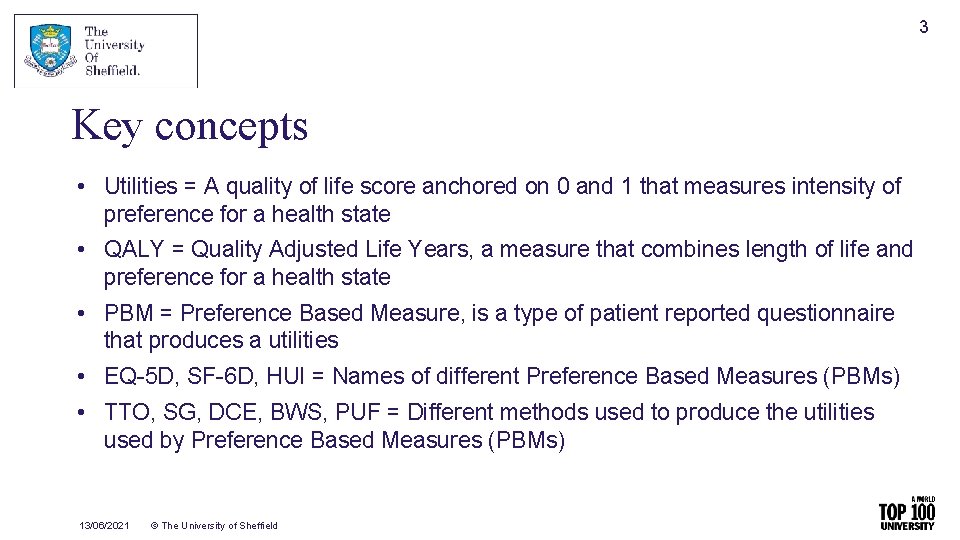
3 Key concepts • Utilities = A quality of life score anchored on 0 and 1 that measures intensity of preference for a health state • QALY = Quality Adjusted Life Years, a measure that combines length of life and preference for a health state • PBM = Preference Based Measure, is a type of patient reported questionnaire that produces a utilities • EQ-5 D, SF-6 D, HUI = Names of different Preference Based Measures (PBMs) • TTO, SG, DCE, BWS, PUF = Different methods used to produce the utilities used by Preference Based Measures (PBMs) 13/06/2021 © The University of Sheffield
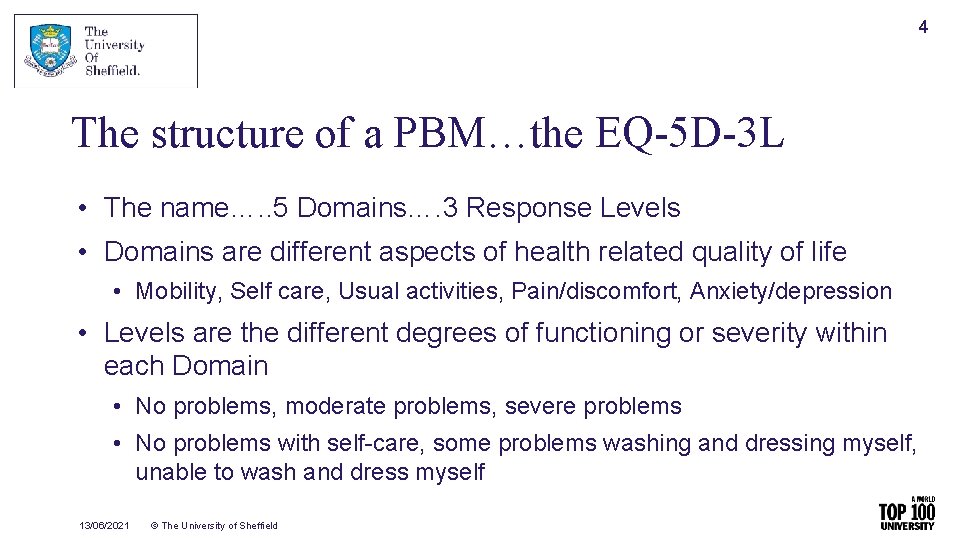
4 The structure of a PBM…the EQ-5 D-3 L • The name…. . 5 Domains…. 3 Response Levels • Domains are different aspects of health related quality of life • Mobility, Self care, Usual activities, Pain/discomfort, Anxiety/depression • Levels are the different degrees of functioning or severity within each Domain • No problems, moderate problems, severe problems • No problems with self-care, some problems washing and dressing myself, unable to wash and dress myself 13/06/2021 © The University of Sheffield
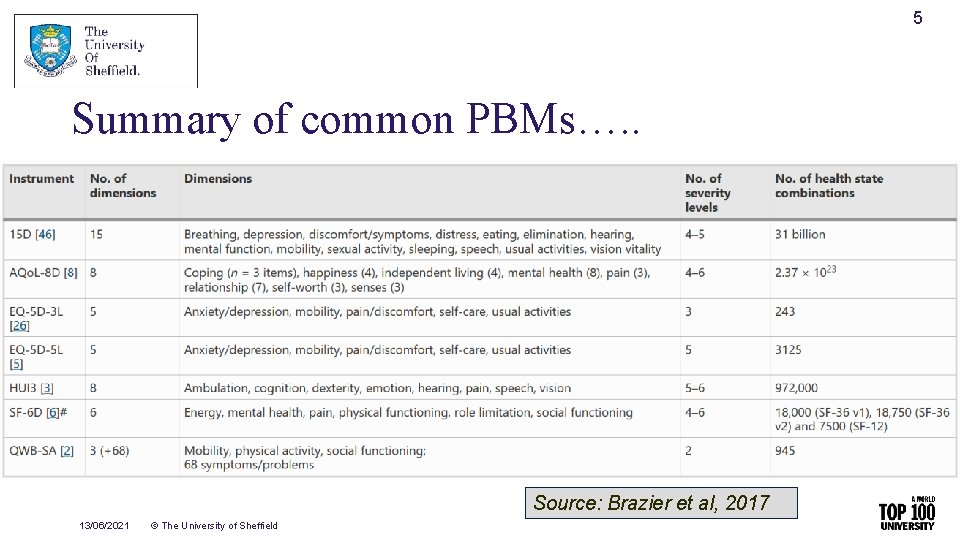
5 Summary of common PBMs…. . Source: Brazier et al, 2017 13/06/2021 © The University of Sheffield
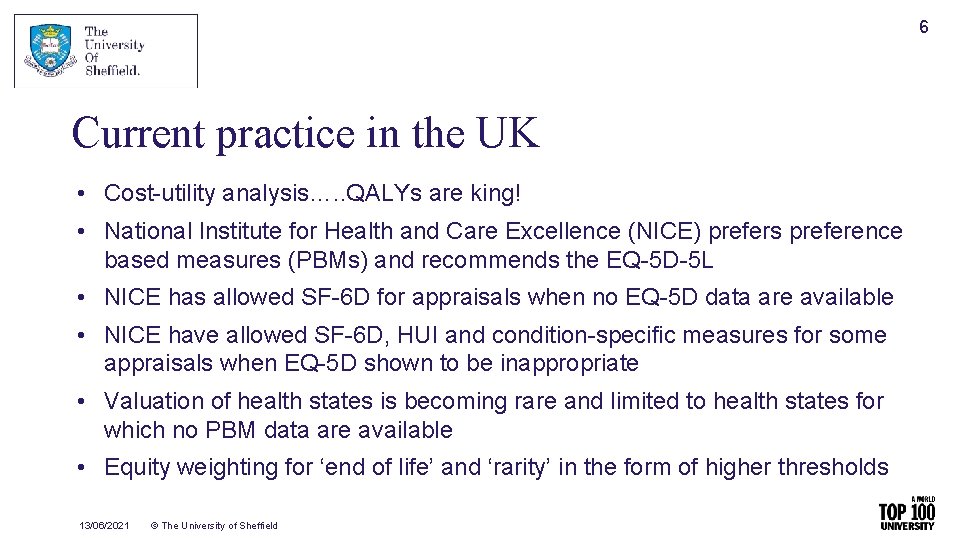
6 Current practice in the UK • Cost-utility analysis…. . QALYs are king! • National Institute for Health and Care Excellence (NICE) prefers preference based measures (PBMs) and recommends the EQ-5 D-5 L • NICE has allowed SF-6 D for appraisals when no EQ-5 D data are available • NICE have allowed SF-6 D, HUI and condition-specific measures for some appraisals when EQ-5 D shown to be inappropriate • Valuation of health states is becoming rare and limited to health states for which no PBM data are available • Equity weighting for ‘end of life’ and ‘rarity’ in the form of higher thresholds 13/06/2021 © The University of Sheffield
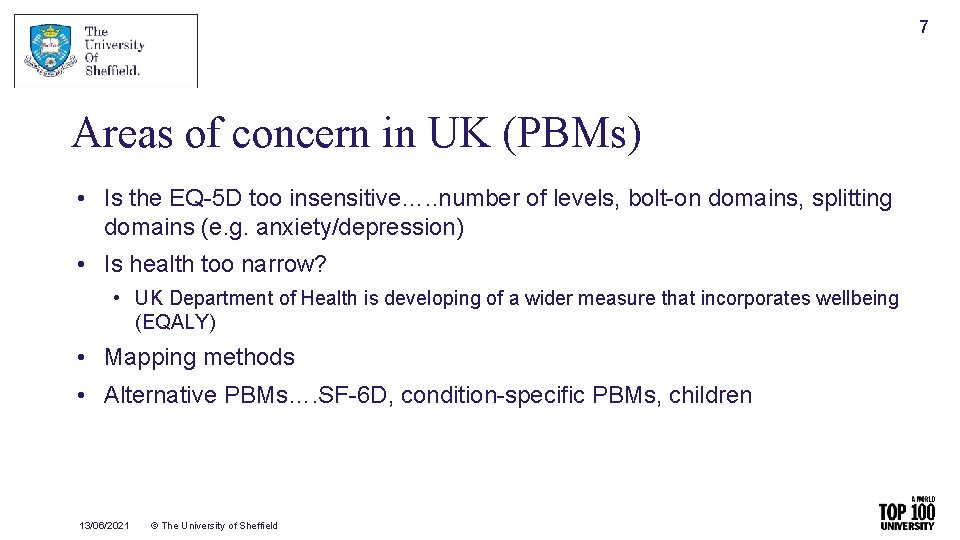
7 Areas of concern in UK (PBMs) • Is the EQ-5 D too insensitive…. . number of levels, bolt-on domains, splitting domains (e. g. anxiety/depression) • Is health too narrow? • UK Department of Health is developing of a wider measure that incorporates wellbeing (EQALY) • Mapping methods • Alternative PBMs…. SF-6 D, condition-specific PBMs, children 13/06/2021 © The University of Sheffield
8 Areas of concern in UK (other issues) • Valuation methodology…TTO, SG, LT-TTO, DCE, BWS, DCE-TTO, PUF • Tariff estimation…Bayesian, frequentist, personal utility functions (PUF) • Valuation of health states…how are health state descriptions developed? • Use of utilities within decision analytic models…adjustment for comorbidities/side-effects, adjustment for age, choice of distributions for PSA • Non-patient utilities…parents, partners • Non-QALY utility measures, using DCE, used only once by NICE in 20 years. WTP never used 13/06/2021 © The University of Sheffield
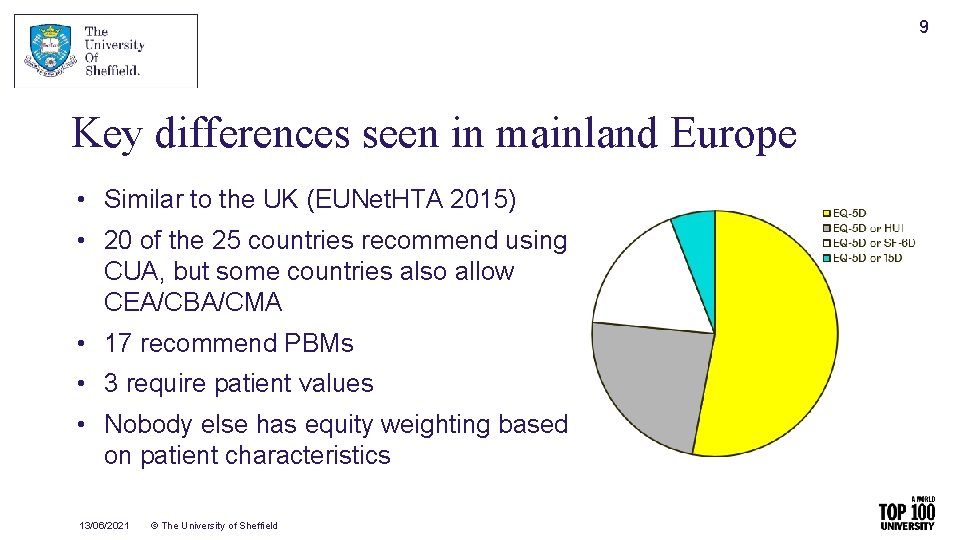
9 Key differences seen in mainland Europe • Similar to the UK (EUNet. HTA 2015) • 20 of the 25 countries recommend using CUA, but some countries also allow CEA/CBA/CMA • 17 recommend PBMs • 3 require patient values • Nobody else has equity weighting based on patient characteristics 13/06/2021 © The University of Sheffield
10 Euro. Qo. L Group’s ongoing research • Valuation studies for the EQ-5 D-5 L in different countries • Methodological work in support of the EQ-5 D-Y • Valuation methods…. elicitation techniques • Comparisons between instruments and countries • Descriptive systems…bolt-on dimensions, ‘beyond health’ • In 2018 -2019 Euro. Qo. L Group awarded 2, 695, 961 euros in research funding across 77 studies 13/06/2021 © The University of Sheffield
11 Key differences seen in North America (1) • Canada has a similar position to Europe, with its own EQ-5 D-5 L tariff and explicit use of CUA in reimbursement decisions • Weightings for innovation and burden are to be introduced in 2021 using different thresholds • Two main sets of guidelines in the US are Institute for Clinical and Economic Review (ICER) and the Academy of Managed Care Pharmacy (AMCP) • Both use CUA but do not give a preferred method • ICER mentions EQ-5 D, AMCP lists EQ-5 D, HUI, SF-6 D and QWB 13/06/2021
12 Key differences seen in North America (2) • United States is more fragmented due to multiple purchasers competing for customers…ICER and AMCP not very influential • ISPOR has identified 25 different value frameworks, most not including QALYs and many not including costs • After attacks on the QALY, ICER amended its framework: • “To provide additional context to the cost per QALY estimates, ICER reports include analyses of cost per ev. LYG, cost per life-year gained, and cost per some conditionspecific consequence as a core part of every report” • Value frameworks have led to increased interest in condition-specific patient reported outcomes (non-preference based) 13/06/2021 © The University of Sheffield
13 Key differences seen in North America (3) • An exception to this overall picture in the UK is the Patient-Reported Outcomes Measurement Information System®(PROMIS) • A set of 300 measures of physical, mental, and social health for use with the general population, with 30 sub-domains…clinical and patient focus • From that, the PROMIS-29 has been developed • 7 domains, physical functioning, anxiety, depression, fatigue, sleep disturbance, social functioning, and pain • Valuation study has been undertaken (Craig et al, 2014) • 28 citations in Pub. Med…. . how many CEAs? 13/06/2021 © The University of Sheffield
14 Conclusions • The EQ-5 D, HUI and SF-6 D will remain dominant and so getting the best tariff for these remains a high priority • But, are we measuring the right thing? This depends on the objectives of the purchaser and the preferences of the consumer • The purchaser defines the broad policy goals…. is the purpose of the health service to generate ‘health’ or ‘wellbeing’? • The consumer identifies the importance of the individual components of the policy goals…is sleep an important part of health? • The United States appears to be looking for alternatives to QALYs, whilst Europe and Canada are looking to improve QALYs 13/06/2021 © The University of Sheffield
15 Other issues to consider… • New measures are not an instant solution • Lag before data becomes widely available…. evidence base needs to be developed (35 yrs), before drug companies will use them in trials, then you have to wait for the results (3 -5 yrs) • Need for mapping in the short/medium term…mapping is till used frequently within NICE appraisals, 20 years after the EQ-5 D was developed • Continued need for health state valuation in some circumstances • Should QALYs be equity weighted? • Changing utility measurement, changes the QALYs generated by new and displaced interventions…. the cost-effectiveness threshold changes, too 13/06/2021 © The University of Sheffield
16 References • EUNet. HTA (2015) Methods for health economic evaluations - A guideline based on current practices in Europe. • AMCP (2016) Format for Formulary Submissions v 4. 0. • ICER (2020) 2020 -2023 Value Assessment Framework. • Brazier J, Ara R, Rowen D, Chevrou-Severac H. A review of generic preference-based measures. Pharmacoecon. doi: 10. 1007/s 40273 -017 -0545 x. • Craig B, et al (2014) US Valuation of Health Outcomes Measured Using the PROMIS-29. Value Health; 17(8): 846– 853. 13/06/2021 © The University of Sheffield
17 Further reading • Ara R, Rowen D, Mukuria C. The use of mapping to estimate health state utility values. Pharmacoecon. doi: 10. 1007/s 40273 -017 -0548 -7. • Ara R, Brazier J, Azzabi Zouraq I. The use of health state utility values in decision models. Pharmacoecon. doi: 10. 1007/s 40273 -017 -0550 -0. • Ara R, Brazier J. Estimating health state utility values for comorbidities. Pharmacoecon. doi: 10. 1007/s 40273 -017 -0551 -z. • Brazier J, Ara R, Rowen D, Chevrou-Severac H. A review of generic preference-based measures. Pharmacoecon. doi: 10. 1007/s 40273 -017 -0545 x. 13/06/2021 © The University of Sheffield
To Discover And Understand.