
Key Issues Factors important in project selection decisions



- Slides: 39
Key Issues • Factors important in project selection decisions • Project selection methods • Methods of project evaluation • Value analysis • Multiple objective analysis • Optimization models with budget constraints
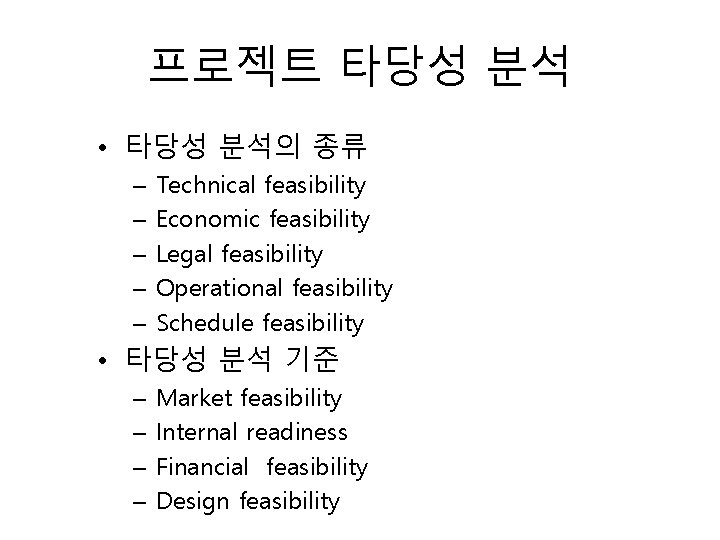
프로젝트 타당성 분석 • 타당성 분석의 종류 – – – Technical feasibility Economic feasibility Legal feasibility Operational feasibility Schedule feasibility • 타당성 분석 기준 – – Market feasibility Internal readiness Financial feasibility Design feasibility
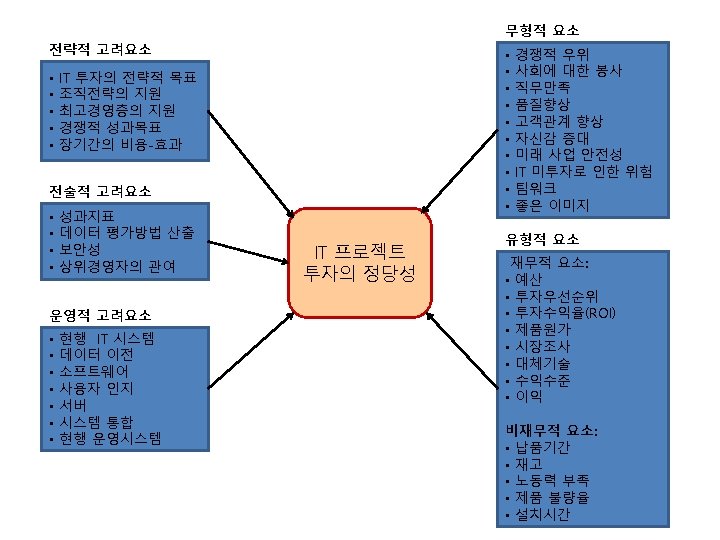
프로젝트 선정 • The project process begins with a project proposal • Initial selection of projects – by a case-by case basis – by periodic selection by committees • Analysis methods support project selection process – Provide decision makers with analysis of expected outcomes – Provide basis for communication
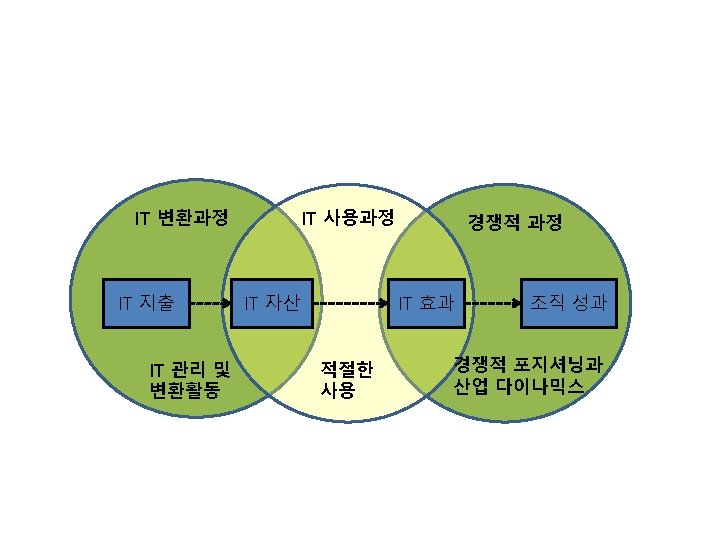
Measurement of Project Effect • IS projects involve benefits that are difficult to measure in terms of concrete monetary benefits • The reasons are • by Hinton & Kaye – Cost and benefit intangibility – Hidden outcomes involved in IT investment – Changing nature of IT systems
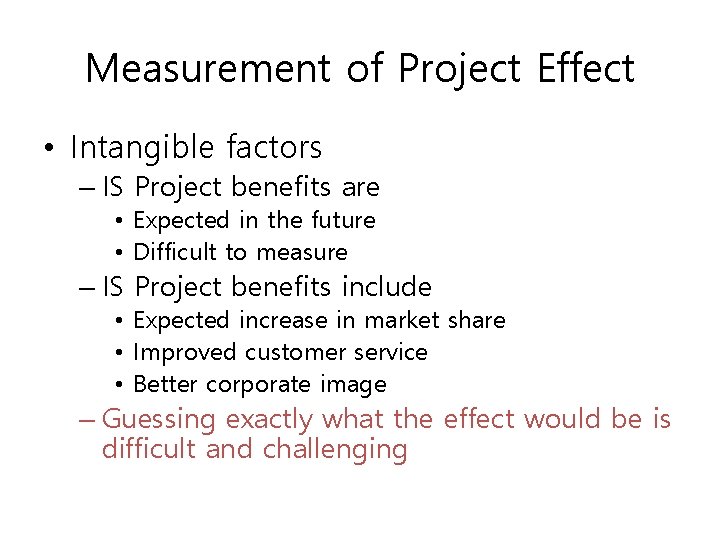
Measurement of Project Effect • Intangible factors – IS Project benefits are • Expected in the future • Difficult to measure – IS Project benefits include • Expected increase in market share • Improved customer service • Better corporate image – Guessing exactly what the effect would be is difficult and challenging
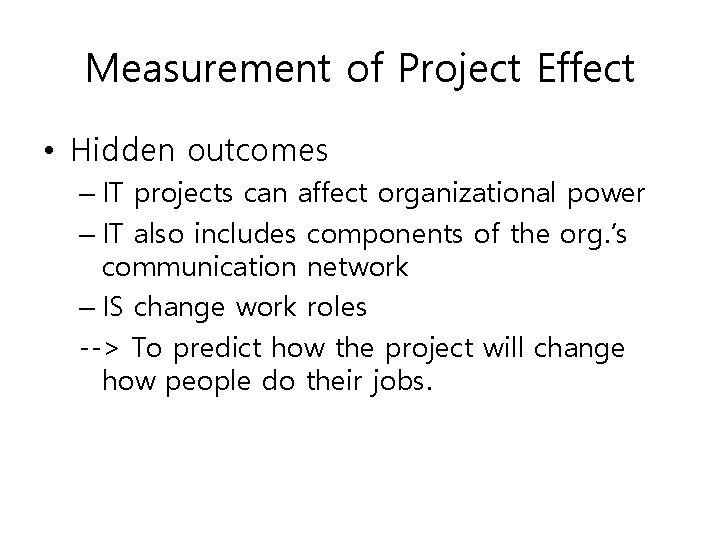
Measurement of Project Effect • Hidden outcomes – IT projects can affect organizational power – IT also includes components of the org. ’s communication network – IS change work roles --> To predict how the project will change how people do their jobs.
Measurement of Project Effect • The changing nature of IT – IT is highly dynamic – Some IS projects take years to implement • After installation, it may be outdated by newer technology – Maximum IS project is 9 month • by Mc. Leod & Smith
Selection Practice • What is the best way to evaluate IS project • IS project expenditure must be treated as capital investment – Usually, a capital investment involves cost/benefit analysis (ex. Operations, IT) – Revenue-related does not require C/B analysis (ex. Marketing, Training)
Selection Practice • IT project treated as a capital investment • Financial techniques – Payback – Discounted cash flow – Cost/benefit analysis • Most decision makers treat IT investment more like operations project – with measurable profitability requirement – or tangible benefits. • Operations investments focus on efficiency-related measures • Marketing investments are usually viewed as revenue.
Selection Practice • Factors affect project time – Project manager ability – Experience with • similar type of application • Programming environment • Language or system used – – – Familiarity with modern programming practices Availability of critical equipment, S/W, and program language completeness of project team Personnel turnover Project team size Relative control of project manager over project team
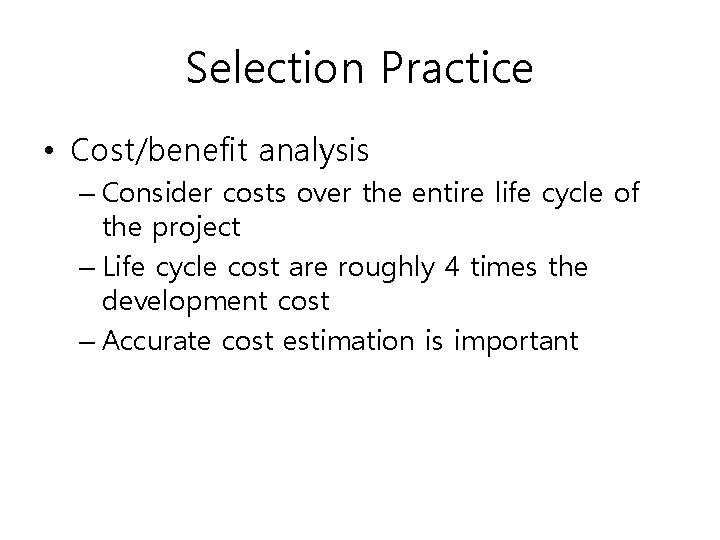
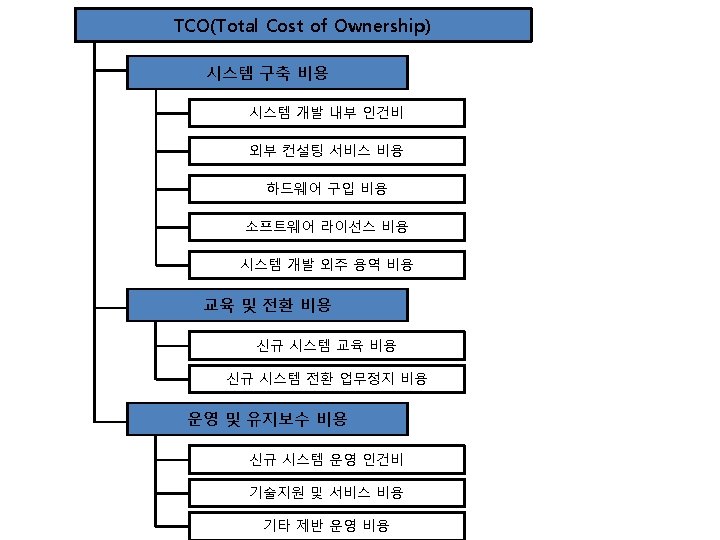
Selection Practice • Cost/benefit analysis – Consider costs over the entire life cycle of the project – Life cycle cost are roughly 4 times the development cost – Accurate cost estimation is important
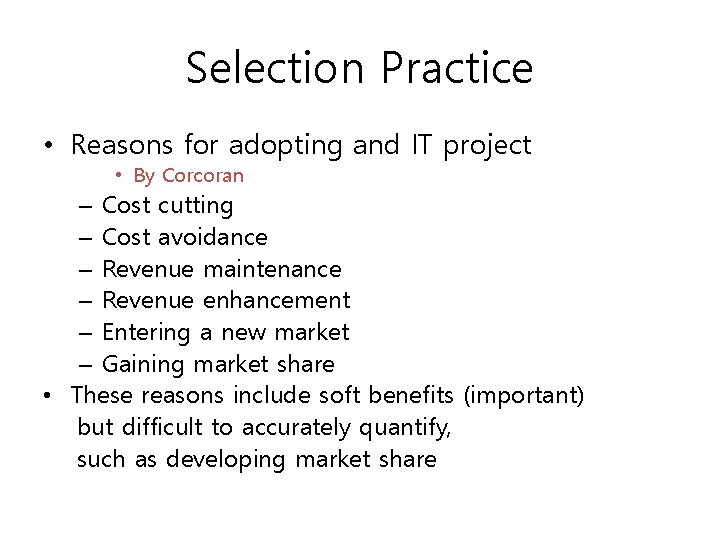
Selection Practice • Reasons for adopting and IT project • By Corcoran – Cost cutting – Cost avoidance – Revenue maintenance – Revenue enhancement – Entering a new market – Gaining market share • These reasons include soft benefits (important) but difficult to accurately quantify, such as developing market share
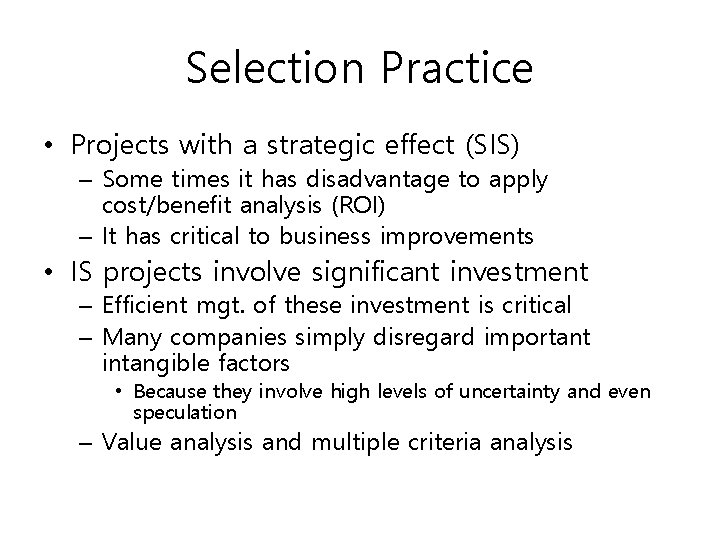
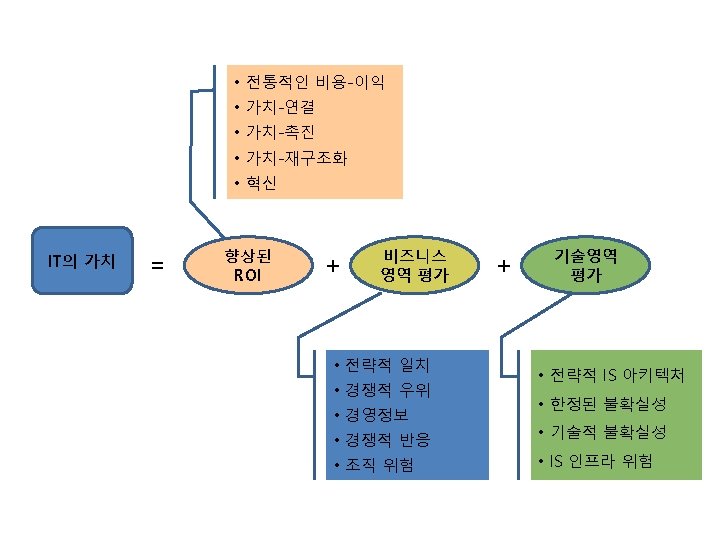
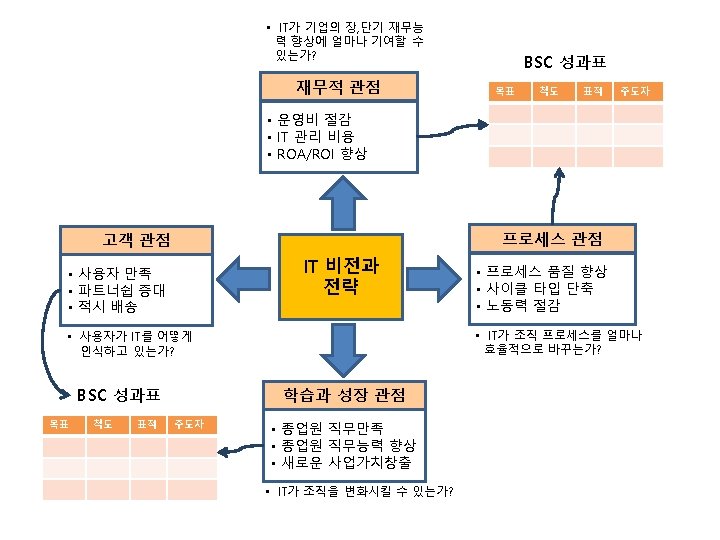
Selection Practice • Projects with a strategic effect (SIS) – Some times it has disadvantage to apply cost/benefit analysis (ROI) – It has critical to business improvements • IS projects involve significant investment – Efficient mgt. of these investment is critical – Many companies simply disregard important intangible factors • Because they involve high levels of uncertainty and even speculation – Value analysis and multiple criteria analysis
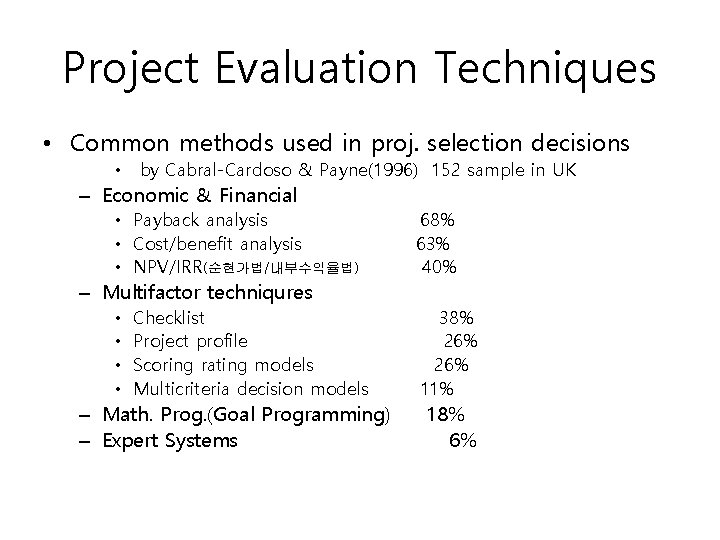
Project Evaluation Techniques • Common methods used in proj. selection decisions • by Cabral-Cardoso & Payne(1996) 152 sample in UK – Economic & Financial • Payback analysis • Cost/benefit analysis • NPV/IRR(순현가법/내부수익율법) – Multifactor techniqures • • Checklist Project profile Scoring rating models Multicriteria decision models – Math. Prog. (Goal Programming) – Expert Systems 68% 63% 40% 38% 26% 11% 18% 6%
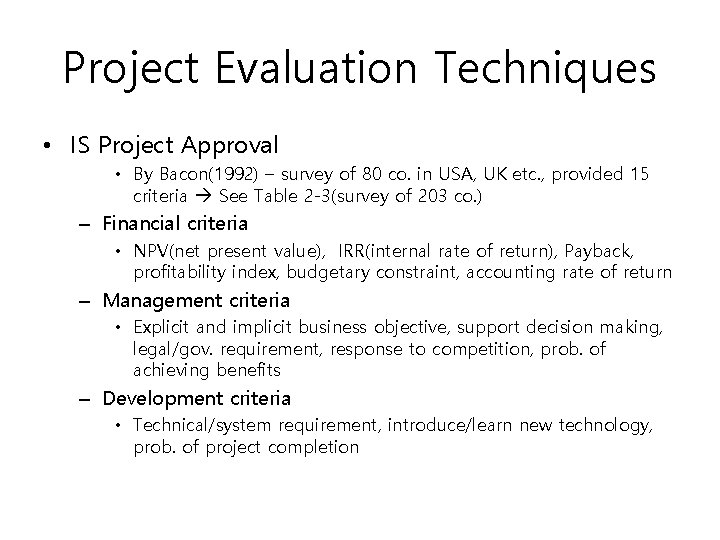
Project Evaluation Techniques • IS Project Approval • By Bacon(1992) – survey of 80 co. in USA, UK etc. , provided 15 criteria See Table 2 -3(survey of 203 co. ) – Financial criteria • NPV(net present value), IRR(internal rate of return), Payback, profitability index, budgetary constraint, accounting rate of return – Management criteria • Explicit and implicit business objective, support decision making, legal/gov. requirement, response to competition, prob. of achieving benefits – Development criteria • Technical/system requirement, introduce/learn new technology, prob. of project completion
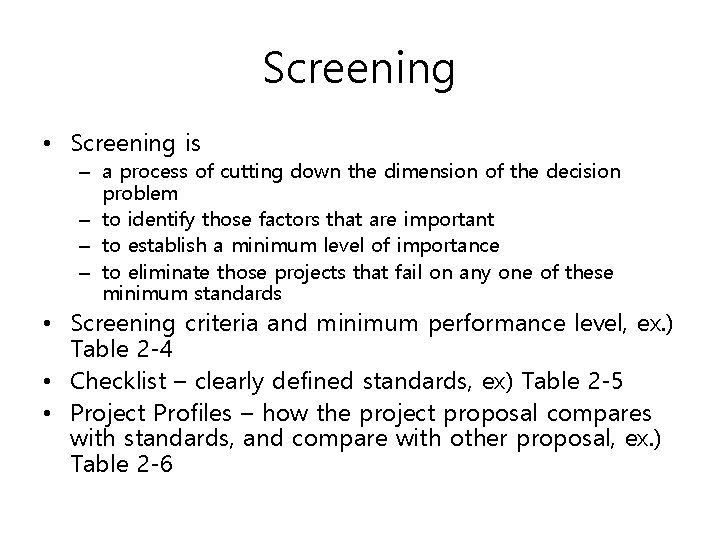
Screening • Screening is – a process of cutting down the dimension of the decision problem – to identify those factors that are important – to establish a minimum level of importance – to eliminate those projects that fail on any one of these minimum standards • Screening criteria and minimum performance level, ex. ) Table 2 -4 • Checklist – clearly defined standards, ex) Table 2 -5 • Project Profiles – how the project proposal compares with standards, and compare with other proposal, ex. ) Table 2 -6
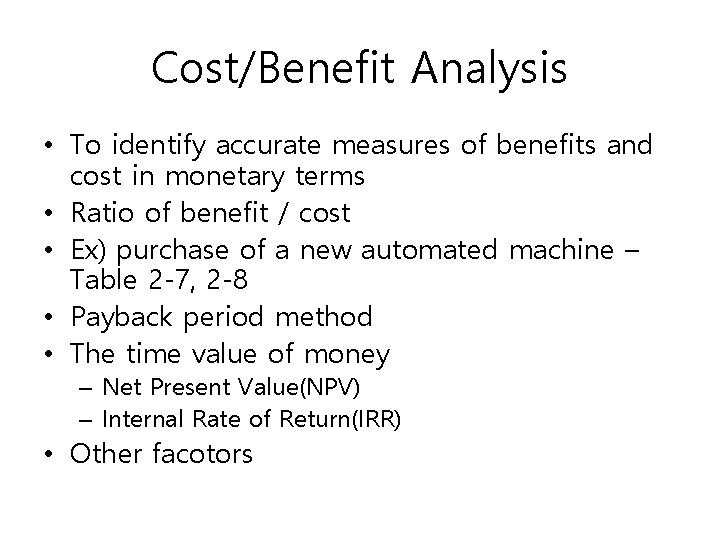
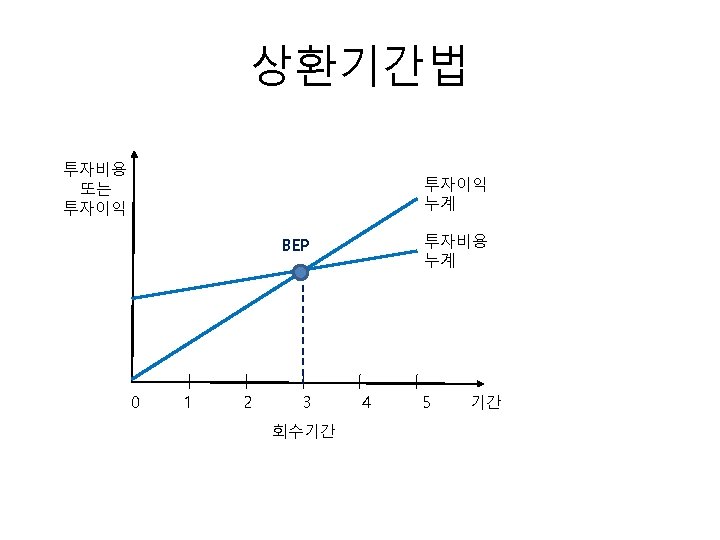
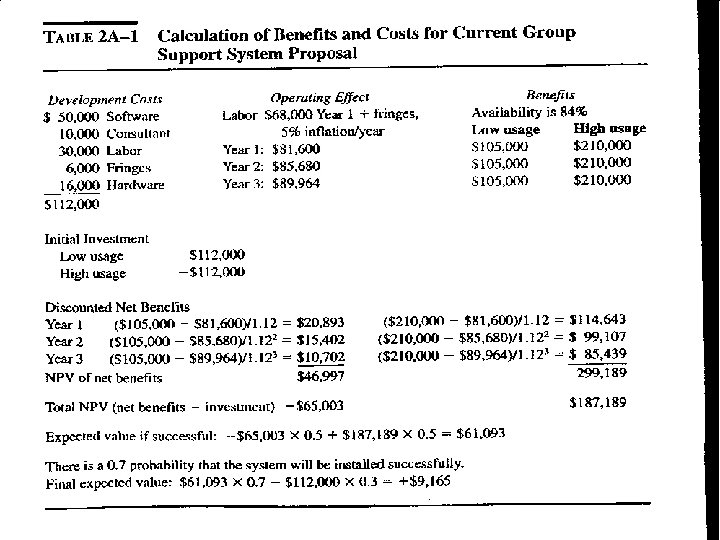
Cost/Benefit Analysis • To identify accurate measures of benefits and cost in monetary terms • Ratio of benefit / cost • Ex) purchase of a new automated machine – Table 2 -7, 2 -8 • Payback period method • The time value of money – Net Present Value(NPV) – Internal Rate of Return(IRR) • Other facotors
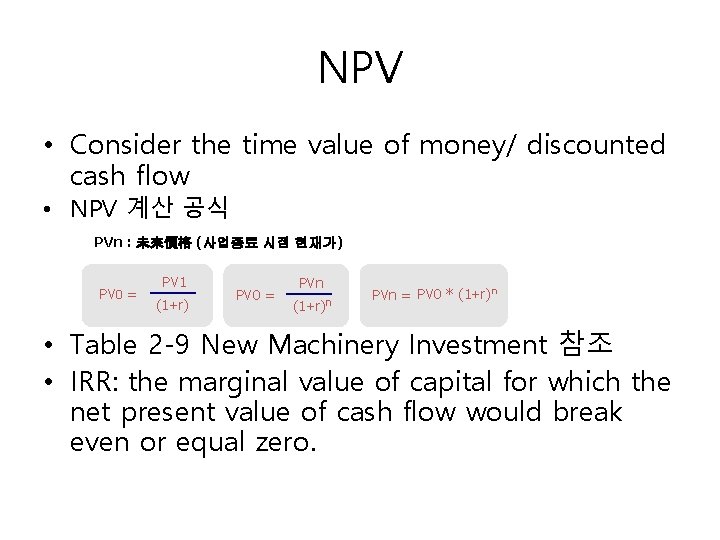
NPV • Consider the time value of money/ discounted cash flow • NPV 계산 공식 PVn : 未來價格 (사업종료 시점 현재가) PV 0 = PV 1 (1+r) PV 0 = PVn (1+r)n PVn = PV 0 * (1+r)n • Table 2 -9 New Machinery Investment 참조 • IRR: the marginal value of capital for which the net present value of cash flow would break even or equal zero.
Other Factors • Limitations of C/B analysis method – Benefits (even costs) can involve high levels of uncertainty – Using expected values – Ex) demand would be optimistic or pessimistic ROI will be change • C/B ratio does not reflect intangible benefits unless they are presented in monetary terms • Governments have encountered some problem in applying C/B analysis to public works • Governmental regulations such as environment pollution or safe working conditions
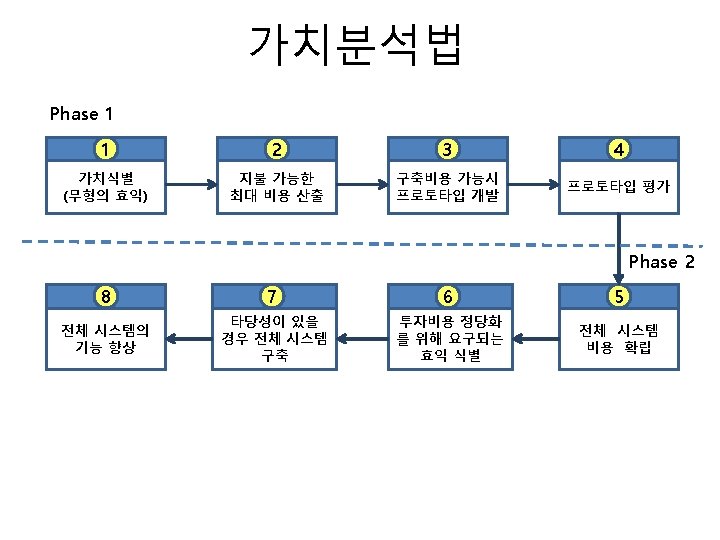
Value Analysis • An alternative to C/B analysis in the evaluation of IS projects • Projects which are attractive but suffer in that their benefits are often heavily intangible • Ex) DSS, “What is the exact dollar value of improved decision making? ” • The value of the benefits would be descriptive • The dollar value of these intangible is a matter of willing to pay in monetary terms • Taking value analysis one step more, to quantify these intangible benefits in terms of value (not in terms of dollars) multiple criteria analysis
Multiple Objectives • An org. have multiple obj. – Society become more complex, competitive environment etc. – Short term profit remains important – Long term factors such as market maintenance, product quality, development of productive capacity are important also – These obj. are conflict with measurable short term profit
Conflicts • Decision factors – Profit is a valuable concentration point – Minimizing risk becomes a second dimension for decision making – Others • Advertising expenditure • Capital replenishment - reinvestment in capital equipment • Labor policies – training expense
Multiple Criteria Analysis • SMART(simple multiple attribute rating technuque) – Step 1 : Scoring process, ex) Table 2 -13 – Step 2 : Weighting process ex) Table 2 -14, 15 , 16 • • • Rank ordering Assign value First estimate of weights Second estimate of weights Compromise between estimates – step 3 : Value Score, ex) Table 2 -17 • Comparison of C/B and SMART – Table 2 -18 • AHP(analytic hierarchy process)
Budget Optimization • Linear Programming – Objective function : Max Profit or Min Cost – Constraint function : Subject to. resources • Goal Programming – Multiple objective function • Zero-one LP problem – ex) Table 2 -19, Fig. 2 -1
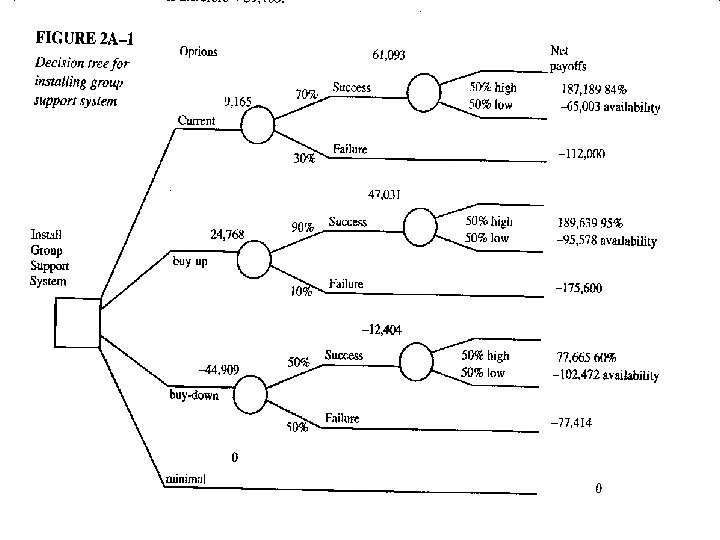
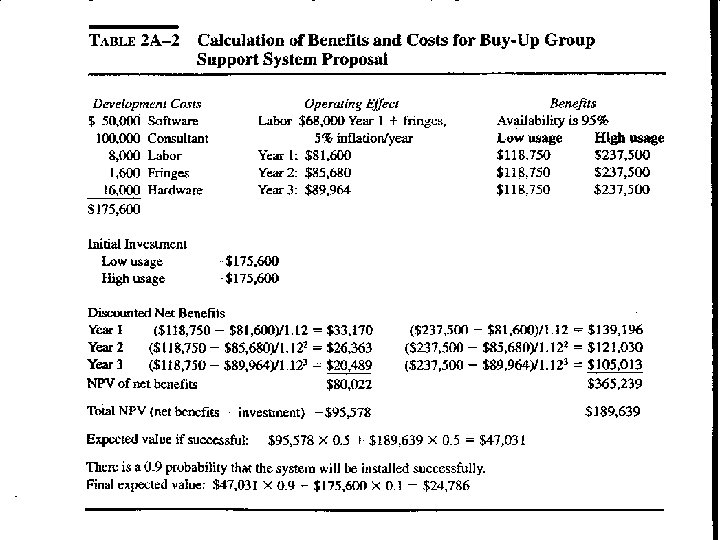
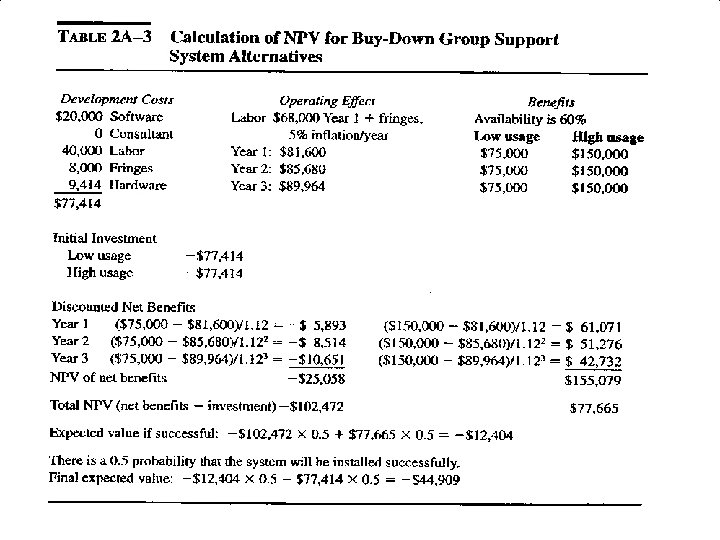
Method for Implementing Design to Budget • Sharp & Keelin(1998) in HBR – Presented a procedure to evaluate funding for their portfolio of research project – This process combines the ideas of decision tree to evaluate risk with cost/benefit analysis • The Process 1. Generate alternatives 2. Value alternatives 3. Rank projects by ROI(Return on Investment) – See example pp. 54 -58.