
Key Issue 4 Why do people preserve local


- Slides: 33
Key Issue 4: Why do people preserve local languages? Distribution of a language illustrates the fate of a people. u So, what does the distribution of English say? u What does the fact that people in Japan are the only people who speak Japanese say? u How does language display the competing trends of globalization and local diversity? u
Preserving Language Diversity u u u First off, ethnologue… Extinct languages, 516 nearly extinct: 46 in Africa, 170 in Americas, 78 in Asia, 12 in Europe, 210 in Pacific Peru had more the 500 languages in the 16 th century; only 92 survive today; 14 face immediate extinction because fewer than 100 people speak them Gothic was widely spoken in Eastern and Northern Europe. It’s entire language group is extinct (East Germanic). The last speakers of Gothic were in the Crimea in Russia in the 16 th century European Bureau for Lesser Used Languages (EBLUL), based in Dublin. Provides funding for the preservation of 60 indigenous, regional and minority languages Estimate that only 300 languages are safe from extinction because they have official government support and adequate speakers
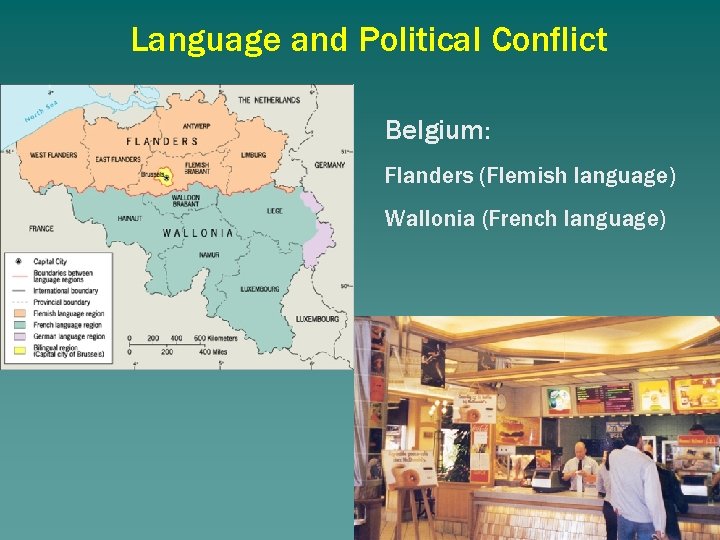
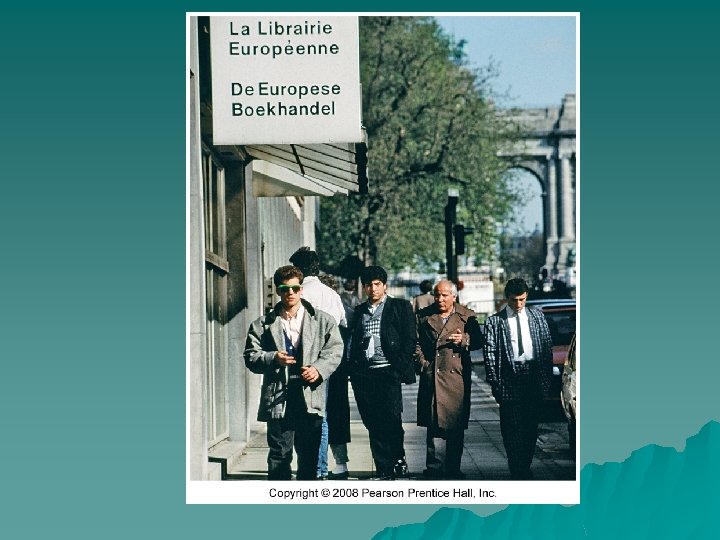
Why Do People Preserve Local Languages? u Language Diversity – Difficulties can arise at the boundary between two languages. u Varying degrees of difficulties – Belgium u Southern Belgians (Walloons) speak French. u Northern Belgians (Flemings) speak Flemish. u Pressure from Flemish speakers led to the division of Belgium into two independent regions with each controlling their own cultural affairs, public health, road construction, and urban development. u Antagonism between the Flemings and Walloons is aggravated by economic and political differences. Historically, Flemings dominated Belgium’s economy and politics, and French is the official state language
Language and Political Conflict Belgium: Flanders (Flemish language) Wallonia (French language)
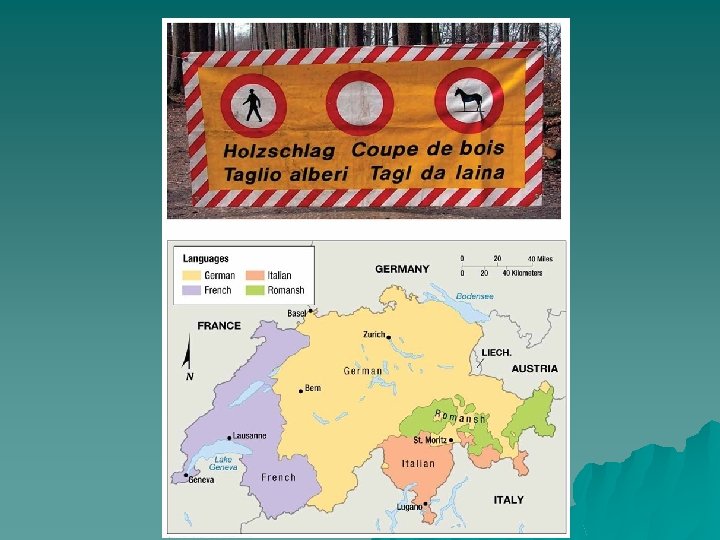
Why Do People Preserve Local Languages? u Language Diversity – Difficulties can arise at the boundary between two languages. u Varying degrees of difficulties – Switzerland u Peacefully exists with multiple languages. u Switzerland attributes success to decentralized government, in which local authorities hold most of the power, and decisions are frequently made on a local level by voter referenda. u Four official languages—German (65%), French (18%), Italian (10%), and Romansh (1%)
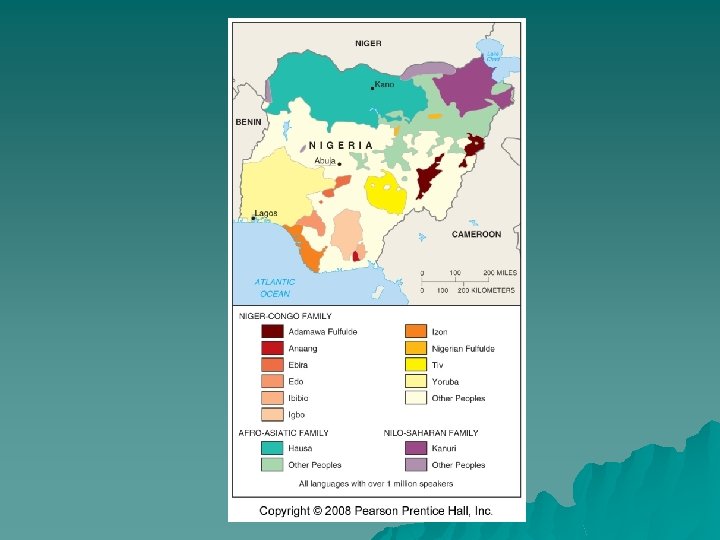
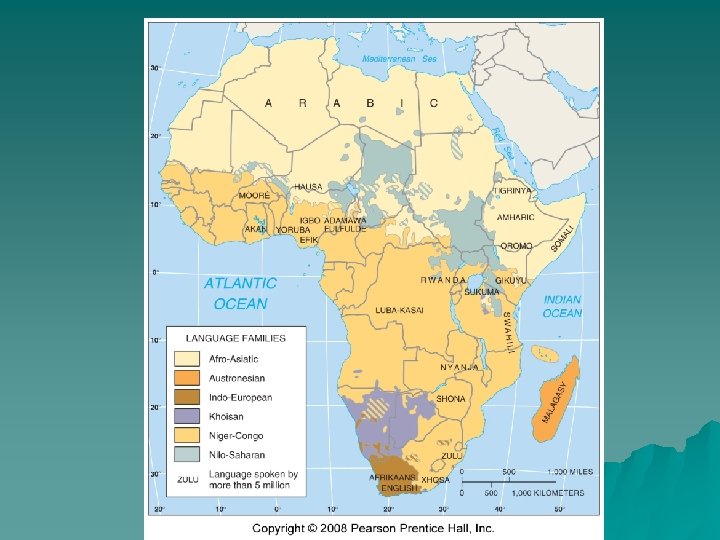
Nigeria u u u Problems from so many speakers 493 distinct languages Only 3 of which have widespread use: Afro-Asiatic language, Hausa (15% Hausa and Fulani in the North), a Niger-Congo language Yoruba(15% in the southwest), and Igbo (15% in south) Southern Ibos attempted to secede in the 60 s. Northerners claim the Yorubas discriminate against them Government moved capital to ease tensions from the Yoruba dominated southwest to Abuja in the center
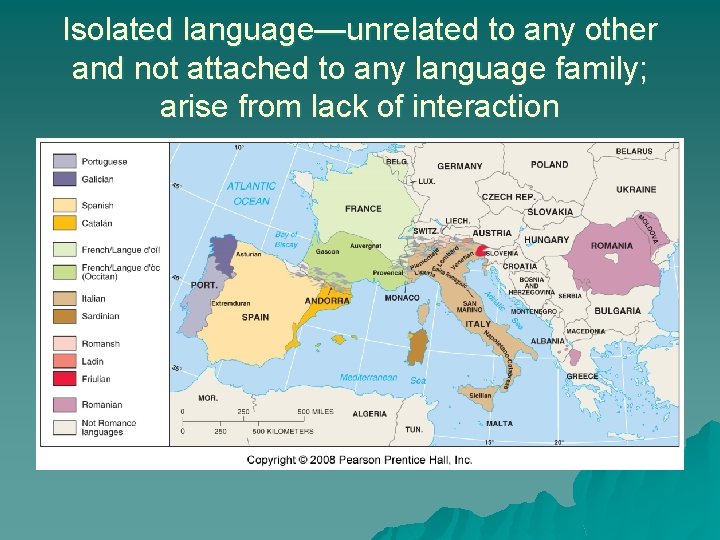
Isolated language—unrelated to any other and not attached to any language family; arise from lack of interaction
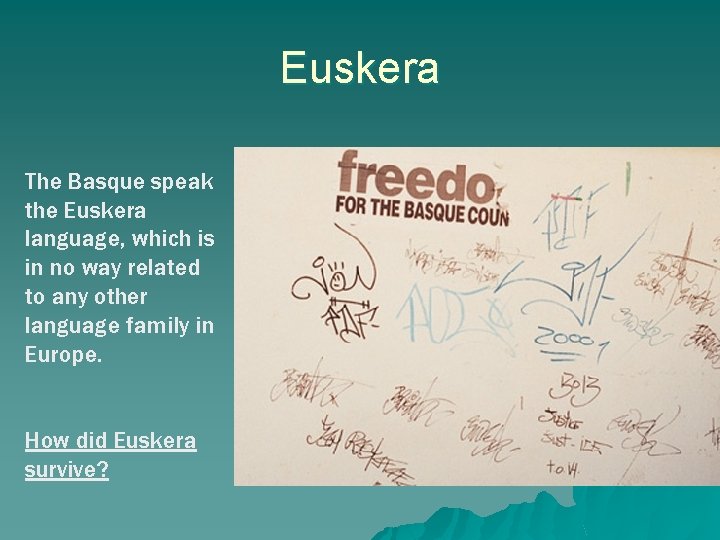
Euskera The Basque speak the Euskera language, which is in no way related to any other language family in Europe. How did Euskera survive?
Icelandic u North Germanic group of the Germanic Branch of the Indo. European Family u Norwegians colonized Iceland in 847 AD u Isolated with no reason to change
Why Do People Preserve Local Languages? u Extinct and Revived Languages – An extinct language is one that is no longer spoken or read in daily activities by anyone in the world. u Presently, 473 languages nearly extinct – 46 in Africa – 182 in Americas – 84 in Asia – 9 in Europe – 152 in Pacific u Ex. Native Americans – 74 languages extinct in the United States that were once spoken by Native Americans.
Hebrew: revived from extinction u Use of Hebrew diminished in the 4 th century BC; retained for religious services; Aramaic then Arabic u 1948—Hebrew became one of the country’s two official languages along with Arabic u Formidable task—thousands of words created—Eliezer Ben-Yehuda
Why Do People Preserve Local Languages? u Preserving Celtic Endangered Languages: – Linguists expect hundreds of languages will become extinct during the twenty-first century. u Only about 300 languages are said to be safe from extinction. – Celtic Language u Significant to English speakers because of its primacy in the British Isles. u Language of Isles before Angles, Jutes and Saxons invaded
Celtic languages were spoken in much of Germany, France and northern Italy u Survives only in remote parts of Scotland, Wales, and Ireland, and on the Brittany peninsula of France. u Republic of Ireland’s 2 official languages are Irish Gaelic and English u Welsh dominated Wales until 19 th century when English Coal-miners began to migrate to Wales. 1/6 still use it u
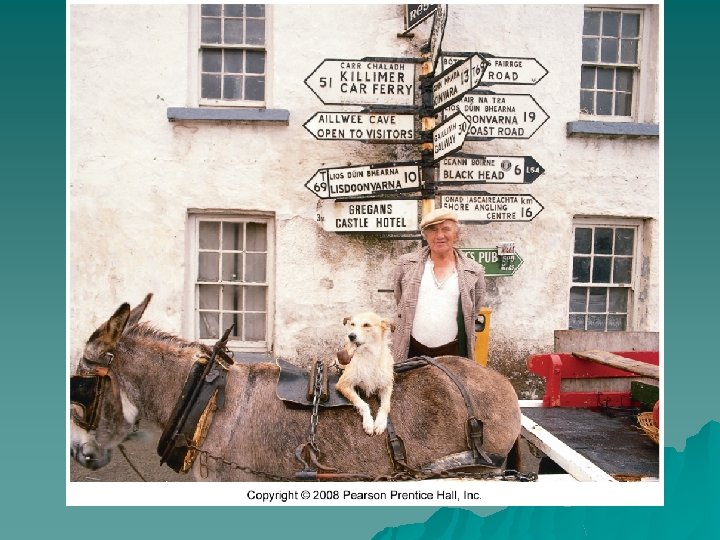
Revival of Celtic u u u Celtic speakers must work hard to preserve their language in face of diffusion by others who have greater political and economic strength. Welsh Language Society Britain’s 1988 Education Act—Welsh training compulsory, along with addition of history and music Local governments & electric companies must provide Welsh services, road signs, the BBC Irish Gaelic—rock groups do songs, Irish TV station began broadcasting in 96, English road signs banned in portions of W. Ireland in 2005 100 people now speak Cornish
Spatial Interaction helps create: u Lingua franca – A language used among speakers of different languages for the purposes of trade and commerce. u Pidgin language – a language created when people combine parts of two or more languages into a simplified structure and vocabulary, often a simplified form of a lingua franca, used for speakers of two different languages u Creole language – a pidgin language that has developed a more complex structure and vocabulary and has become the native language of a group of people.
Why Do People Preserve Local Languages? u Global Dominance of English – A lingua franca is a language of international communication. u Ex. English – First language of 328 million people – Spoken fluently by another ½ to 1 billion people. – Official language in 57 countries – People in smaller countries learn English to participate more fully in the global economy and culture. u Other Examples – Swahili in East Africa – Hindi in South Asia – Indonesian in Southeast Asia – Russian in former Soviet Union.
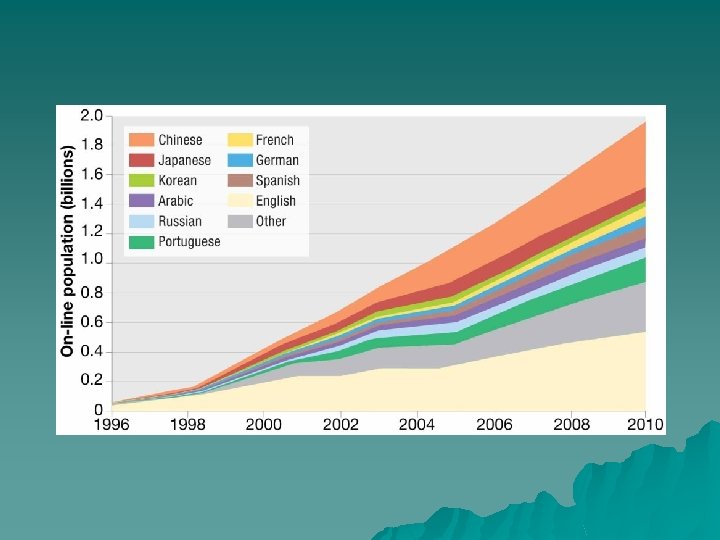
u Global Dominance of English – English on the Internet u Majority of content on Internet is in English. – Dominance of content in English is waning. u Percentage of English-language online users declined from 46 percent in 2000 to 27 percent in 2010. – Mandarin will likely replace English as the mostfrequently used online language before 2020.
u Global Dominance of English – Expansion Diffusion of English--Unlike most examples of expansion diffusion, English has been a bottom-to-top approach with percolated from common usage rather than brought by the elite u Recent growth in the use of English is an example of expansion diffusion—the spread of a trait through the snowballing effect of an idea.
Expansion has occurred in two ways with English. 1. English is changing through diffusion of new vocabulary, spelling, and pronunciation. 2. English words are fusing with other languages. u Ex. Words, such as cowboy, hamburger, jeans, and T-shirt were allowed to diffuse into French. u Ex. English words have spurred the creation of English-like words to replace traditional Spanish words, such as parquin (Spanglish) for estacionamiento (Spanish
Diffusion to other languages u Franglais – French official language of 26 countries – English words have diffused – 1635, French Academy protects the French language – Stationnement/parking—fin de semaine/le weekend
Spanglish—Cubonics – Bipiar, i-meiliar, bancuncliner u Denglish – Diffusion of English into German (deutsch) u
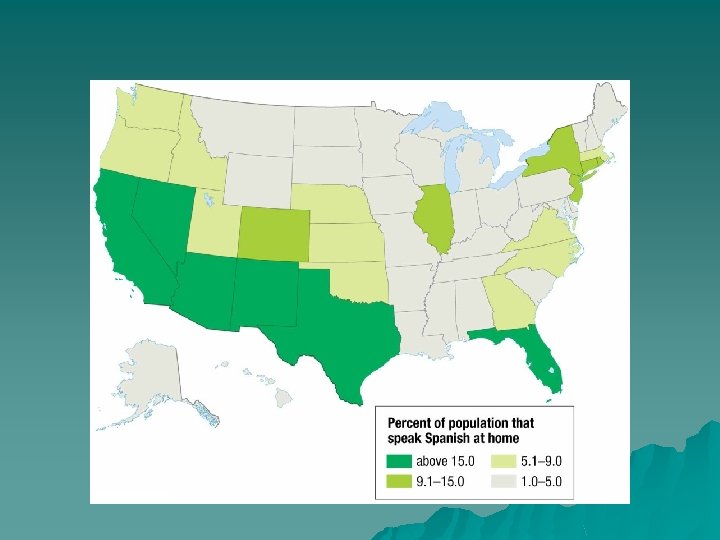
u Spanish and French in the United States and Canada – Spanish u Increasingly important language in recent years in United States because of largescale immigration from Latin America. – Some communities now issue public notices, government documents, and advertisements in Spanish. – Radio stations and TV now broadcast in Spanish in places where most of the 35 million Spanish speakers live. u In reaction, 30 states and number of localities have laws making English the official language. – Some courts have judged these laws to be unconstitutional restrictions on free speech.
u Spanish and French in the United States and Canada – French u Québec government has made the use of French mandatory in many daily activities. u Québec faces challenges integrating a large number of immigrants from Europe, Asia, and Latin America who don’t speak French. – Immigrants prefer to use English as the lingua franca because of its greater global usage.
Summary Languages can be classified as belonging to particular families. Some families are divided into branches and groups. u English is in the Germanic branch of the Indo-European language family. Because nearly ½ of all humans currently speak a language in the same family, English is related to other languages. u Languages vary among places because of the regional influence on language that stems from isolation. u
Summary u People preserve local languages, because a culture’s identity is intimately intertwined with its local language.