
KEY HISTORICAL EVENTS 1985 2015 Problem after Fiji
KEY HISTORICAL EVENTS 1985 -2015: Problem after Fiji Independence post 1970 1. 2. 3. Representation: How much Europeans in Fiji should be involved in government Paramountcy: How to protect the interests of and give privileges to Fijians Equality: How to provide equality for the other half of the population of 250, 000 Fiji-Indians. Process of Transfer of government � Since 1961, British colonial government allowed Fijian ministers to take responsibility for government departments, i. e Forestry, Transport and shipping � In 1963, Ist members of Legislative Council were elected. National Alliance party (NAP) and National Federation Party (NEP) were formed as Fiji began to prepare for independence. Fijians were given some control over the government.
Problem of Europeans or Others representation. � But the Europeans or Others who were over represented in colonial days still wanted a chance to elect members in parliament but this problem was resolved after independence because voting became two-party race. 1. Fijians for NAP 2. Fiji-Indians for NFP.
Rise of Question of Paramouncty � During 1975, question of Paramouncty rose, when members of parliament moved a motion calling for all Fiji-Indians to be repatriated. Both NAP and NFP suggested this would lead to racial tension, riots and increased discrimination. Both parties rejected the motion but Fijians secretly agreed with this motion. � In the planning for independence, equality was given to Fiji-Indians by a communal voting system in which Fijians and Fiji-Indians voted for parliamentary members who were representatives of their own race. Each voter had several votes. � During 5 elections from 1970 -1987, voting was always based on racial grounds.
Questions of Power, land, Seats and development � During the course of independence, several decisions were made in rush without considering the long term effects. So 4 problems persisted 1. How decision making should be shared? 2. Ownership of land distribution of leases and rents? 3. The best method of giving all Fijians a vote? 4. The most appropriate form of development?
1985 FIJI LABOUR PARTY Formerly launched March 1985 � General secretary – Krishna Datt (former teacher) � A democratic socialist party � Advocated for social justice, balanced economic development & regional institutions in Fiji � Proposed a new vision and new direction � An alternative to communalism & ethnic separatism of Alliance Party � Began its political success & ascendancy to power by winning the local government 1986 Suva municipal elections � Formed a coalition with NFP to contest 1987 elections � 1987 elections was mainly a contest between the Alliance(Ratu K. Mara) and NFP (J. M. Reddy)-FLP (Dr. Timoci Bavadra) Coalition �
The Coalition had in its lineup of candidates, highly educated Fijian professionals, academics, trade unionists, high ranking civil servants & former Alliance senators � Highlighted regionalism & regional disparities in resource use between eastern maritime & western provinces � This new FLP-NFP coalition won the elections on 12 April 1987 � Coalition won by 28 seats to Alliance Party’s 24. � Election debates had been about development policy, future changes and a new style of leadership in government. � Ended 17 years of rule by Ratu Mara & the Alliance Party � Coalition cabinet was dominated by FLP members (11 Ministers) ; NFP (3 Ministers) � Important Government positions were occupied by trade unionists � The new government ruled for one month �
� 14 May 1987 - Lieutenant -Colonel Sitiveni Rabuka seized power through a coup. He with a group of soldiers entered the Government Building in Suva and PM, Cabinet Ministers and other members of the coalition were taken away. Coup d'état occurred. � Coalition government detained till 19 May. � Lieutenant-Colonel Sitiveni Rabuka came to power with a bloodless coup with the aim of making indigenous Fijians politically dominant. � The caretaker government was established and Fiji was in turmoil. Many Fiji-Indians began to emigrate to escape threats and violence. � 4 months later, 25 September 1987 - Rabuka instigated a second coup � 1 October 1987 -1970 Constitution formerly revoked � 7 October 1987 - Fiji proclaimed a republic � Fiji expelled from the Commonwealth
� Rabuka appointed Ratu Penaia Ganilau President � Ratu Penaia Ganilau appointed Ratu Mara Prime Minister � Britain, USA, Australia & NZ suspended aid � 1989 - some thirty thousand Indians migrated � 1990 – new Constitution showed the political dominance for indigenous Fijians � Indicated positive discrimination in favour of Fijians and Rotumans
� Bicameral legislature � Executive President appointed by Great Council of Chiefs (GCC) for 5 years, accountable to GCC � President had powers to appoint public officers, in exercising the prerogative of mercy, in dealing with emergencies � Include ability to suspend constitution & civil Liberties of individuals � Senate-appointed by President; 34 members-24 Fijians (GCC appointed), 1 Rotuman (Rotuma Council appointed), 9 other members (appointed by President) � Senate powers: � Review bills passed by Lower House � Veto power over legislation affecting Fijian rights, customs & customary rights
Lower House-House of Representatives: � 70 members � 37 Fijians, 27 Indo Fijians, 5 General Electors, 1 Rotuman. Fijian paramouncy � Voting on racial lines � Fijian seats- 32 elected from 14 Provinces, 5 from five urban constituencies � Regional disparity in Provincial seats- Ba (3), Lau (3), Rewa (2), Kadavu (2) � Promoted positive discrimination in favour of Fijians & Rotumans � GCC –enhanced political role � Proposed restructuring of GCC composition- from 154 to 52 (few select group of chiefs-decision making � 1989 -Western chiefs proposed a 4 th Fijian Confederacy. Yasayasa Vaka Ra to Constitution Inquiry & Advisory Committee �
1992 General Election – Rabuka became Prime Minister; President-Ratu P Ganilau � 1994 – GCC appoints Ratu Mara President after death of Ratu P Ganilau � 1997 new Constitution created by Jai Ram Reddy & Rabuka with power sharing among two major ethnic groups � 1997 - Fiji re-admitted into the Common wealth due to new non-discriminatory constitution � 1999 General Elections – FLP won with clear majority, Mahendra Chaudhry –first Indo-Fijian Prime Minister � May 2000 – Civilian coup led by George Speight, PM Chaudhry & Cabinet taken hostage � George Speight proclaims himself Acting premier and retired major Ilisoni Ligairi storm parliament, aiming to make indigenous Fijians the dominant political force. � Ratu Mara sacks Chaudhry government on orders of GCC � June 2000 – Commonwealth suspends Fiji � July 2000 – hostages released �
� GCC appoints Ratu Josefa Iloilo President � July 2000 – Speight & 369 supporters arrested � November 2000 – failed mutiny in army barracks – 8 soldiers arrested � August 2001 Elections – Laisenia Qarase & his party won elections but needed to form a multiparty government � September 2001 – Qarase sworn in as PM but refused to offer cabinet posts to opposition FLP in defiance of constitution � December 2001 - George Speight expelled from parliament for failing to attend sessions. � December 2001 – Fiji re-admitted to Commonwealth
2002 – George Speight sentenced to death for treason. President Iloilo commutes his sentence to life imprisonment � November 2002 – government announces radical privatisation plan to stave off collapse of sugar industry, threatened by withdrawal of EU subsidies � July 2003 - Supreme Court rules Qarase must include ethnic-Indian members of opposition Labour Party in his cabinet � April 2004 – Ratu Sir Kamisese Mara passes away. � August 2004 – Vice President Ratu Jope Seniloli found guilty of treason over his involvement in May 2000 coup. Served few months of his four year sentence. � November 2004 – Labour Party declines cabinet seats in favour of opposition role � July 2005 – Army Commander Bainimarama threatens to remove government if proposed amnesty for those involved in 2000 coup goes ahead � �
March 2006 – GCC elects Ratu Iloilo to a second, five year term as President � May 2006 –Former PM Rabuka charged with orchestrating a failed army mutiny in Nov 2000. � May 2006 – Elections - PM Qarase narrowly wins & is sworn in for a second term � October to November, 2006 - tension rises between Qarase & Bainimarama, who threatens to oust government after it tries & fails, to replace him. Qarase goes into hiding as crisis escalates. � December 2006 – Bainimarama gives televised address he has taken executive powers and dismissed Qarase as PM. � Commonwealth suspends Fiji because of coup. � January 2007 – Bainimarama restores executive powers to President Iloilo and takes on role of interim PM. � Feb 2007 – Bainimarama announces plans to hold elections in 2010. �
� April 2007 – Bainimarama sacks GCC, suspends all future meetings after chiefs refuse to endorse his government & his nomination for vice president. � June 2007 state of emergency lifted but reimposed in September then lifted again in October. � November 2007 – Bainimarama reports police foiled assassination plot on his life. � February 2008 - Bainimarama appoints himself chairman of GCC
July 2008 – Bainimarama postpones elections promised for early 2009, on grounds electoral reforms could not be completed in time � August 2008 – South Pacific leaders warns Fiji it faces suspension from regional groupings if it fails to show progress towards holding elections � January 2009 – Pacific leaders demand Fiji hold elections by end of year �
Constitution Repealed April 2009 – Appeals Court rules military regime was illegally appointed after 2006 coup. Says a caretaker PM should be appointed to call elections to restore democracy. � President Iloilo repeals 1997 Constitution, appoints himself Head of State, sets a 2014 election deadline & sacks all judges; � He then reappoints Bainimarama as interim PM. Martial law is imposed. � May 2009 – South Pacific nations suspends Fiji from Pacific Islands Forum regional bloc for failure to hold elections. � July 2009 –Bainimarama unveils plans for a new Constitution by 2013, ahead of elections in 2014. Under new constitution, he says, racial based system in 1997 constitution will be scrapped. �
� July 2009 – President Iloilo steps down, succeeded on interim basis by Vice-President Ratu Epeli Nailatikau. � September 2009 – suspension again from Commonwealth � March 2010 – Court jails 8 men for attempting to kill Bainimarama in 2007. � October 2010 – Fiji authorities admit to losing document confirming independence from UK � August 2011 - government orders cancellation of Methodist Church Conference – saying its leadership too political. � January 2012 – martial law lifted by PM, informs consultation on new constitution will begin in Feb. � July 2012 – Australia & NZ agree to restore full diplomatic ties with Fiji after Bainimarama agrees to hold elections in 2014.
� � � � August 2012 – Qarase jailed for a year on corruption charges December 2012 – Constitution Commission produces draft constitution. Draft constitution copies burnt and copies shredded. Government against the public comments on Draft before meeting of Constituent Assembly. Government rewrote a draft constitution A selected few in Constituent Assembly passed it. 2013 September - New constitution introduced, paving the way for elections. 2014 September - Forty five Fijian peacekeepers are held hostage for more than two weeks by Islamist militants in the Golan Heights in Syria. Frank Bainimarama becomes the country's civilian leader after winning parliamentary elections. Commonwealth re-instates Fiji as a full member. September 2014 - The United Nations says 45 captured peacekeepers from Fiji have been released in the Golan Heights in Syria after being held for two weeks by rebels from the al-Qaeda-linked al-Nusra Front. 2014 December - An annual international survey of world happiness lists Fiji as the happiest nation in the world, according to polling organisation WIN/Gallup. New Constitution signed in Friday 6 September 2013. 3 April 2014 Launched the new Constitution a 'blueprint for future direction of country'
General Elections of 2014 General elections in Fiji held on 17 September 2014, to select the 50 members in the Parliament of Fiji. � The previous Prime Minister, Frank Bainimarama, was reelected. Prior to the election Bainimarama was an Independent but stood for the Fiji. First Party in 2014. � The elections were originally scheduled for March 2009, but were not held then because politicians did not agree to the People's Charter for Change, Peace and Progress. Between 2009 and 2014 many public announcements and requests were made and on 23 March 2014 the interim government announced the election would be held on 17 September 2014. � The elections were to be held under the new constitution which lowered the voting age to 18 and gave the right of multiple citizenship to Fijians for the first time. �
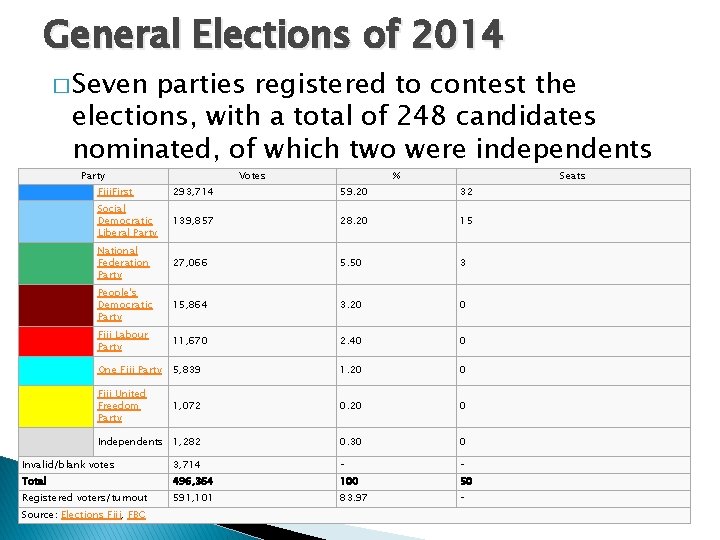
General Elections of 2014 � Seven parties registered to contest the elections, with a total of 248 candidates nominated, of which two were independents Party Votes % Seats Fiji. First 293, 714 59. 20 32 Social Democratic Liberal Party 139, 857 28. 20 15 National Federation Party 27, 066 5. 50 3 People's Democratic Party 15, 864 3. 20 0 Fiji Labour Party 11, 670 2. 40 0 One Fiji Party 5, 839 1. 20 0 Fiji United Freedom Party 1, 072 0. 20 0 Independents 1, 282 0. 30 0 Invalid/blank votes 3, 714 – – Total 496, 364 100 50 Registered voters/turnout 591, 101 83. 97 – Source: Elections Fiji, FBC
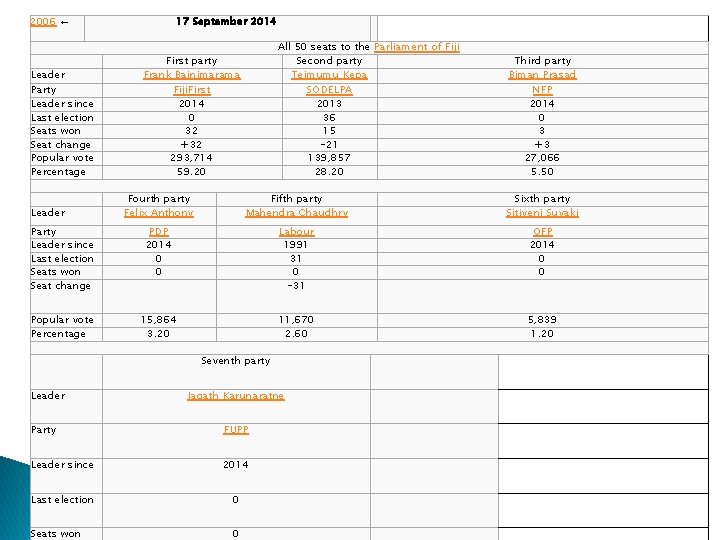
2006 ← Leader Party Leader since Last election Seats won Seat change Popular vote Percentage 17 September 2014 All 50 seats to the Parliament of Fiji Second party Teimumu Kepa First party Frank Bainimarama Fiji. First 2014 0 32 +32 293, 714 59. 20 SODELPA 2013 36 15 -21 139, 857 28. 20 Third party Biman Prasad NFP 2014 0 3 +3 27, 066 5. 50 Fourth party Felix Anthony Fifth party Mahendra Chaudhry Sixth party Sitiveni Suvaki Party Leader since Last election Seats won Seat change PDP 2014 0 0 Labour 1991 31 0 -31 OFP 2014 0 0 Popular vote Percentage 15, 864 3. 20 11, 670 2. 60 5, 839 1. 20 Leader Seventh party Leader Jagath Karunaratne Party FUPP Leader since 2014 Last election 0 Seats won 0
2015 Events � 2015 January - After decades of campaigning, Fijian military veterans receive financial compensation for their exposure to radiation from British nuclear tests carried out on Christmas Islands in the late 1950 s. � 2015 February - Fiji confirms plans to change its flag to remove the Union Jack, saying the existing design includes symbols which are out of date and rooted in a colonial past. � 2015 May - Fiji's Prime Minister Frank Bainimarama accuses Australia and New Zealand of failing Pacific island nations in the fight against climate change.
Major Political Parties Alliance Party The governing party from independence in 1970 until the elections of 1987. Dominated by leaders from the indigenous Fijian chiefly elite such as Ratu ('paramount chief') Kamisese Mara. � Soqosoqo ni Vakavulewa ni Taukei (SVT) Roughly translates to Fijian Political Party. The successor to the Alliance Party, formed to contest the elections of 1990. Lead by Sitiveni Rabuka (pronounced Rambuka), leader of the coups of 1987. Less cohesive than the Alliance and suffered a split in 1994 when seven of its MPs resigned. � Fijian Association Party Formed in 1994 out of a split in the SVT when Josevata Kamikamica (pronounced Kamikamitha) and six other SVT MPs resigned from the SVT. Remerged with the SVT in 1997. � Taukei Movement: Extreme indigenous Fijian nationalist organisation formed to oppose the formation of the government elected in 1987 by mainly Indo-Fijian votes. Continues to operate on the margins of Fiji politics. �
Political Parties � National Federation Party (NFP) Formed in 1963 to advance the interests of the mainly Indo-Fijian sugar farmers. Became the main party of the Indo-Fijian community after independence in 1970. Joined with the Fiji Labour Party in the Coalition of 1987, which won the elections of that year but which was overthrown in the coup. � Fiji Labour Party (FLP) Formed in 1985, with a support base in the Indo-Fijian community but also with indigenous Fijian supporters in the west of the country. Led by an indigenous Fijian, Dr Timoci Bavadra (pronounced Timothi Bavandra). Coalition government with the NFP overthrown in the coup of 1987. Now led by Mahendra Chaudry and with the loss of its indigenous Fijian support after 1987, generally seen as the smaller of the two Indo-Fijian parties.
- Slides: 25