
Key General Terminology Mercy College Occupational Therapy Program

- Slides: 20
Key General Terminology Mercy College Occupational Therapy Program HLSC 210 – Overview of Occupational Therapy Donna J. Roberto, MS, OTR/L; CEAS I; ATP
Occupation • Ordinary and familiar things that people do • Activities that have meaning and value…that have unique meaning and purpose in a person’s life • Bigger than “activity, ” and assume a place of central importance in a person’s life
Occupation • Occupations are mediated by context and/or culture, and the values of and meanings to those who perform them (Dickie, 2014). • Occupations contribute to one’s health and well-being. • Engagement in meaningful occupations shape who we are, our selfconcept and self-esteem • Occupations organize our time (day) and provide a sense of satisfaction
Occupation • Our quality of life is influenced by “engagement in meaningful activities. ” • Helping a person who has a disability (acquired or otherwise) to gain new or return to old meaningful occupations – and accomplishing this through helping them “do” - is occupational therapy.
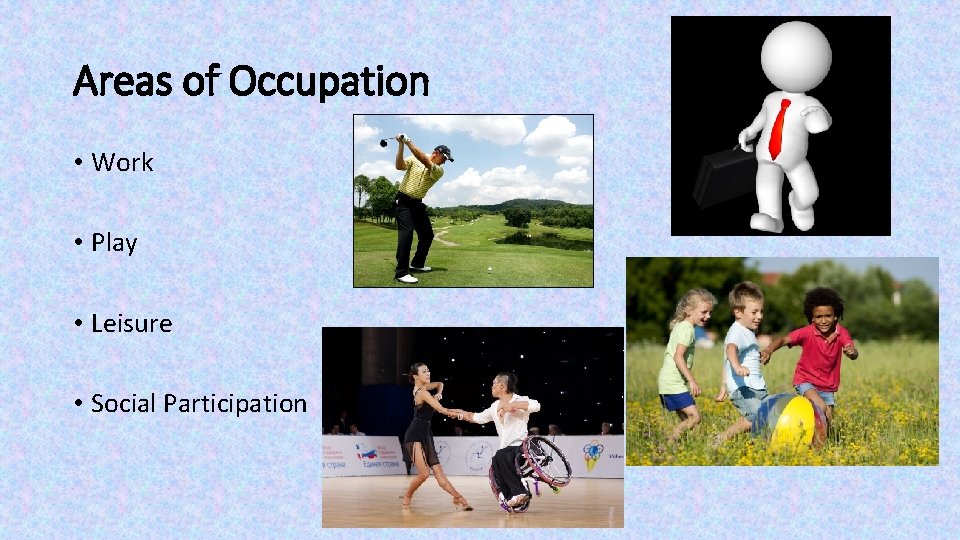
Areas of Occupation • Work • Play • Leisure • Social Participation
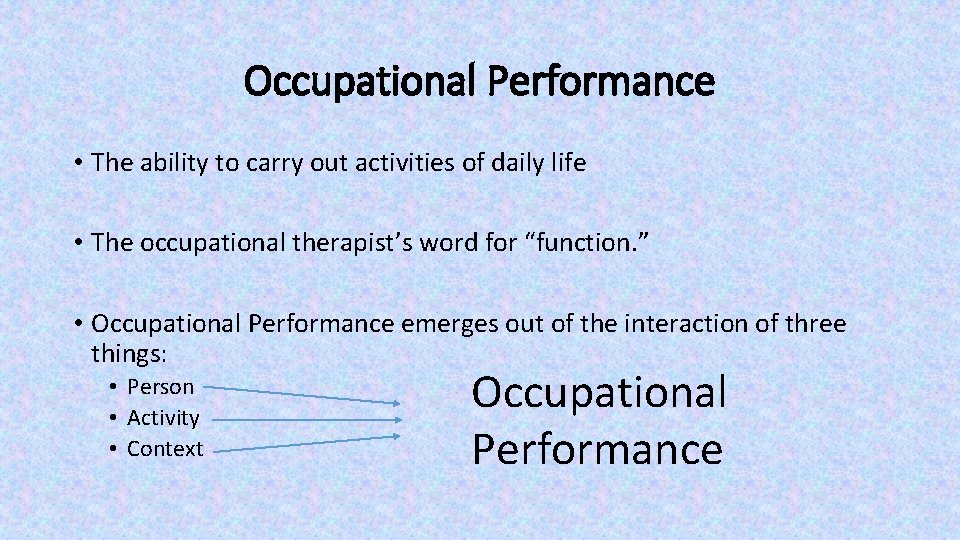
Occupational Performance • The ability to carry out activities of daily life • The occupational therapist’s word for “function. ” • Occupational Performance emerges out of the interaction of three things: • Person • Activity • Context Occupational Performance
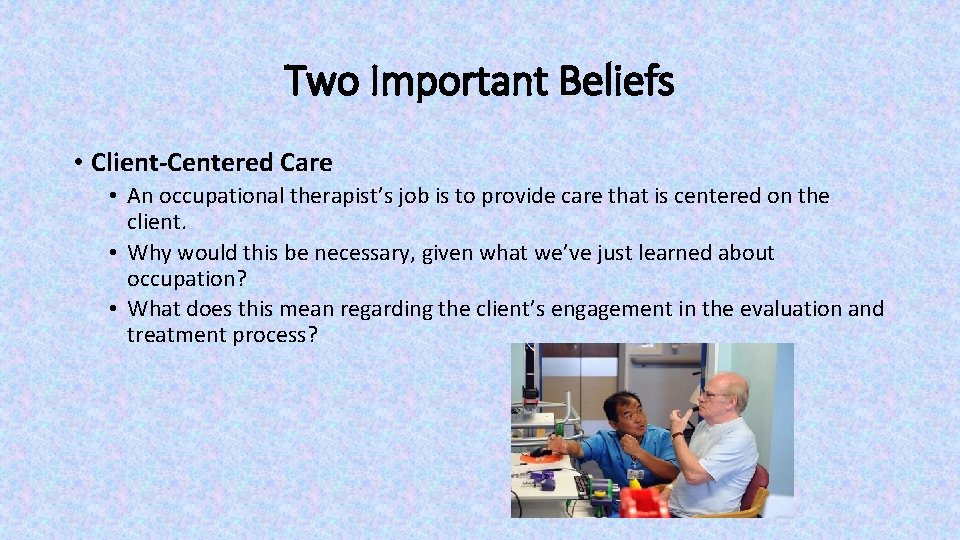
Two Important Beliefs • Client-Centered Care • An occupational therapist’s job is to provide care that is centered on the client. • Why would this be necessary, given what we’ve just learned about occupation? • What does this mean regarding the client’s engagement in the evaluation and treatment process?
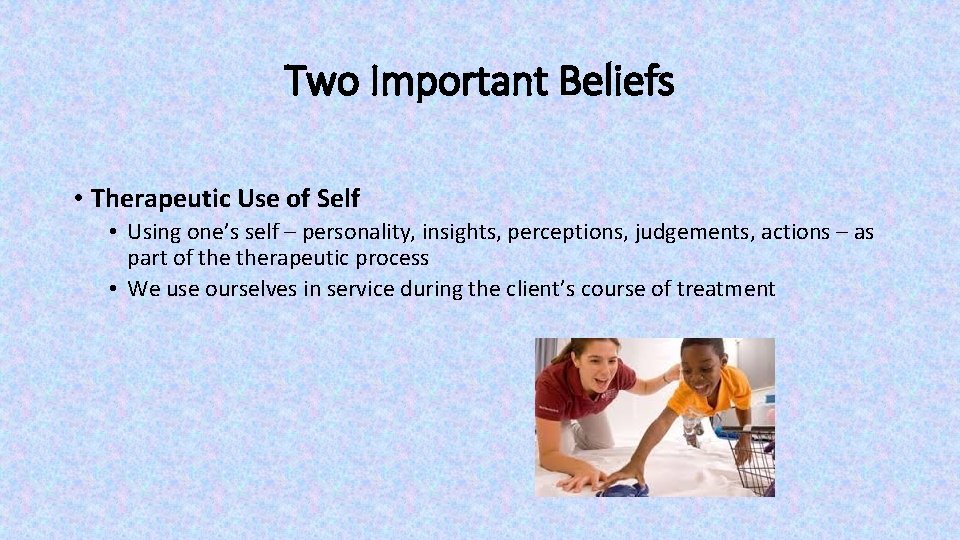
Two Important Beliefs • Therapeutic Use of Self • Using one’s self – personality, insights, perceptions, judgements, actions – as part of therapeutic process • We use ourselves in service during the client’s course of treatment
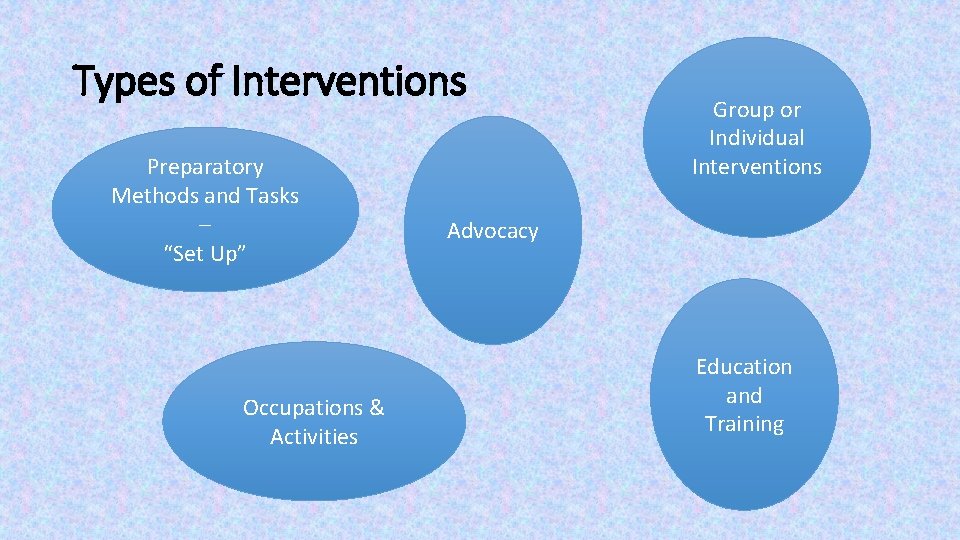
Types of Interventions Preparatory Methods and Tasks – “Set Up” Occupations & Activities Group or Individual Interventions Advocacy Education and Training
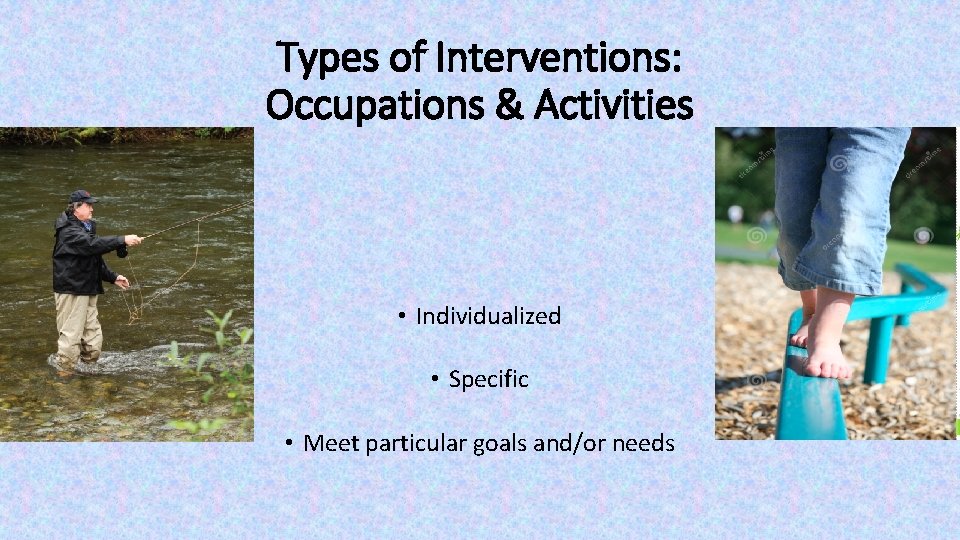
Types of Interventions: Occupations & Activities • Individualized • Specific • Meet particular goals and/or needs
Types of Interventions: Preparatory Methods and Tasks Preparatory Methods • Might be done “to” the client • Get the client “ready” for occupational performance • Examples • Hot packs; cold packs; splinting; sensory strategies; muscle facilitation
Types of Interventions: Preparatory Methods and Tasks Preparatory Tasks • Activities that will help the client attain their goals • Involve active participation by the client • Examples • Exercises; stretches; eye exercises • May not be meaningful to client
Types of Interventions: Education and Training • Education • share knowledge • Prevention • Examples: energy saving techniques; facts about disease process • Training • Teach skills to meet goals • Promotes increased engagement and independence • Examples: dressing with one hand; low vision techniques; tying one’s shoes
Types of Interventions: Advocacy • Empowering clients to seek out resources • Helping client learn to advocate for themselves • Educating others on behalf of the client • Examples: speaking with employers re: employee needs; speaking with village board about an accessible playground
Types of Interventions: Group Interventions • Groups are “mini-” reflections of social participation in society • Provide a place to learn and to practice skills needed for participation and engagement in society • Always will involve an activity • May involve a task • May involve learning and practicing a skill • May involve providing support to peers
Types of Approaches to Intervention Modify Create/Promote “Health Promotion” Maintain Establish, Restore, Remediate Prevent
Approaches to Interventions • Create and/or Promote Health – Health Promotion • Does not assume a disability is present • Designed to provide enriched experiences • Life-style Re-Design • Establish, Restore, Remediate • Help clients learn a skill that has not been developed • Restore an ability that client no longer has
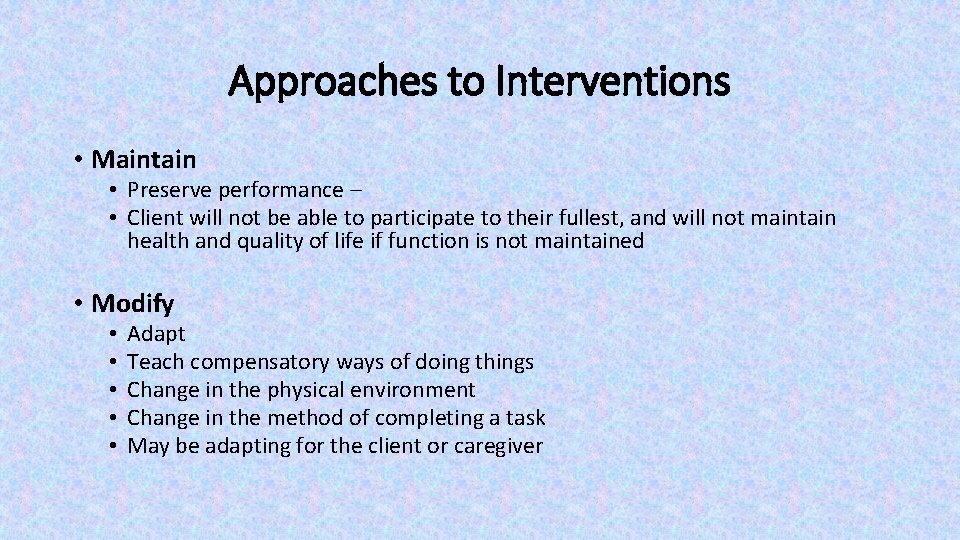
Approaches to Interventions • Maintain • Preserve performance – • Client will not be able to participate to their fullest, and will not maintain health and quality of life if function is not maintained • Modify • • • Adapt Teach compensatory ways of doing things Change in the physical environment Change in the method of completing a task May be adapting for the client or caregiver
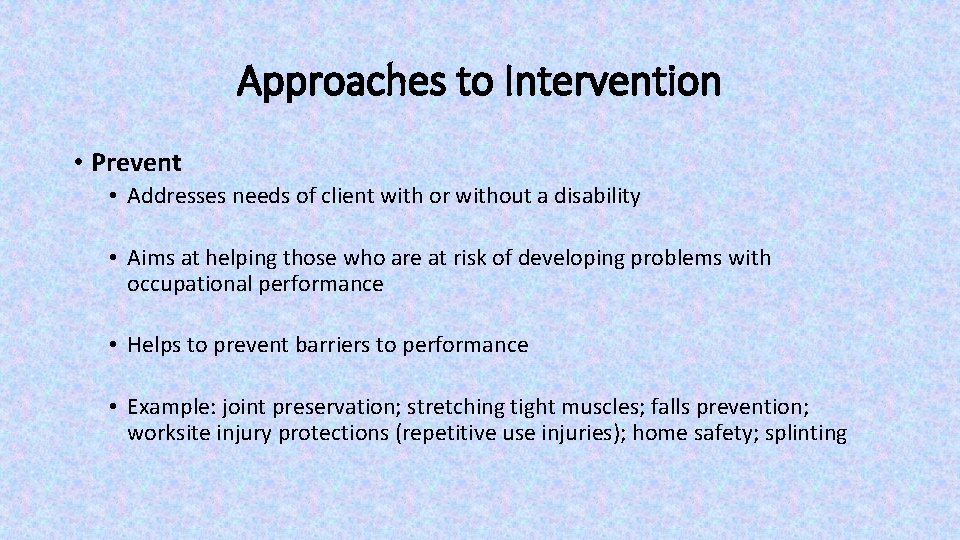
Approaches to Intervention • Prevent • Addresses needs of client with or without a disability • Aims at helping those who are at risk of developing problems with occupational performance • Helps to prevent barriers to performance • Example: joint preservation; stretching tight muscles; falls prevention; worksite injury protections (repetitive use injuries); home safety; splinting
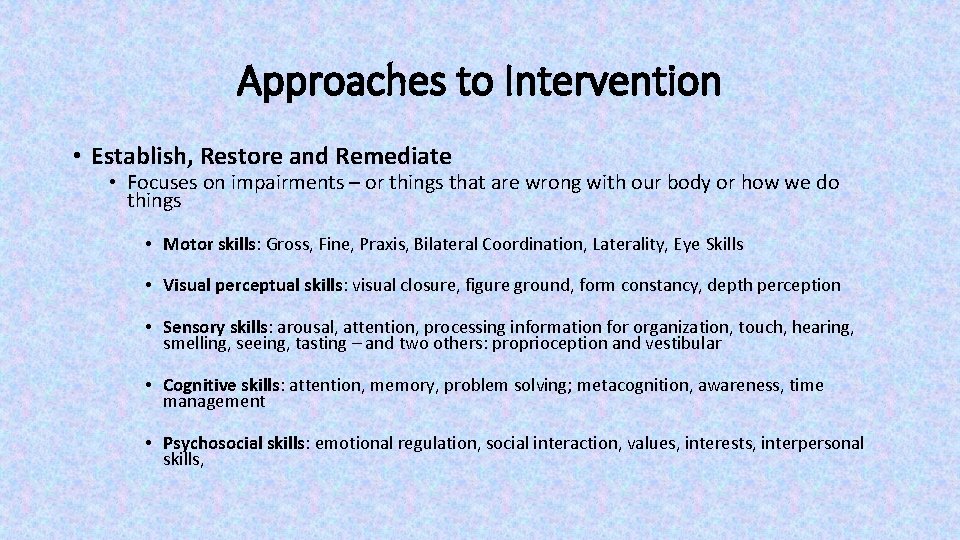
Approaches to Intervention • Establish, Restore and Remediate • Focuses on impairments – or things that are wrong with our body or how we do things • Motor skills: Gross, Fine, Praxis, Bilateral Coordination, Laterality, Eye Skills • Visual perceptual skills: visual closure, figure ground, form constancy, depth perception • Sensory skills: arousal, attention, processing information for organization, touch, hearing, smelling, seeing, tasting – and two others: proprioception and vestibular • Cognitive skills: attention, memory, problem solving; metacognition, awareness, time management • Psychosocial skills: emotional regulation, social interaction, values, interests, interpersonal skills,