
Key Features of Nixons Politics and Domestic Policies
- Slides: 34
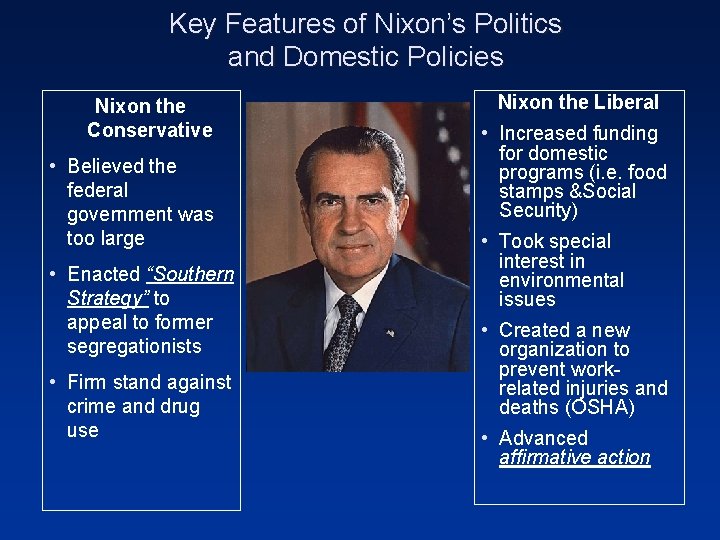
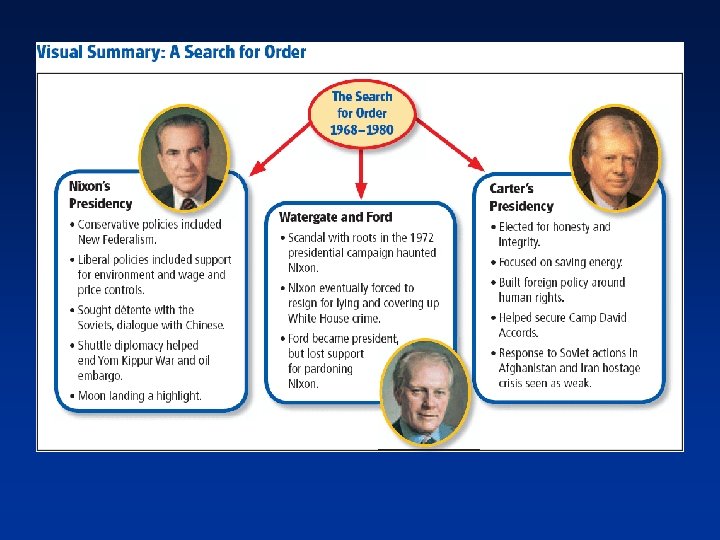
Key Features of Nixon’s Politics and Domestic Policies Nixon the Conservative • Believed the federal government was too large • Enacted “Southern Strategy” to appeal to former segregationists • Firm stand against crime and drug use Nixon the Liberal • Increased funding for domestic programs (i. e. food stamps &Social Security) • Took special interest in environmental issues • Created a new organization to prevent workrelated injuries and deaths (OSHA) • Advanced affirmative action
Nixon’s Politics and Domestic Policies Environmentalism Southern Strategy Drugs and Crime • Nixon wanted to expand his support in the Democratic south • Opposed federal • Rachel Carson’s Silent Spring court rulings that put limits on the • Massive Earth Day power of the demonstrations in 1970 police. • Signed the Clean Air Act • Sought to name conservative • Act sought to regulate levels judges to federal of air pollution created by courts factories and other sources. • Filled four • Worked to establish the openings on the Environmental Protection Supreme Court Agency • Tried to weaken the 1965 Voting Rights Act • Urged a slowdown in forced integration • Opposed busing
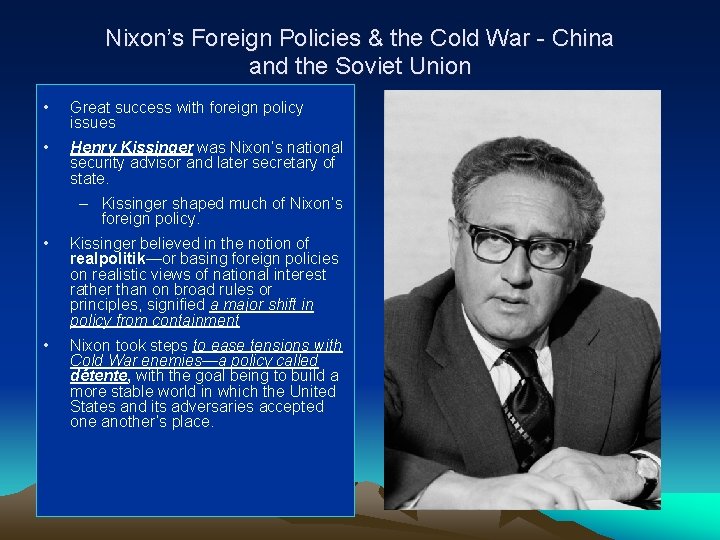
Nixon’s Foreign Policies & the Cold War - China and the Soviet Union • Great success with foreign policy issues • Henry Kissinger was Nixon’s national security advisor and later secretary of state. – Kissinger shaped much of Nixon’s foreign policy. • Kissinger believed in the notion of realpolitik—or basing foreign policies on realistic views of national interest rather than on broad rules or principles, signified a major shift in policy from containment • Nixon took steps to ease tensions with Cold War enemies—a policy called détente, with the goal being to build a more stable world in which the United States and its adversaries accepted one another’s place.
Nixon’s Foreign Policies The Soviet Union China • In 1969 Nixon began talks with the Soviet Union in order to slow the arms race. • Nixon wanted to improve relations with the Communist People’s Republic of China. • Known as the Strategic Arms Limitations Talks (SALT) • Believed that friendlier relations with China would force a more cooperative relationship with the Soviet Union (China’s rival). • Both nations had increased their number of weapons and made innovations in weapons technology (Ex. antiballistic missiles, or ABMs). • In 1972 Nixon and Leonid Brezhnev agreed to an ABM treaty. • Following this round of talks (now called SALT I), negotiations began on a second round of discussions. • His efforts were done secretly • Nixon surprised Americans by visiting China in 1972 where he met with Chinese leaders and Mao Zedong. • They agreed to disagree about Taiwan.
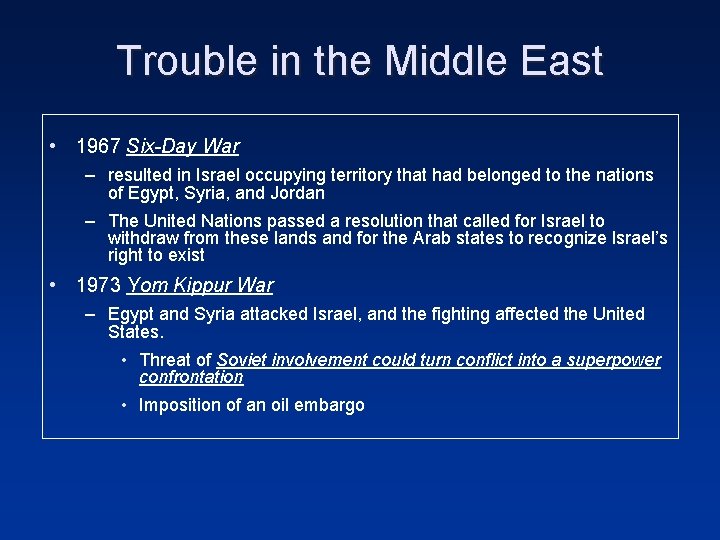
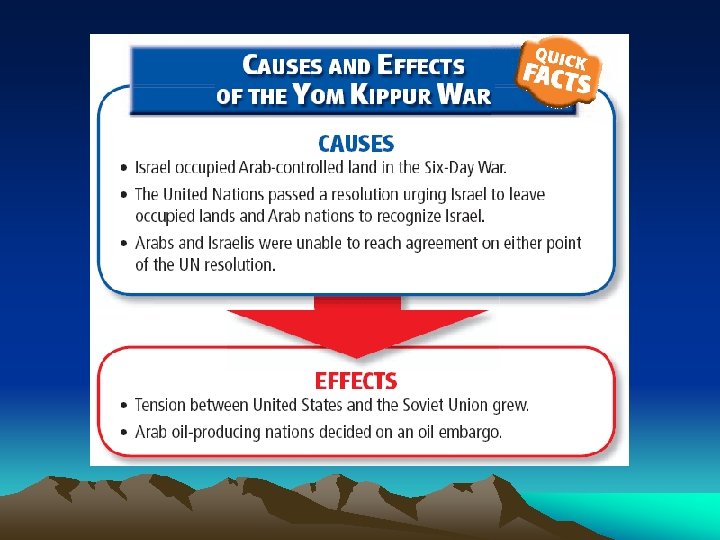
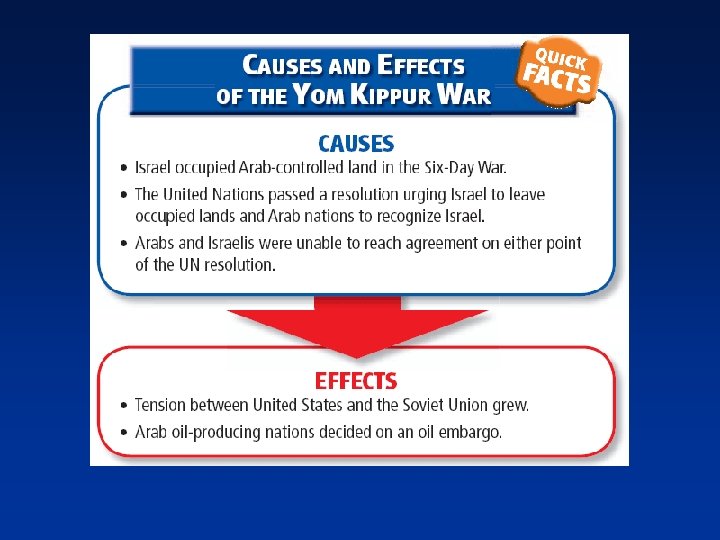
Trouble in the Middle East • 1967 Six-Day War – resulted in Israel occupying territory that had belonged to the nations of Egypt, Syria, and Jordan – The United Nations passed a resolution that called for Israel to withdraw from these lands and for the Arab states to recognize Israel’s right to exist • 1973 Yom Kippur War – Egypt and Syria attacked Israel, and the fighting affected the United States. • Threat of Soviet involvement could turn conflict into a superpower confrontation • Imposition of an oil embargo
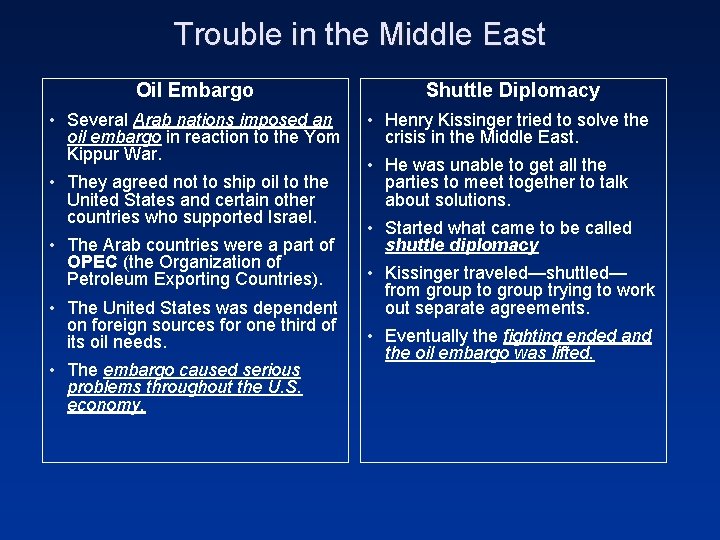
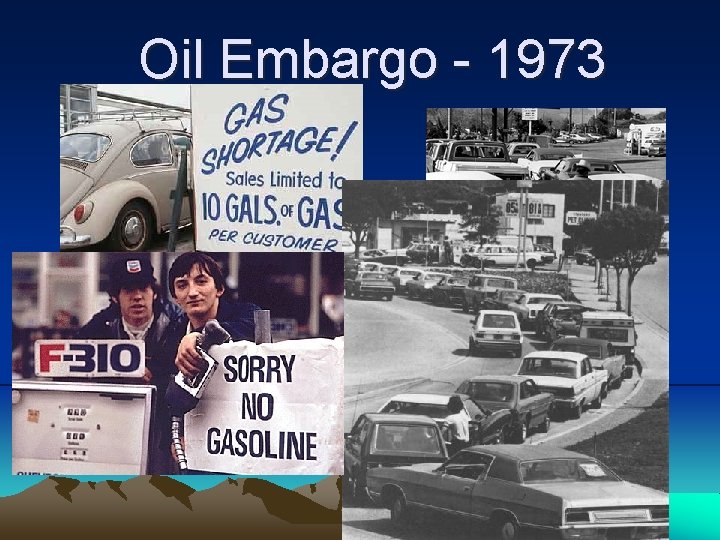
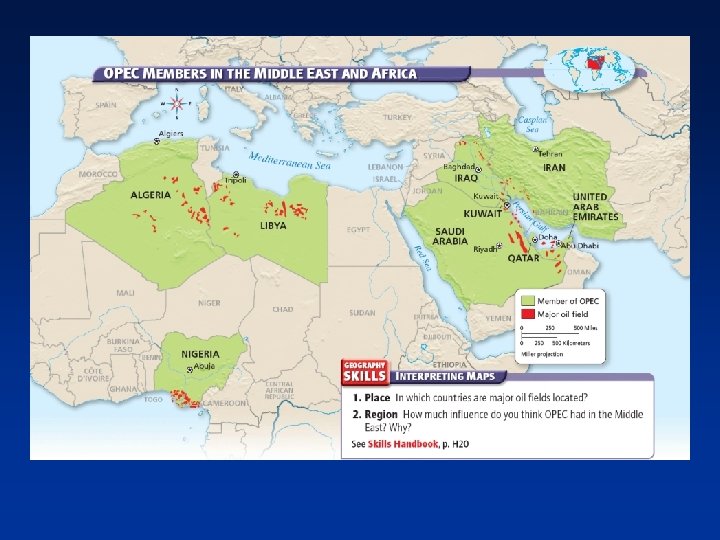
Trouble in the Middle East Oil Embargo Shuttle Diplomacy • Several Arab nations imposed an oil embargo in reaction to the Yom Kippur War. • Henry Kissinger tried to solve the crisis in the Middle East. • They agreed not to ship oil to the United States and certain other countries who supported Israel. • The Arab countries were a part of OPEC (the Organization of Petroleum Exporting Countries). • The United States was dependent on foreign sources for one third of its oil needs. • The embargo caused serious problems throughout the U. S. economy. • He was unable to get all the parties to meet together to talk about solutions. • Started what came to be called shuttle diplomacy • Kissinger traveled—shuttled— from group to group trying to work out separate agreements. • Eventually the fighting ended and the oil embargo was lifted.
Oil Embargo - 1973
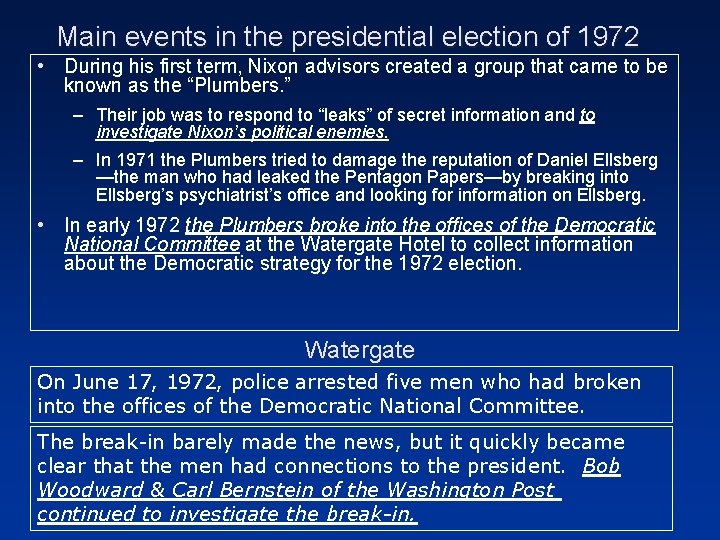
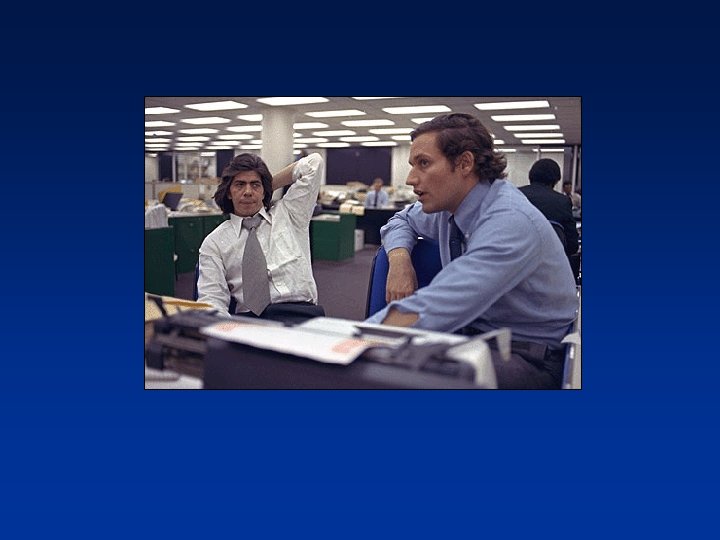
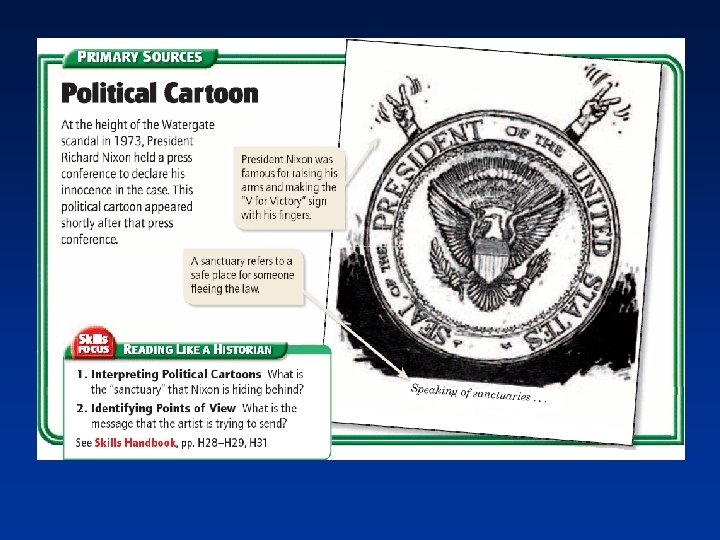
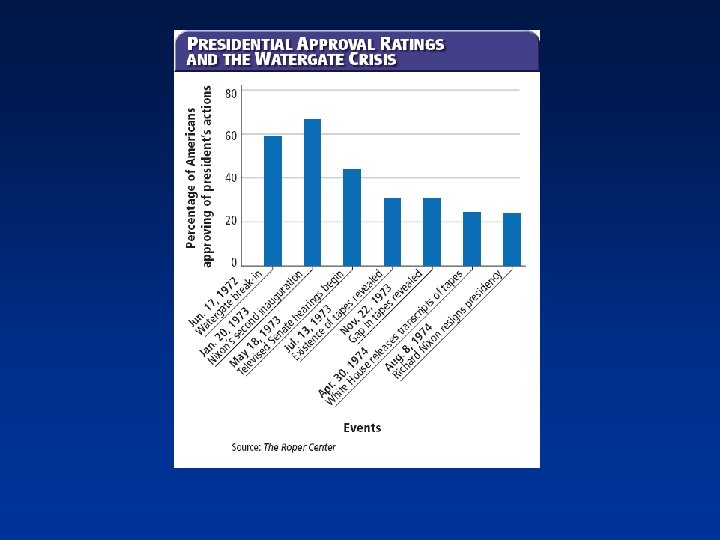
Main events in the presidential election of 1972 • During his first term, Nixon advisors created a group that came to be known as the “Plumbers. ” – Their job was to respond to “leaks” of secret information and to investigate Nixon’s political enemies. – In 1971 the Plumbers tried to damage the reputation of Daniel Ellsberg —the man who had leaked the Pentagon Papers—by breaking into Ellsberg’s psychiatrist’s office and looking for information on Ellsberg. • In early 1972 the Plumbers broke into the offices of the Democratic National Committee at the Watergate Hotel to collect information about the Democratic strategy for the 1972 election. Watergate On June 17, 1972, police arrested five men who had broken into the offices of the Democratic National Committee. The break-in barely made the news, but it quickly became clear that the men had connections to the president. Bob Woodward & Carl Bernstein of the Washington Post continued to investigate the break-in.
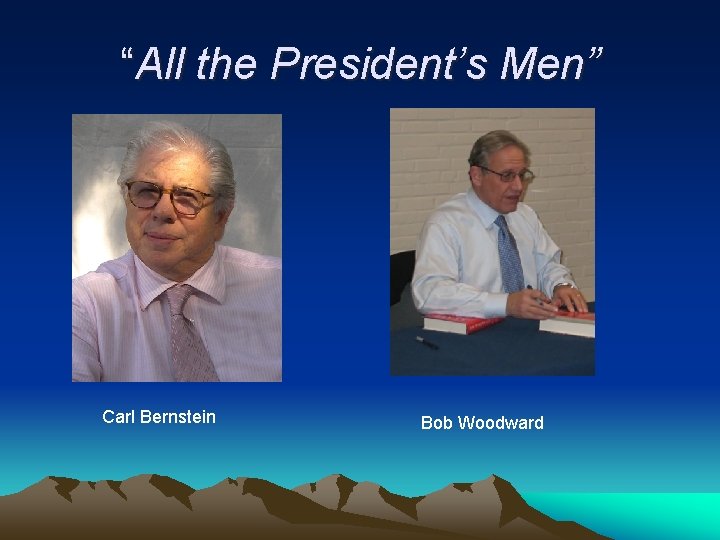
“All the President’s Men” Carl Bernstein Bob Woodward
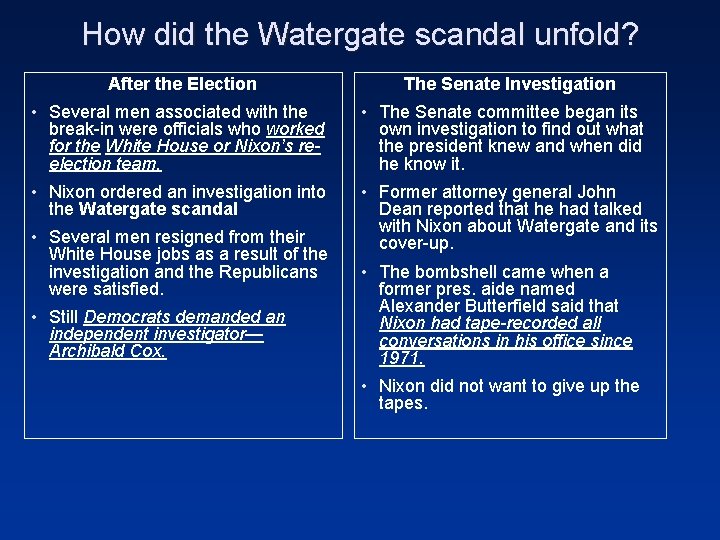
How did the Watergate scandal unfold? After the Election The Senate Investigation • Several men associated with the break-in were officials who worked for the White House or Nixon’s reelection team. • The Senate committee began its own investigation to find out what the president knew and when did he know it. • Nixon ordered an investigation into the Watergate scandal • Former attorney general John Dean reported that he had talked with Nixon about Watergate and its cover-up. • Several men resigned from their White House jobs as a result of the investigation and the Republicans were satisfied. • Still Democrats demanded an independent investigator— Archibald Cox. • The bombshell came when a former pres. aide named Alexander Butterfield said that Nixon had tape-recorded all conversations in his office since 1971. • Nixon did not want to give up the tapes.
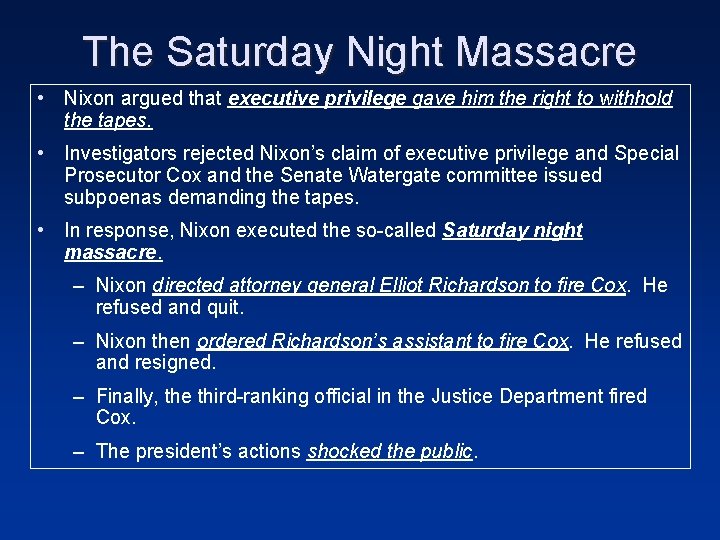
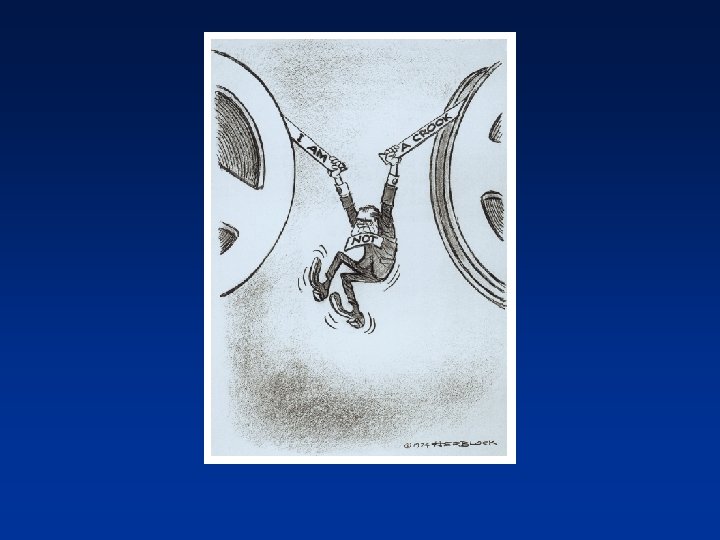
The Saturday Night Massacre • Nixon argued that executive privilege gave him the right to withhold the tapes. • Investigators rejected Nixon’s claim of executive privilege and Special Prosecutor Cox and the Senate Watergate committee issued subpoenas demanding the tapes. • In response, Nixon executed the so-called Saturday night massacre. – Nixon directed attorney general Elliot Richardson to fire Cox. He refused and quit. – Nixon then ordered Richardson’s assistant to fire Cox. He refused and resigned. – Finally, the third-ranking official in the Justice Department fired Cox. – The president’s actions shocked the public.
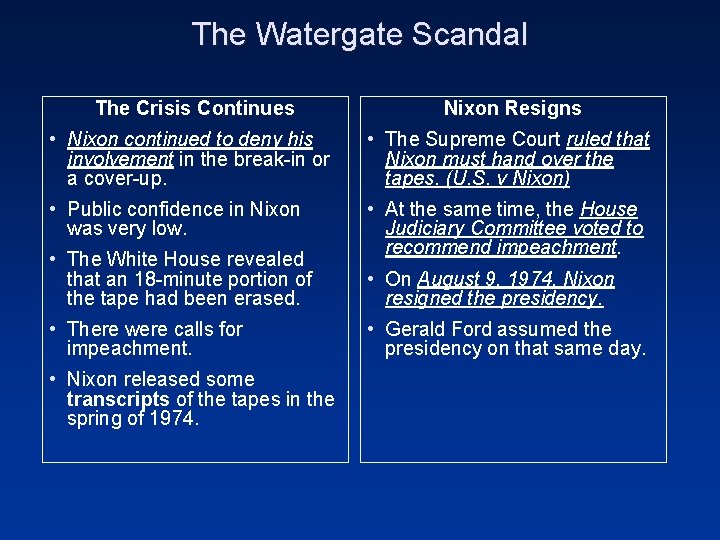
The Watergate Scandal The Crisis Continues Nixon Resigns • Nixon continued to deny his involvement in the break-in or a cover-up. • The Supreme Court ruled that Nixon must hand over the tapes. (U. S. v Nixon) • Public confidence in Nixon was very low. • At the same time, the House Judiciary Committee voted to recommend impeachment. • The White House revealed that an 18 -minute portion of the tape had been erased. • There were calls for impeachment. • Nixon released some transcripts of the tapes in the spring of 1974. • On August 9, 1974, Nixon resigned the presidency. • Gerald Ford assumed the presidency on that same day.
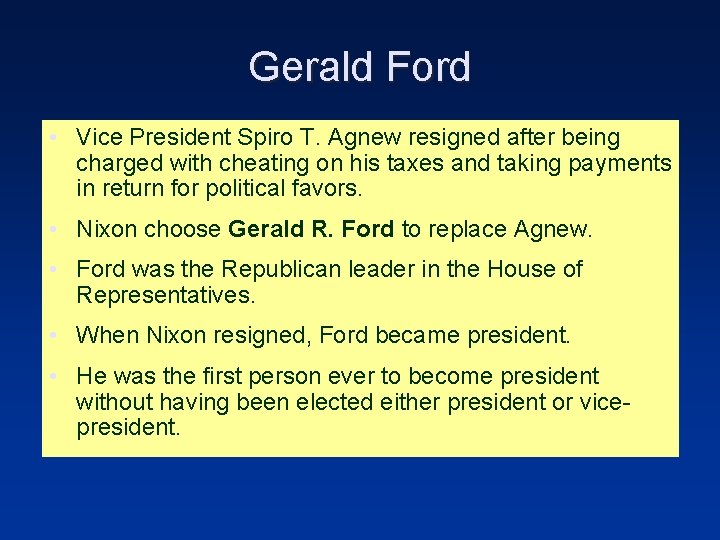
Gerald Ford • Vice President Spiro T. Agnew resigned after being charged with cheating on his taxes and taking payments in return for political favors. • Nixon choose Gerald R. Ford to replace Agnew. • Ford was the Republican leader in the House of Representatives. • When Nixon resigned, Ford became president. • He was the first person ever to become president without having been elected either president or vicepresident.
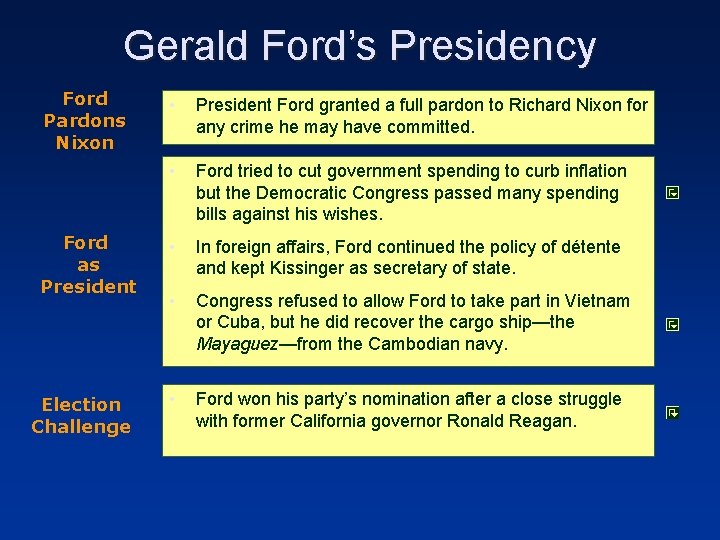
Gerald Ford’s Presidency Ford Pardons Nixon Ford as President Election Challenge • President Ford granted a full pardon to Richard Nixon for any crime he may have committed. • Ford tried to cut government spending to curb inflation but the Democratic Congress passed many spending bills against his wishes. • In foreign affairs, Ford continued the policy of détente and kept Kissinger as secretary of state. • Congress refused to allow Ford to take part in Vietnam or Cuba, but he did recover the cargo ship—the Mayaguez—from the Cambodian navy. • Ford won his party’s nomination after a close struggle with former California governor Ronald Reagan.
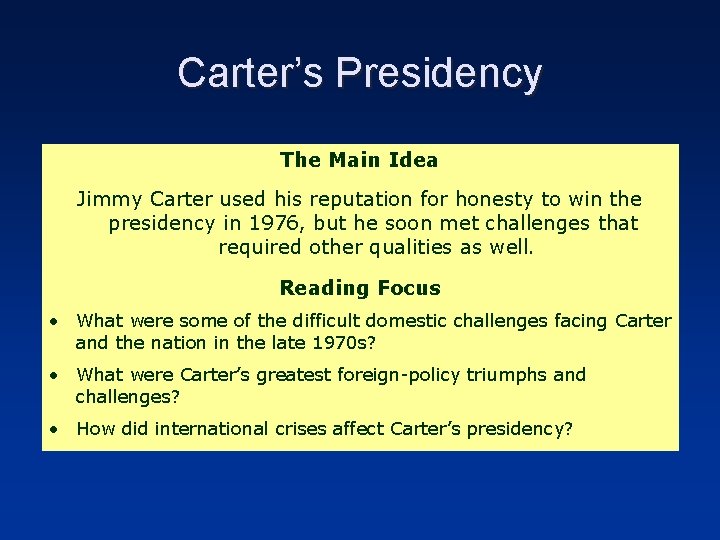
Carter’s Presidency The Main Idea Jimmy Carter used his reputation for honesty to win the presidency in 1976, but he soon met challenges that required other qualities as well. Reading Focus • What were some of the difficult domestic challenges facing Carter and the nation in the late 1970 s? • What were Carter’s greatest foreign-policy triumphs and challenges? • How did international crises affect Carter’s presidency?
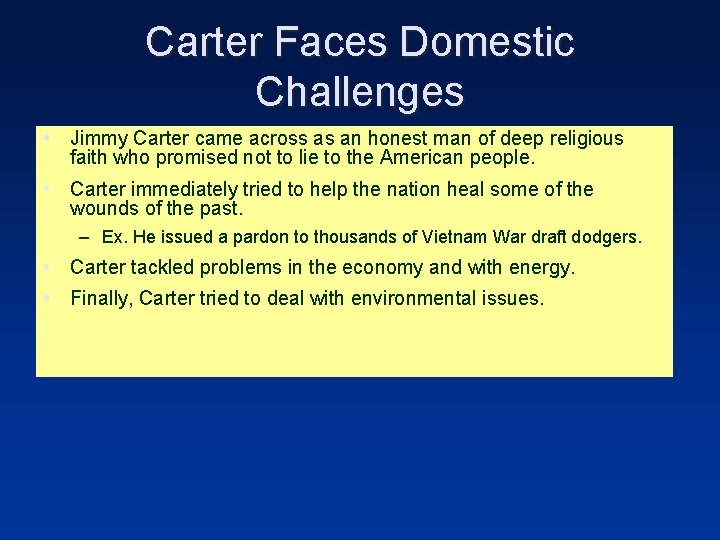
Carter Faces Domestic Challenges • Jimmy Carter came across as an honest man of deep religious faith who promised not to lie to the American people. • Carter immediately tried to help the nation heal some of the wounds of the past. – Ex. He issued a pardon to thousands of Vietnam War draft dodgers. • Carter tackled problems in the economy and with energy. • Finally, Carter tried to deal with environmental issues.
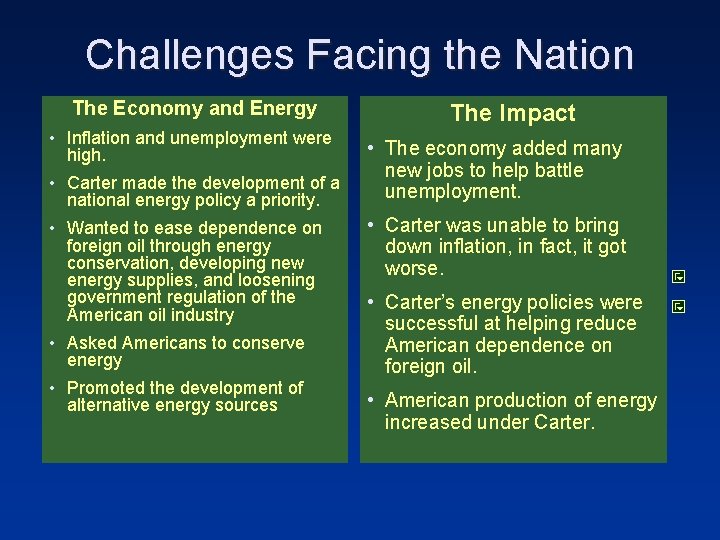
Challenges Facing the Nation The Economy and Energy • Inflation and unemployment were high. • Carter made the development of a national energy policy a priority. • Wanted to ease dependence on foreign oil through energy conservation, developing new energy supplies, and loosening government regulation of the American oil industry • Asked Americans to conserve energy • Promoted the development of alternative energy sources The Impact • The economy added many new jobs to help battle unemployment. • Carter was unable to bring down inflation, in fact, it got worse. • Carter’s energy policies were successful at helping reduce American dependence on foreign oil. • American production of energy increased under Carter.
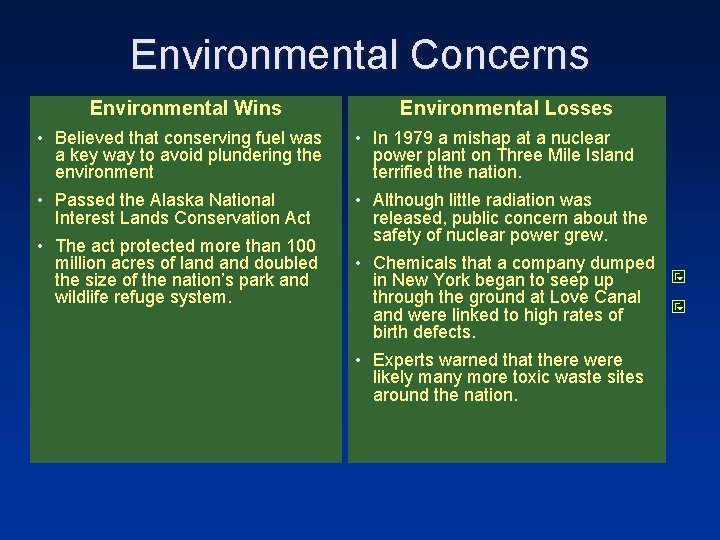
Environmental Concerns Environmental Wins Environmental Losses • Believed that conserving fuel was a key way to avoid plundering the environment • In 1979 a mishap at a nuclear power plant on Three Mile Island terrified the nation. • Passed the Alaska National Interest Lands Conservation Act • Although little radiation was released, public concern about the safety of nuclear power grew. • The act protected more than 100 million acres of land doubled the size of the nation’s park and wildlife refuge system. • Chemicals that a company dumped in New York began to seep up through the ground at Love Canal and were linked to high rates of birth defects. • Experts warned that there were likely many more toxic waste sites around the nation.
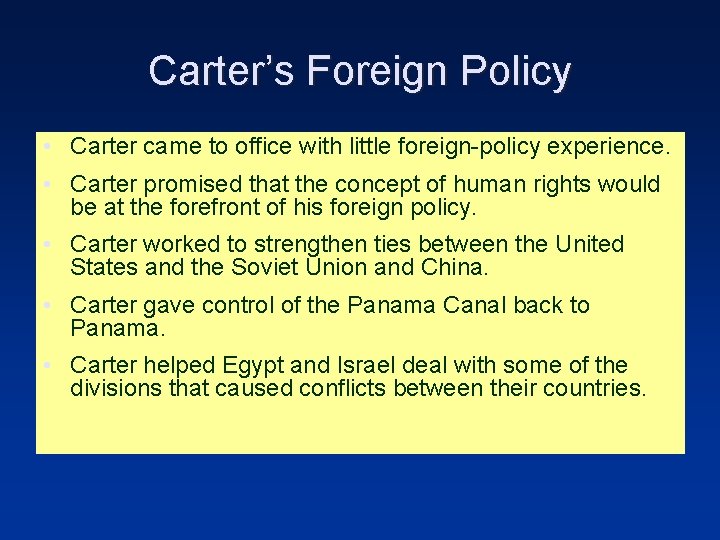
Carter’s Foreign Policy • Carter came to office with little foreign-policy experience. • Carter promised that the concept of human rights would be at the forefront of his foreign policy. • Carter worked to strengthen ties between the United States and the Soviet Union and China. • Carter gave control of the Panama Canal back to Panama. • Carter helped Egypt and Israel deal with some of the divisions that caused conflicts between their countries.
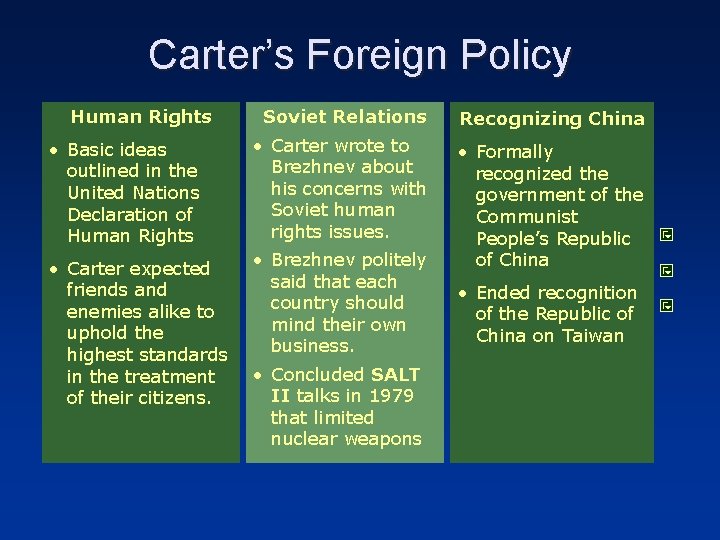
Carter’s Foreign Policy Human Rights Soviet Relations Recognizing China • Basic ideas outlined in the United Nations Declaration of Human Rights • Carter wrote to Brezhnev about his concerns with Soviet human rights issues. • Carter expected friends and enemies alike to uphold the highest standards in the treatment of their citizens. • Brezhnev politely said that each country should mind their own business. • Formally recognized the government of the Communist People’s Republic of China • Concluded SALT II talks in 1979 that limited nuclear weapons • Ended recognition of the Republic of China on Taiwan
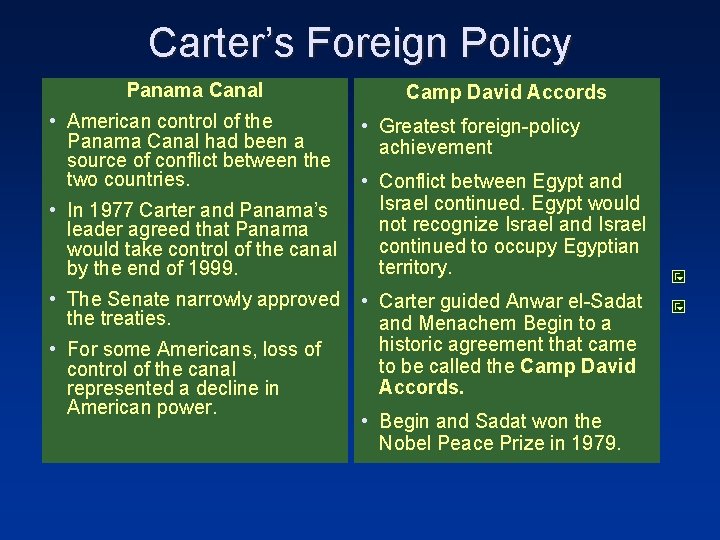
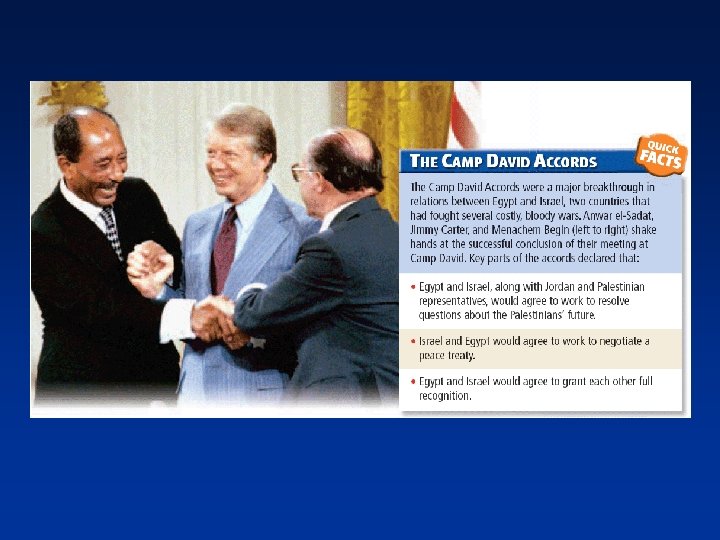
Carter’s Foreign Policy Panama Canal • American control of the Panama Canal had been a source of conflict between the two countries. • In 1977 Carter and Panama’s leader agreed that Panama would take control of the canal by the end of 1999. • The Senate narrowly approved the treaties. • For some Americans, loss of control of the canal represented a decline in American power. Camp David Accords • Greatest foreign-policy achievement • Conflict between Egypt and Israel continued. Egypt would not recognize Israel and Israel continued to occupy Egyptian territory. • Carter guided Anwar el-Sadat and Menachem Begin to a historic agreement that came to be called the Camp David Accords. • Begin and Sadat won the Nobel Peace Prize in 1979.
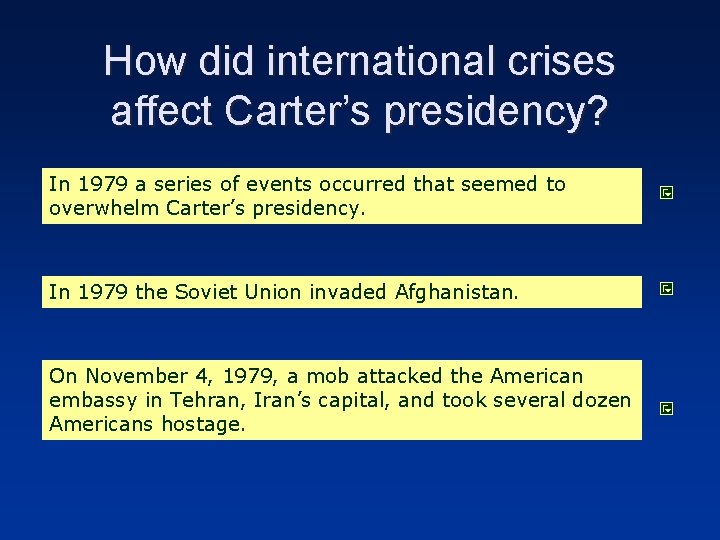
How did international crises affect Carter’s presidency? In 1979 a series of events occurred that seemed to overwhelm Carter’s presidency. In 1979 the Soviet Union invaded Afghanistan. On November 4, 1979, a mob attacked the American embassy in Tehran, Iran’s capital, and took several dozen Americans hostage.
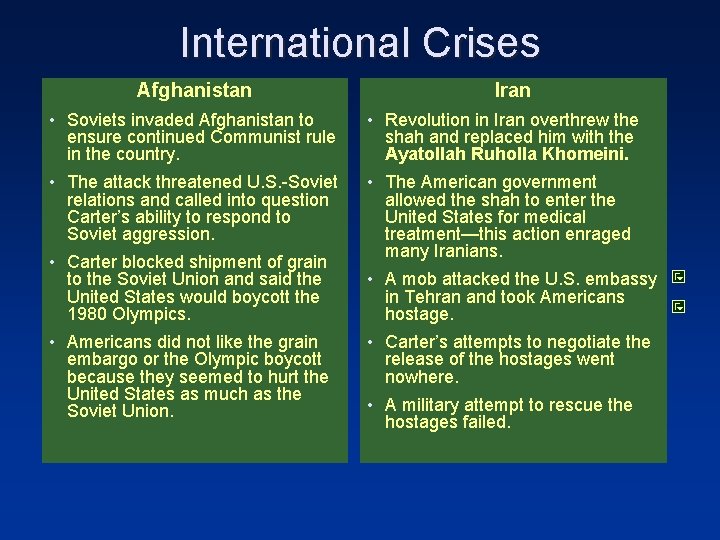
International Crises Afghanistan Iran • Soviets invaded Afghanistan to ensure continued Communist rule in the country. • Revolution in Iran overthrew the shah and replaced him with the Ayatollah Ruholla Khomeini. • The attack threatened U. S. -Soviet relations and called into question Carter’s ability to respond to Soviet aggression. • The American government allowed the shah to enter the United States for medical treatment—this action enraged many Iranians. • Carter blocked shipment of grain to the Soviet Union and said the United States would boycott the 1980 Olympics. • Americans did not like the grain embargo or the Olympic boycott because they seemed to hurt the United States as much as the Soviet Union. • A mob attacked the U. S. embassy in Tehran and took Americans hostage. • Carter’s attempts to negotiate the release of the hostages went nowhere. • A military attempt to rescue the hostages failed.
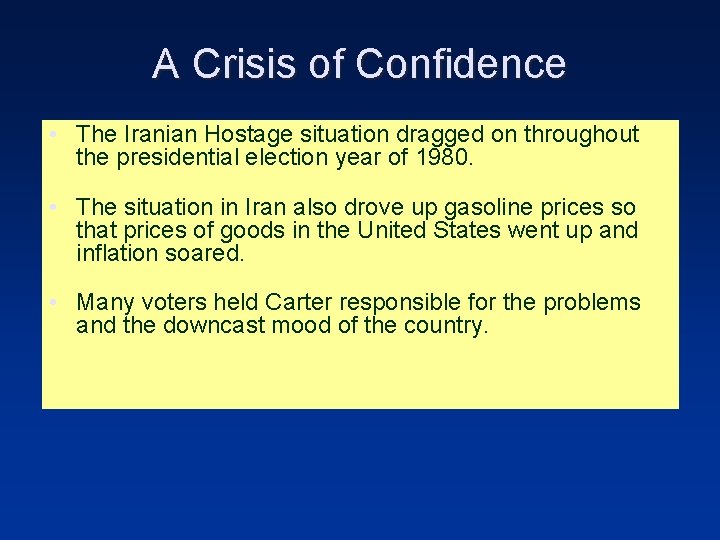
A Crisis of Confidence • The Iranian Hostage situation dragged on throughout the presidential election year of 1980. • The situation in Iran also drove up gasoline prices so that prices of goods in the United States went up and inflation soared. • Many voters held Carter responsible for the problems and the downcast mood of the country.