
Key Elements of Vision Fulfillment I What are







- Slides: 47
Key Elements of Vision Fulfillment I. What are the five main elements contributing to vision success or fulfillment? There are five tools that will assist in bringing one’s vision to fulfillment or completion. A. A Concise Mission Statement B. A Consistent Vision Statement C. Long Term and Short Term Goals D. Clearly Articulated Values E. Appropriate Strategies or Methodologies
II. What is a mission statement and what is its purpose? A. What is a mission statement? A mission statement is a brief, written statement reflecting the primary purpose for which the organization has been established. A mission statement answers the question, “Why do we exist? ”
B. What is the purpose of a mission statement? A good mission statement will accomplish several things. 1. A mission statement will explain your intentions to people both inside and outside of the organization. 2. A mission statement will help give a sense of direction to everyone in the organization.
3. A mission statement will help keep the organization tied to purpose. 4. A mission statement will help keep the organization focused on the “main thing. ” 5. A mission statement will promote unity throughout the organization. 6. A mission statement helps you to set your agenda for the present and near future.
7. A mission statement will serve as a guide to the decision making process. 8. A mission statement will motivate people to be personally involved and committed.
C. What are the qualities of an effective mission statement? 1. An effective mission statement is broad. 2. An effective mission statement is brief. 3. An effective mission statement is clear. 4. An effective mission statement inspires.
D. How is a mission statement formulated? 1. Set aside time with your leadership group for this purpose and this purpose alone. 2. Set the stage and allow members of the group to brainstorm by responding openly to some key questions.
• Why do you believe that we exist? • What are you here for? • What do you believe we are to accomplish together? • What are your personal expectations regarding involvement in this organization? • What are the most important things that we should never lose sight of?
3. Set the group at ease by explaining that there are no right or wrong answers in this process. 4. Record and write down all comments or suggestions without any particular filter on what is being said until no new thoughts are coming forth. 5. Identify the most commonly held and most repeated concepts.
6. Attempt to bring the group to a consensus regarding the core themes. 7. Utilize the results to compose a first attempt or rough draft of the proposed statement taking into account the group consensus. 8. Work over the wording until it passes “the mother test. ”
In a local church, this process will most likely happen among the elders or leadership team of the church. It will be tempered by the fact that Christ has a vision for the church. In addition, the discussion will be guided by the vision of the senior pastor of the church.
The Mission Statement of City Life Church Long form: City Life Church exists for the purpose of reaching people with the Gospel of Jesus Christ, raising leaders for all areas of church and society and releasing ministry to extend the Kingdom of God in all spheres of influence.
Shorter form: Reaching People, Raising Leaders, Releasing Ministry Shortest form: Reaching, Raising, Releasing
III. What is a vision statement and what is its purpose? A. What is a vision statement? A vision statement is brief paragraph reflecting the translation of the organization’s mission into a specific description and details of the desired outcomes creating a concrete image of the target. A vision statement paints a picture of the future look of the organization.
B. What is the difference between a mission statement and a vision statement? 1. A mission statement defines the broad purpose for which an organization exists.
2. A vision statement defines the intended or future state of the organization in terms of its fundamental objectives and strategic direction in the fulfillment of that mission. C. What is the purpose of a vision statement?
The purpose of the vision statement is very much like the eight-fold purpose given for the mission statement above. 1. It helps to flesh out the overall mission of the church. 2. It will help dictate to the programs and specific ministries of the church. 3. It will change to adapt to the ever changing world of the future.
D. What are some guidelines for the development of a vision statement? 1. The vision statement should begin with a summary phrase that captures the essence of the vision. 2. The vision statement should reflect the nature of the vision when it is complete.
3. The vision statement should be composed of sentences that describe the best possible outcomes. 4. The vision statement should focus on outcomes that are a reachable distance away (five to ten years). 5. The vision statement should be challenging. 6. The vision statement is not the same as goals.
7. The vision statement should be stated in the present tense (Heb. 11: 1). 8. The vision statement will need to be periodically evaluated and, if necessary, updated.
The Vision Statement of City Life Church The vision of City Life Church is to be an apostolic or a resource church that reflects a strong commitment to prayer, the word of God, discipleship, spirit-filled worship, authentic community, multicultural and multigenerational expression, team ministry and world outreach. It seeks exemplify a spirit of generosity by lifting, equipping and providing resources to the poor, to believers…
…to church leaders and to local churches assisting them in entering into their full destiny in God. This vision includes the establishing of a numerically strong pattern church, a ministry training center, online resources for all phases of church life and the establishment of like churches throughout the world.
II. How do long term and short term goals contribute to vision fulfillment? For more details on long and short term goals see the course Life Management II, Lesson 2 -3. A. What is the difference between purpose, goals and achievements?
1. Purpose or mission is that thing for which a person or company is born. It is their reason for existing. 2. A goal is a long or short term target or proposal that you place in front of yourself as a specific step or challenge toward accomplishing your ultimate purpose.
3. Achievement is the realization of a goal or purpose. It is to finish, to carry out, to bring to an end or to obtain the final result. The achievement of goals is motivation in itself to set new and higher goals. B. Why is it important to have goals? 1. Having goals makes life meaningful, interesting and exciting.
2. Goals are an effective way to measure our effort. 3. Goals give us targets toward which to aim our faith and our confession. 4. Goals help us to stay focused and motivated. 5. Goal setting forces us to stretch and move from mediocrity to excellence.
6. Goals can keep us moving on the path toward ultimate success. 7. Goal setting and achievement keeps us fresh and alive. C. What are some characteristics of a good goal? For goals to be effective they should have the following characteristics:
1. Goals should be specific. 2. Goals should be realistic and achievable. 3. Goals should be measurable. 4. Goals should be timely. D. What are some additional guidelines for setting goals?
When setting goals: 1. Calculate the amount of time, energy and effort that is needed to accomplish the whole task (Luke 14: 24 -33). 2. Anticipate distractions, hindrances and obstacles that will most likely be in your path.
3. Determine if you are setting your goals too high or too low. 4. Determine the practical steps that must be taken toward the realization of your goal. 5. Write your goals and use them as prayer points before the Lord.
6. When specific goals are not reached, set new ones immediately based on what you learned in the process.
III. What are values and how do they help to promote vision fulfillment? A. What are values? 1. Values are ideals that are accepted by a person or a group. 2. Values are core beliefs to which people have an emotional bond.
3. Values are underlying principles that shape a person’s views of right and wrong. 4. Values are guiding principles that determine what is desirable in life especially as it pertains to personal conduct. B. What are the characteristics of values and value statements?
1. Values are not a measure of what is right or wrong. 2. Values affect behavior. 3. Values are unique and personal. 4. Values do not define the work, but influence how we go about our work.
C. How do clearly articulated core values promote vision fulfillment? The core values of an organization are shared values that serve as a basis for our work and conduct. They are those primary principles that we have defined as the “non-negotiables” in our life and ministry. They are the solid ground for which we are prepared to live and die regardless of the changes in society, government or technology.
1. They help us to determine the means by which we will progress. 2. They help guide us in the decision making process. 3. They help us to filter our options. 4. They help us articulate who we are and what we truly stand for. 5. They help us to bring others into our vision. 6. They help us to know what to celebrate or reward in the process.
7. They help us to explain why we do things the way we do.
IV. How do you develop and evaluate strategies that will ensure vision fulfillment? A. What is a strategy? 1. A strategy is a systematic plan of action. 2. A strategy is a concrete, long-term plan of action designed to achieve a specific goal.
3. A strategy is a means by which a vision is realized. 4. A strategy is a way of achieving the goal in a way that is consistent with the core values of the organization. Strategy answers the question, “What should we be doing now? ”
“The goals you set for yourself and the strategies you choose become your blueprint or plan. Strategies are like recipes: choose the right ingredients, mix them in the correct proportions, and you will always produce the same predictable results: in this case financial success. The success strategies for managing money and building wealth are called Money Strategies. By learning to use money strategies as a part of your day-to-day life, financial frustration and failure will become a thing of the past. ”
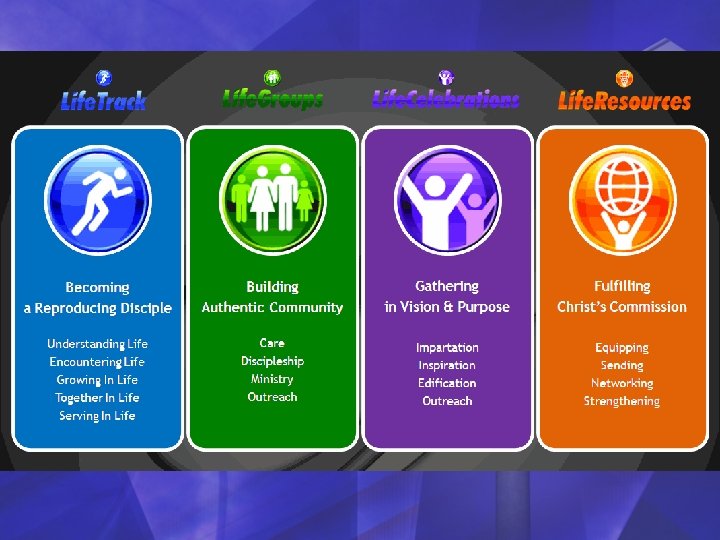
B. What is the strategy of City Life Church to achieve vision? City Life Church seeks to achieve vision through four main channels. 1. Life Track The Life Track is designed to develop genuine converts and reproducing disciples.
2. Life Groups The Life Groups are designed to foster deeper discipleship and authentic community among the believers. 3. Life Celebrations are designed to celebrate the Lord and the fruit of the other tracks in a corporate context.
4. Life Resources is designed to assist in fulfilling the commission of Christ by providing resources to the other track and to the world, by equipping leaders, by strengthening leaders and churches outside of the local church and by planting other churches.