
Key DistributionManagement and Authentication two closely related subjects
Key Distribution/Management and Authentication two closely related subjects n why? n
Key Distribution n symmetric encryption schemes require both parties to share a common secret key – issue is how to securely distribute this key without revealing it to an adversary n many attacks are based on poor key management and distribution – rather than breaking the codes n This is, actually, the most difficult problem in developing secure systems
Key Distribution various key distribution alternatives for parties A and B: 1. A can select key and physically deliver to B – – does not scale for a large and distributed group how many keys do we need for N users? 2. third party can select and physically deliver key to A&B – – similar comment as 1 sometimes finding a “trusted” third party is another problem 3. if A & B have communicated previously, they can use previous key to encrypt a new key – good option but initially several keys need to be distributed 4. if A & B have secure communications with a third party C, C can relay key between A & B on demand – only N master keys are enough
Session Key / Master Key The idea of having a key-encryption-key (master key) to generate random and temporary session keys n can be implemented in several ways n – Basic D-H is such an example • public/private keys are master keys, exchanged key is a session key – Kerberos is another example (will see) – SSL uses three layers (will see) • D-H for master key, master key for the session key
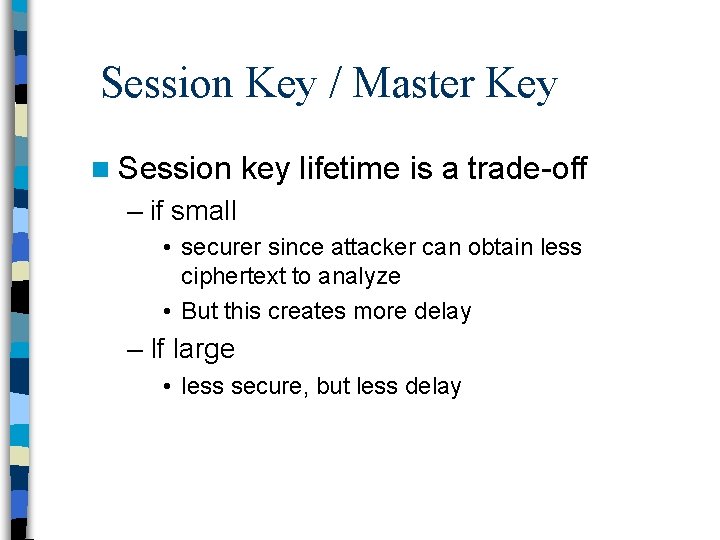
Session Key / Master Key n Session key lifetime is a trade-off – if small • securer since attacker can obtain less ciphertext to analyze • But this creates more delay – If large • less secure, but less delay
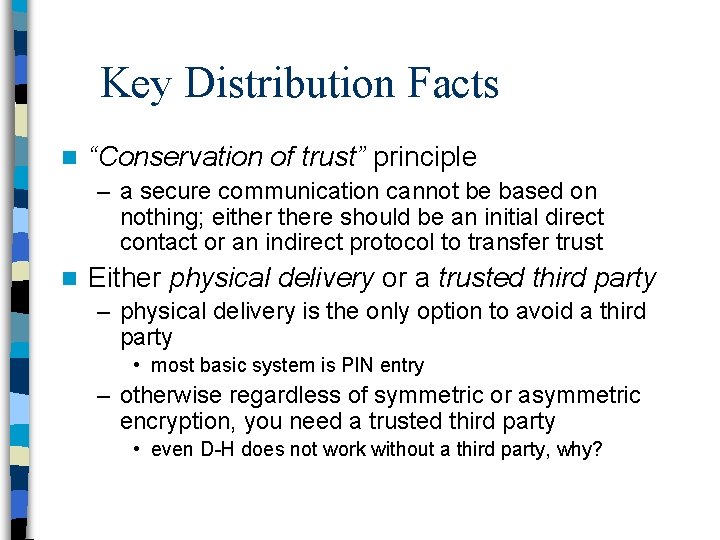
Key Distribution Facts n “Conservation of trust” principle – a secure communication cannot be based on nothing; eithere should be an initial direct contact or an indirect protocol to transfer trust n Either physical delivery or a trusted third party – physical delivery is the only option to avoid a third party • most basic system is PIN entry – otherwise regardless of symmetric or asymmetric encryption, you need a trusted third party • even D-H does not work without a third party, why?

A Key Distribution Example Symmetric crypto based n Each user shares a symmetric master key with the KDC (Key Distribution Center) n – e. g. Ka, Kb, Kc, … – possibly physically distributed n Basic idea: – whenever a user A wants to communicate with B, it requests a session key (Ks) from KDC n Protocol is in the next slide
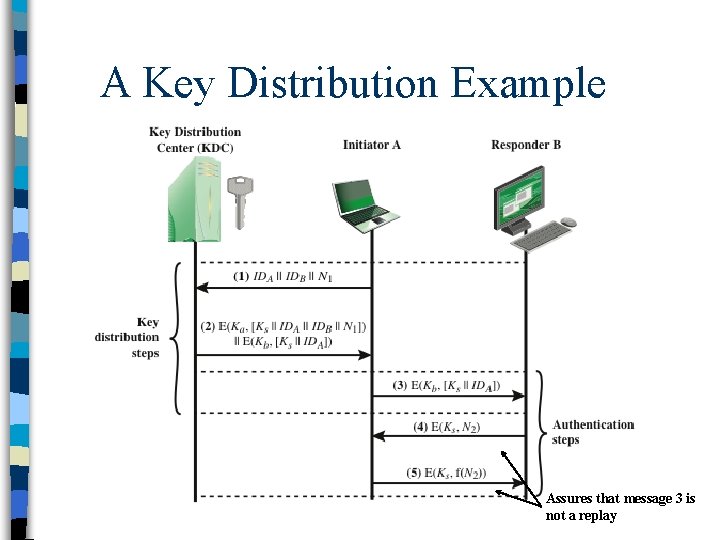
A Key Distribution Example Assures that message 3 is not a replay

Decentralized Key Distribution n Useful when there is a master key shared between parties – Actually not scalable for large systems since n(n-1)/2 master keys need to be distributed a priori to n end users.
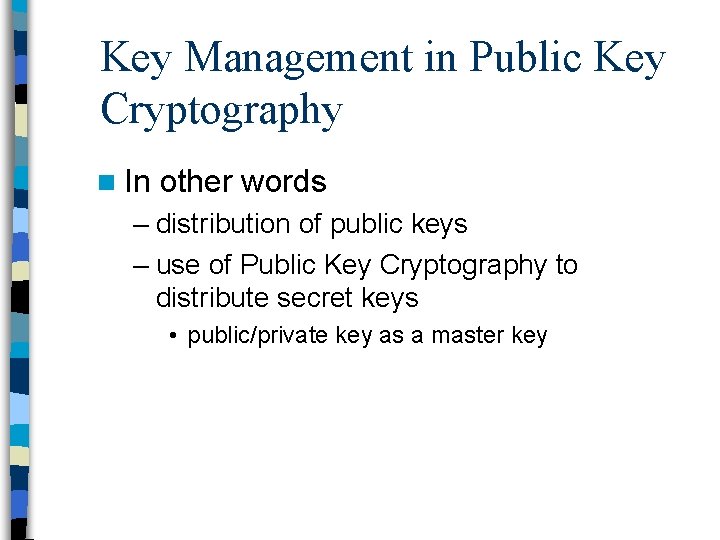
Key Management in Public Key Cryptography n In other words – distribution of public keys – use of Public Key Cryptography to distribute secret keys • public/private key as a master key
Distribution of the Public Keys the most important barrier against the deployment of PKC in applications n Basic question? n – how can I make sure about the legitimacy of a public key? – how can I make sure that Bob’s public key really belongs to Bob, not to Charlie? n Why this is so important? – Name spoofing attacks become possible • remember the man-in-the-middle attacks in anonymous Diffie-Hellman
Distribution of the Public Keys n Some methods – Public Announcement – Publicly available databases/directories – Centralized distribution – Certificates
Public Announcement n Broadcast your public key to the public – via forums, mailing lists, from personal website, whatsapp, social media, etc. – major weakness is anyone can easily pretend as yourself • so attacks are possible
Publicly available directories/databases n There exists a directory/database for {name, public key} pairs n write controlled – a trusted administrator n if administered thoroughly, good – but a proper administration is difficult • need secure mechanisms for registration, update, delete.
Centralized Distribution - Public. Key Authority n Similar to directory/database approach, but access to the directory is automated via a secure protocol – users interact with directory to obtain any desired public key securely – requires real-time access to directory when keys are needed – users should know public key for the directory n the directory/database contains {name, public key} pairs – write permit is restricted

Centralized Distribution - Public. Key Authority PROTOCOL Authentication Messages
Centralized Distribution - Public. Key Authority n What about caching the public keys at the end users? – good for performance • saves some messages – but what happens if a public key is deleted form the database/directory? • fresh copies needed or another protocol for the validity check
Centralized Distribution - Public. Key Authority n Disadvantages/Difficulties – authority is an active entity and may create a performance bottleneck – database should be kept secure to prevent unauthorized modification – The problem of registration of public-keys is still unsolved!
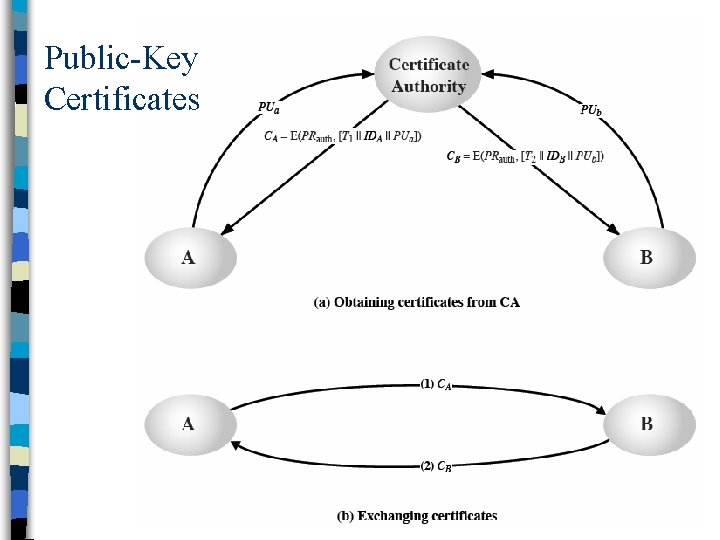
Public-Key Certificates certificates allow public key exchange without real-time access to public-key authority n a certificate binds identity to public key n – usually with other info such as period of validity, issuer’s info, cryptographic details, etc all contents signed by a trusted Certification Authority (CA) n can be verified by anyone who knows the CA public-key n CA must make sure about the identity of the certificate owner n
Public-Key Certificates
Public-Key Certificates n Certificates are widely used in practice – previous slides only show the idea n need lots of polishing for practical use – is a single CA sufficient? – what happens if the CA’s public key is not known? • how to distribute CA public keys? – what happens if a certificate is revoked? – How the users exchange their certificates in practical applications? n We will discuss the use of certificates and state-of-the-art in this area later
What can you do with securely distributed public keys? n Digital signatures – talked about them n Confidentiality (Data Encryption) – theoretically possible but slow – instead session keys can be distributed • those session keys are used for symmetric encryption
Distribution of Secret Keys using PKC n Several methods exist n Diffie-Hellman is one way n we will see some alternatives
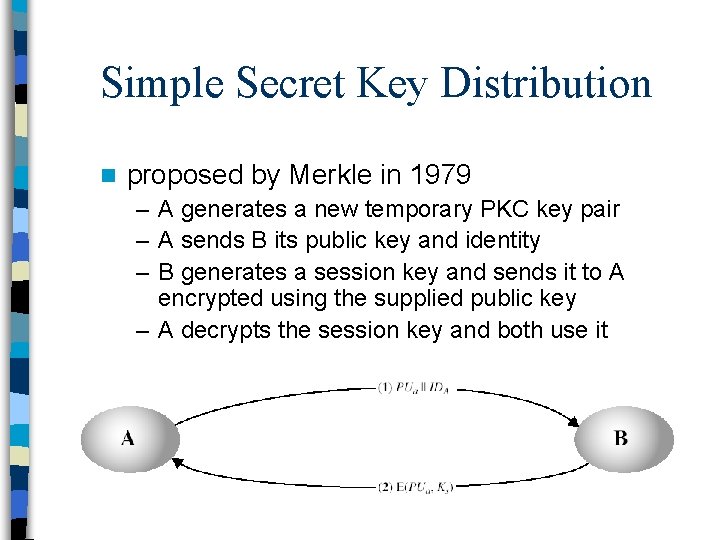
Simple Secret Key Distribution n proposed by Merkle in 1979 – A generates a new temporary PKC key pair – A sends B its public key and identity – B generates a session key and sends it to A encrypted using the supplied public key – A decrypts the session key and both use it
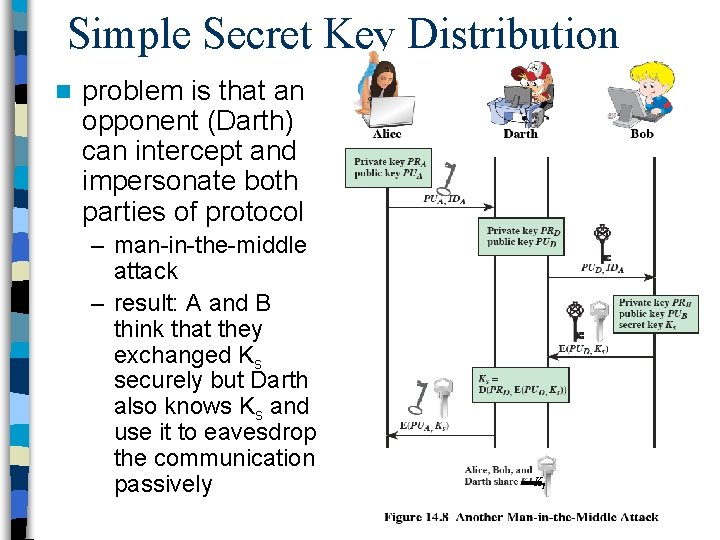
Simple Secret Key Distribution n problem is that an opponent (Darth) can intercept and impersonate both parties of protocol – man-in-the-middle attack – result: A and B think that they exchanged Ks securely but Darth also knows Ks and use it to eavesdrop the communication passively Ks
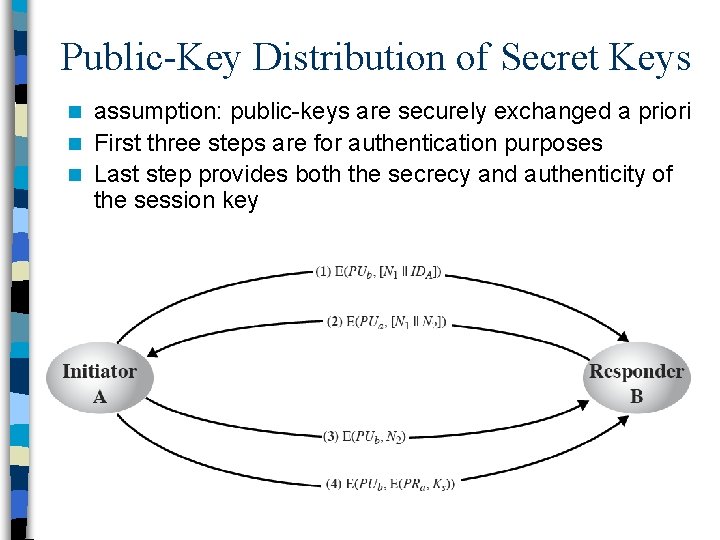
Public-Key Distribution of Secret Keys assumption: public-keys are securely exchanged a priori n First three steps are for authentication purposes n Last step provides both the secrecy and authenticity of the session key n
In practice n Most systems offer a three-level approach – use of PKC to exchange master-key – use of master-key to exchange session keys n most important advantage is at performance
A closer look to authentication n making sure of peer entity’s identity – mutual or one-way – non-repudiation is not an aim here n generally implemented as a protocol – basic idea: making sure that other party knows a common secret – also used for session key distribution n two types – message authentication • mostly one-way – peer entity authentication • connection oriented approach
Two key issues n Protection of any secret information n Timeliness – to prevent replay attacks • a valid message is copied and later resent – Why replays are bad? • at minimum, disrupt properation by presenting messages that appear genuine but actually are not • Think about a real world example!
Countermeasures - 1 n Sequence numbers – not a practical method – parties should keep track of the sequence numbers – and should take care of message losses and duplications in a secure way • complicates the protocol
Countermeasures - 2 n Timestamps – messages contain a timestamp – accept only fresh messages based on this timestamp – sometimes used, but there are some practical problems • clocks must be synchronized in a secure manner (if the timestamp generated by a party will be checked by another party) • tolerance to network delays
Countermeasures - 3 n Challenge/response – Initiator sends a nonce (a challenge phrase or number used only one-time) and expects that nonce (or a transformation of it) in the response – easier to implement – but may require extra message transfer – requires active parties • not suitable for connectionless services – and requires the generating parties to check the uniqueness of generated nonces • Using counters or timestamps as nonces helps to solve this problem
Authentication using Symmetric Encryption n We start with well-known Needham. Schroeder protocol – actually have seen it as a key distribution protocol n There exists a Key Distribution Center (KDC) – each party shares own master key with KDC – KDC generates session keys used for connections between parties – master keys are used to distribute these session keys in a secure way
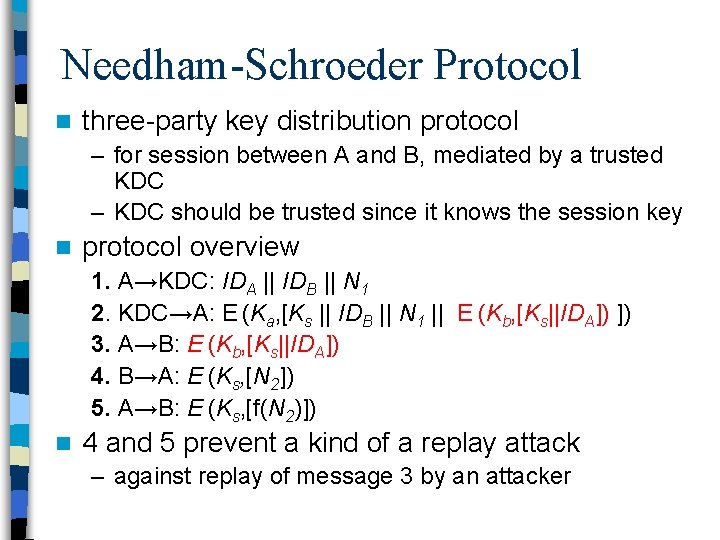
Needham-Schroeder Protocol n three-party key distribution protocol – for session between A and B, mediated by a trusted KDC – KDC should be trusted since it knows the session key n protocol overview 1. A→KDC: IDA || IDB || N 1 2. KDC→A: E (Ka, [Ks || IDB || N 1 || E (Kb, [Ks||IDA]) ]) 3. A→B: E (Kb, [Ks||IDA]) 4. B→A: E (Ks, [N 2]) 5. A→B: E (Ks, [f(N 2)]) n 4 and 5 prevent a kind of a replay attack – against replay of message 3 by an attacker
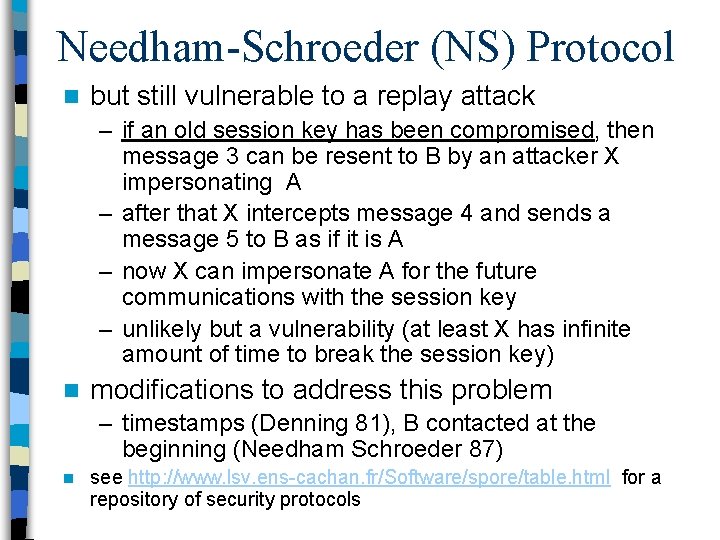
Needham-Schroeder (NS) Protocol n but still vulnerable to a replay attack – if an old session key has been compromised, then message 3 can be resent to B by an attacker X impersonating A – after that X intercepts message 4 and sends a message 5 to B as if it is A – now X can impersonate A for the future communications with the session key – unlikely but a vulnerability (at least X has infinite amount of time to break the session key) n modifications to address this problem – timestamps (Denning 81), B contacted at the beginning (Needham Schroeder 87) n see http: //www. lsv. ens-cachan. fr/Software/spore/table. html for a repository of security protocols
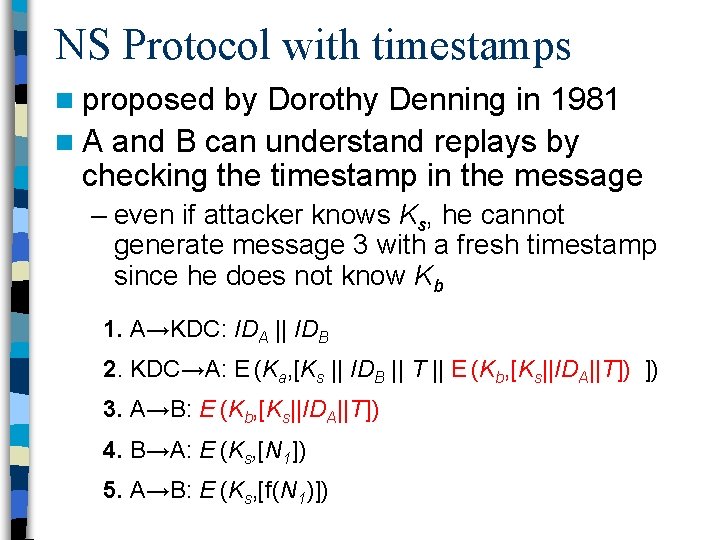
NS Protocol with timestamps n proposed by Dorothy Denning in 1981 n A and B can understand replays by checking the timestamp in the message – even if attacker knows Ks, he cannot generate message 3 with a fresh timestamp since he does not know Kb 1. A→KDC: IDA || IDB 2. KDC→A: E (Ka, [Ks || IDB || T || E (Kb, [Ks||IDA||T]) ]) 3. A→B: E (Kb, [Ks||IDA||T]) 4. B→A: E (Ks, [N 1]) 5. A→B: E (Ks, [f(N 1)])
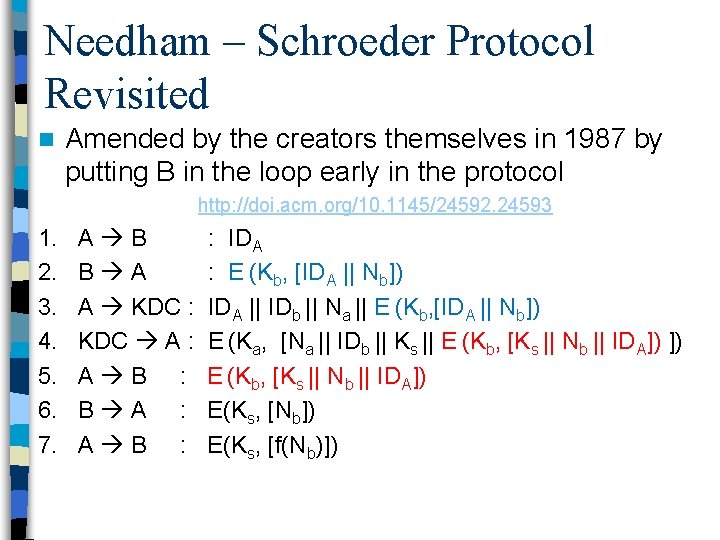
Needham – Schroeder Protocol Revisited n Amended by the creators themselves in 1987 by putting B in the loop early in the protocol http: //doi. acm. org/10. 1145/24592. 24593 1. 2. 3. 4. 5. 6. 7. A B B A A KDC : KDC A : A B : B A : A B : : IDA : E (Kb, [IDA || Nb]) IDA || IDb || Na || E (Kb, [IDA || Nb]) E (Ka, [Na || IDb || Ks || E (Kb, [Ks || Nb || IDA]) ]) E (Kb, [Ks || Nb || IDA]) E(Ks, [Nb]) E(Ks, [f(Nb)])
Synchronization problem Proper use of timestamps requires synchronized clocks n When sender’s clock is ahead of recipient’s clock n – attacker can intercept the message and replay later n Neuman and Stubblebine in 1993 proposed use of nonces with timely session keys to constitute tickets – Nonces and timestamps are used together • Nonces are to avoid replays. Nonces are also used in challenge/response framework • timestamps are expiration dates of the session key established – attacker only has a limited time to break the session key • in original NS, attacker has unlimited time to break the session key
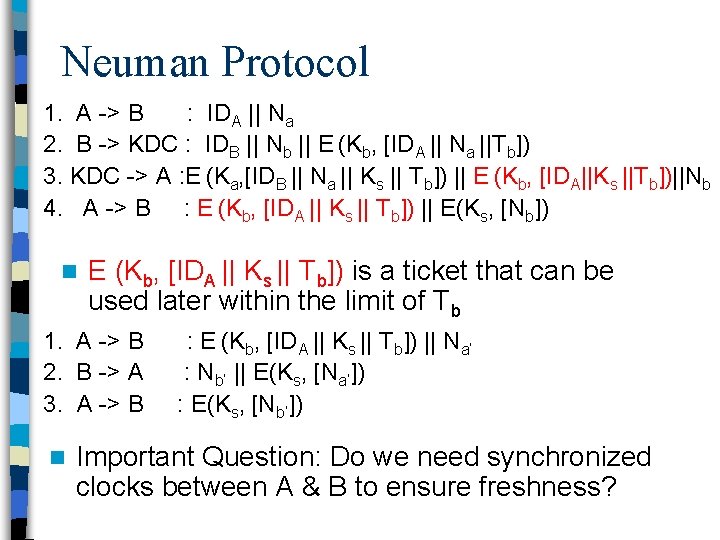
Neuman Protocol 1. A -> B : IDA || Na 2. B -> KDC : IDB || Nb || E (Kb, [IDA || Na ||Tb]) 3. KDC -> A : E (Ka, [IDB || Na || Ks || Tb]) || E (Kb, [IDA||Ks ||Tb])||Nb 4. A -> B : E (Kb, [IDA || Ks || Tb]) || E(Ks, [Nb]) n E (Kb, [IDA || Ks || Tb]) is a ticket that can be used later within the limit of Tb 1. A -> B 2. B -> A 3. A -> B n : E (Kb, [IDA || Ks || Tb]) || Na’ : Nb’ || E(Ks, [Na’]) : E(Ks, [Nb’]) Important Question: Do we need synchronized clocks between A & B to ensure freshness?
Authentication using Public-Key Encryption n We have given an example method that assumes public keys are known n There exists protocols that also distribute public keys – using a central Authentication Server (AS) or KDC – using timestamps or nonces (we will see one example using timestamps)
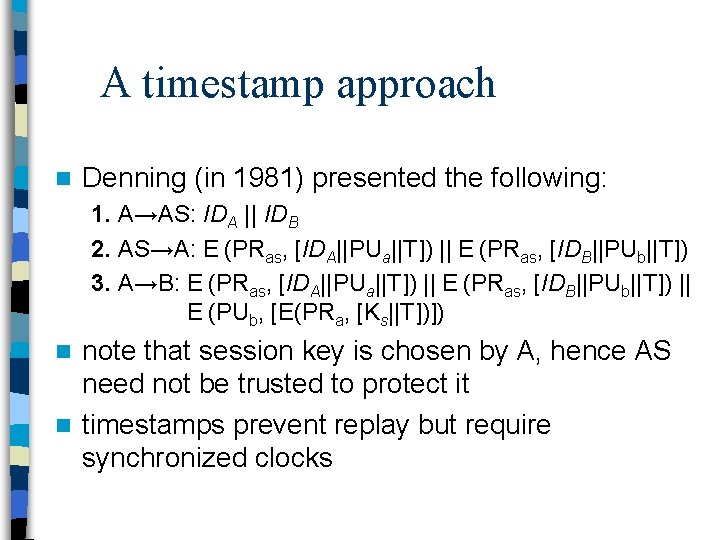
A timestamp approach n Denning (in 1981) presented the following: 1. A→AS: IDA || IDB 2. AS→A: E (PRas, [IDA||PUa||T]) || E (PRas, [IDB||PUb||T]) 3. A→B: E (PRas, [IDA||PUa||T]) || E (PRas, [IDB||PUb||T]) || E (PUb, [E(PRa, [Ks||T])]) note that session key is chosen by A, hence AS need not be trusted to protect it n timestamps prevent replay but require synchronized clocks n
A nonce approach Proposed by Woo and Lam (1992) n nonces are not sent in clear n n SEE THE PROTOCOL in Stallings page 501
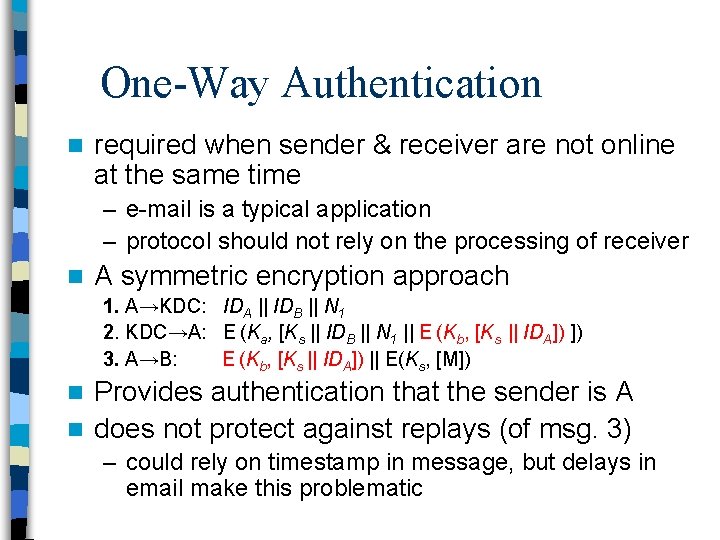
One-Way Authentication n required when sender & receiver are not online at the same time – e-mail is a typical application – protocol should not rely on the processing of receiver n A symmetric encryption approach 1. A→KDC: IDA || IDB || N 1 2. KDC→A: E (Ka, [Ks || IDB || N 1 || E (Kb, [Ks || IDA]) ]) 3. A→B: E (Kb, [Ks || IDA]) || E(Ks, [M]) Provides authentication that the sender is A n does not protect against replays (of msg. 3) n – could rely on timestamp in message, but delays in email make this problematic
One-Way Authentication: Public-Key Approaches n have seen some public-key approaches n if confidentiality is major concern, can use: A→B: E (PUb, [Ks]) || E(Ks, [M]) – digital envelopes n if authentication needed, use a digital signature with a digital certificate: A→B: M || E (PRa, [H(M)]) || E (PRas, [T||IDA||PUa]) – message, signature, certificate n We will detail e-mail security issues later
X. 509 Authentication Protocols n X. 509 is a ITU-T standard part of the “directory services” – mostly for certificates, but also propose three generic authentication protocols – one-way authentication – two-way authentication – three-way authentication – use both nonces and timestamps • nonces are unique only within the lifetime of timestamp – Timestamp includes expiration time
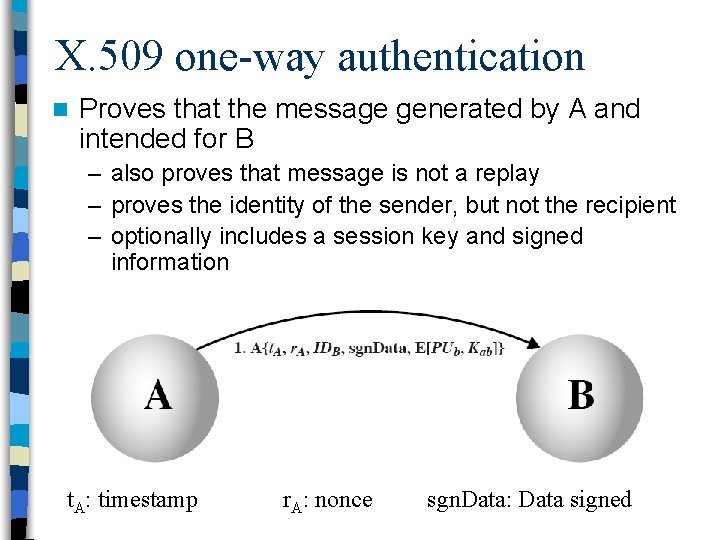
X. 509 one-way authentication n Proves that the message generated by A and intended for B – also proves that message is not a replay – proves the identity of the sender, but not the recipient – optionally includes a session key and signed information t. A: timestamp r. A: nonce sgn. Data: Data signed
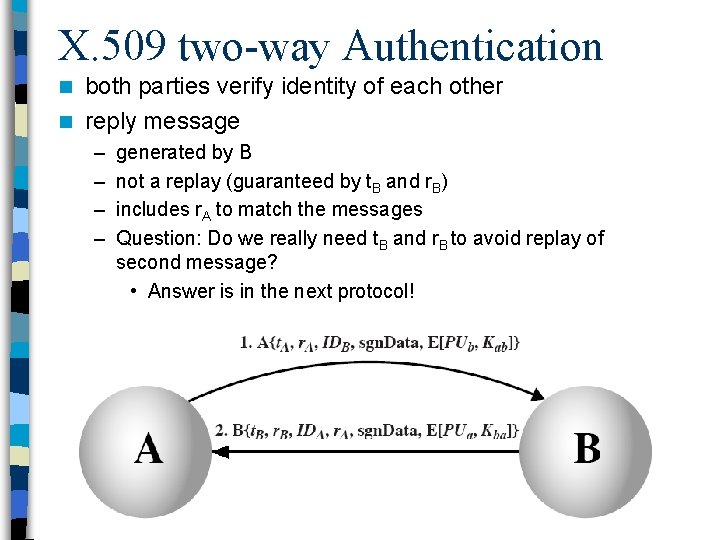
X. 509 two-way Authentication both parties verify identity of each other n reply message n – – generated by B not a replay (guaranteed by t. B and r. B) includes r. A to match the messages Question: Do we really need t. B and r. B to avoid replay of second message? • Answer is in the next protocol!
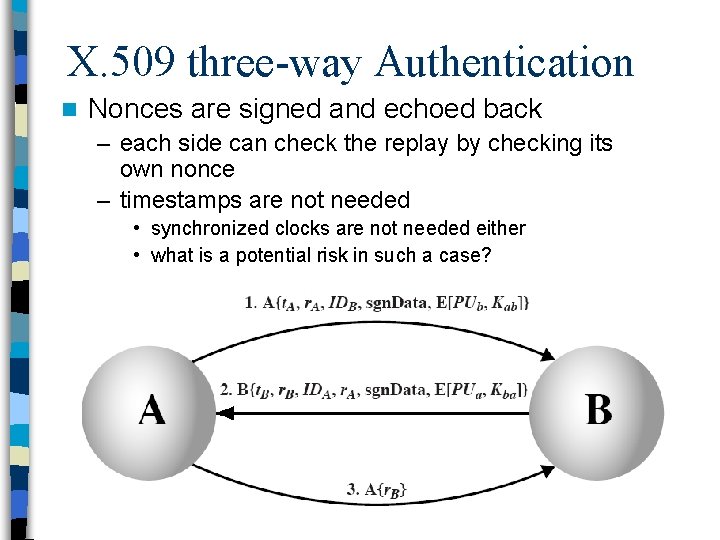
X. 509 three-way Authentication n Nonces are signed and echoed back – each side can check the replay by checking its own nonce – timestamps are not needed • synchronized clocks are not needed either • what is a potential risk in such a case?
- Slides: 48