
Key Difference between Manual Testing and Model Checking
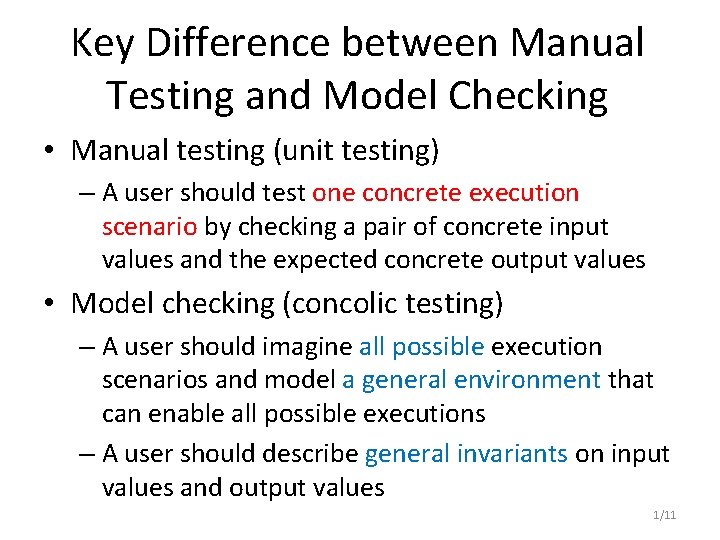
Key Difference between Manual Testing and Model Checking • Manual testing (unit testing) – A user should test one concrete execution scenario by checking a pair of concrete input values and the expected concrete output values • Model checking (concolic testing) – A user should imagine all possible execution scenarios and model a general environment that can enable all possible executions – A user should describe general invariants on input values and output values 1/11
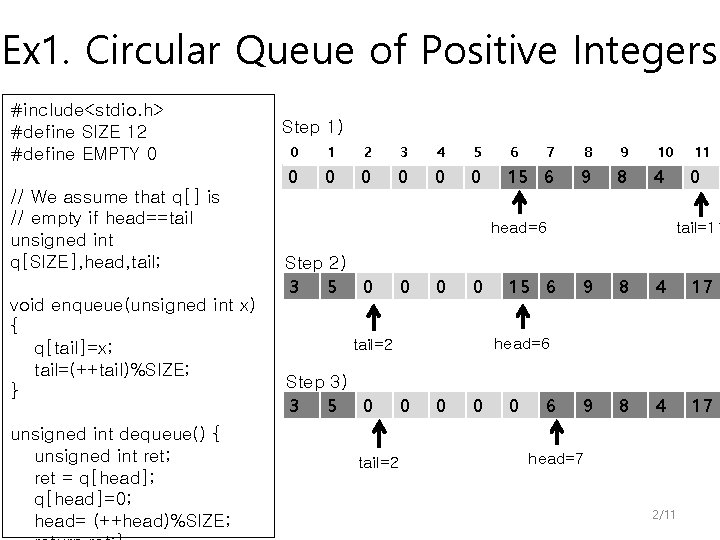
Ex 1. Circular Queue of Positive Integers #include<stdio. h> #define SIZE 12 #define EMPTY 0 // We assume that q[] is // empty if head==tail unsigned int q[SIZE], head, tail; void enqueue(unsigned int x) { q[tail]=x; tail=(++tail)%SIZE; } unsigned int dequeue() { unsigned int ret; ret = q[head]; q[head]=0; head= (++head)%SIZE; Step 1) 0 1 2 3 4 5 6 7 8 9 10 11 0 0 0 15 6 9 8 4 0 head=6 Step 2) 3 5 0 0 tail=2 9 8 4 17 head=6 tail=2 Step 3) 3 5 0 15 6 tail=11 0 0 6 head=7 2/11
![void enqueue_verify() { unsigned int x, old_head, old_tail; unsigned int old_q[SIZE], i; __CPROVER_assume(x>0); for(i=0;](http://slidetodoc.com/presentation_image/0034756f4db880d656482ccb167a1e2e/image-3.jpg "void enqueue_verify() { unsigned int x, old_head, old_tail; unsigned int old_q[SIZE], i; __CPROVER_assume(x>0); for(i=0;")
void enqueue_verify() { unsigned int x, old_head, old_tail; unsigned int old_q[SIZE], i; __CPROVER_assume(x>0); for(i=0; i < SIZE; i++) old_q[i]=q[i]; old_head=head; old_tail=tail; void dequeue_verify() { unsigned int ret, old_head, old_tail; unsigned int old_q[SIZE], i; for(i=0; i < SIZE; i++) old_q[i]=q[i]; old_head=head; old_tail=tail; __CPROVER_assume(head!=tail); ret=dequeue(); enqueue(x); assert(q[old_tail]==x); assert(tail== ((old_tail +1) % SIZE)); assert(head==old_head); for(i=0; i < old_tail; i++) assert(old_q[i]==q[i]); for(i=old_tail+1; i < SIZE; i++) assert(old_q[i]==q[i]); int } main() {// cbmc q. c –unwind SIZE+2 environment_setup(); enqueue_verify(); } assert(ret==old_q[old_head]); assert(q[old_head]== EMPTY); assert(head==(old_head+1)%SIZE); assert(tail==old_tail); for(i=0; i < old_head; i++) assert(old_q[i]==q[i]); for(i=old_head+1; i < SIZE; i++) assert(old_q[i]==q[i]); } int main() {// cbmc q. c –unwind SIZE+2 environment_setup(); dequeue_verify(); }
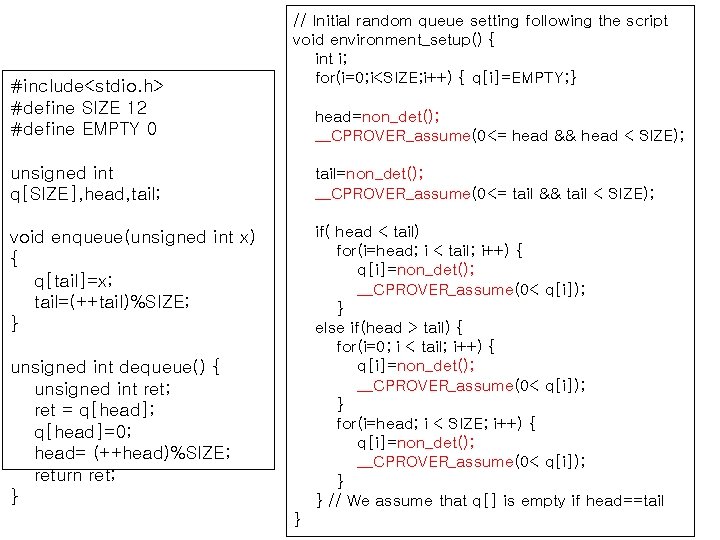
#include<stdio. h> #define SIZE 12 #define EMPTY 0 // Initial random queue setting following the script void environment_setup() { int i; for(i=0; i<SIZE; i++) { q[i]=EMPTY; } head=non_det(); __CPROVER_assume(0<= head && head < SIZE); unsigned int q[SIZE], head, tail; tail=non_det(); __CPROVER_assume(0<= tail && tail < SIZE); void enqueue(unsigned int x) { q[tail]=x; tail=(++tail)%SIZE; } if( head < tail) for(i=head; i < tail; i++) { q[i]=non_det(); __CPROVER_assume(0< q[i]); } else if(head > tail) { for(i=0; i < tail; i++) { q[i]=non_det(); __CPROVER_assume(0< q[i]); } for(i=head; i < SIZE; i++) { q[i]=non_det(); __CPROVER_assume(0< q[i]); } } // We assume that q[] is empty if head==tail unsigned int dequeue() { unsigned int ret; ret = q[head]; q[head]=0; head= (++head)%SIZE; return ret; } }
- Slides: 4