
Key Criteria for Viable Sustainable and Affordable Housing
Key Criteria for Viable, Sustainable, and Affordable Housing Programs and Projects Presented by Zaigham M. Rizvi Presentation made to Housing Workshop of ABAD, Karachi January 23, 2013
Issues to be addressed • Challenges of Pro-Poor Affordable Housing • Stakeholders in Pro-Poor Housing Supply • Linking Urban Planning with development of affordable and sustainable neighborhoods • Role of Developer/Construction Industry in Affordable Housing Supply • Definition of Affordability in Market Housing and Social Housing • How to address Homebuyers expectations for Affordable Housing 2 Presentation on Viable, Sustainable, and Affordable Housing Programs and Projects by Zaigham Rizvi
Issues we Know, Answers we Need Pro-Poor Affordable Housing is a Global Issue … with Country specific Challenges … that needs Shared Wisdom and Indigenized Answers! 3 Presentation on Viable, Sustainable, and Affordable Housing Programs and Projects by Zaigham Rizvi
Housing is a ‘Numbers’ game – Muslim World is no exception! • • The Muslim world represents 1 of 4 humans on the planet Nearly the same share in number of countries Represents 1 of 2 poor on the planet An acute challenge of widening demand/supply gap and rising housing backlog • Most of the housing backlog and short supply is in low-income segment of the population • Population growth and urbanization are further compounding the existing huge backlog • Rising costs (land, construction materials) are making housing unaffordable for the poor 4 Presentation on Viable, Sustainable, and Affordable Housing Programs and Projects by Zaigham Rizvi
Housing Supply Challenge – Figures speak for themselves • IDB study suggests housing needs of the Muslim World at 8 mn • • • 5 units. This estimate needs further analysis and breakdown: – MENA 3. 2 mn; – Asia 2. 7 mn; and – Africa/others 2. 3 mn. Urban population likely to rise from 1/4 th to 1/3 rd of the population Rapid Urbanization a major issue in low income housing Need for new housing due to generic population growth is estimated at 4 to 5 mn units/year Urbanization and population growth further increases the year-onyear housing needs in major metropolitans Supply is 30 -40% on new demand for housing Presentation on Viable, Sustainable, and Affordable Housing Programs and Projects by Zaigham Rizvi
Housing Finance Challenges • As most of housing shortage is in low income segment, poor need • • 6 empowerment through housing finance Institutional Housing Finance is either non-existent or in infancy stages in most of the Muslim World (Afghanistan and some African Countries) Slightly advanced in some others (Malaysia, Turkey, Egypt, Morocco, Indonesia, Pakistan and Saudi Arabia) Regulatory Framework needs strengthening Additional challenges include: – Role and responsibilities of Specialized Housing Finance Institutions (HFIs) and Commercial Banks (CBs) – Long Term Liquidity Facility Institutions and Instruments – Low-Cost Housing Supply Agents and Technologies Presentation on Viable, Sustainable, and Affordable Housing Programs and Projects by Zaigham Rizvi
Sharia-Compatible Housing Finance • An issue of faith e. g. Afghanistan with nearly 100% Muslim • • • 7 Population Also an issue of Financial Inclusion. Even if conventional finance is available, Faith-Based clients do not avail it Standardization and Diversification of RE/Housing Products on Asset Side and Liability Side Islamic REITS and MBS Products Role of Islamic Banks and Islamic Windows of Conventional Banks Need for Research and Development Centers Presentation on Viable, Sustainable, and Affordable Housing Programs and Projects by Zaigham Rizvi
An Asian Snapshot • Asia-Pacific represents: – 1/4 th of the Worlds population, and – Nearly ½ of the Worlds Poor • Housing is an essential part of political sloganizm – “Housing for all”; – “Slum Free Cities” – “Maang Raha hai har Insaan-Roti, Kapra, aur Makan” (Every human demands food, clothing and shelter); etc. • In some countries there is SOME delivery but in most there is NONE • Each country in the region has its own geo-socio- economic parameters and all face a common issue of “shelter less poor” – Regional successful models would be needed for sharing experience and knowledge 8 Presentation on Viable, Sustainable, and Affordable Housing Programs and Projects by Zaigham Rizvi
Housing Challenges in Asia-Pacific region • Region represents more than 1/4 th of Worlds population and ½ of • • • 9 the poor on the planet Including China, Asia-Pacific represents ½ of the Worlds population Region still among the lowest in terms of Mortgage Finance – Average Mortgage Debt to GDP Ratio 3. 3 Region is faced with massive housing shortage – India alone faces an Urban Housing shortage of 27 mn Nearly entire urban shortage is in Low-Income Category Persons per Room Density: – India/Pakistan is 3. 5; – EU is 1. 1; and – USA is 0. 5 Presentation on Viable, Sustainable, and Affordable Housing Programs and Projects by Zaigham Rizvi
Slums Prevalence in Asia • Afghanistan: 80% of Kabul’s population (2. 44 mn) live in slums or damaged/destroyed housing • Bangladesh: 2, 100 slums. In Dhaka, 2 mn people live either in slums or are without any proper shelter • India: 52, 000 slums provide housing to 8 mn people (about 14% of the total urban population) • Pakistan: Karachi alone has between 600 -800 slums sheltering 7. 6 mn people (1 million households) out of the total city’s population of 15. 1 mn people • Sri Lanka: A considerable share of the population of Sri Lanka lives in plantations, slums or shanties • Mongolia: 51% of the population residing in temporary ‘ger’ dwellings • Indonesia: 17. 2 mn families live in approximately 10, 000 slum areas 10 Presentation on Viable, Sustainable, and Affordable Housing Programs and Projects by Zaigham Rizvi
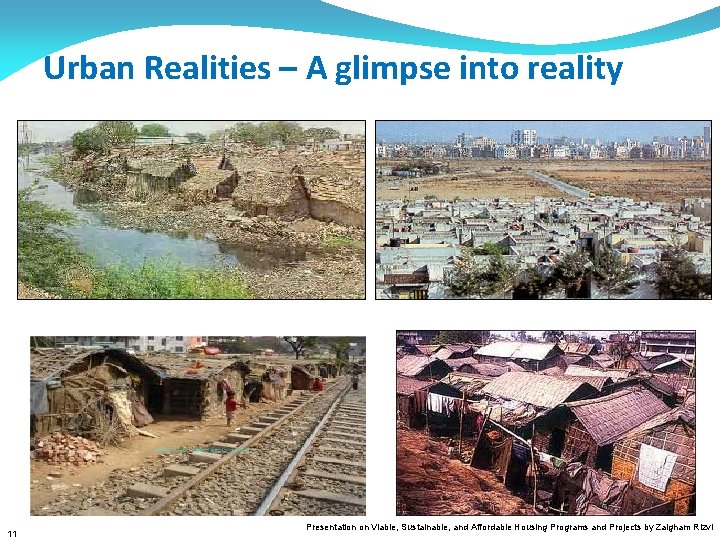
Urban Realities – A glimpse into reality 11 Presentation on Viable, Sustainable, and Affordable Housing Programs and Projects by Zaigham Rizvi
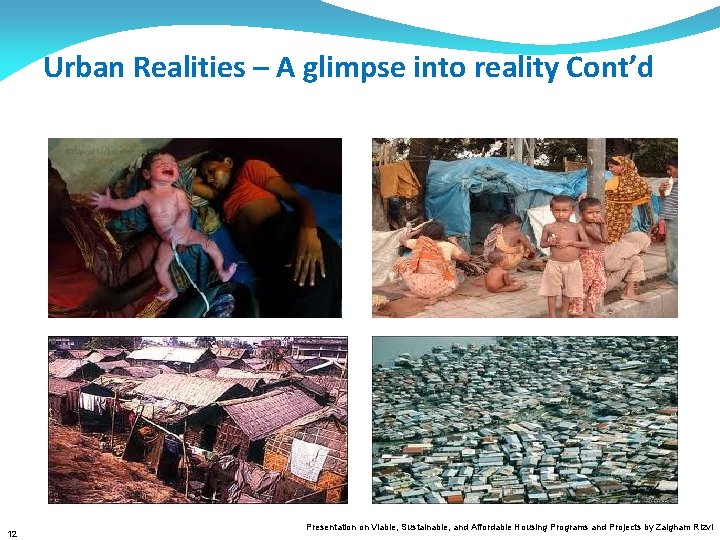
Urban Realities – A glimpse into reality Cont’d 12 Presentation on Viable, Sustainable, and Affordable Housing Programs and Projects by Zaigham Rizvi
Linking Urban Planning with development of affordable and sustainable neighborhoods • Rapid Urbanization, prior backlog, and affordability challenges call for innovative approaches to urban planning • Current trend of cities expanding in circles around circles results in • • 13 further densification of cities that is not being addressed Urban Planners need to find alternates options for slums prevalence, expansion and inefficient use of land Planners need to develop new neighborhood/satellite towns equipped with physical, social infrastructure, transport etc. Wisdom sharing and on-going coordination between urban planners, housing, developers and academia is needed Business Model of Pubic-Private partnership for viable and sustainable plans and projects Presentation on Viable, Sustainable, and Affordable Housing Programs and Projects by Zaigham Rizvi
Affordability Defined • Housing units currently being supplied in the residential “Housing Market” are considered ‘affordable’ since they are catered to the income segment that can afford them – Hence, supply matches demand at times may exceed it as well – The One Billion $ house in Mumbai, was affordable, since Mr. Ambani could afford it • Affordability is an issue of Low-Income Segment, where housing backlog and demand is massive, and market forces/developers do not come forward with supply • Affordability issue arises where there is an acute mismatch between the low-income and the high-cost of housing 14 Presentation on Viable, Sustainable, and Affordable Housing Programs and Projects by Zaigham Rizvi

Affordability Defined as per market practice Income Affordability : • When 35 -40% of the disposable income can match the equated mortgage payments (EMIs) • Loan to value (LTV) ratios used are typically 80: 20 • Loan Tenors are long term of 20 -30 years Cost Affordability: • The cost of a housing unit is equal to 60 -70 times (5 -6 years) of monthly income and EMI is determined for long term loans The above market norms are used for low and lower-middle income segments of population and do not apply in case of Housing Microfinance (the bottom of the pyramid), where an entirely different business model is used 15 Presentation on Viable, Sustainable, and Affordable Housing Programs and Projects by Zaigham Rizvi
Market Segmentation for Affordability Housing Continuum covers: Market Housing: • Represents High and Middle Income Market Segments • Market Segment is addressed by market forces on its own without any need for state-intervention or support • Supply is there to meet the demand Social Housing: • Represents Lower-Middle and Low-Income Market • Market Segment needs State intervention/support to facilitate affordable housing supply and an enabling role for Stakeholders • Bottom of Pyramid: They are candidates for Housing Microfinance and need special delivery models and direct/indirect subsidies from the State 16 Presentation on Viable, Sustainable, and Affordable Housing Programs and Projects by Zaigham Rizvi
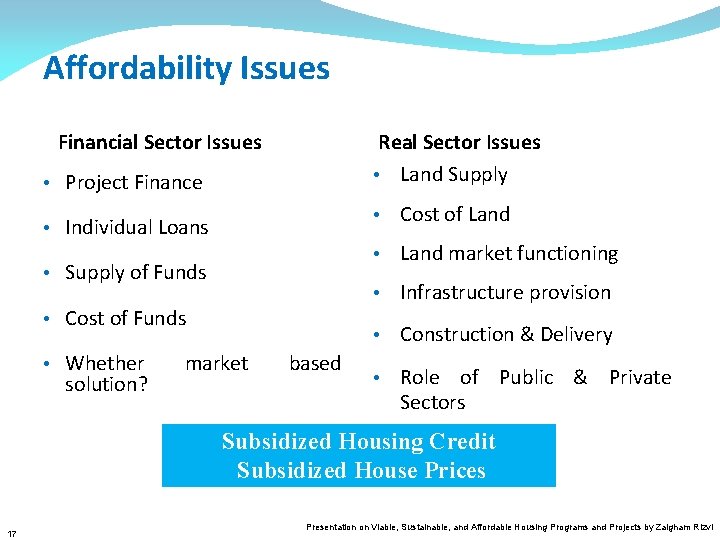
Affordability Issues Financial Sector Issues Real Sector Issues • Land Supply • Project Finance • Individual Loans • Supply of Funds • Cost of Funds • Whether solution? market based • Cost of Land • Land market functioning • Infrastructure provision • Construction & Delivery • Role of Public & Private Sectors Subsidized Housing Credit Subsidized House Prices 17 Presentation on Viable, Sustainable, and Affordable Housing Programs and Projects by Zaigham Rizvi
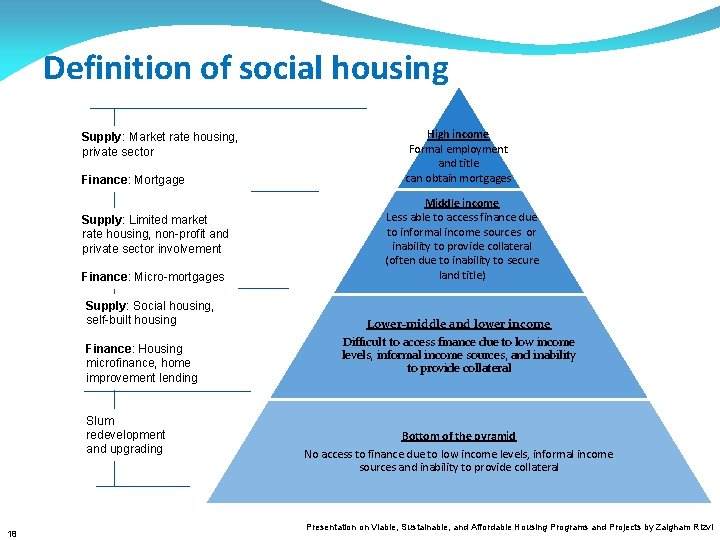
Definition of social housing Supply: Market rate housing, private sector Finance: Mortgage Supply: Limited market rate housing, non-profit and private sector involvement Finance: Micro-mortgages Supply: Social housing, self-built housing Finance: Housing microfinance, home improvement lending Slum redevelopment and upgrading 18 High income Formal employment and title can obtain mortgages Middle income Less able to access finance due to informal income sources or inability to provide collateral (often due to inability to secure land title) Lower-middle and lower income Difficult to access finance due to low income levels, informal income sources, and inability to provide collateral Bottom of the pyramid No access to finance due to low income levels, informal income sources and inability to provide collateral Presentation on Viable, Sustainable, and Affordable Housing Programs and Projects by Zaigham Rizvi
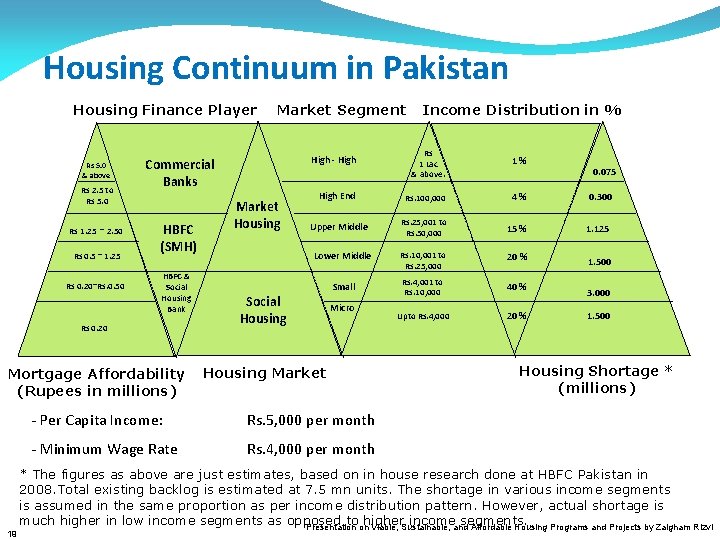
Housing Continuum in Pakistan Housing Finance Player Rs 5. 0 & above Rs 2. 5 to Rs 5. 0 Rs 1. 25 ~ 2. 50 Rs 0. 5 ~ 1. 25 Rs 0. 20~Rs. 0. 50 Commercial Banks HBFC (SMH) HBFC & Social Housing Bank Rs 0. 20 Mortgage Affordability (Rupees in millions) 19 Market Segment Market Housing Income Distribution in % High - High Rs 1 Lac & above. 1% High End Rs. 100, 000 4% 0. 300 Upper Middle Rs. 25, 001 to Rs. 50, 000 15 % 1. 125 Rs. 10, 001 to Rs. 25, 000 20 % Rs. 4, 001 to Rs. 10, 000 40 % Upto Rs. 4, 000 20 % Lower Middle Social Housing Small Micro Housing Market - Per Capita Income: Rs. 5, 000 per month - Minimum Wage Rate Rs. 4, 000 per month 0. 075 1. 500 3. 000 1. 500 Housing Shortage * (millions) * The figures as above are just estimates, based on in house research done at HBFC Pakistan in 2008. Total existing backlog is estimated at 7. 5 mn units. The shortage in various income segments is assumed in the same proportion as per income distribution pattern. However, actual shortage is much higher in low income segments as opposed toonhigher incomeand segments. Presentation Viable, Sustainable, Affordable Housing Programs and Projects by Zaigham Rizvi
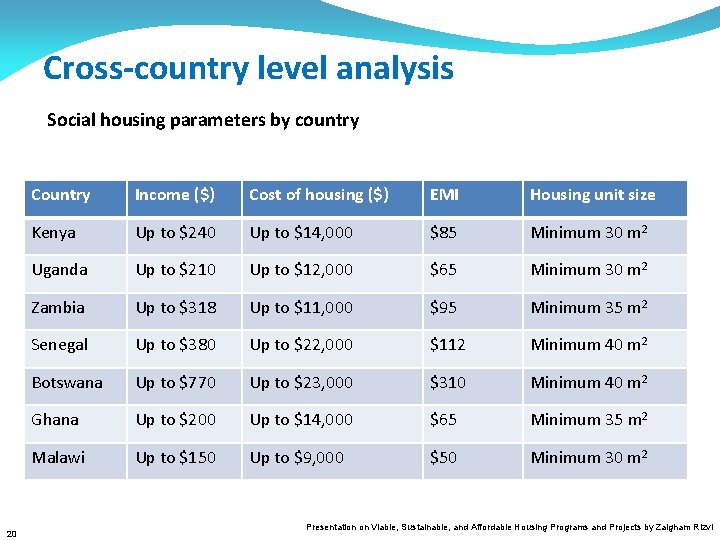
Cross-country level analysis Social housing parameters by country 20 Country Income ($) Cost of housing ($) EMI Housing unit size Kenya Up to $240 Up to $14, 000 $85 Minimum 30 m 2 Uganda Up to $210 Up to $12, 000 $65 Minimum 30 m 2 Zambia Up to $318 Up to $11, 000 $95 Minimum 35 m 2 Senegal Up to $380 Up to $22, 000 $112 Minimum 40 m 2 Botswana Up to $770 Up to $23, 000 $310 Minimum 40 m 2 Ghana Up to $200 Up to $14, 000 $65 Minimum 35 m 2 Malawi Up to $150 Up to $9, 000 $50 Minimum 30 m 2 Presentation on Viable, Sustainable, and Affordable Housing Programs and Projects by Zaigham Rizvi
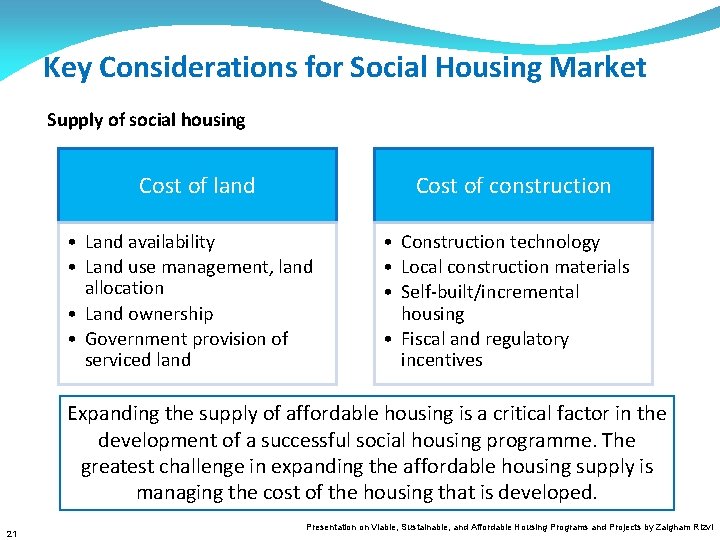
Key Considerations for Social Housing Market Supply of social housing Cost of land Cost of construction • Land availability • Land use management, land allocation • Land ownership • Government provision of serviced land • Construction technology • Local construction materials • Self-built/incremental housing • Fiscal and regulatory incentives Expanding the supply of affordable housing is a critical factor in the development of a successful social housing programme. The greatest challenge in expanding the affordable housing supply is managing the cost of the housing that is developed. 21 Presentation on Viable, Sustainable, and Affordable Housing Programs and Projects by Zaigham Rizvi
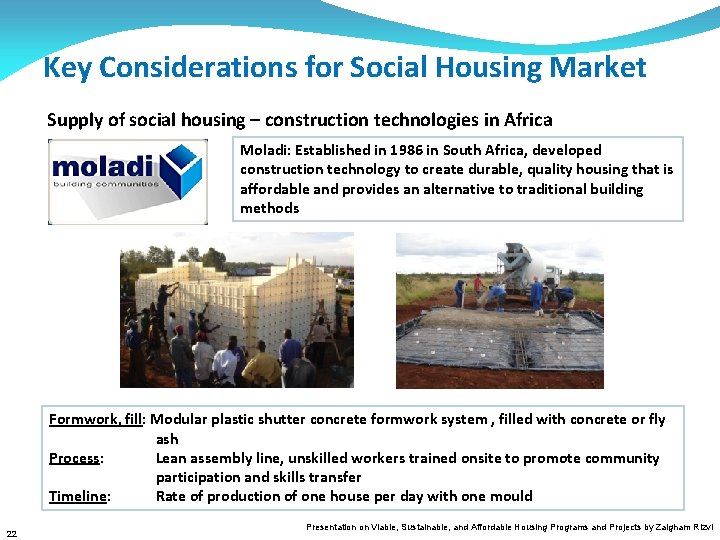
Key Considerations for Social Housing Market Supply of social housing – construction technologies in Africa Moladi: Established in 1986 in South Africa, developed construction technology to create durable, quality housing that is affordable and provides an alternative to traditional building methods Formwork, fill: Modular plastic shutter concrete formwork system , filled with concrete or fly ash Process: Lean assembly line, unskilled workers trained onsite to promote community participation and skills transfer Timeline: Rate of production of one house per day with one mould 22 Presentation on Viable, Sustainable, and Affordable Housing Programs and Projects by Zaigham Rizvi
ROLE OF THE DEVELOPER INDUSTRY AND THE CONSTRUCTION INDUSTRY 23 Presentation on Viable, Sustainable, and Affordable Housing Programs and Projects by Zaigham Rizvi
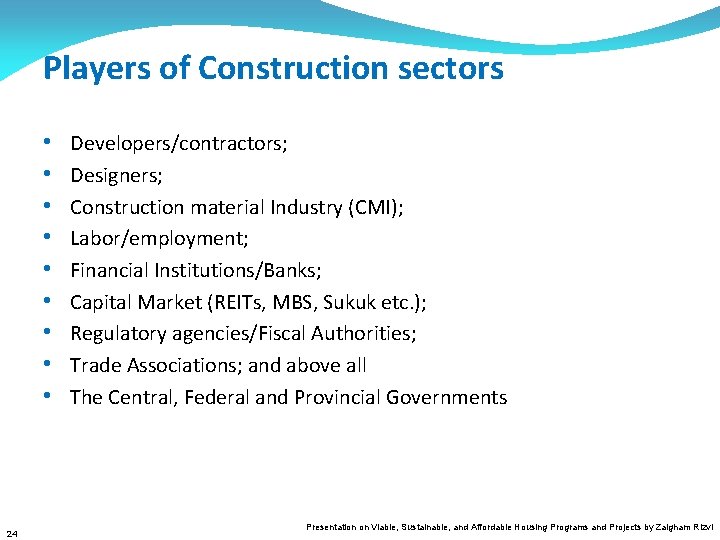
Players of Construction sectors • • • 24 Developers/contractors; Designers; Construction material Industry (CMI); Labor/employment; Financial Institutions/Banks; Capital Market (REITs, MBS, Sukuk etc. ); Regulatory agencies/Fiscal Authorities; Trade Associations; and above all The Central, Federal and Provincial Governments Presentation on Viable, Sustainable, and Affordable Housing Programs and Projects by Zaigham Rizvi
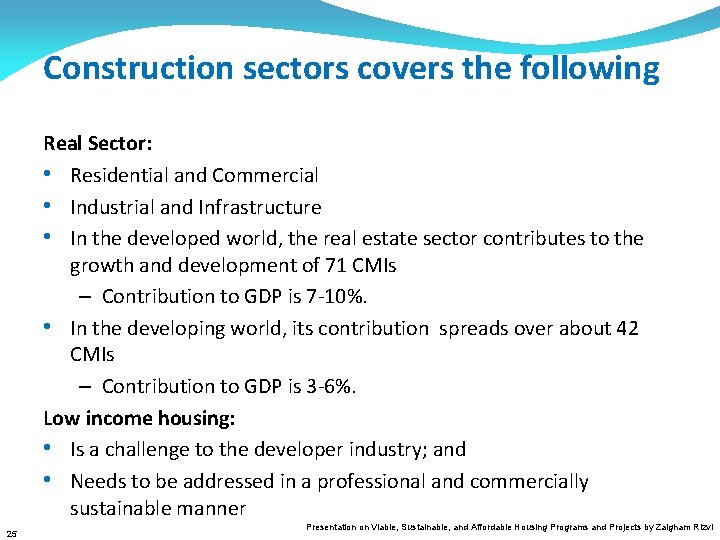
Construction sectors covers the following Real Sector: • Residential and Commercial • Industrial and Infrastructure • In the developed world, the real estate sector contributes to the growth and development of 71 CMIs – Contribution to GDP is 7 -10%. • In the developing world, its contribution spreads over about 42 CMIs – Contribution to GDP is 3 -6%. Low income housing: • Is a challenge to the developer industry; and • Needs to be addressed in a professional and commercially sustainable manner 25 Presentation on Viable, Sustainable, and Affordable Housing Programs and Projects by Zaigham Rizvi
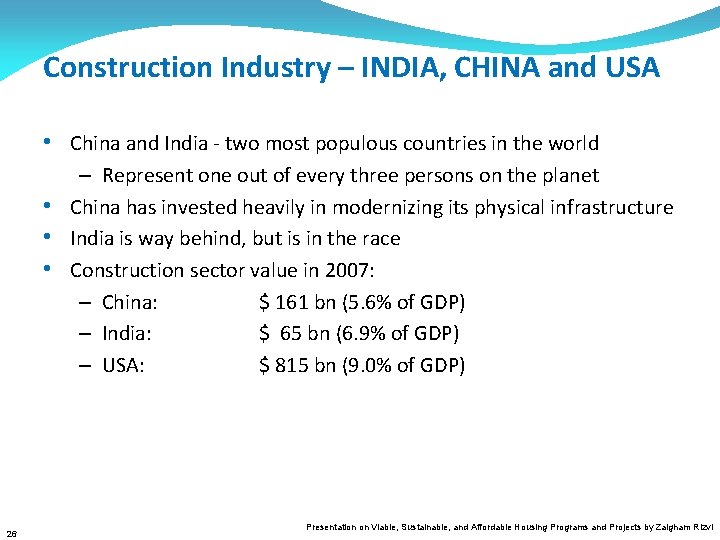
Construction Industry – INDIA, CHINA and USA • China and India - two most populous countries in the world – Represent one out of every three persons on the planet • China has invested heavily in modernizing its physical infrastructure • India is way behind, but is in the race • Construction sector value in 2007: – China: $ 161 bn (5. 6% of GDP) – India: $ 65 bn (6. 9% of GDP) – USA: $ 815 bn (9. 0% of GDP) 26 Presentation on Viable, Sustainable, and Affordable Housing Programs and Projects by Zaigham Rizvi
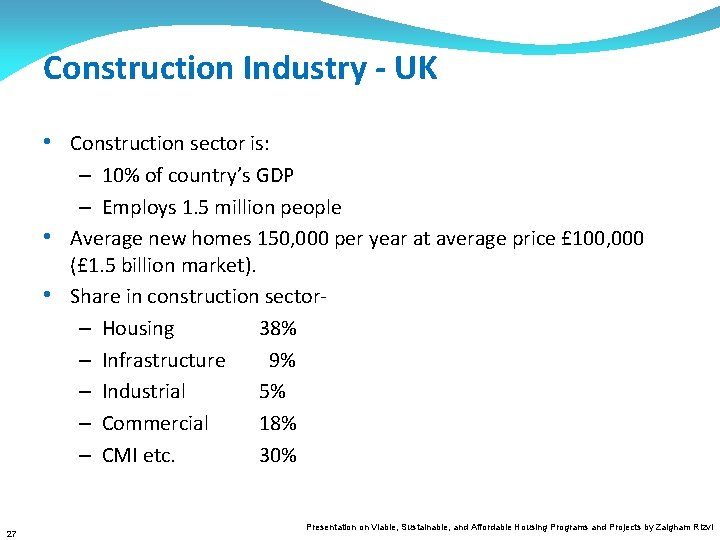
Construction Industry - UK • Construction sector is: – 10% of country’s GDP – Employs 1. 5 million people • Average new homes 150, 000 per year at average price £ 100, 000 (£ 1. 5 billion market). • Share in construction sector– Housing 38% – Infrastructure 9% – Industrial 5% – Commercial 18% – CMI etc. 30% 27 Presentation on Viable, Sustainable, and Affordable Housing Programs and Projects by Zaigham Rizvi
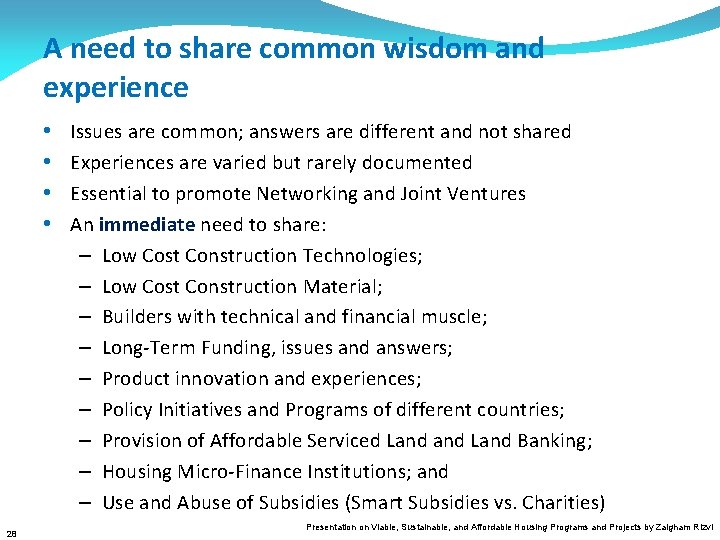
A need to share common wisdom and experience • • 28 Issues are common; answers are different and not shared Experiences are varied but rarely documented Essential to promote Networking and Joint Ventures An immediate need to share: – Low Cost Construction Technologies; – Low Cost Construction Material; – Builders with technical and financial muscle; – Long-Term Funding, issues and answers; – Product innovation and experiences; – Policy Initiatives and Programs of different countries; – Provision of Affordable Serviced Land Banking; – Housing Micro-Finance Institutions; and – Use and Abuse of Subsidies (Smart Subsidies vs. Charities) Presentation on Viable, Sustainable, and Affordable Housing Programs and Projects by Zaigham Rizvi
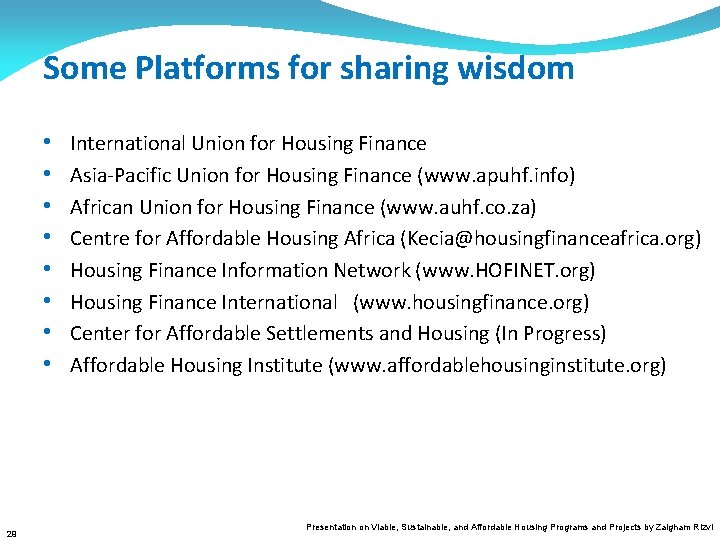
Some Platforms for sharing wisdom • • 29 International Union for Housing Finance Asia-Pacific Union for Housing Finance (www. apuhf. info) African Union for Housing Finance (www. auhf. co. za) Centre for Affordable Housing Africa (Kecia@housingfinanceafrica. org) Housing Finance Information Network (www. HOFINET. org) Housing Finance International (www. housingfinance. org) Center for Affordable Settlements and Housing (In Progress) Affordable Housing Institute (www. affordablehousinginstitute. org) Presentation on Viable, Sustainable, and Affordable Housing Programs and Projects by Zaigham Rizvi
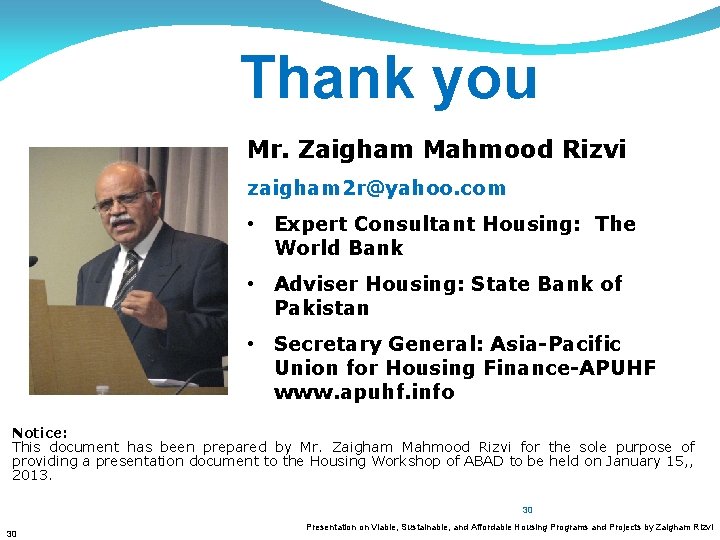
Thank you Mr. Zaigham Mahmood Rizvi zaigham 2 r@yahoo. com • Expert Consultant Housing: The World Bank • Adviser Housing: State Bank of Pakistan • Secretary General: Asia-Pacific Union for Housing Finance-APUHF www. apuhf. info Notice: This document has been prepared by Mr. Zaigham Mahmood Rizvi for the sole purpose of providing a presentation document to the Housing Workshop of ABAD to be held on January 15, , 2013. 30 30 Presentation on Viable, Sustainable, and Affordable Housing Programs and Projects by Zaigham Rizvi
- Slides: 30