
Key Concepts of Synthetic Biology The Central Dogma
Key Concepts of Synthetic Biology & The Central Dogma IGEM Presentation 1 7 th July 09 Dineka Khurmi James mag. A Field
Synthetic Biology • Last century & SB potential • US leads with: - $16 m funding of Syn. BERC (UC Berkeley) - Bill & Melinda Gates Foundation $43 m investment - $500 m Energy Biosciences Institute • SB development over the last few years due to: - advances in biology, genetics & genome sequencing - coupled to vast increase in the speed & storage capacity of computers & internet. - researchers understanding of living organisms

What is Synthetic Biology? “The design and fabrication of biological components and systems that do not already exist in the natural world” “The re-design and fabrication of existing biological systems” • Definition: - maintains level of simplicity - expresses key aspects of SB - consistent with the views of most researchers in the field • SB strives to make the engineering of biology

What is Synthetic Biology? The Driving Concepts • To enable the systematic engineering of biology • To promote the open and transparent development of tools for engineering biology • And to help construct a community that can productively apply biological technology
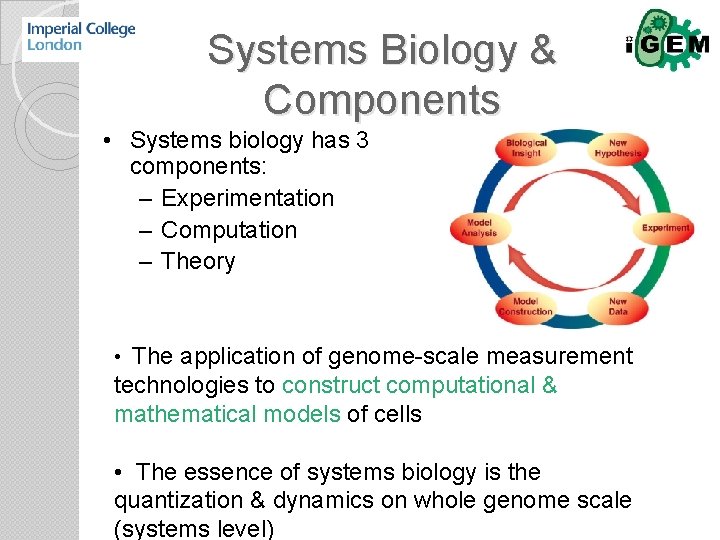
Systems Biology & Components • Systems biology has 3 components: – Experimentation – Computation – Theory • The application of genome-scale measurement technologies to construct computational & mathematical models of cells • The essence of systems biology is the quantization & dynamics on whole genome scale (systems level)
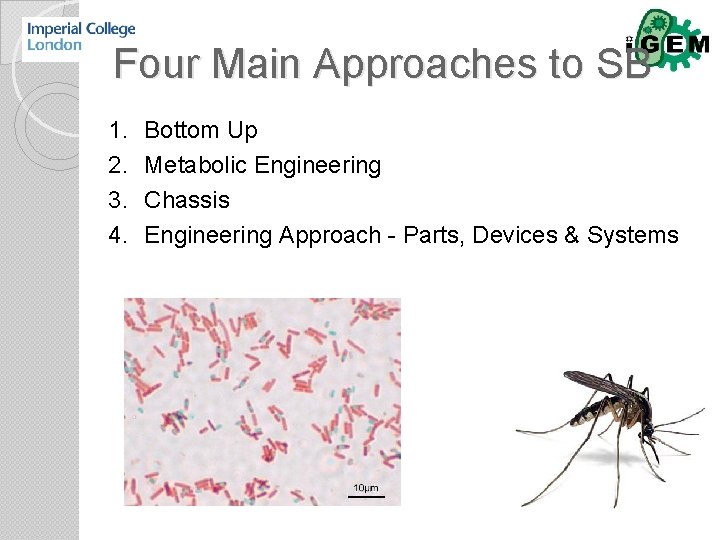
Four Main Approaches to SB 1. 2. 3. 4. Bottom Up Metabolic Engineering Chassis Engineering Approach - Parts, Devices & Systems
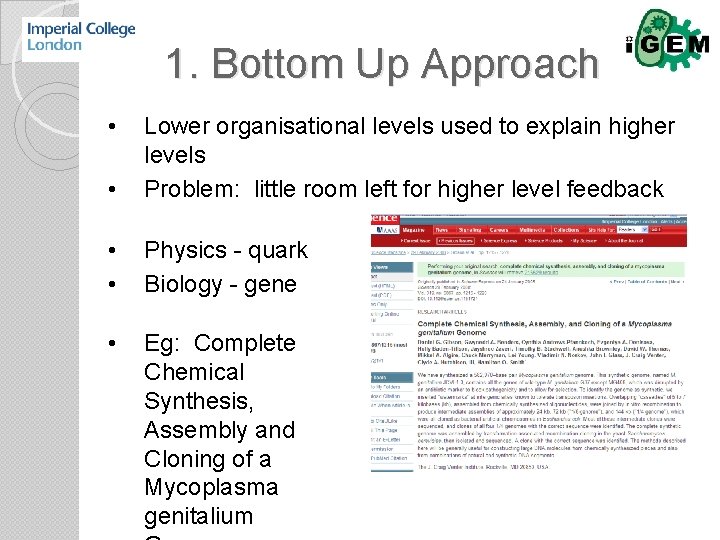
1. Bottom Up Approach • • Lower organisational levels used to explain higher levels Problem: little room left for higher level feedback • • Physics - quark Biology - gene • Eg: Complete Chemical Synthesis, Assembly and Cloning of a Mycoplasma genitalium

2. Metabolic Engineering Jay Keasling Artemisinin Malaria
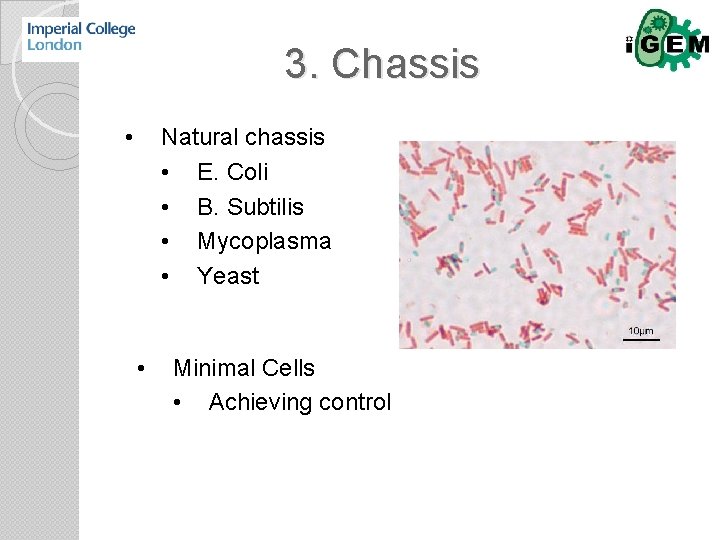
3. Chassis • Natural chassis • E. Coli • B. Subtilis • Mycoplasma • Yeast • Minimal Cells • Achieving control
Opportunities • Biotechnology: Re-programming cells for bio- catalysis (pharmaceuticals, fine chemicals, bio-fuels) • Environment: Re-programming regulation; engineering microbial communities, biodegradation, etc. • Biomedicine: Re-programming stem cells, smart delivery of chemicals/antimicrobials, cancer therapy • Plants: re-programming plants for antibiotic production, food production • Biosensors: toxins, pollutants etc.
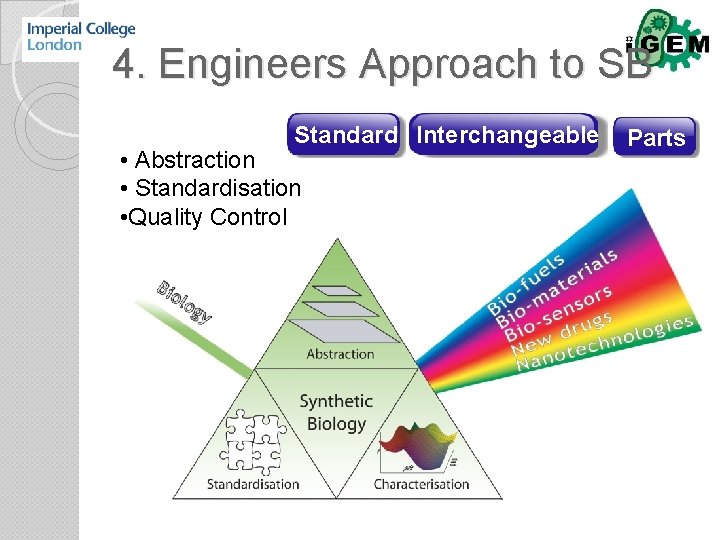
4. Engineers Approach to SB Standard Interchangeable • Abstraction • Standardisation • Quality Control Parts

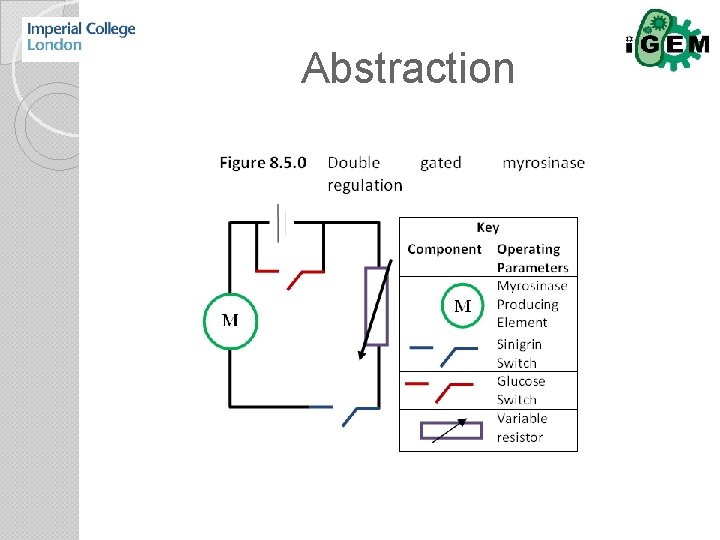
4. Engineers Approach to SB Break down complexity Modularity Inputs / Outputs Abstraction Hierarchy Decoupling Abstraction Layer Andrianantoandro et al, 2006
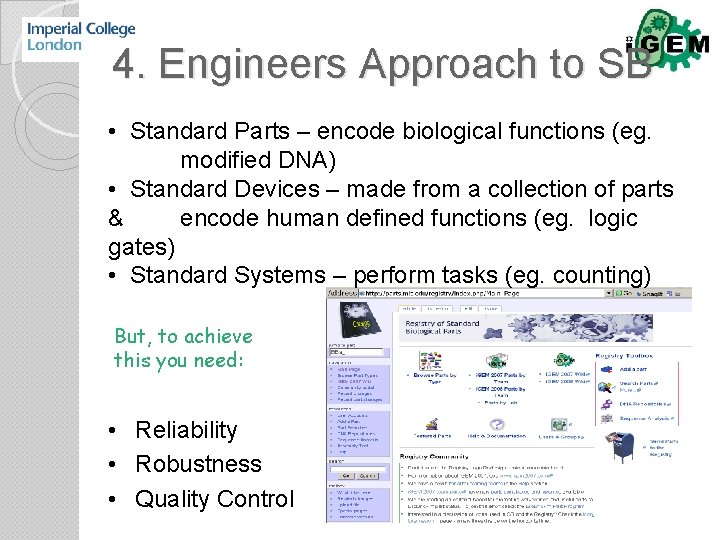
4. Engineers Approach to SB • Standard Parts – encode biological functions (eg. modified DNA) • Standard Devices – made from a collection of parts & encode human defined functions (eg. logic gates) • Standard Systems – perform tasks (eg. counting) But, to achieve this you need: • Reliability • Robustness • Quality Control

Standardisation Uniform and agreed Inter-operability Re-usability Economic Benefits
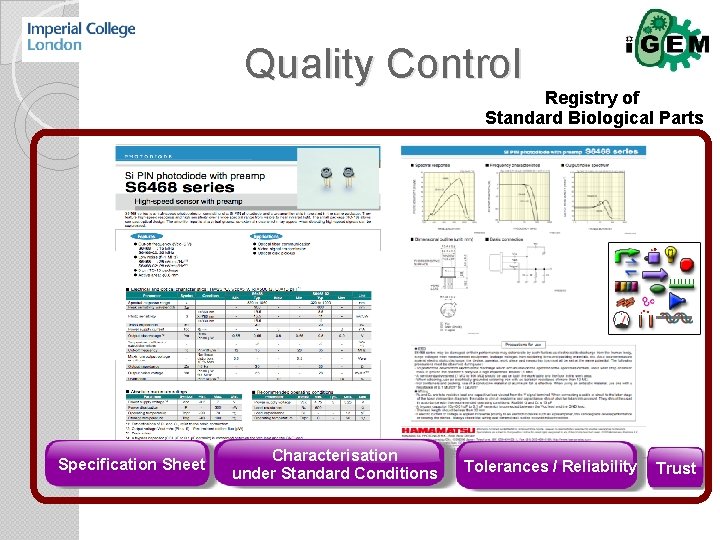
Quality Control Registry of Standard Biological Parts Specification Sheet Characterisation under Standard Conditions Tolerances / Reliability Trust
The IGEM Perspective • Can simple biological systems be built from standard, interchangeable parts & operated in living cells? • How will parts function when brought together? • Or is biology simply too complicated to be engineered in this way?
Social, Ethical & Legal Issues • Bio-security • Regulations and policy • Intellectual property versus open source • Public engagement (GM debate) • Ethics • BBSRC report June 08 “Synthetic Biology – social and ethical challenges” (www. bbsrc. ac. uk/organisation/policies/reviews/sci entific_areas 0806_synthetic_biology. pdf)
Key Concepts of Synthetic Biology & The Central Dogma IGEM Presentation 1 7 th July 09 Dineka Khurmi James mag. A Field
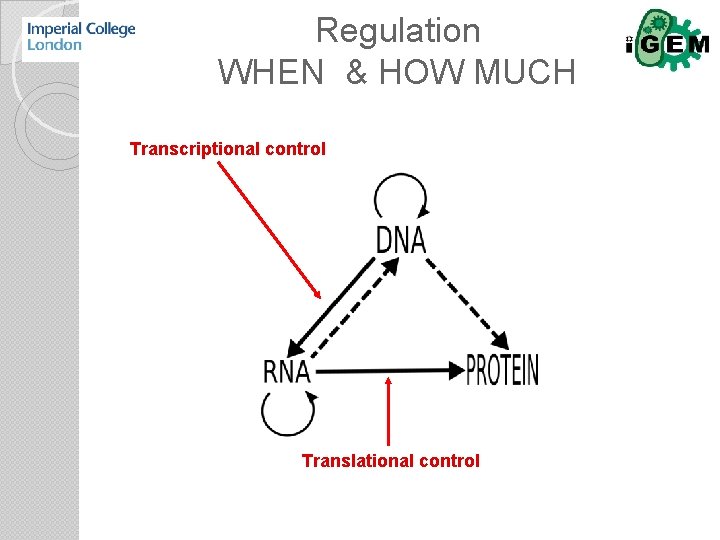
Regulation WHEN & HOW MUCH Transcriptional control Translational control
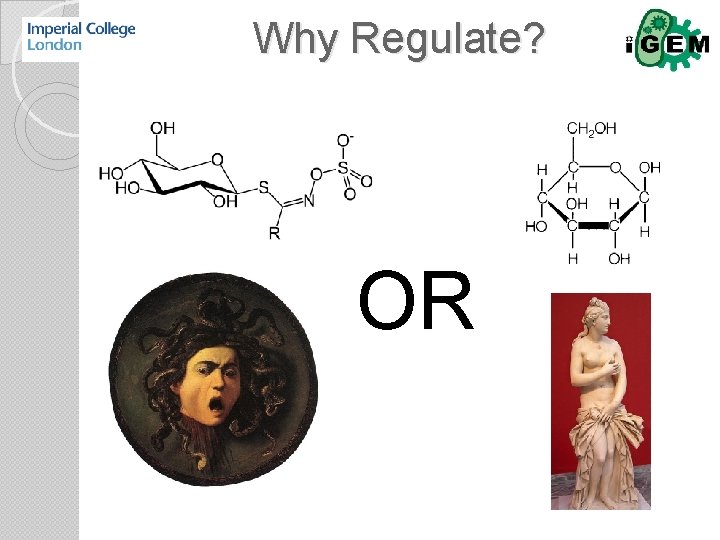
Why Regulate? OR
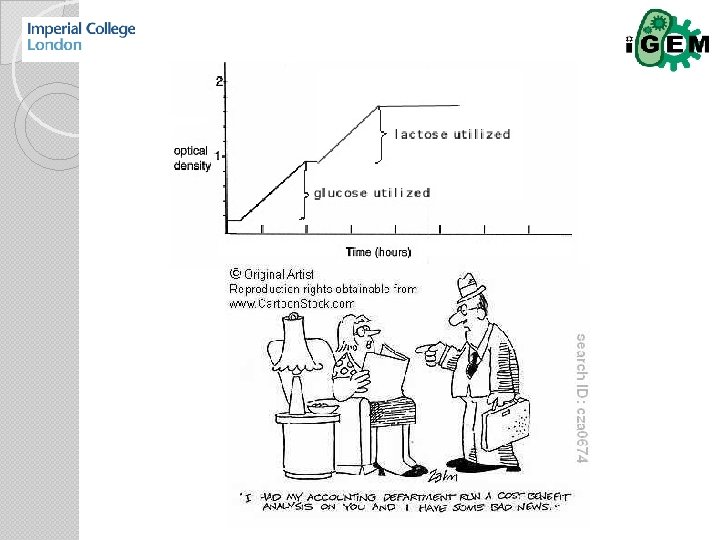
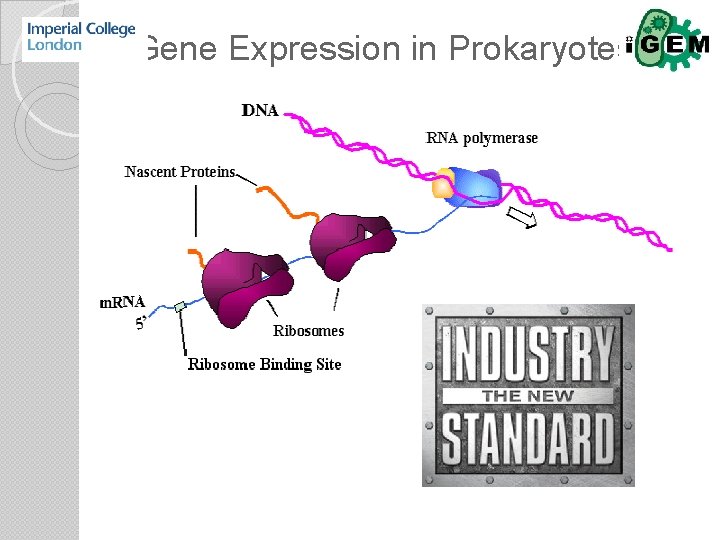
Gene Expression in Prokaryotes
Po. PS & Ri. PS Following the Registry, Po. PS can be defined as the quantity of RNA polymerases that passes a defined point on the DNA per time with unit molars per second (M/s). An analogous definition is valid for Ri. PS. Fa. PS are the quantity of transcription factors (activators or repressors) produced per second inside their corresponding coding regions. Si. PS represent the amount of environmental signals (inducers or corepressors) that enters the cell per time unit. Thus, every flux is just a derivative of a concentration with respect to time so that it is straightforward to integrate it into an ODE-based model.
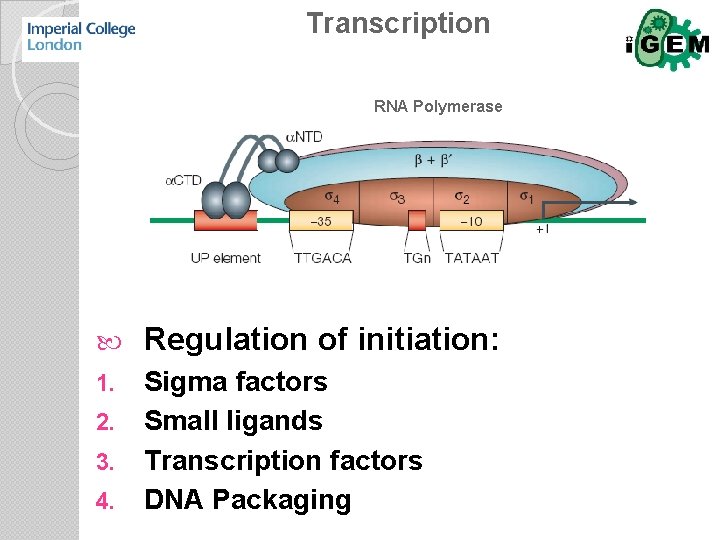
Transcription RNA Polymerase Regulation of initiation: 1. Sigma factors Small ligands Transcription factors DNA Packaging 2. 3. 4.
Sigma Factors Element Tinkering σ factor When: 1. Match promoter with appropriate σ factor. How Much: 1. Increase promoter affinity for σ factor. 2. Reduce number of competing σ factors. 3. Increase σ factor expression. 4. Reduce anti σ factor expression. 5. Increase anti σ factor expression.
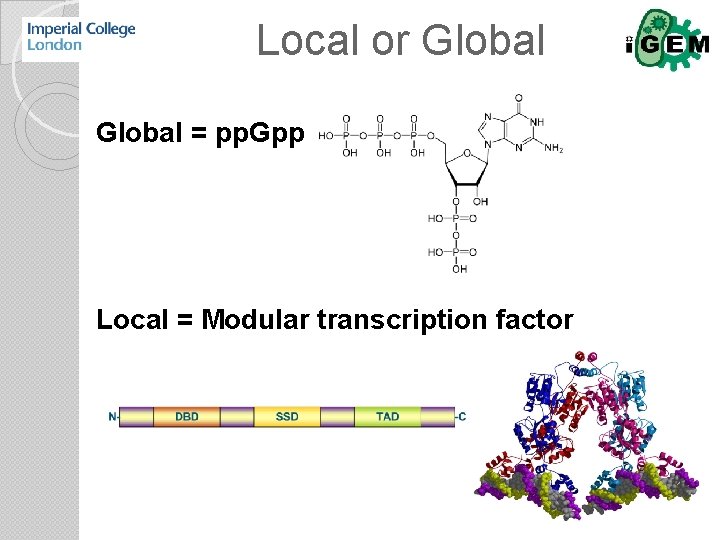
Local or Global = pp. Gpp Local = Modular transcription factor
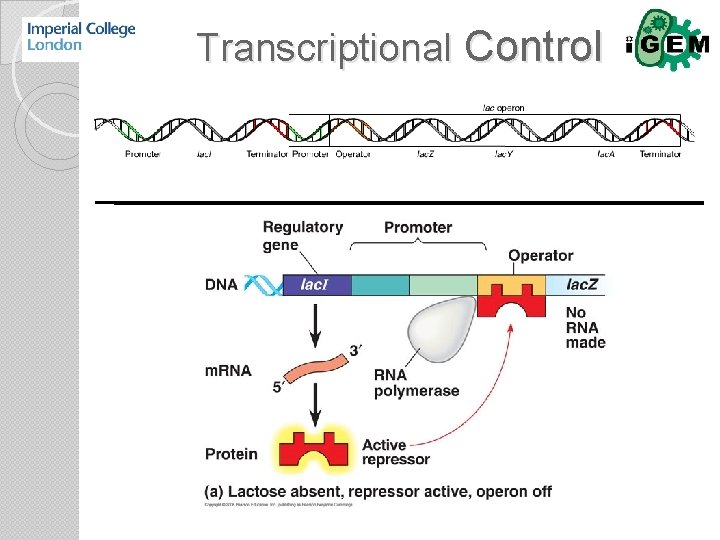
Transcriptional Control
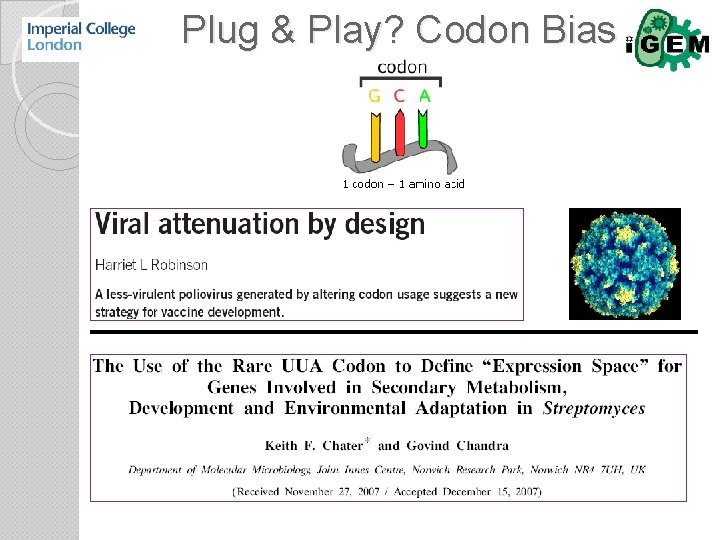
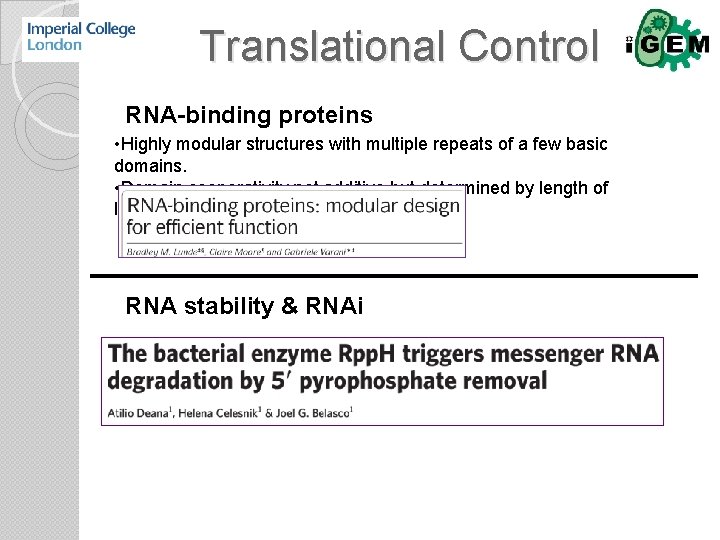
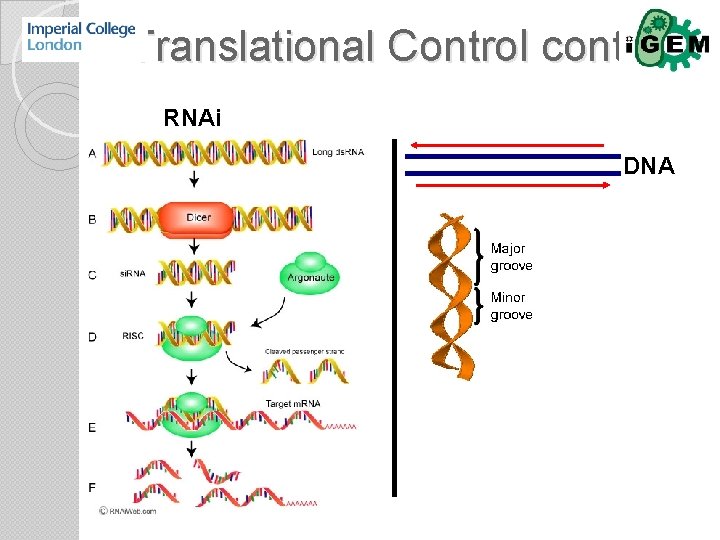
Translational control Codon bias m. RNA secondary structure…. riboswitch m. RNA halflife m. RNA binding proteins
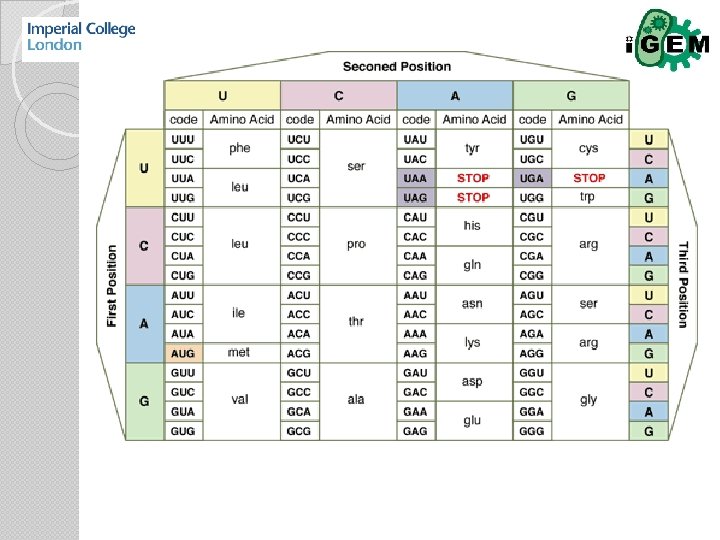
Plug & Play? Codon Bias

Riboswitch Aptamer Expression platform FMN = flavin mononucleotide
Translational Control RNA-binding proteins • Highly modular structures with multiple repeats of a few basic domains. • Domain cooperativity not additive but determined by length of linker. RNA stability & RNAi
Translational Control cont. RNAi DNA

Boolean Logic
Abstraction
- Slides: 36