
Key Concepts Kemshall H Mackenzie G Wilkinson B
Key Concepts Kemshall, H. , Mackenzie, G. , Wilkinson, B. , (2011) Risk of Harm Guidance and Training Resource CD Rom, De Montfort University 1
What is Risk • A judgement about a usually negative event or behaviour based on – Likelihood (probability) – Impact (the outcome) • Key domains of risk in criminal justice terms – Re-offending and reconviction – Serious Harm to others – Also the risk of harm to self Kemshall, H. , Mackenzie, G. & Wilkinson, B. (2011) Risk of Harm Guidance and Training Resources CD ROM. De Montfort University 2

The Two Dimensions of Risk likelihood High likelihood/ low impact eg shoplifting, low value property thefts High likelihood/ high impact, eg TWOC, burglary Impact Low likelihood/ low impact eg first time opportunistic theft Low likelihood/ high impact eg mass murder, public massacre Kemshall, H. , Mackenzie, G. & Wilkinson, B. (2011) Risk of Harm Guidance and Training Resources CD ROM. De Montfort University 3
Structured Assessment • A good risk assessment will help you to – Make a prediction of risk along both dimensions – Risk of re-offending – Risk of harm (what and to whom) – Key risk factors – risk reduction • N. B. can also be used to evaluate effectiveness Kemshall, H. , Mackenzie, G. & Wilkinson, B. (2011) Risk of Harm Guidance and Training Resources CD ROM. De Montfort University 4
Structured Assessment • Actuarial – Statistically based insurance approach • Clinical – Individually based – Interviewing observation social history – Professional judgement • Both have limitations so a structured holistic assessment to build on the strengths of each and reduce bias Kemshall, H. , Mackenzie, G. & Wilkinson, B. (2011) Risk of Harm Guidance and Training Resources CD ROM. De Montfort University 5
Structured Assessment • • • OASys and Asset Reducing bias Guiding the thinking of the assessor Focusing on most important risk factors Analysing and recording the evidence Consistency and comparability Kemshall, H. , Mackenzie, G. & Wilkinson, B. (2011) Risk of Harm Guidance and Training Resources CD ROM. De Montfort University 6
Main Indicators • Past behaviour and convictions • Motivation for and attitude towards offending • Access and proximity to victims (including and grooming) • Preparedness to use weapons • Disinhibitors (alcohol and drugs) • Situational triggers • Conditions and circumstances Kemshall, H. , Mackenzie, G. & Wilkinson, B. (2011) Risk of Harm Guidance and Training Resources CD ROM. De Montfort University 7
Imminence – A Difficult Concept • How soon is the offender likely to commit this act – some questions – More likely to do it than not – As soon as an opportunity or victim presents – Actively grooming opportunity or victim – Will act as soon as risk management plan breaks down – Already failing to attend or comply – Past circumstances and conditions are repeating Kemshall, H. , Mackenzie, G. & Wilkinson, B. (2011) Risk of Harm Guidance and Training Resources CD ROM. De Montfort University 8
Risk Management Reduction rather than Eradication • Intervention programmes – Changing thinking and behaviour • Restrictive conditions – Limiting opportunities – enforcement essential • Monitoring and surveillance – keeping a watchful eye Kemshall, H. , Mackenzie, G. & Wilkinson, B. (2011) Risk of Harm Guidance and Training Resources CD ROM. De Montfort University 9
Defensible Decisions Withstanding Hindsight Scrutiny • All reasonable steps were taken in assessment and management Kemshall, H. , Mackenzie, G. & Wilkinson, B. (2011) Risk of Harm Guidance and Training Resources CD ROM. De Montfort University 10
Defensible Decisions • Decisions grounded in the evidence • Reliable risk assessment tools • Collect verify and thoroughly evaluate information • Record and account for decision making • Communicate with relevant others seek information you do not have Kemshall, H. , Mackenzie, G. & Wilkinson, B. (2011) Risk of Harm Guidance and Training Resources CD ROM. De Montfort University 11
Defensible Decisions • Stay within agency policies and procedures • Match risk management interventions to risk factors • Maintain contact with offender at a level commensurate with the level of risk of harm • Respond to escalating risk, deteriorating behaviour and non-compliance Kemshall, H. , Mackenzie, G. & Wilkinson, B. (2011) Risk of Harm Guidance and Training Resources CD ROM. De Montfort University 12
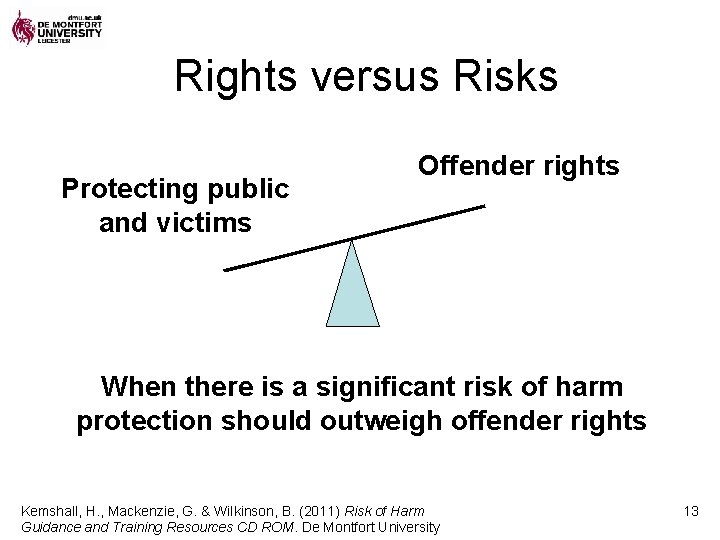
Rights versus Risks Protecting public and victims Offender rights When there is a significant risk of harm protection should outweigh offender rights Kemshall, H. , Mackenzie, G. & Wilkinson, B. (2011) Risk of Harm Guidance and Training Resources CD ROM. De Montfort University 13
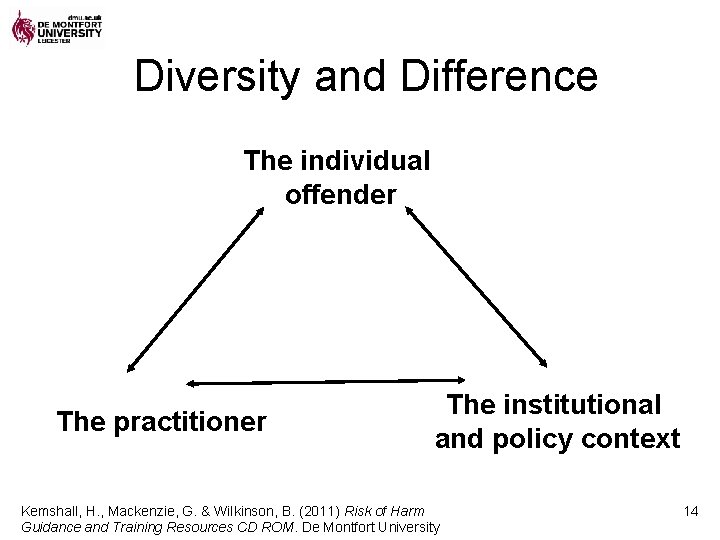
Diversity and Difference The individual offender The practitioner The institutional and policy context Kemshall, H. , Mackenzie, G. & Wilkinson, B. (2011) Risk of Harm Guidance and Training Resources CD ROM. De Montfort University 14
Key Messages • Likelihood and impact • Assess risk of harm in all cases • Ensure you have made a defensible decision and evidenced your actions • Prioritise public and victim protection Kemshall, H. , Mackenzie, G. & Wilkinson, B. (2011) Risk of Harm Guidance and Training Resources CD ROM. De Montfort University 15
- Slides: 15