
KEY CONCEPTS AND GUIDELINES FOR THREAT ASSESSMENT Presented



- Slides: 34
KEY CONCEPTS AND GUIDELINES FOR THREAT ASSESSMENT Presented by LD 6 Crisis Team PSWs Flavia Cabrera-Rodgers, Virginia Hernandez, Maria Olvera & Monica Puentes
TODAY’S OBJECTIVES • Understand the key factors to consider when assessing risk • Understand the threat assessment process at a school site
THREAT ASSESSMENT Threat Assessment has been referred to as the “missing link” in violence prevention. It is the process of deliberately trying to connect the dots or data that paints the picture that someone is moving on a pathway towards serious violence before the violent act occurs.
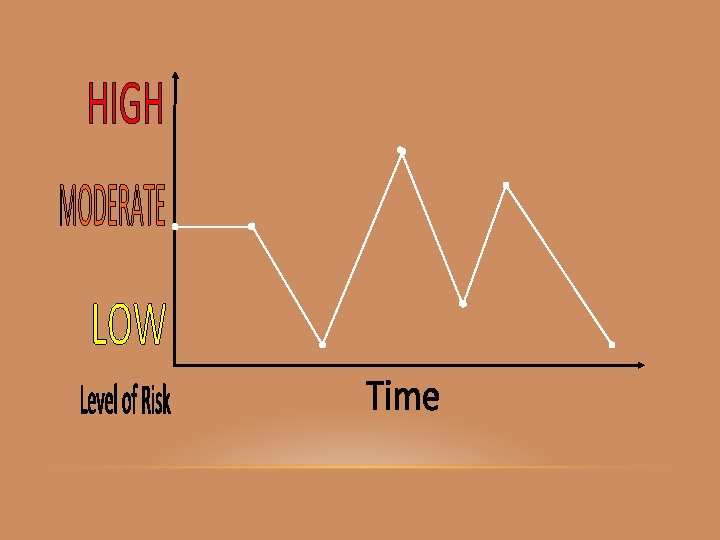
THREAT ASSESSMENT ñ Threat assessment “utilizes available information about warning signs, risk factors, stabilizing factors, and potential precipitating events to arrive at a categorical description of risk for a particular point in time. ” ñ Threat assessment “is only as good as the data collection to support it. Use of collateral data sources is essential. ”
THE UNIDIMENSIONAL ASSESSMENT The plague of the Violence Threat/Risk Assessment Field
OVERREACTION VS. UNDER REACTION “The biggest problem in the aftermath of high-profile school violence was originally thought to be overreacting but experience dictates that the biggest problem is actually under reaction to often blatant indicators that a student is moving on a pathway to serious violence”.
GUIDELINES FOR ACTION • Student makes a threat against the life of another student or staff (verbal/written). Staff notifies the Site Administrator/Designee • Administrator assesses referral for immediate action & convenes the school site Threat Assessment Team • Administrator notifies their LD Operations Coordinator
BUL-1119. 1 ORGANIZING FOR ASSESSING AND MANAGING THREATS • Threat Assessment Team is comprised of: • Administrator • Mental Health Professional • Law Enforcement
THREAT ASSESSMENT TEAM ACTIONS ñ Review information ñ Apply varied specialized expertise ñ Advise decision making process ñ Investigate to determine the level of danger ñ Evaluate and recommend options with safety and individual rights considered ñ Delegate tasks logically for follow-up ñ Document process
THE PROCESS-CONVENE • Team members come together • 3 Questions lead discussion 1. Is the individual moving on a path towards violent action? 2. Is there evidence to suggest movement from thought to action? 3. What can be done to control the progression of the threat? • Identify specific threat & . Determine impact on school.
THE PROCESS-ASSESS • Review warning signs and background information. • Interview witnesses, staff, peers, etc. • Interview student making threat • DO ALL THIS BEFORE CONTACTING THE PARENT • Interview Parent Last
• WARNING SIGNS BACKGROUND INFORMATION
STABILITY FACTORS
INTERVIEWS
THREAT ASSESSMENT QUESTIONS ï Does the person have the ability (access, means, capacity, and opportunity) to become violent? ï Is there evidence of intent (specificity of plan, action taken toward plan)? ï Have they crossed thresholds (engaged in attack-related behaviors, broken rules) which indicate elevated risk?
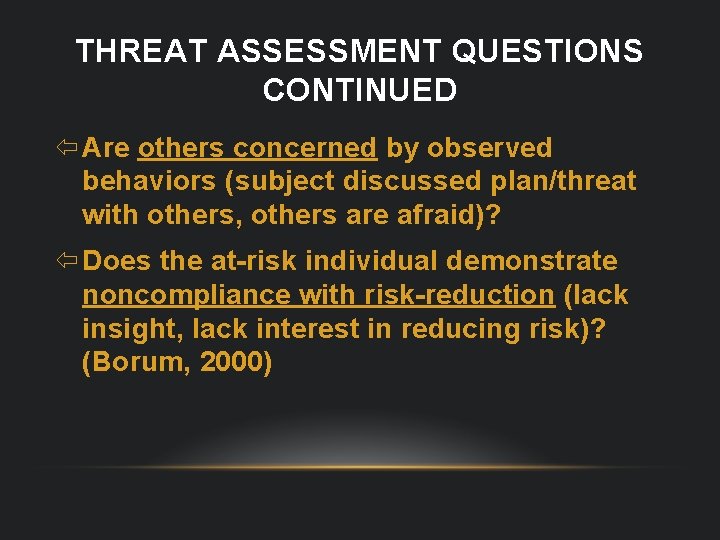
THREAT ASSESSMENT QUESTIONS CONTINUED ï Are others concerned by observed behaviors (subject discussed plan/threat with others, others are afraid)? ï Does the at-risk individual demonstrate noncompliance with risk-reduction (lack insight, lack interest in reducing risk)? (Borum, 2000)
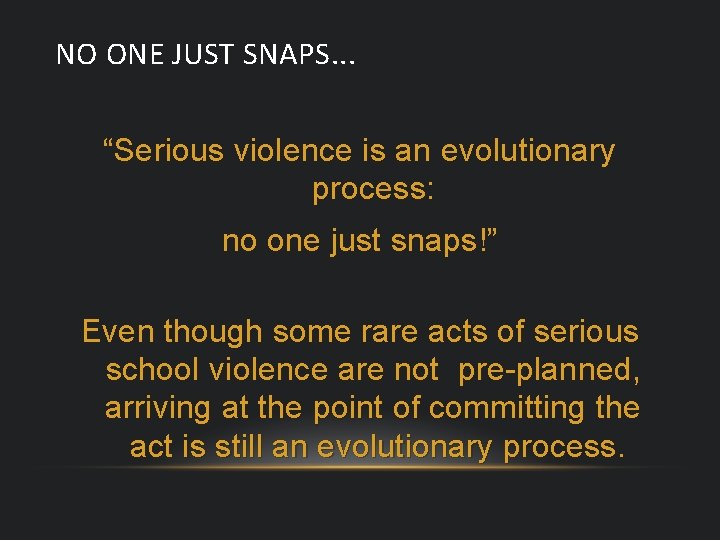
NO ONE JUST SNAPS. . . “Serious violence is an evolutionary process: no one just snaps!” Even though some rare acts of serious school violence are not pre-planned, arriving at the point of committing the act is still an evolutionary process.
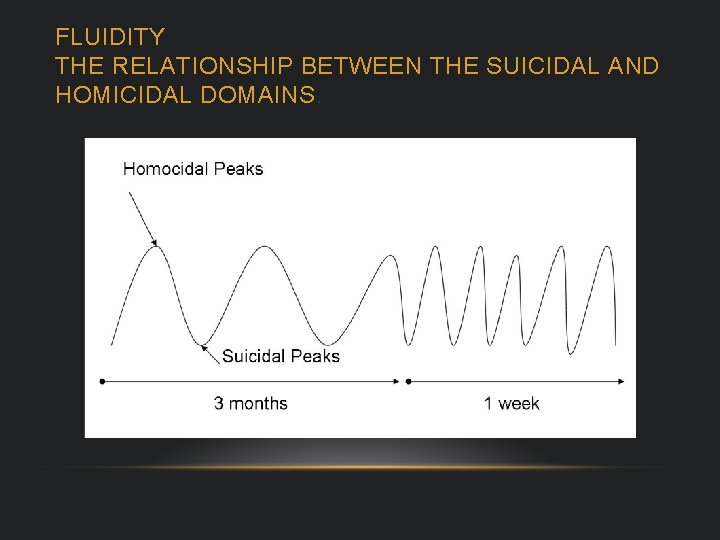
FLUIDITY THE RELATIONSHIP BETWEEN THE SUICIDAL AND HOMICIDAL DOMAINS.
“EMPTY VESSELS” • In many cases of serious youth violence the student did not have a “healthy connection” with a “mature adult”. • When this is the case, the question we ask in Threat Assessment is: “then what are they filling themselves with”?
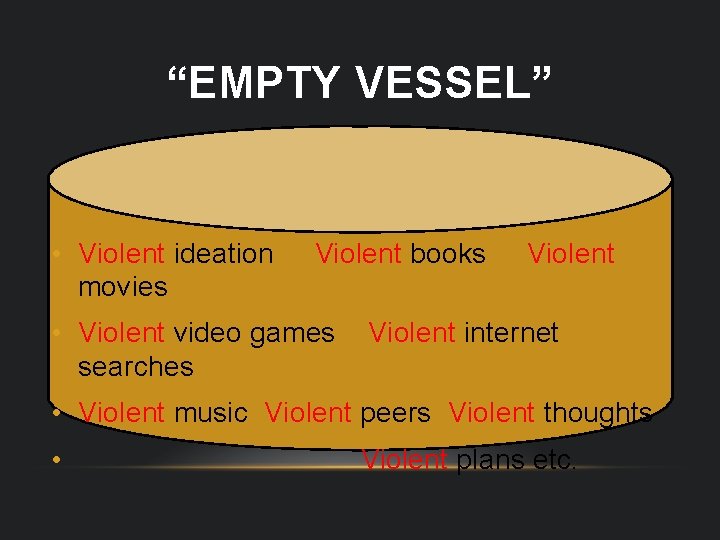
“EMPTY VESSEL” • Violent ideation movies Violent books • Violent video games searches Violent internet • Violent music Violent peers Violent thoughts • Violent plans etc.
“JUSTIFICATION” • We must feel justified in order to harm/kill. The process of justification is necessary to the act of violence.
“HUMAN TARGET & SITE SELECTION” • Human Target - This variable refers to who was currently threatened as well has who have been the targets of violence or threats of violence in the past. Human target selection is influenced by the justification process. • Site Selection - This variable refers to where threat was made and/or where the incident is intended to occur, as well as history of site selection. Teams must distinguish between emotionally determined sites versus sites of opportunity.
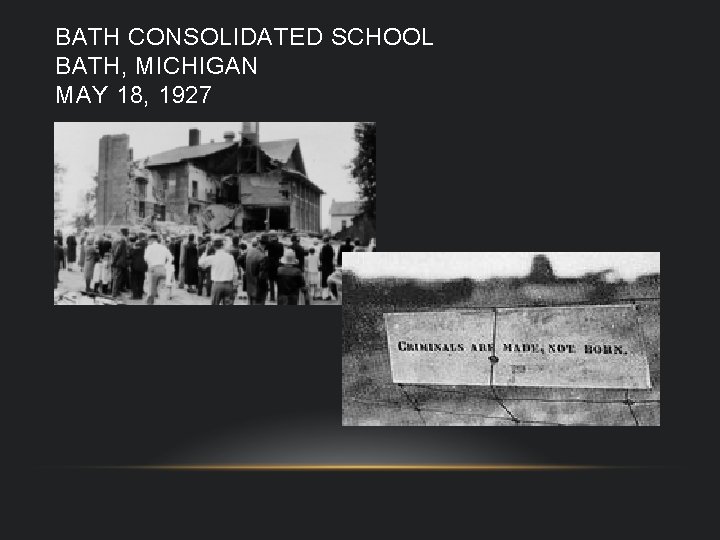
BATH CONSOLIDATED SCHOOL BATH, MICHIGAN MAY 18, 1927
“PARALLEL PROCESS” • When a behavior is motivated because of another similar circumstance that has occurred in the past.
MAKE A TEAM RECOMMENDATION • No one person should make a decision alone. • Implement an intervention plan. • Monitor progress toward reestablishing school safety. • Reconvene team when necessary.
MONITORING STUDENT’S RETURN TO SCHOOL Questions to determine level of confidence • Does student understand the events that lead to threats/threatening behavior or violent acts? • Does student understand distress of others? • Does student have a specific plan to prevent additional problematic behavior?
MONITORING STUDENTS RETURN CONTINUED • If student was hospitalized they must return with a letter from attending physician stating the student no longer poses a threat to self or others. • Use release of information to contact the community agencies on a regular basis • Refer student to program within the school (Impact, School Psychologist, PSW, PSA)
MONITORING STUDENTS RETURN CONTINUED • Return to School Agreement Attendance/behavior contract • Contact parents regularly to discuss progress
THE PROCESS-DOCUMENT • Document all steps taken. • Strict confidentiality about student information should be kept among team members & appropriate District staff
DECISIONS MADE AND ACTIONS TAKEN SHOULD RESULT IN: • Contact with and/or apprehension of person/s who initiated the threat. • Warning and protection for the targeted victim(s) of the threat. • Disciplinary action, if needed. • Continuation of a safe school environment.
AT LAUSD EVERY ADULT ON CAMPUS PLAYS AN IMPORTANT ROLE • Two predictive factors that make kids getting into trouble very unlikely • Kids feel connected at home • Kids feel connected at school
REFERENCES Adapted from: “Key Concepts in Threat Assessment and Management “ J. Kevin Cameron, M. Sc. , R. S. W. , B. C. E. T. S. , B. C. S. C. R. Los Angeles Unified School District “Certified Trainers” 2008 Adapted from: “School Violence Threat Management” Kris Mohandie, Ph. D LAUSD Crisis Team Training Fall 2010