
Key Concepts and Definitions What is a Policy
- Slides: 15
Key Concepts and Definitions
What is a Policy? A law, rule, regulation, or a set of guidelines, procedures, or norms from a higher-level authority to guide a course of action.
What is Advocacy? Advocacy is the act or process of supporting a cause or issue. An advocacy campaign is a set of targeted actions in support of a cause or issue. We advocate a cause or issue because we want to – Build support for that cause or issue – Influence others to support it – Try to influence or change legislation that affects it — International Planned Parenthood Federation, IPPF Advocacy Guide Advocacy is speaking up, drawing a community’s attention to an important issue, and directing decision-makers toward a solution. Advocacy is working with other people and organizations to make a difference. — CEDPA, Cairo, Beijing and Beyond: A Handbook on Advocacy for Women Leaders
What is Policy Advocacy? Policy advocacy is the deliberate process of informing and influencing decision-makers in support of evidence-based policy change. − Stronger Health Advocates, Greater Health Impacts: A Workshop Curriculum on Policy Advocacy Strategy Development, 2013
Elements of the Definition • Policy advocacy is a deliberate process that requires planning and strategy. • Specifically, policy advocacy: • Aims to inform and influence decisionmakers • Seeks changes that are evidence-based • Has a goal of achieving a desired policy change
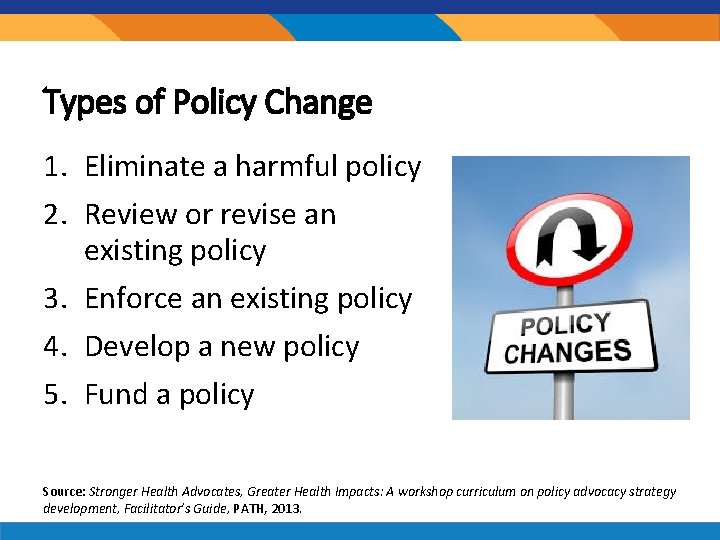
Types of Policy Change 1. Eliminate a harmful policy 2. Review or revise an existing policy 3. Enforce an existing policy 4. Develop a new policy 5. Fund a policy Source: Stronger Health Advocates, Greater Health Impacts: A workshop curriculum on policy advocacy strategy development, Facilitator’s Guide, PATH, 2013.
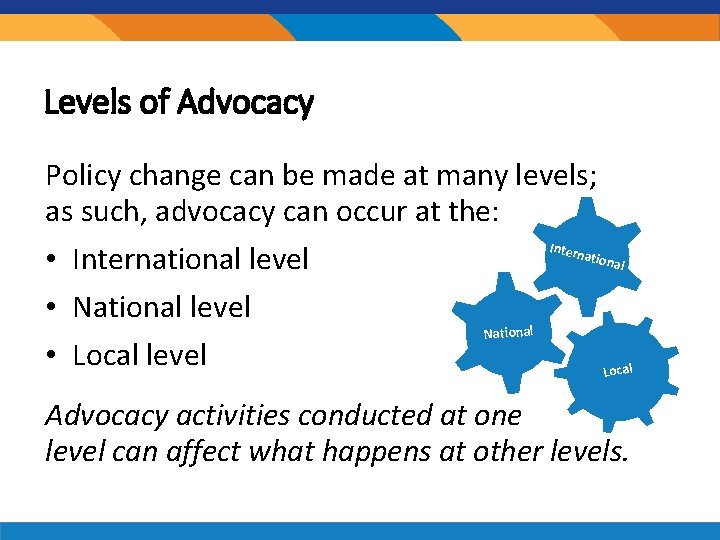
Levels of Advocacy Policy change can be made at many levels; as such, advocacy can occur at the: Inter natio nal • International level • National level • Local level National Local Advocacy activities conducted at one level can affect what happens at other levels.
Levels of Advocacy (continued) Level(s) of your advocacy work will depend on: • The scale of the problem or issue • Where you can have the greatest impact • Resources your organization can supply (i. e. , staff time, skills, and funds) • Your organization’s networks • Geographic scope of your organization
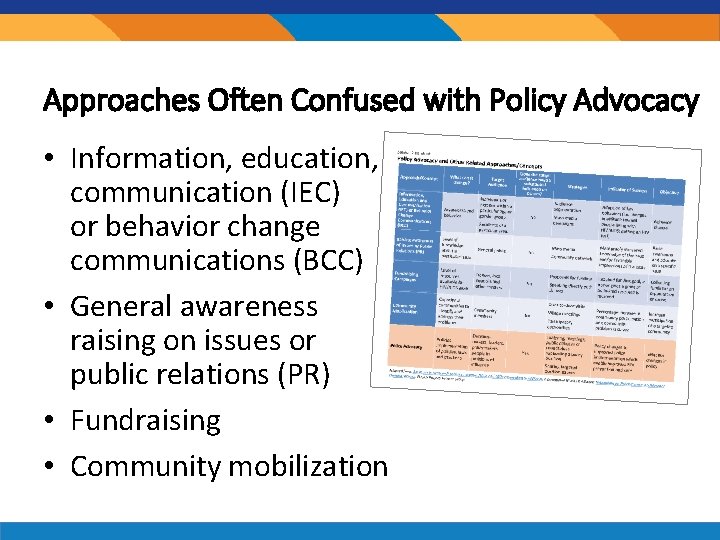
Approaches Often Confused with Policy Advocacy • Information, education, communication (IEC) or behavior change communications (BCC) • General awareness raising on issues or public relations (PR) • Fundraising • Community mobilization
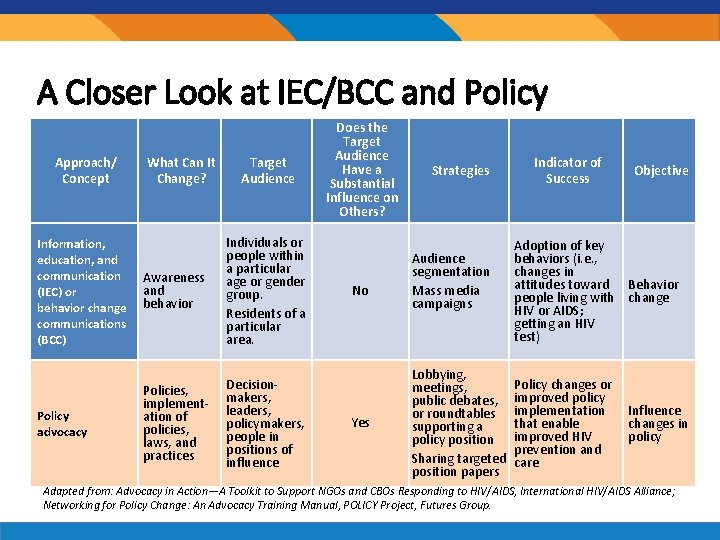
A Closer Look at IEC/BCC and Policy Advocacy Approach/ Concept Information, education, and communication (IEC) or behavior change communications (BCC) Policy advocacy What Can It Change? Target Audience Awareness and behavior Individuals or people within a particular age or gender group. Residents of a particular area. Policies, implementation of policies, laws, and practices Decision- makers, leaders, policymakers, people in positions of influence Does the Target Audience Have a Substantial Influence on Others? Strategies Indicator of Success Objective No Audience segmentation Mass media campaigns Adoption of key behaviors (i. e. , changes in attitudes toward Behavior people living with change HIV or AIDS; getting an HIV test) Yes Lobbying, meetings, public debates, or roundtables supporting a policy position Sharing targeted position papers Policy changes or improved policy implementation Influence that enable changes in improved HIV policy prevention and care Adapted from: Advocacy in Action—A Toolkit to Support NGOs and CBOs Responding to HIV/AIDS, International HIV/AIDS Alliance; Networking for Policy Change: An Advocacy Training Manual, POLICY Project, Futures Group.
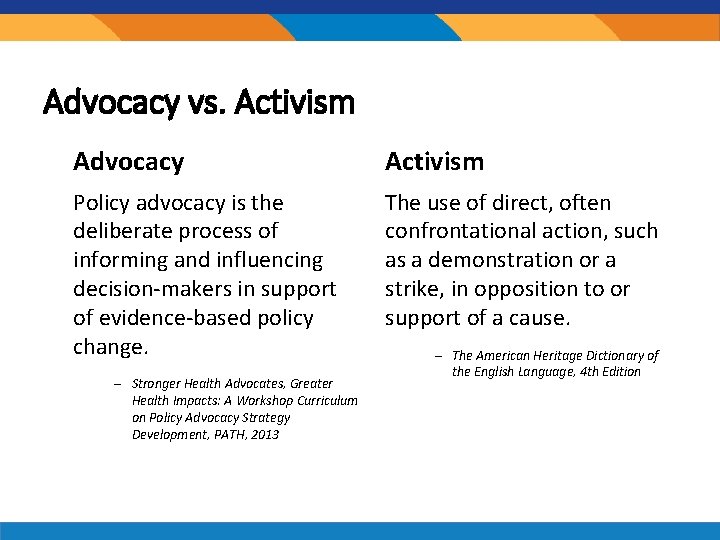
Advocacy vs. Activism Advocacy Activism Policy advocacy is the deliberate process of informing and influencing decision-makers in support of evidence-based policy change. The use of direct, often confrontational action, such as a demonstration or a strike, in opposition to or support of a cause. ─ Stronger Health Advocates, Greater Health Impacts: A Workshop Curriculum on Policy Advocacy Strategy Development, PATH, 2013 ─ The American Heritage Dictionary of the English Language, 4 th Edition
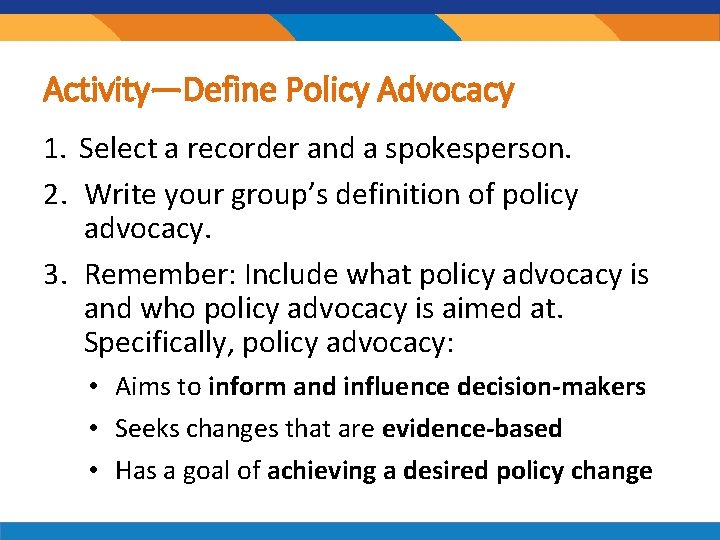
Activity—Define Policy Advocacy 1. Select a recorder and a spokesperson. 2. Write your group’s definition of policy advocacy. 3. Remember: Include what policy advocacy is and who policy advocacy is aimed at. Specifically, policy advocacy: • Aims to inform and influence decision-makers • Seeks changes that are evidence-based • Has a goal of achieving a desired policy change
Discussion Questions • What are the common elements in each definition? • What are the unique elements of each definition?
Activity—Agree on Policy Advocacy Definition 1. Create a new definition combining common elements from all the small group definitions. OR Create a new definition by combining two or three favorite small group definitions. OR Select one of the small group definitions. 2. Write the final definition on a flip chart for use during the workshop.
Learning Objectives—Session 2 • Define policy and policy advocacy • Differentiate between policy advocacy and other similar concepts such as activism • Develop a working definition of policy advocacy for the workshop