
Key challenges for the future of youth justice

![Defining ‘diversion’ (cont) � [‘Diversion’ is] any process that is used by components of](https://slidetodoc.com/presentation_image_h/98ee9e37af2890a9d21bc133d17df1bf/image-7.jpg "Defining ‘diversion’ (cont) � [‘Diversion’ is] any process that is used by components of")

- Slides: 11
Key challenges for the future of youth justice in Australia Dr Kelly Richards, School of Justice, Queensland University of Technology
School of Justice, QUT
School of Justice, QUT (cont) Research themes: � Social and Indigenous justice � Policing � Sexuality, gender and justice � Eco-crime and corruption International Journal and biennial conference: http: //www. qut. edu. au/research/ourresearch/institutes-centres-and-researchgroups/crime-and-justice-research-centre
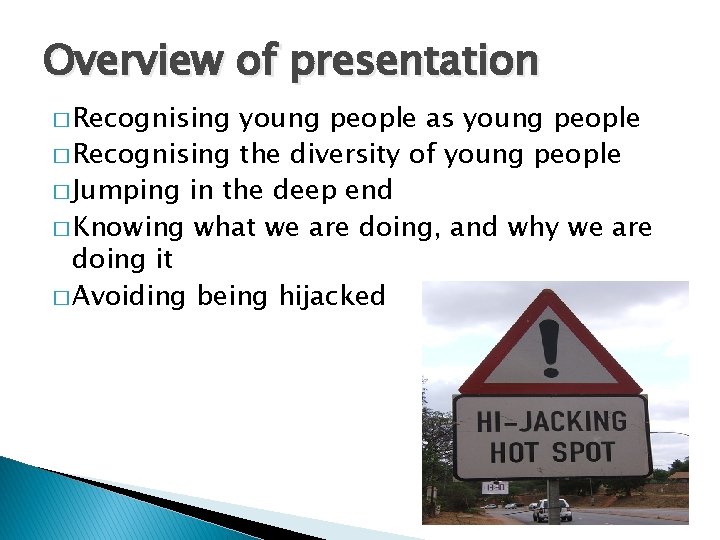
Overview of presentation � Recognising young people as young people � Recognising the diversity of young people � Jumping in the deep end � Knowing what we are doing, and why we are doing it � Avoiding being hijacked
Defining ‘diversion’ � Diversion is defined as the channelling of cases to noncourt institutions, in instances where these cases would ordinarily have received an adjudicatory (or fact-finding) hearing by a court (Nejelski 1976: 396). � [‘Diversion’ is] a means of diverting eligible offenders from the criminal justice system to specific programs that address issues related to criminal behaviour (Heseltine & Howells 2012: 512).
Defining ‘diversion’ (cont) � Diversion o o o primarily operates at three levels: crime prevention strategies — which aim to prevent young people becoming involved in criminal activity in the first instance; diversionary schemes — which aim to divert young offenders away from the criminal justice system as early as possible; and sentencing options — which aim to divert young people away from custodial sentences (Jordan & Farrell 2013: 421).
Defining ‘diversion’ (cont) � [‘Diversion’ is] any process that is used by components of the criminal justice system whereby youths avoid formal juvenile court processing and adjudication (Roberts cited in Bechard et al. 2011: 607).
Conceptual confusion � What are young people to be ‘diverted’ from and to? � Are young people to be ‘diverted’ from the criminal justice system or from offending behaviour? � Are young people to be ‘diverted’ from criminal justice processes or outcomes?
Conceptual confusion (cont) � Although police cannot always be involved in community development strategies and social programs that aim to prevent crime, these should be facilitated wherever possible. Policing initiatives that divert offenders from the criminal justice system at a young age are critical (Attorney-General’s Department 2010: 5).
References � � � � � Attorney-General’s Department 2010. National youth policing model. Canberra: Australian Government Australian Capital Territory Department of Disability, Health and Community Services nd. Diversionary framework for youth justice: Questions and answers. Canberra: ACT Government Bechard S et al. 2011. Arbitrary arbitration: Diverting juveniles into the justice system - A reexamination after 22 years. International Journal of Offender Therapy and Comparative Criminology 55(4): 605 -625 Heseltine K and Howells K 2012. Community-based corrections. In Marmo M et al (eds) Crime and justice: A guide to criminology. Sydney: Thomson Reuters: 507 -526 Jordan L and Farrell J 2013. Juvenile justice diversion in Victoria: A blank canvas? Current Issues in Criminal Justice 24(3): 419 -437 Mc. Ara L & Mc. Vie S 2010. Youth crime and justice: Key messages from the Edinburgh Study of Youth Transitions and Crime. Criminology and Criminal Justice 10(2): 179 -209 Mc. Ara L & Mc. Vie S 2007. Youth justice? The impact of system contact on patterns of desistance from offending European Journal of Criminology 4(3): 315 -345 Nejelski P 1976. Diversion: The promise and the danger. Crime & Delinquency 22: 393 -410 New South Wales Bureau of Crime Statistics and Research 2011. Submission No 9 to NSW Department of Attorney-General and Justice, Review of the Young Offenders Act 1997 and the Children (Criminal Proceedings) Act 1987, 12 December Weatherburn D, Mc. Grath A & Bartels L 2012. Three dogmas of juvenile justice University of New South Wales Law Journal 35(3): 781 -809
Thank you � Dr Kelly Richards � Ph: (07) 3138 7125 � k 1. richards@qut. edu. au