
Key Areas covered Hubbles law shows the relationship
Key Areas covered • Hubble’s law shows the relationship between the recession velocity of a galaxy and its distance from us. • Hubble’s law allows us to estimate the age of the Universe.
What we will do today • Use Hubble’s law to calculate how far away a galaxy is. • Describe how we can use Hubble’s law to estimate the age of the Universe.

Hubble’s law
Hubble’s Law • The astronomer Edwin Hubble noticed in the 1920 s that the light from some distant galaxies was shifted towards the red end of the spectrum. • The size of the shift was the same for all elements coming from the galaxies. • This shift was due to the galaxies moving away from Earth at speed.
The bigger the shift the faster the galaxy moves • Hubble found that the further away a galaxy was the faster it was travelling. • The relationship between the distance and speed of a galaxy is known as Hubble’s Law: v = Ho d • Ho = Hubble’s constant = 2. 3 x 10 -18 s-1
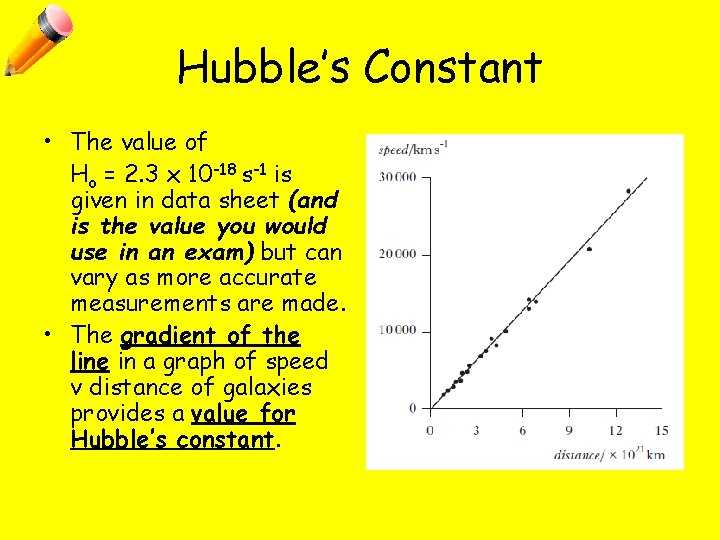
Hubble’s Constant • The value of Ho = 2. 3 x 10 -18 s-1 is given in data sheet (and is the value you would use in an exam) but can vary as more accurate measurements are made. • The gradient of the line in a graph of speed v distance of galaxies provides a value for Hubble’s constant.
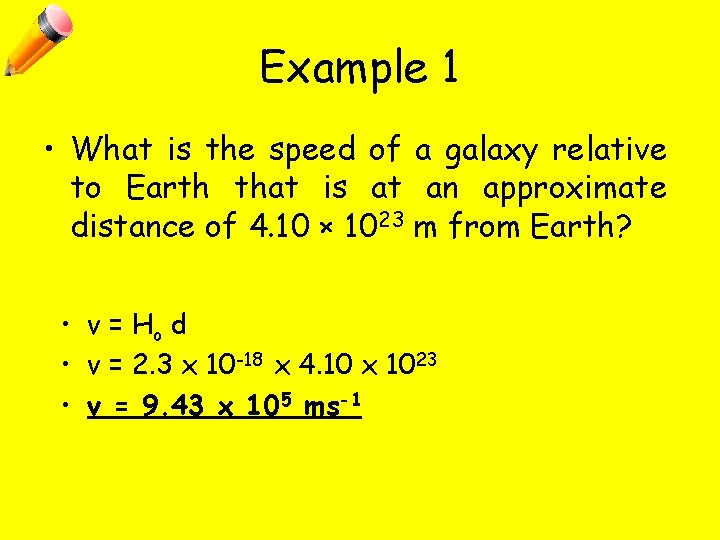
Example 1 • What is the speed of a galaxy relative to Earth that is at an approximate distance of 4. 10 × 1023 m from Earth? • v = Ho d • v = 2. 3 x 10 -18 x 4. 10 x 1023 • v = 9. 43 x 105 ms-1

What is a light year? • Sometimes distances can be given in light years. • One light year is the distance travelled by light in one year. • It can be calculated as follows using d = vt: • 3 x 10⁸ (speed of light) x 365 (days) x 24 (hours) x 60 (mins) x 60 (s) • One light year = 9. 46 x 1015 m
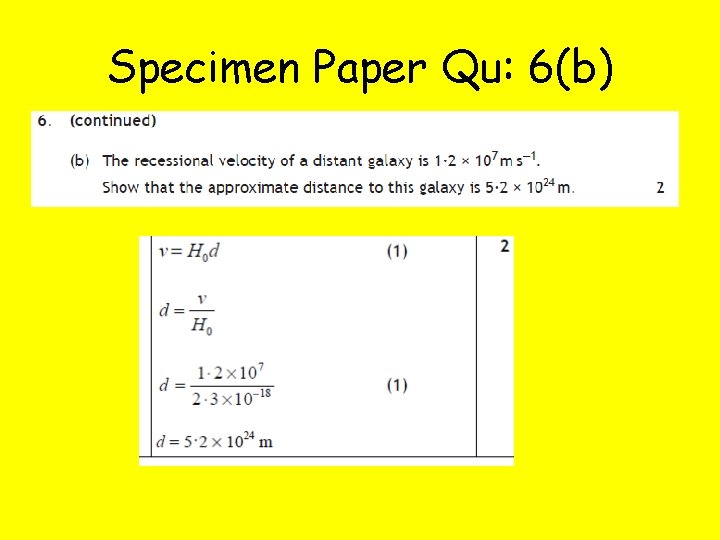
Specimen Paper Qu: 6(b)
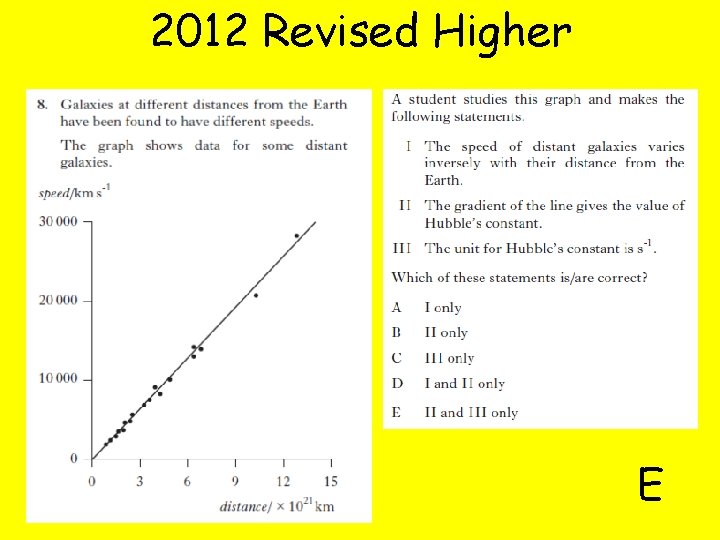
2012 Revised Higher E

Revised Higher (specimen paper) • v = Ho d • 5. 5 x 105 = 2. 3 x 10 -18 x d • d = 5. 5 x 10⁵ 2. 3 x 10 -18 • d = 2. 39 x 1023 m
Questions • You can now attempt the questions on Hubble’s Law in your class jotter • Note the different value for Hubble’s law here – this should be changed to 2. 3 x 10 -18 s-1(not 2. 4 as in the booklet)
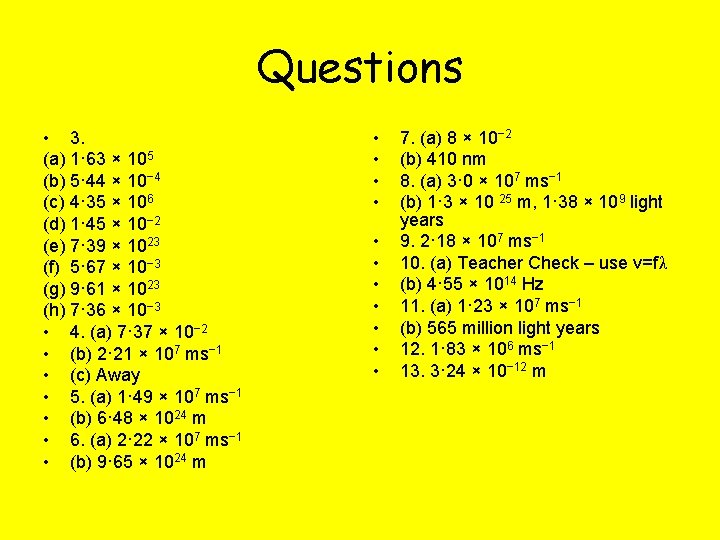
Questions • 3. (a) 1· 63 × 105 (b) 5· 44 × 10− 4 (c) 4· 35 × 106 (d) 1· 45 × 10− 2 (e) 7· 39 × 1023 (f) 5· 67 × 10− 3 (g) 9· 61 × 1023 (h) 7· 36 × 10− 3 • 4. (a) 7· 37 × 10− 2 • (b) 2· 21 × 107 ms− 1 • (c) Away • 5. (a) 1· 49 × 107 ms− 1 • (b) 6· 48 × 1024 m • 6. (a) 2· 22 × 107 ms− 1 • (b) 9· 65 × 1024 m • • • 7. (a) 8 × 10− 2 (b) 410 nm 8. (a) 3· 0 × 107 ms− 1 (b) 1· 3 × 10 25 m, 1· 38 × 109 light years 9. 2· 18 × 107 ms− 1 10. (a) Teacher Check – use v=fλ (b) 4· 55 × 1014 Hz 11. (a) 1· 23 × 107 ms− 1 (b) 565 million light years 12. 1· 83 × 106 ms− 1 13. 3· 24 × 10− 12 m
- Slides: 13