
Key area 2 4 Metabolism in conformers and
Key area 2. 4: Metabolism in conformers and regulators CFE Higher Biology Metabolism and survival
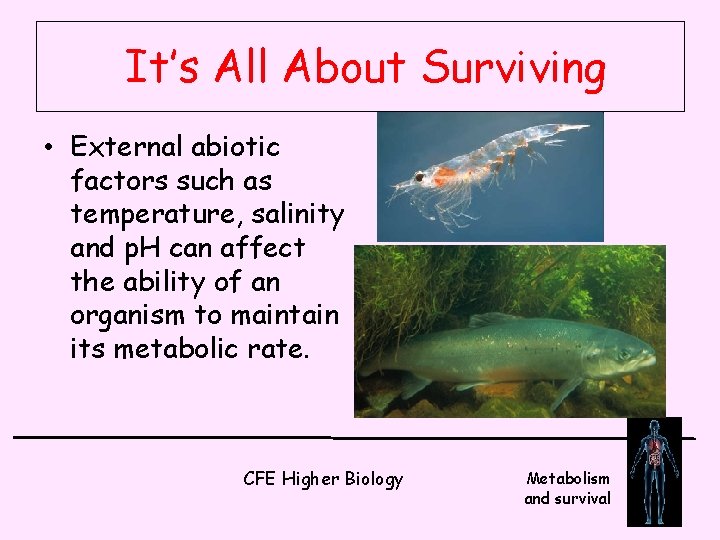
It’s All About Surviving • External abiotic factors such as temperature, salinity and p. H can affect the ability of an organism to maintain its metabolic rate. CFE Higher Biology Metabolism and survival
Measuring Metabolic Rate Environmental conditions vary, an organism can respond to these variations in 2 ways: 1. Conformation 2. Regulation CFE Higher Biology Metabolism and survival

Conformers • A conformers internal environment is directly dependent upon its external environment. • These organisms cannot maintain their metabolic rate by physiological mechanisms. • Most conformers live in the ocean where the environment is relatively stable. CFE Higher Biology Metabolism and survival
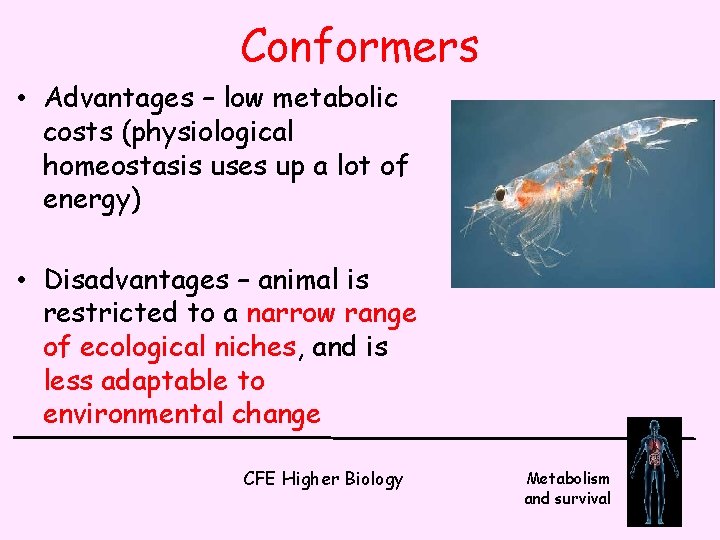
Conformers • Advantages – low metabolic costs (physiological homeostasis uses up a lot of energy) • Disadvantages – animal is restricted to a narrow range of ecological niches, and is less adaptable to environmental change CFE Higher Biology Metabolism and survival

Conformers • Conformers may have a narrow ecological niche unless they can TOLERATE or RESIST variation in their external environment. CFE Higher Biology Metabolism and survival
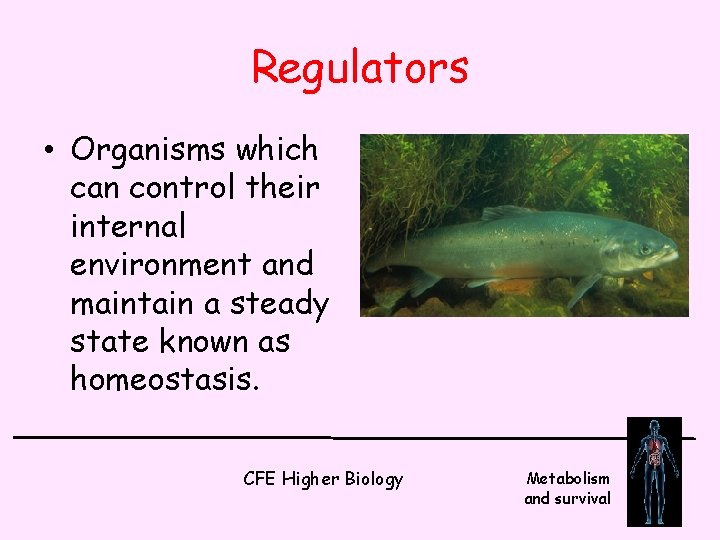
Regulators • Organisms which can control their internal environment and maintain a steady state known as homeostasis. CFE Higher Biology Metabolism and survival
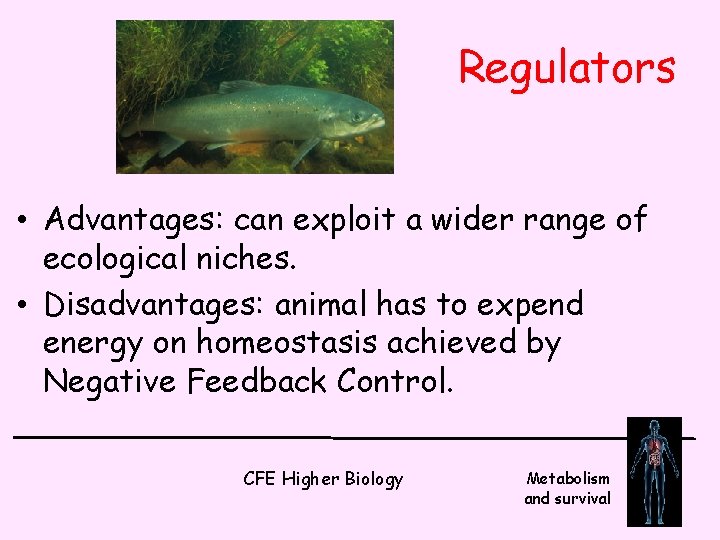
Regulators • Advantages: can exploit a wider range of ecological niches. • Disadvantages: animal has to expend energy on homeostasis achieved by Negative Feedback Control. CFE Higher Biology Metabolism and survival
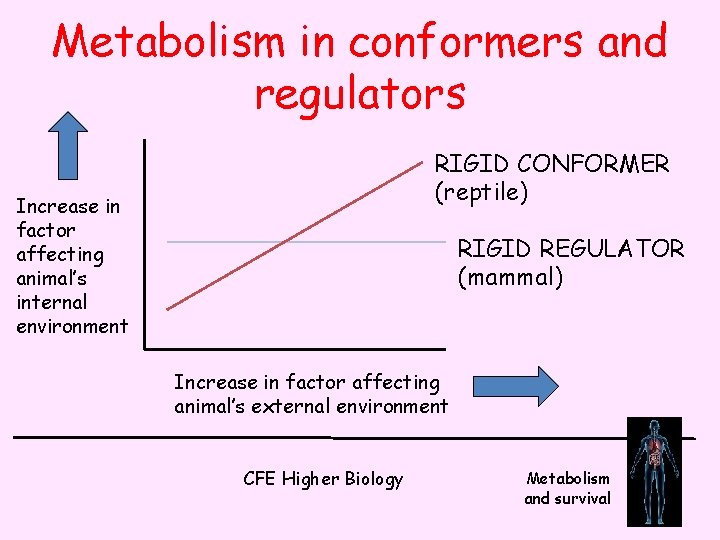
Metabolism in conformers and regulators RIGID CONFORMER (reptile) Increase in factor affecting animal’s internal environment RIGID REGULATOR (mammal) Increase in factor affecting animal’s external environment CFE Higher Biology Metabolism and survival
• How might climate change impact on survival of species? CFE Higher Biology Metabolism and survival
• How might climate change impact on survival of species? • If the climate changes and the species is not able to survive it may die out. • Or another species which is better suited may outcompete the original. CFE Higher Biology Metabolism and survival
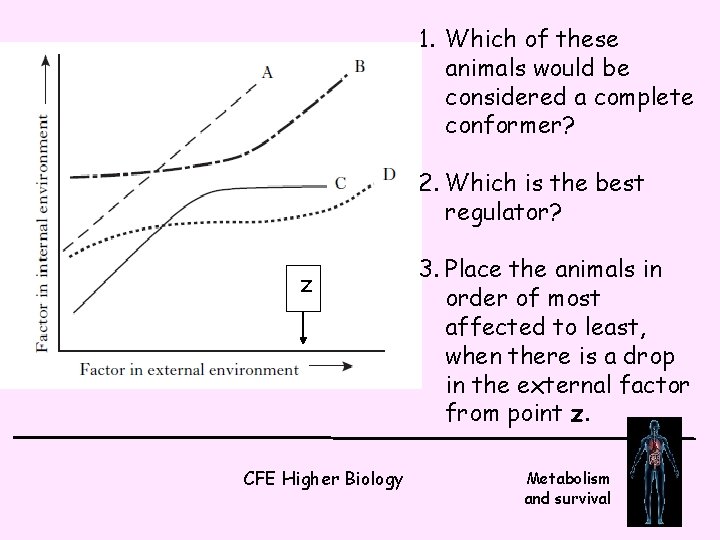
1. Which of these animals would be considered a complete conformer? 2. Which is the best regulator? z CFE Higher Biology 3. Place the animals in order of most affected to least, when there is a drop in the external factor from point z. Metabolism and survival
Physiological Homeostasis • Maintenance of the body’s internal environment within certain tolerable limits despite changes in the body’s external environment. • This regulation is brought about by negative feedback control and requires energy. CFE Higher Biology Metabolism and survival
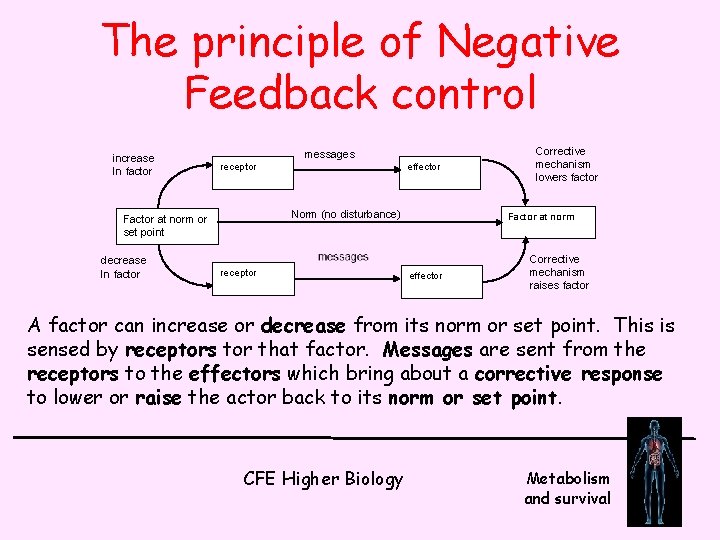
The principle of Negative Feedback control increase In factor messages receptor Norm (no disturbance) Factor at norm or set point decrease In factor effector receptor Corrective mechanism lowers factor Factor at norm effector Corrective mechanism raises factor A factor can increase or decrease from its norm or set point. This is sensed by receptors tor that factor. Messages are sent from the receptors to the effectors which bring about a corrective response to lower or raise the actor back to its norm or set point. CFE Higher Biology Metabolism and survival
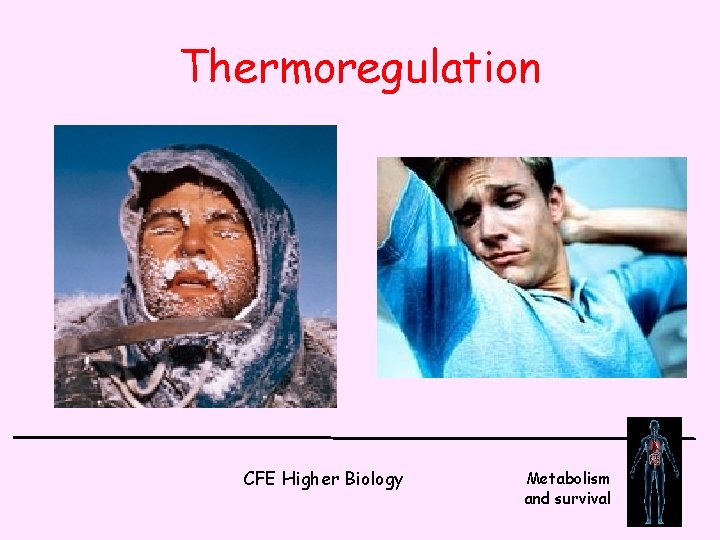
Thermoregulation CFE Higher Biology Metabolism and survival
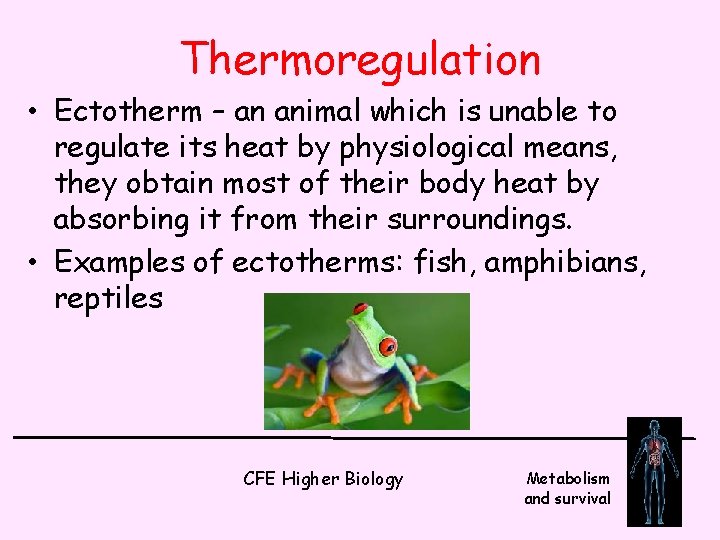
Thermoregulation • Ectotherm – an animal which is unable to regulate its heat by physiological means, they obtain most of their body heat by absorbing it from their surroundings. • Examples of ectotherms: fish, amphibians, reptiles CFE Higher Biology Metabolism and survival
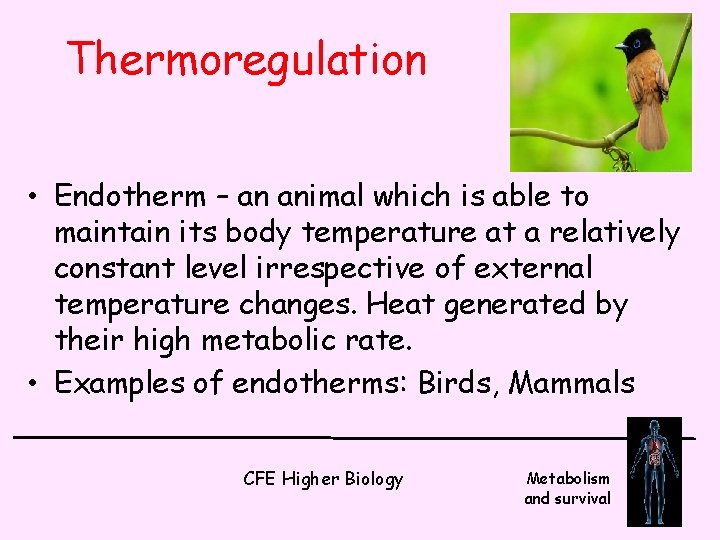
Thermoregulation • Endotherm – an animal which is able to maintain its body temperature at a relatively constant level irrespective of external temperature changes. Heat generated by their high metabolic rate. • Examples of endotherms: Birds, Mammals CFE Higher Biology Metabolism and survival
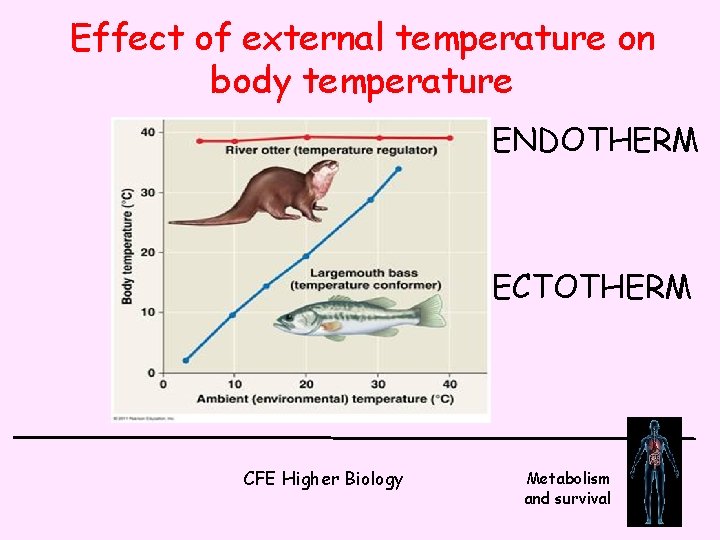
Effect of external temperature on body temperature ENDOTHERM ECTOTHERM CFE Higher Biology Metabolism and survival
Importance of temperature regulation • It is important to regulate temperature for optimal enzyme-controlled reactions and diffusion rates for maintenance of metabolism. • Diffusion of substances such as oxygen and carbon dioxide are faster at warmer temperatures. CFE Higher Biology Metabolism and survival
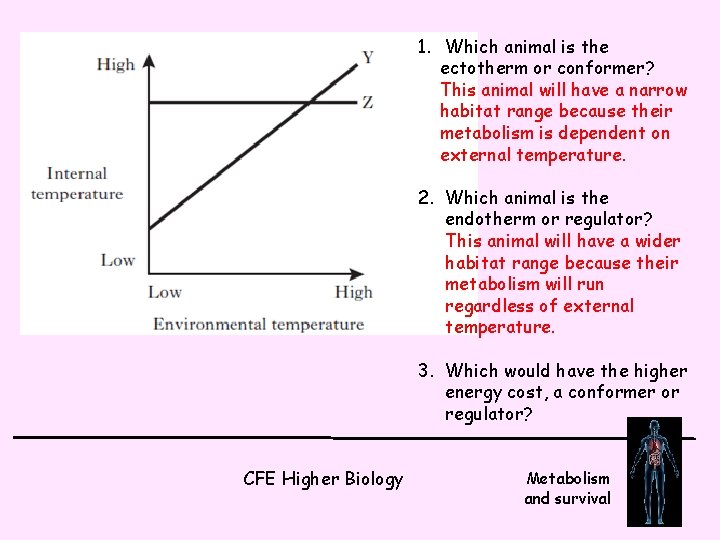
1. Which animal is the ectotherm or conformer? This animal will have a narrow habitat range because their metabolism is dependent on external temperature. 2. Which animal is the endotherm or regulator? This animal will have a wider habitat range because their metabolism will run regardless of external temperature. 3. Which would have the higher energy cost, a conformer or regulator? CFE Higher Biology Metabolism and survival
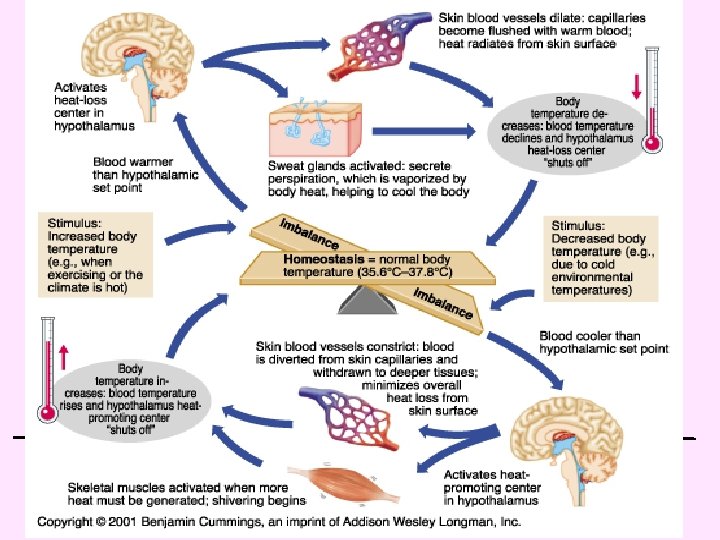
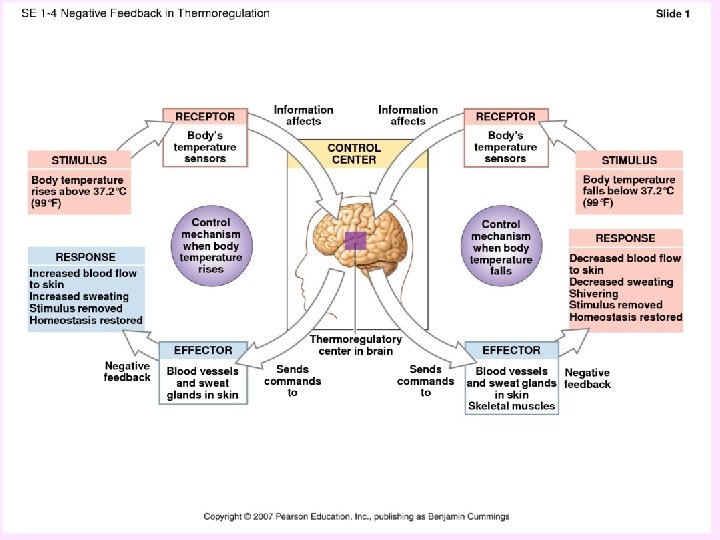
Thermoregulation and Negative Feedback • Negative Feedback Control and Thermoregulation in mammals include the role of the hypothalamus, nerves, effectors and skin CFE Higher Biology Metabolism and survival
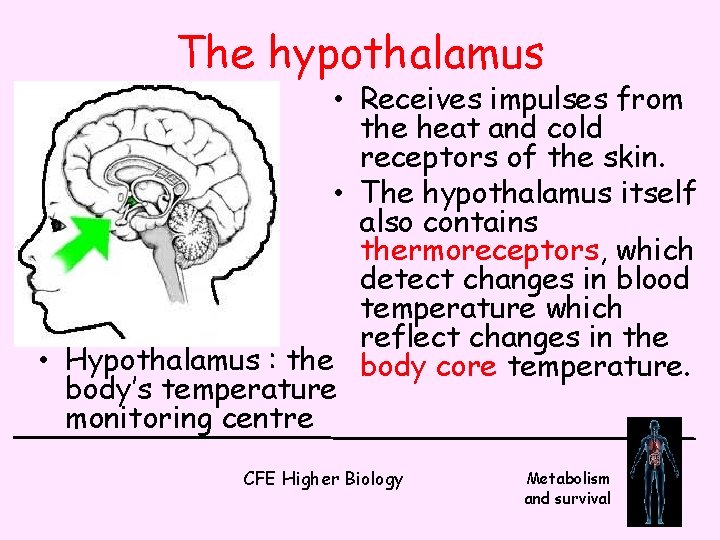
The hypothalamus • Receives impulses from the heat and cold receptors of the skin. • The hypothalamus itself also contains thermoreceptors, which detect changes in blood temperature which reflect changes in the • Hypothalamus : the body core temperature. body’s temperature monitoring centre CFE Higher Biology Metabolism and survival
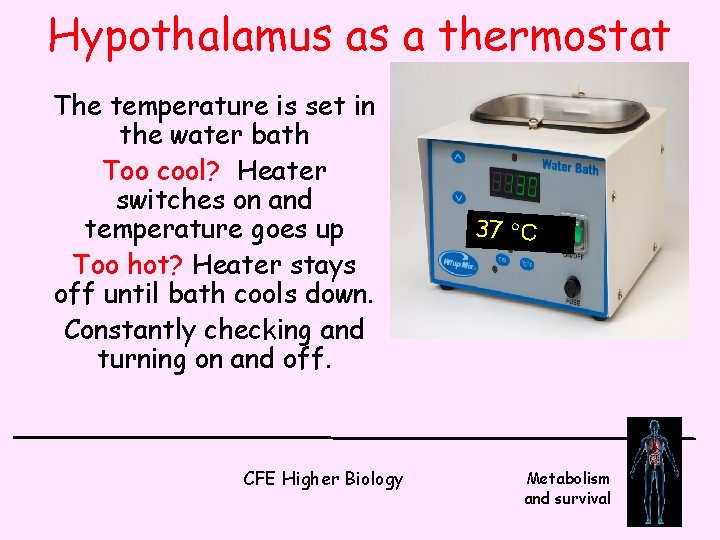
Hypothalamus as a thermostat The temperature is set in the water bath Too cool? Heater switches on and temperature goes up Too hot? Heater stays off until bath cools down. Constantly checking and turning on and off. CFE Higher Biology 37 °C Metabolism and survival
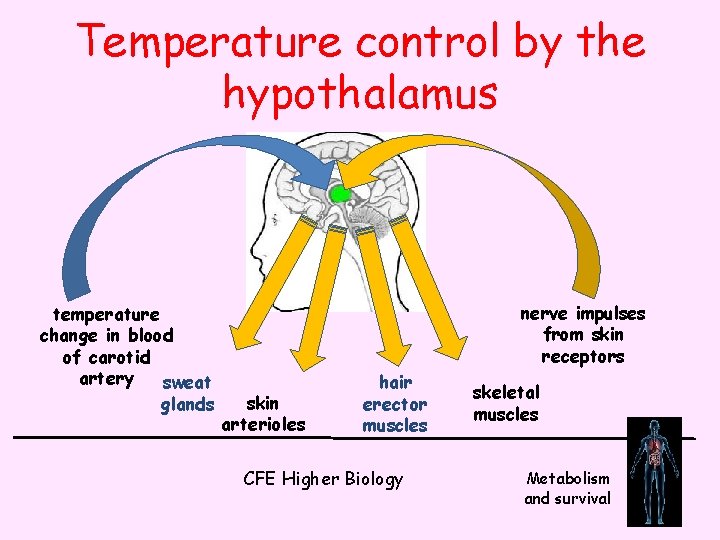
Temperature control by the hypothalamus temperature change in blood of carotid artery sweat glands nerve impulses from skin receptors skin arterioles hair erector muscles CFE Higher Biology skeletal muscles Metabolism and survival
CFE Higher Biology Metabolism and survival
Role of the Skin • The skin plays a leading role in temperature regulation. • In response to nerve impulses from the hypothalamus, the skin acts as an effector. CFE Higher Biology Metabolism and survival
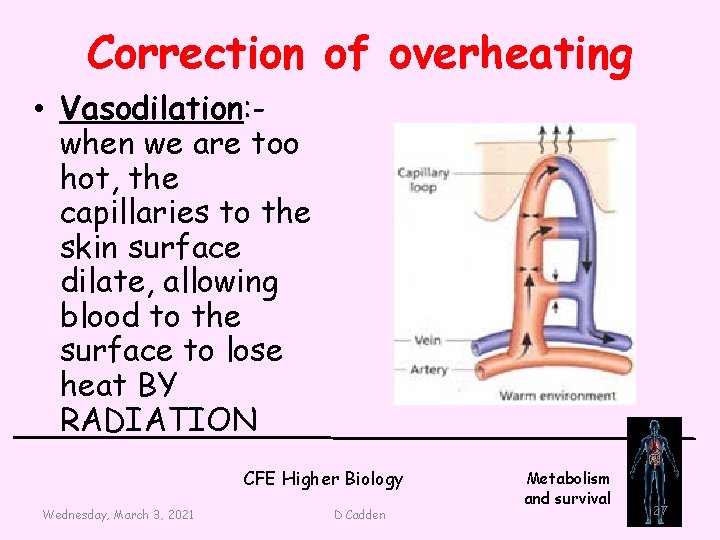
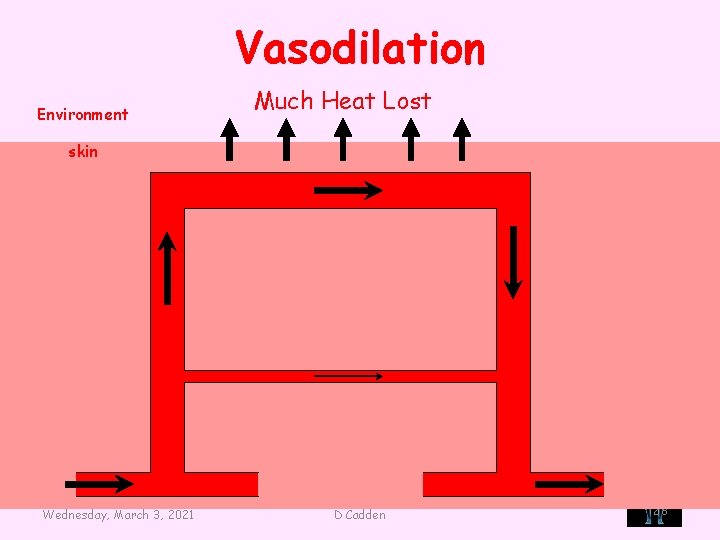
Correction of overheating • Vasodilation: when we are too hot, the capillaries to the skin surface dilate, allowing blood to the surface to lose heat BY RADIATION CFE Higher Biology Wednesday, March 3, 2021 D Cadden Metabolism and survival 27
Vasodilation Environment Much Heat Lost skin CFE Higher Biology Wednesday, March 3, 2021 D Cadden Metabolism and survival 28
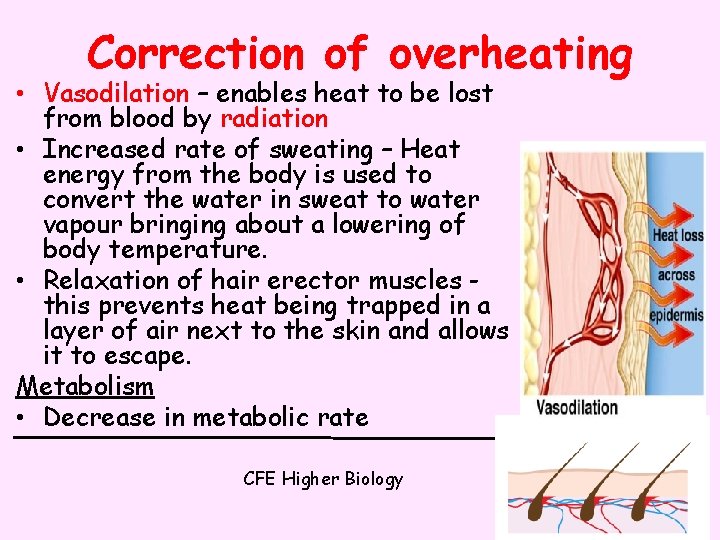
Correction of overheating • Vasodilation – enables heat to be lost from blood by radiation • Increased rate of sweating – Heat energy from the body is used to convert the water in sweat to water vapour bringing about a lowering of body temperature. • Relaxation of hair erector muscles this prevents heat being trapped in a layer of air next to the skin and allows it to escape. Metabolism • Decrease in metabolic rate CFE Higher Biology Metabolism and survival
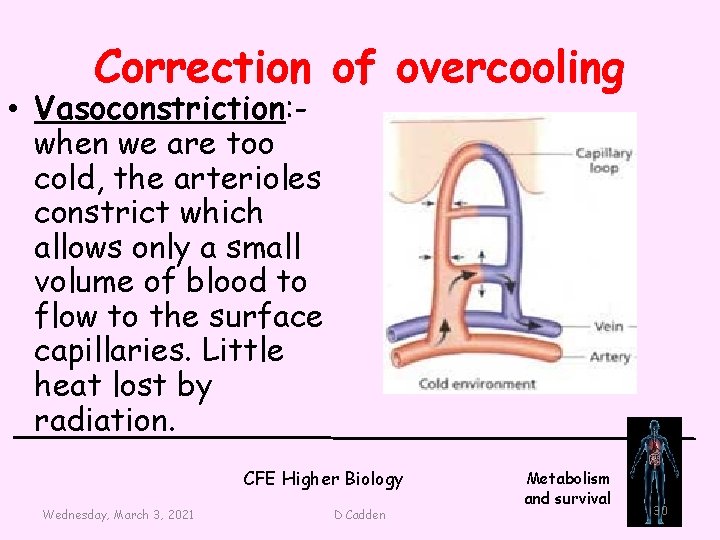
Correction of overcooling • Vasoconstriction: when we are too cold, the arterioles constrict which allows only a small volume of blood to flow to the surface capillaries. Little heat lost by radiation. CFE Higher Biology Wednesday, March 3, 2021 D Cadden Metabolism and survival 30
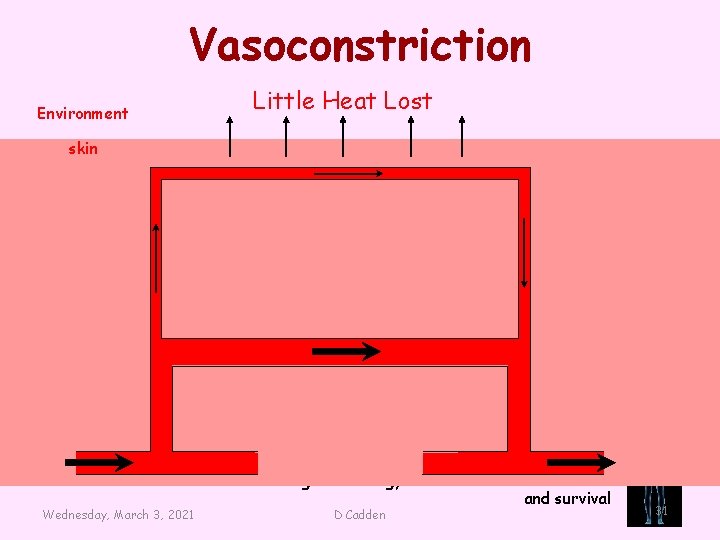
Vasoconstriction Environment Little Heat Lost skin CFE Higher Biology Wednesday, March 3, 2021 D Cadden Metabolism and survival 31
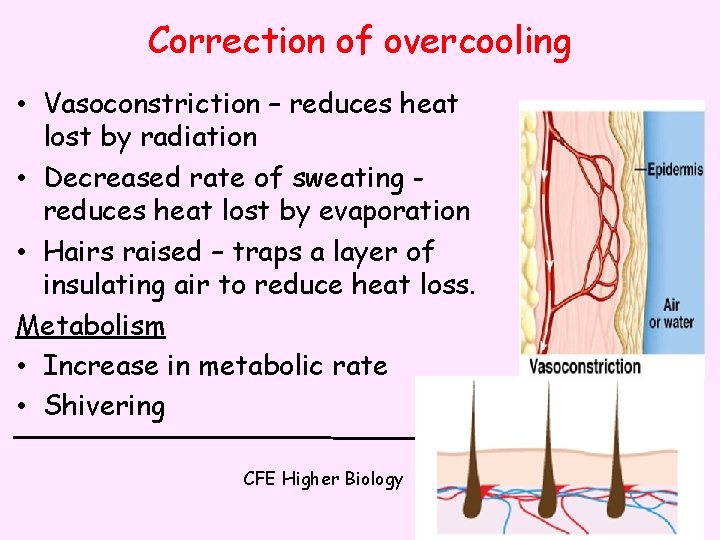
Correction of overcooling • Vasoconstriction – reduces heat lost by radiation • Decreased rate of sweating reduces heat lost by evaporation • Hairs raised – traps a layer of insulating air to reduce heat loss. Metabolism • Increase in metabolic rate • Shivering CFE Higher Biology Metabolism and survival
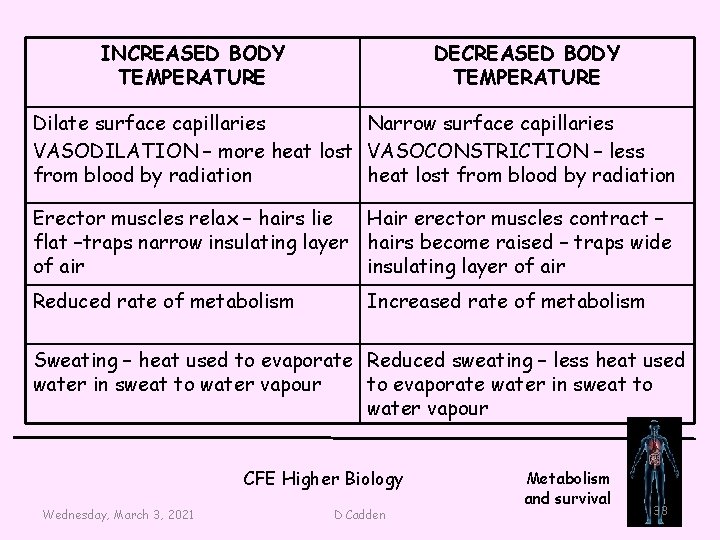
INCREASED BODY TEMPERATURE DECREASED BODY TEMPERATURE Dilate surface capillaries Narrow surface capillaries VASODILATION – more heat lost VASOCONSTRICTION – less from blood by radiation heat lost from blood by radiation Erector muscles relax – hairs lie Hair erector muscles contract – flat –traps narrow insulating layer hairs become raised – traps wide of air insulating layer of air Reduced rate of metabolism Increased rate of metabolism Sweating – heat used to evaporate Reduced sweating – less heat used water in sweat to water vapour to evaporate water in sweat to water vapour CFE Higher Biology Wednesday, March 3, 2021 D Cadden Metabolism and survival 33
CFE Higher Biology Metabolism and survival

How much do you know? Higher Biology for Cf. E P 170 Testing Your Knowledge 2 Complete Q 1 -4 Applying Knowledge and Skills P 40 Q 5 + 6. CFE Higher Biology Metabolism and survival
Extended Responses Give an account of the mechanisms of thermoregulation in mammals (9) Give an account of metabolism in conformers in relation to their ecological niches (7) CFE Higher Biology Metabolism and survival
- Slides: 36