
Ketone body formation and utilisation v Acetoacetate hydroxy
Ketone body formation and utilisation v. Acetoacetate, -hydroxy butyrate and acetone are collectively called as ketone bodies. v. The process of formation of ketone bodies in the liver is called ketogenesis. v. Blood level is usually less than 2 mg % in well-fed state. v. Increased production of ketone bodies is known as ketosis. v. High level of ketone bodies in blood are referred to as ketonemia v. More ketone bodies in the urine is called as ketonuria. v. Lungs mainly eliminate acetone. The acetyl Co. A formed in fatty acid oxidation enters into
Conditions in which ketone body formation are Prolonged starvation: During starvation the carbohydrate level will be low. So the stored fat of the adipose tissue break down to free fatty acids. The free fatty acids formed enter the liver and undergoes oxidation to release acetyl Co. A which cannot be utilized by the liver through TCA cycle due to lack of Oxaloacetate. In starvation TCA cycle is impaired due to the deficiency of oxaloacetate which is diverted to glucose synthesis (gluconeogenesis). Therefore acetyl Co. A converted to ketone bodies to meet the energy needs.
Uncontrolled diabetes mellitus: Because of the lack of insulin the carbohydrate metabolism is impaired The adipose tissue fat becomes the main source of energy and its degradation is generally accelerated. This results in the excessive production of acetyl Co. A, leading to accumulation of acetyl Co. A and its conversion to ketone bodies Feeding high fat diet: Excess breakdown of fatty acids in the liver takes place. Formation of more acetyl Co. A. Once the acetyl Co. A formation exceeds more than the requirement of the liver tissues it is converted to ketone bodies and exported to muscle, heart and kidney to meet the energy requirement. . So the peripheral tissues switch over to utilize ketone
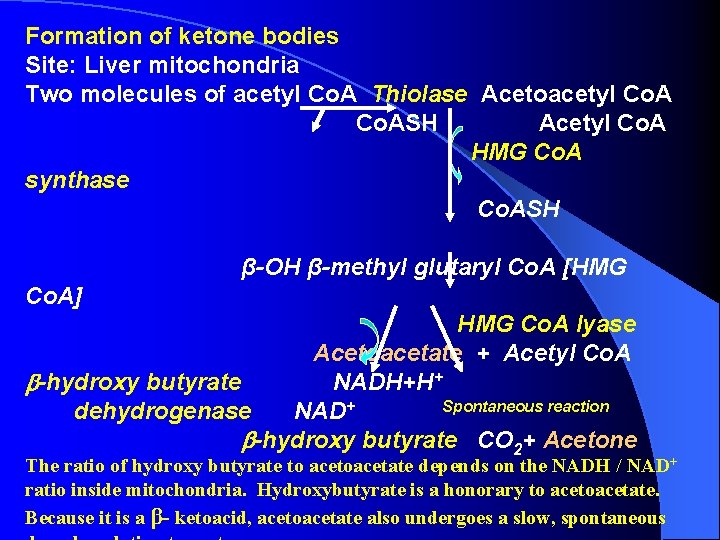
Formation of ketone bodies Site: Liver mitochondria Two molecules of acetyl Co. A Thiolase Acetoacetyl Co. ASH Acetyl Co. A HMG Co. A synthase Co. ASH β-OH β-methyl glutaryl Co. A [HMG Co. A] HMG Co. A lyase Acetoacetate + Acetyl Co. A -hydroxy butyrate NADH+H+ Spontaneous reaction dehydrogenase NAD+ -hydroxy butyrate CO 2+ Acetone The ratio of hydroxy butyrate to acetoacetate depends on the NADH / NAD+ ratio inside mitochondria. Hydroxybutyrate is a honorary to acetoacetate. Because it is a β- ketoacid, acetoacetate also undergoes a slow, spontaneous

Acetoacetate and -hydroxy butyrate are week acids, which slowly deplete alkali reserves (bicarbonate) of the body and causes metabolic acidosis. This condition is known as ketoacidosis. Utilisation of ketone bodies (ketolysis) The liver cannot utilize ketone bodies because it lacks the enzyme Thiophorase or Co. A transferase which is required for the activation of ketone bodies Acetoacetate and -hydroxybutyrate can be used as a source of energy in peripheral tissues [kidney, muscle]. The -hydroxybutyrate is reconverted to acetoacetate and the acetoacetate is then reactivated to acetoacetyl Co. A. Acetoacetyl Co. A, formed , is cleaved by thiolase to yield two molecules of acetyl Co. A which can be oxidized in the TCA cycle to H 2 O and CO 2
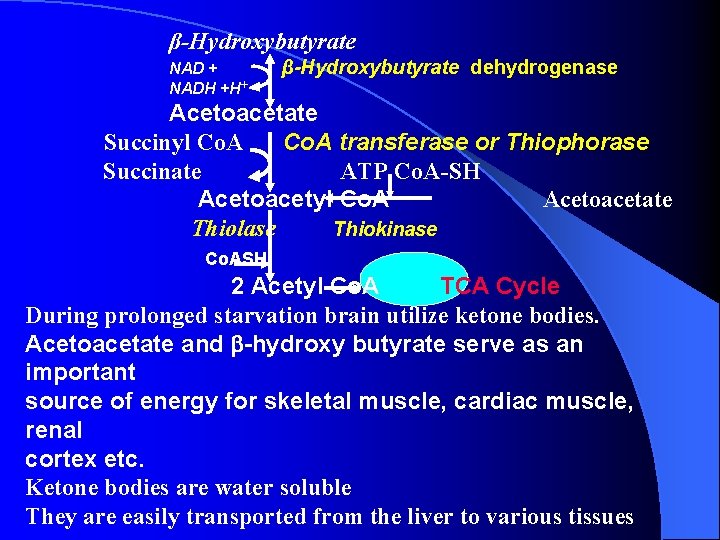
β-Hydroxybutyrate NAD + NADH +H+ β-Hydroxybutyrate dehydrogenase Acetoacetate Succinyl Co. A transferase or Thiophorase Succinate ATP Co. A-SH Acetoacetyl Co. A Acetoacetate Thiolase Thiokinase Co. ASH 2 Acetyl Co. A TCA Cycle During prolonged starvation brain utilize ketone bodies. Acetoacetate and -hydroxy butyrate serve as an important source of energy for skeletal muscle, cardiac muscle, renal cortex etc. Ketone bodies are water soluble They are easily transported from the liver to various tissues
Ø During starvation ketone bodies can meet 50 -70% energy needs of brain. Regulation Ø Glucagon stimulate ketogenesis Ø Insulin Inhibit ketogenesis Ø The increased ratio of glucagon/insulin in diabetes mellitus promotes ketone body formation. Ketogenic substances: Fatty Acids, amino acids Antiketogenic substances; Glucose, glycerol and glucogenic amino acids (Glycine, Alanine , Serine, Glutamate etc) Reference: Essentials of Biochemistry Dr. S. Nayak March 2011
- Slides: 7